
There is a day in mid-March each year that all gardeners recognise. It’s that morning when the warming sun first helps to straighten stiff winter backs, and thoughts turn to seed catalogues, and the sense of stirring life in dormant beds and borders. That day came on Wednesday, which was also, happily, the eve of the opening of In Bloom: How Plants Changed Our World at the Ashmolean in Oxford, a celebration of the ways that plants have sprouted and unfurled in our artistic and scientific imaginations. The gallery’s Ionic columns were suitably swagged in ivy and tumbling blossom.
The exhibition traces the roots of those springtime rituals back to a plant-hunting father and son John Tradescant the Elder and the Younger, who made a garden centre of most of the world, bringing back specimens to please their patrons; first, the spymaster Robert Cecil and, later, King Charles I. The Tradescants’ Orchard, a manuscript of 1620-29, has dainty little watercolours of some of their tastier finds: French strawberries and Portuguese quince.
Tradescant Sr, hipster-bearded, is framed in a portrait by plump grapes and parsnips; his son, who ventured to the new colony of Virginia in 1637, came back with phlox, aster, columbine and jasmine, startling new scents for English noses that eventually drifted from country estates to cottage gardens.
That zeal for collection seeded many branches of curiosity, not least the determination to label and catalogue. There is an extraordinary book of pressed flowers here, 2ft thick, opened on a page of auriculas and primulas as a memento mori of the lost summer of 1660. Each flower, now the colour of tea or parchment, is given its love poem name: “Flourishing Prince”, “Double Purple”, “Fair Hanna”.
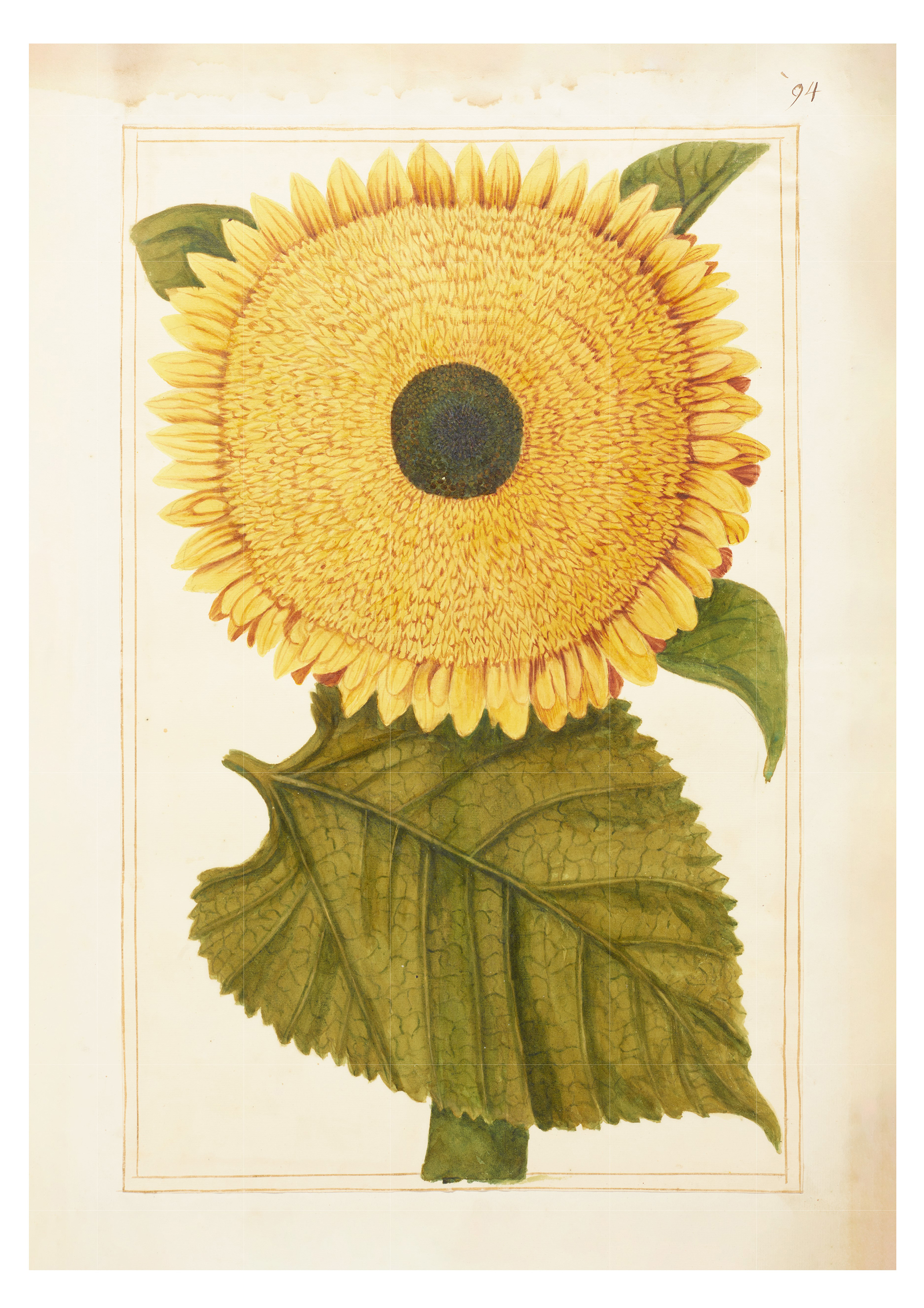
A ‘wild-eyed’ sunflower painted in 1703 for Mary Somerset
Formal gardens became living encyclopedias. Mary Somerset, duchess of Beaufort, gathered plants from across the world, and laid them out as a “botanical spectacle” behind the walls of her Gloucestershire estate. As a defence against autumn – and death – she commissioned paintings of them, including a fabulous frame-filling sunflower of 1703. It stares out, wild-eyed, catching in its gaze a still life that is a defining expression of fortune in the Dutch golden age: an overflowing vase of double flowering curiosities by Simon Verelst that shouts of cultivated decadence and tulipomania.
All that close artistic looking led Enlightenment minds to an understanding of the precise mechanics of plant reproduction. Alongside a beautifully rendered engraving of the nocturnal blooming cactus called queen of the night, the wonderfully named Georg Dionysius Ehret started to detail seeds and seed pods. Later in the 18th century, the botanical artist Edward Rooker doodled stamens and carpels in the margins of his etchings.
When Carl Linnaeus first published his taxonomy of plants in 1753, the gendered language of botanical coupling – evidence that flowers were already at it in the Garden of Eden before the fall – troubled polite society. The poet Erasmus Darwin attempted to popularise Linnaean methodology in his ever-curious poem The Loves of the Plants, which made the acts of pollination into ardent courtship (the polygamous lily Gloriosa, for example, “led three chosen swains / The blushing captives of her virgin chains” while “Three other youths her riper years engage, / The flatter’d victims of her wily age.” ).
The Victorians were, of course, obsessed with such thoughts. Preserved here are strange “teaching models” of flowers made of painted wood that highlight every detail of botanical reproduction. By then, plant hunters had become plant traders. Tea and opium created the brutal fortune of the East India Company. You can sniff burned poppy seeds here beside a case a 19th-century opium pipe, bearing the legend: “how intellectuals continue chatting … even though the humble house has become overgrown by moss and grass”: How Plants Changed Our World, indeed.
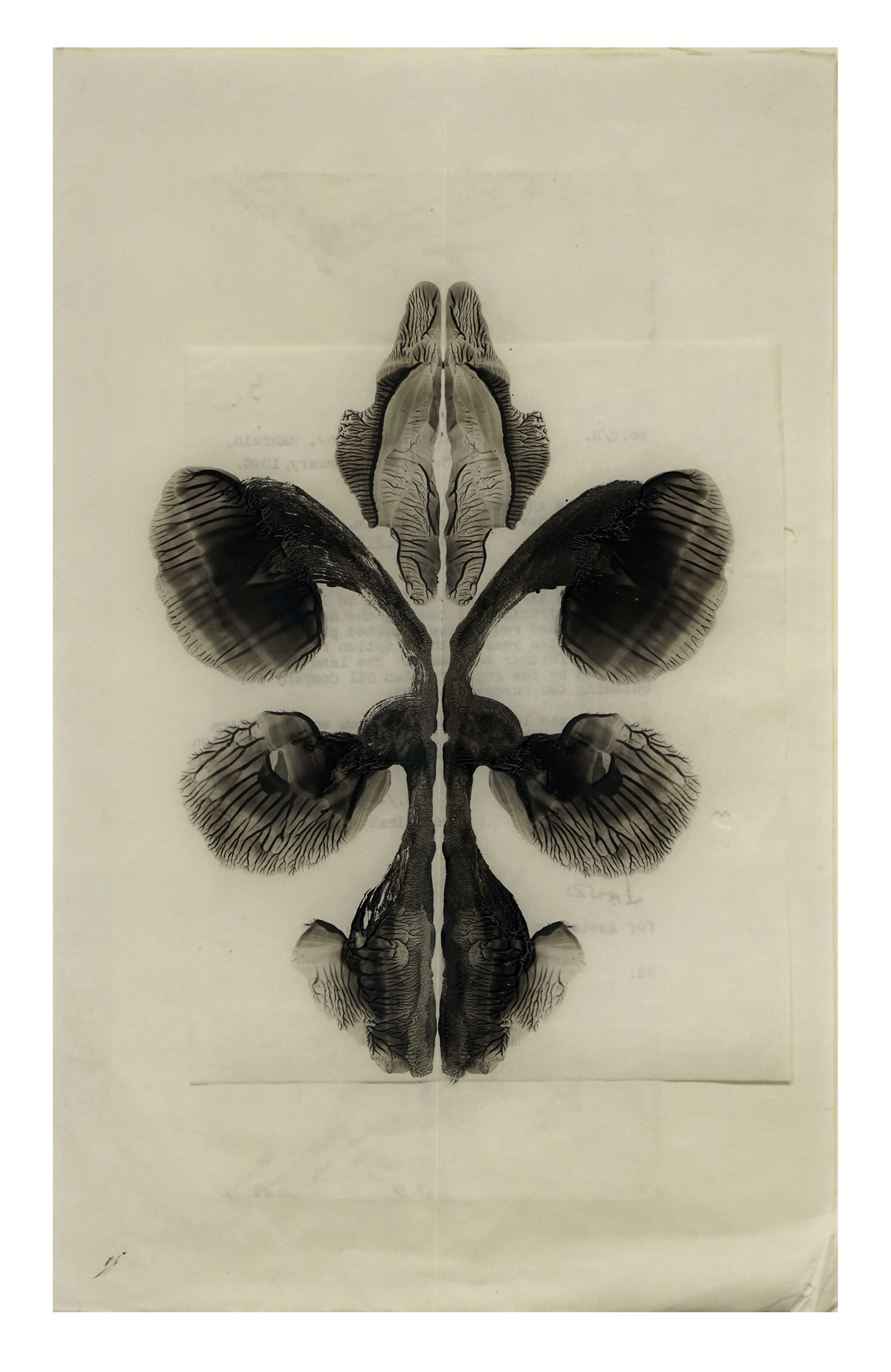
Iranian artist Anahita Norouzi creates negatives of iris flowers out of crude oil and translucent paper in her 2022 series
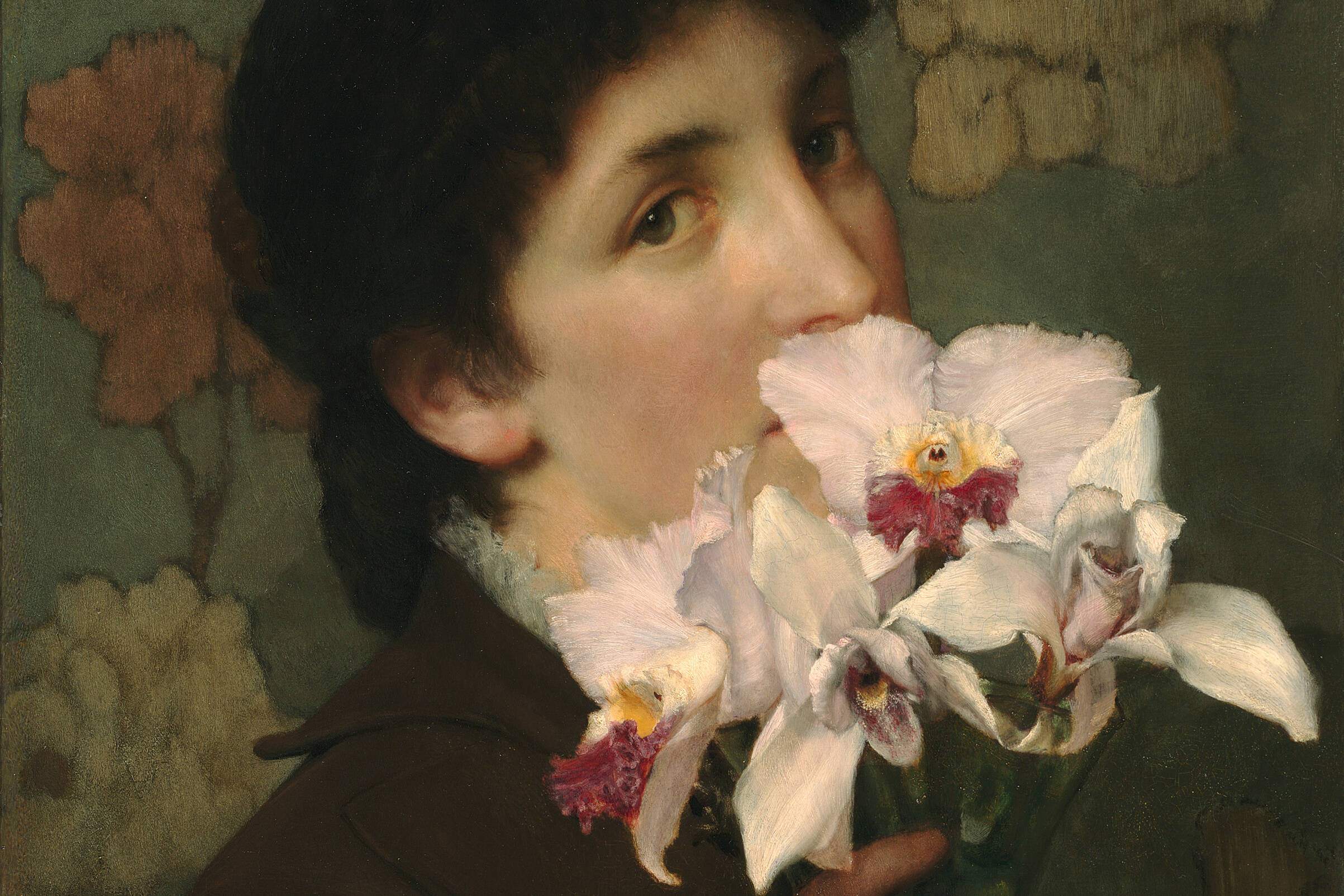
Photography made flower depiction in paint more impressionistic. Ruskin’s study of a rose is far sketchier than those produced 100 years earlier. Science has become beside the point: flowers are now all about subjective feeling. The pre-Raphaelites found eroticism in blown lilies and blowsy peonies long before Georgia O’Keeffe. Lawrence Alma-Tadema’s Orchids, in which a young woman holds an exotic example to her face, is a little more restrained than his orgiastic visions of nymphs drowning in rose petals, but you get the picture.
The final rooms of this consistently illuminating show bring us up to date. The artist Anahita Norouzi, who is of Iranian heritage, was just installing her piece What Is in a Name when I visited. It consists of 11 jet black irises made of delicate glass. The piece references a journey that Vita Sackville-West made to Norouzi’s native region in the north of Iran a century ago with her husband Harold Nicolson, a British envoy in Tehran. Sackville-West was in search of rare irises for her Kent garden. She discovered not only the bulbs but also the then largest oil refinery in the world at Abadan, on land seized by the Anglo-Persian Oil Company, later British Petroleum. Norouzi’s piece reflects on colonialism and collecting: her glass irises have names such as “black gold” and “reckless prosperity”. On an adjacent wall, Rorschach prints made with crude oil look for all the world like negatives of iris flowers.
Newsletters
Choose the newsletters you want to receive
View more
For information about how The Observer protects your data, read our Privacy Policy
Alexandra Daisy Ginsberg, meanwhile, reminds us that, though humans have a recent history of appropriating and destroying the world of plants, we have only ever been peripheral to its priorities. Her wall-sized tapestries, including Pollinator Vision, are designed in the colour spectrum as it may appear to flying insects. It is a reminder that flowers never adopt their evolutionary come-ons for our benefit – their colours and scents are designed to keep bees on a permanent trippy high as they nuzzle for nectar and stash pollen in their hip pockets, and keep all life buzzing in the process.
In Bloom: How Plants Changed Our World is at the Ashmolean Museum, Oxford, until 16 August
Photographs by Richard Green Gallery, London/© Anahita Norouzi. Courtesy of Anahita Norouzi and Galerie Nicolas Robert