Photographs by Gautier Deblonde
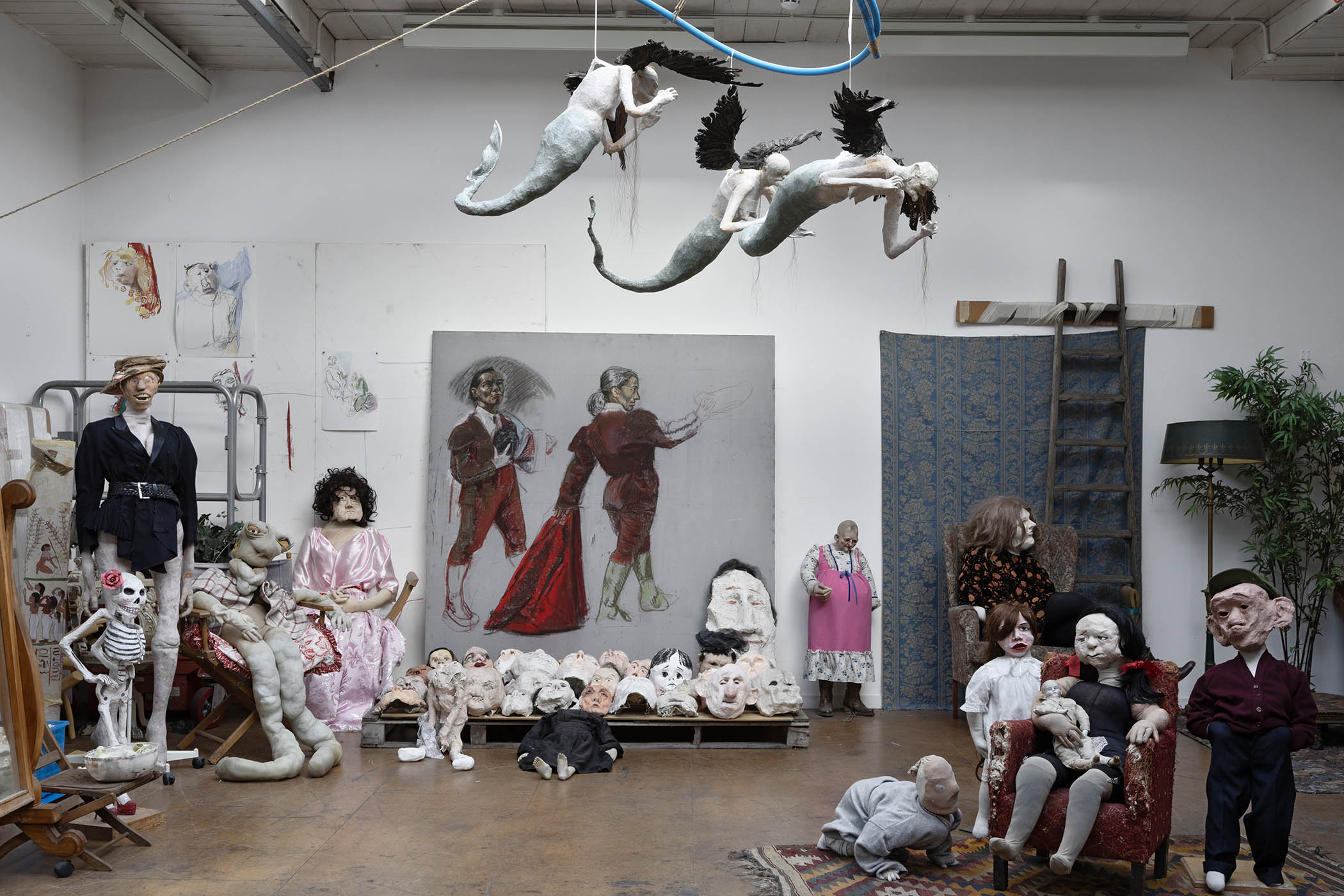
Pale, misshapen faces, lit through a glass ceiling, greet me as I enter Paula Rego’s studio. The unblinking eyes of wonky animals, puckish urchins and fairytale demons stare out. The space is empty, but very busy at the same time, populated as it is by her rag-doll puppets and outlandish papier-mache figures, all laid out under a flock of suspended mermaids.
Her studio, hidden off a north London mews, has been left pretty much as it was in June 2022, when the influential, idiosyncratic Anglo-Portuguese artist died at the age of 87. This is the place where Rego worked between 9.30am to 7pm each day of her later life, abetted by her assistant, model and co-conspirator Lila Nunes, and pausing only for a quick siesta – or “kip” – in a bed hidden up on a curtained platform.
Had I come here back then, Rego’s film-maker son, Nick Willing, tells me, I would have immediately been recruited as a mannequin. “‘Come in, Vanessa,’ my mother would have said, and then started to tell you a story as she took you over there, to hair and makeup,” he says, pointing to a rail of vintage dresses, brightly coloured tulle and floppy hats. “‘You’re a princess and you’re in love with a frog,’ she would have explained to you, ‘but the frog, unfortunately, is married to a cabbage.’ And she’d create an environment, like a set, and put you in there with a frog she’d made for you to love. And then she’d make a picture of you.”
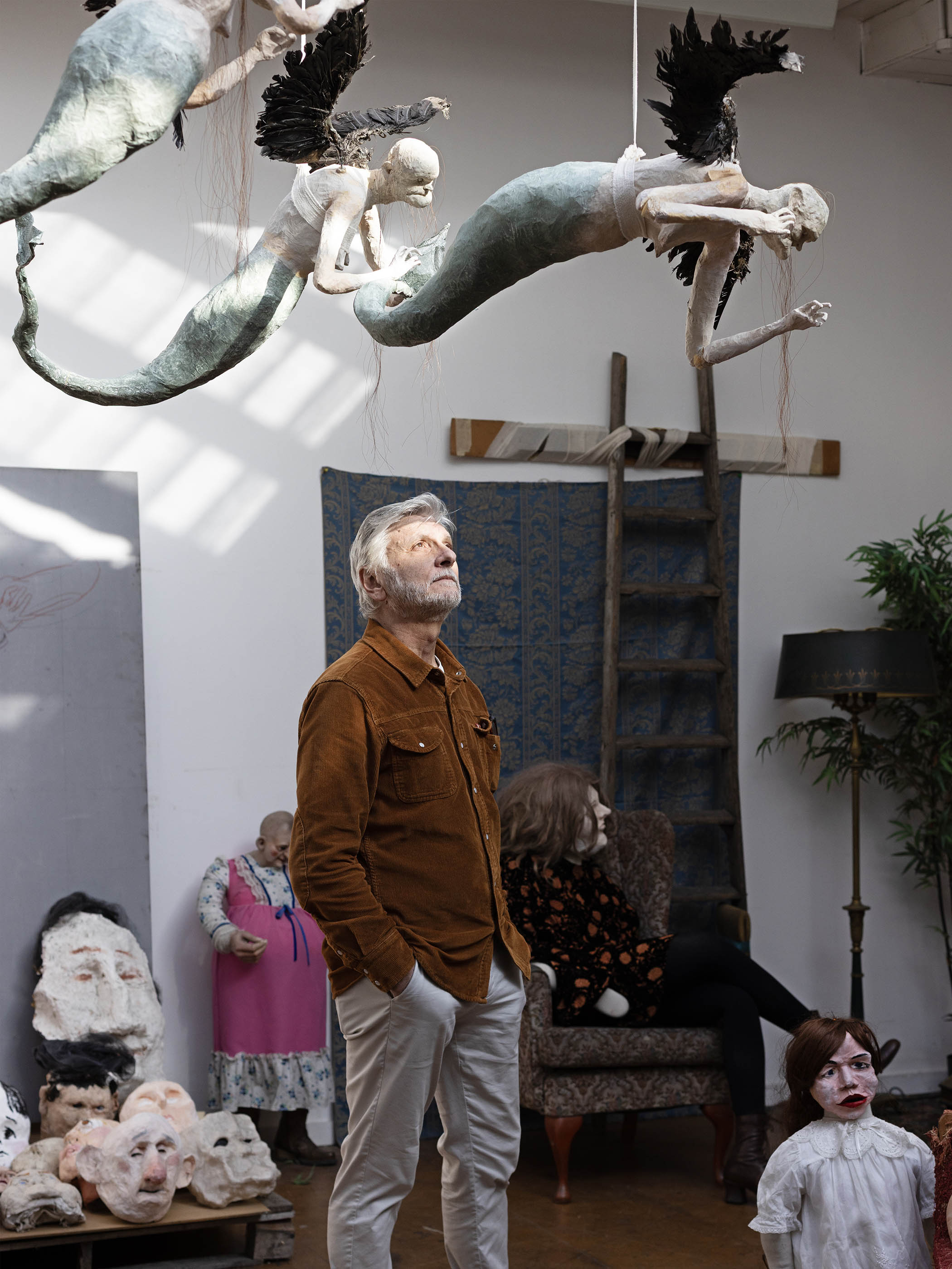
Nick Willing inside Paula Rego’s studio in north London
Rego’s handmade “dollies”, she once explained, were like characters in a play that she could move around. Possibly, it was closer to an opera, since classical arias were the habitual soundtrack to these dramas, followed in the afternoons by the distraught strains of her native fado.
In Portugal, Rego has long been a household name. Elsewhere, since her death, her reputation is growing rapidly in stature; a large Rego painting can now fetch several million pounds, and a string of new shows are lined up in the UK and across Europe this spring and summer, including the London gallery show, Story Line, that Willing is preparing for, plus another big exhibition next monthin April at the Munch Museum in Oslo.
Managing the legacy is all-consuming for Willing, who made an acclaimed documentary about his mother in 2017, Paula Rego, Secrets & Stories, and who holds the copyright to her images, handling requests for loans or reproductions. “The Paula Rego caravan will move on through 32 museums in the next three years,” he says. “There’ll be six books internationally this year and a number planned for next – God knows how many academic PhDs and research studies. I have an archive here, too, with thousands of letters and documents.”
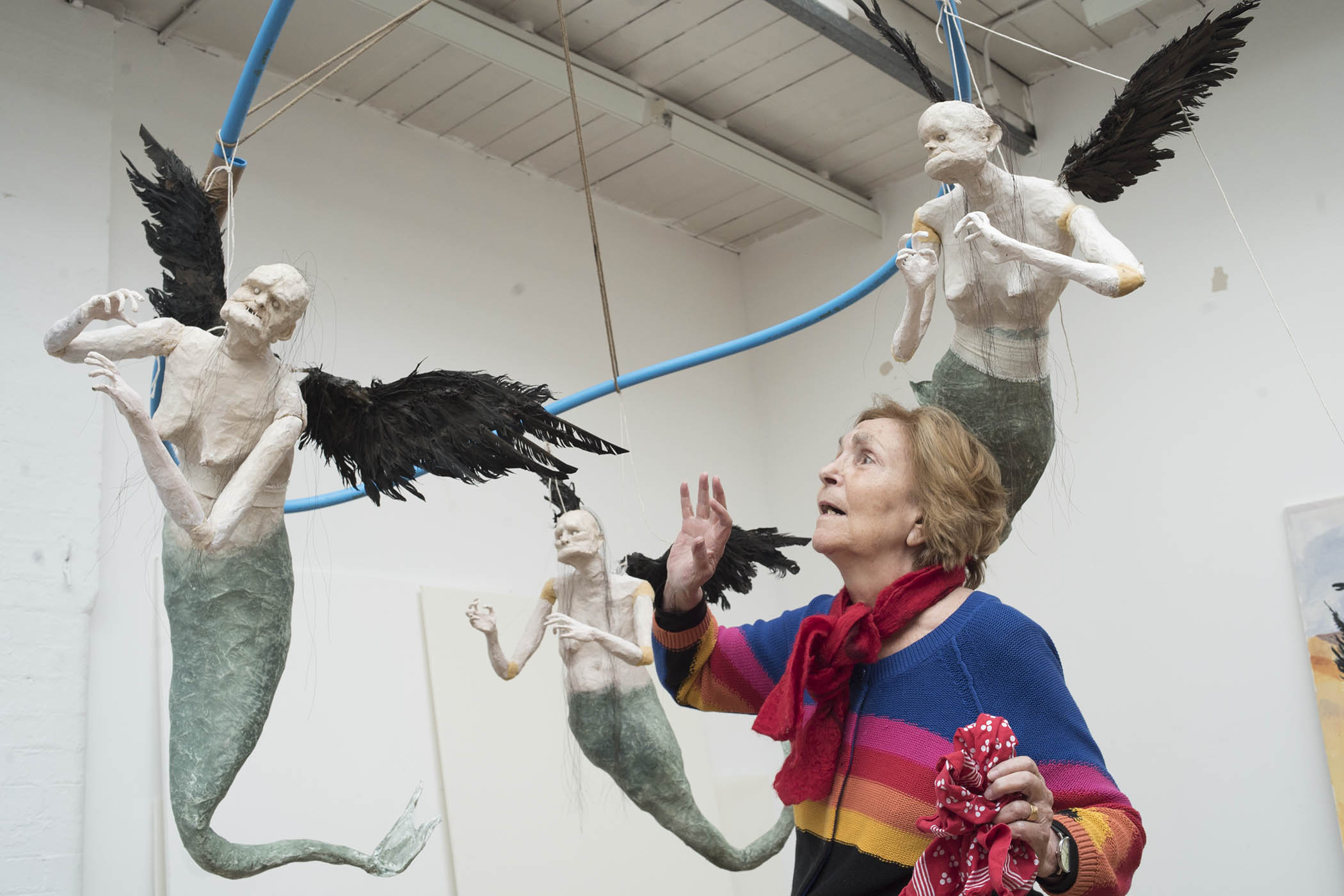
Rego with her work The Flying Mermaids, from 2017
The burden of finding that your mother has “turned into Pablo Picasso”, as Willing puts it, is heavy. “Here’s my problem: it’s a great privilege, of course, but what I’ve got is a mum that’s a genius. While we were making my film, she told me everything. So I also have hundreds of hours of interviews with her. If people ask me: ‘What did your mother think about X, Y and Z?’, I just go and find out. I haven’t been able to grieve her death, because she’s talking to me more now than when she was alive. I’m working with her every day.”
But Willing has a plan, and the forthcoming gallery show is a key step: “What I’m going to do, although it hasn’t been approved yet, is form a charity – the Paula Rego Foundation. Once the Charity Commission says yes, I’m going to gift everything to the foundation: the entire collection, the buildings, the copyright, the books, the archive, the catalogue raisonné – everything. And my sisters are cool with this, and so are our children, even when I explain they’re not going to get any money. After all, as Mum would often say: ‘This is not your stuff, darling.’ The London show of drawings and sketchbooks is designed to raise money for the foundation, so that I can also give grants to struggling young artists.”
Maria Paula Figueiroa Rego was born in Lisbon in 1935, just as the dictatorship of António de Oliveira Salazar took hold. The tension and uncertainty of that violent period is woven through her work. Her parents were well-to-do, but her father, José, a Marconi engineer, was plagued with a debilitating depression that his daughter believed she had inherited.
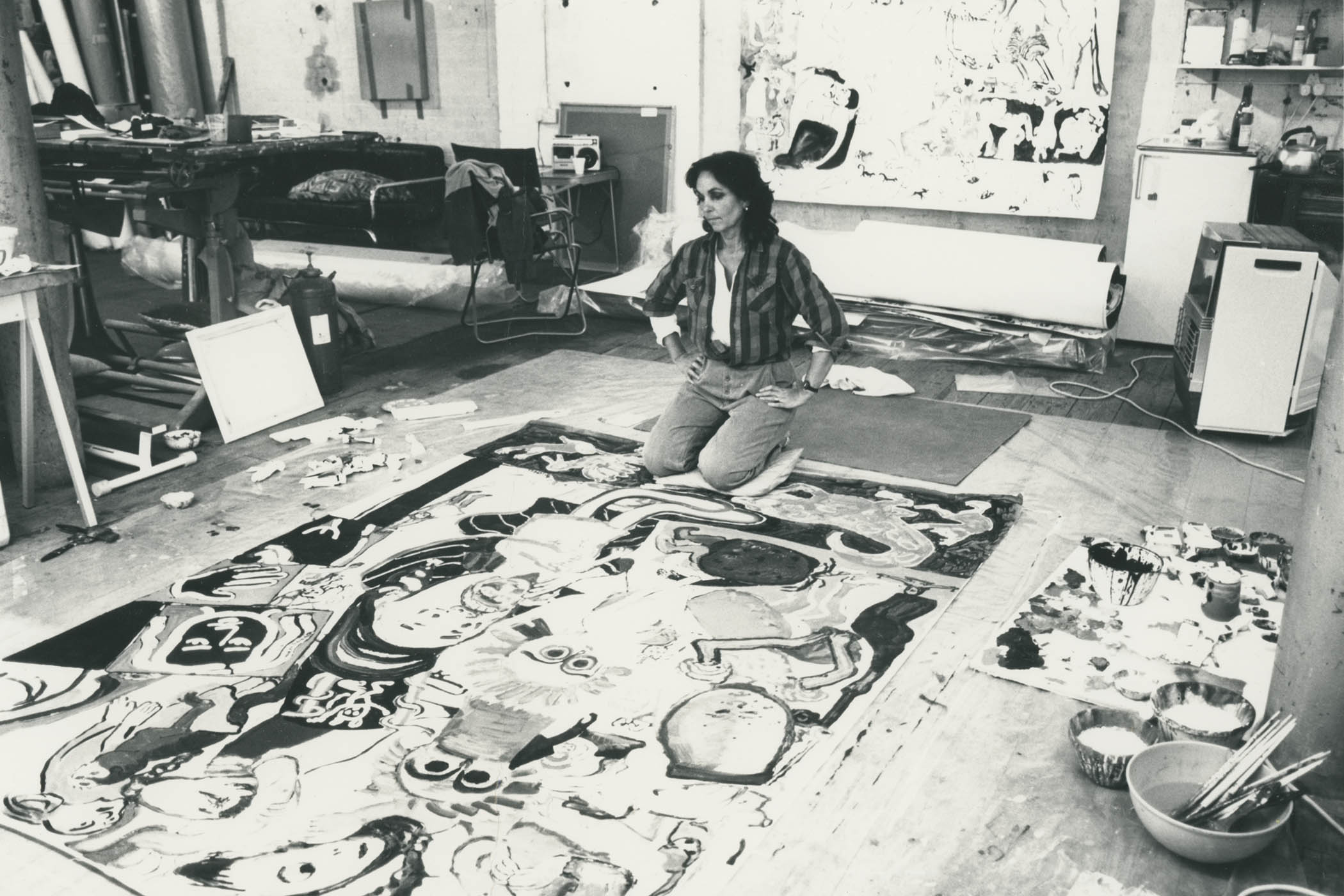
The artist in her studio in 1984
At 17, Rego travelled up to London from a Kent finishing school to study at the Slade School of Fine Art. Here, she met Willing’s father, her late husband, Victor Willing. An admired painter and critic, he was married to someone else, and so when Rego became pregnant with her eldest child, Caroline, her father arrived to take her back home to Portugal to quietly give birth there.
Nick Willing was born in 1961, two years after the couple had eventually married, but he spent much of his childhood in Portugal with his grandparents and his other sister, Victoria, distant from Rego and her husband, who were pursuing artistic ambitions in London. “They would visit for the holidays, bringing lots of gifts to soothe their guilt,” he recalls in the book he has written to accompany the forthcoming show.
Rego’s studio, a memorial to her practice, might be romantically described as a smugglers’ cave, or a circus of curiosities; in 2012, the London Evening Standard opted for a more prosaic comparison with an “explosion at a car boot sale”. The truth is, the place offers something both stranger and more precious than all of those things. It is a chance to look into the mind of one the most innovative and unsettling artists of the modern era.
Willing explains that Rego’s puppets, or “props”, were deliberately used in the paintings alongside real models such as Nunes to disconcert the viewer. He uses the German word “unheimlich” to characterise the uncanny effect.
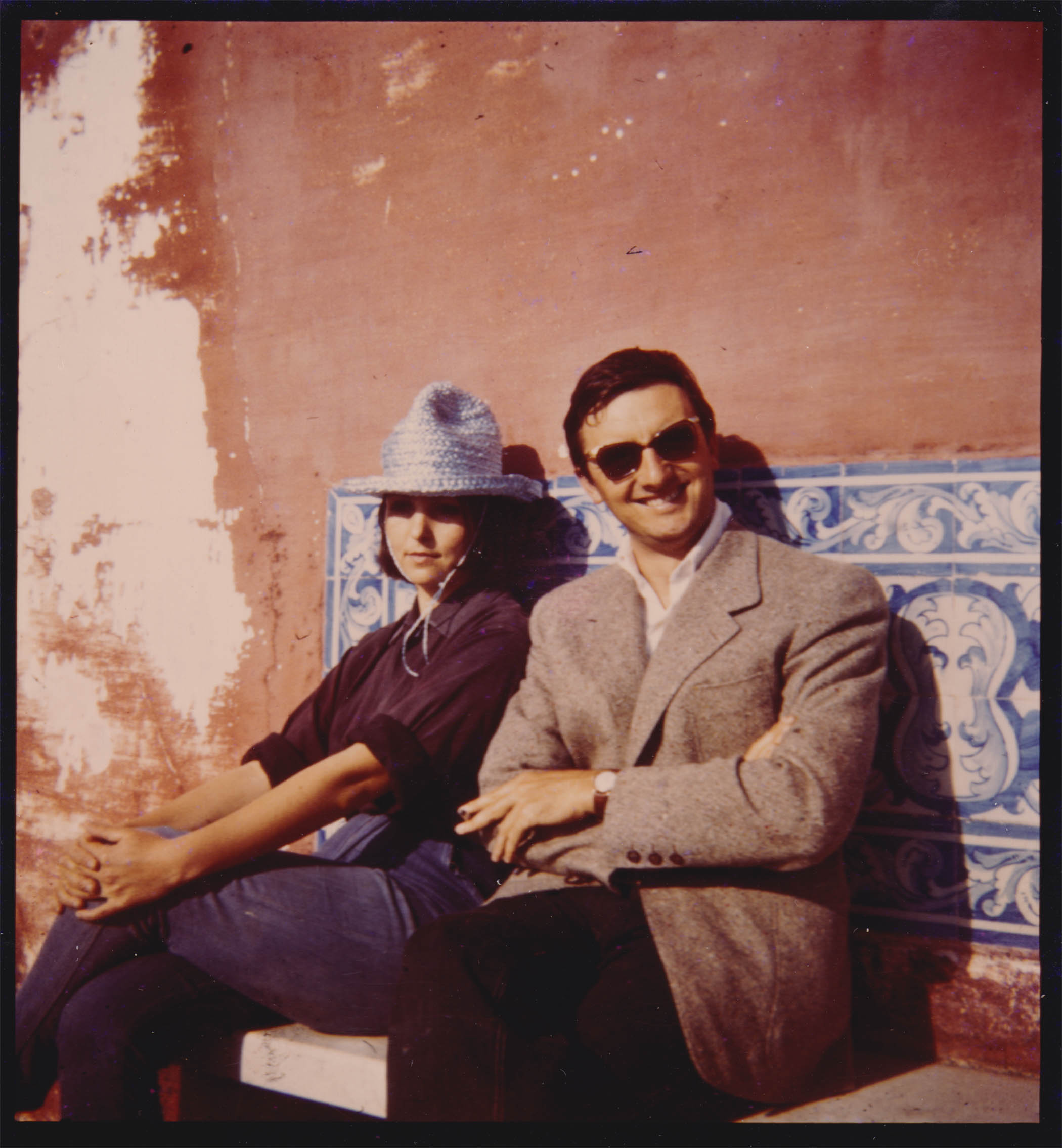
Rego and Victor Willing, a painter and critic, 1960
Rego’s model-making was infectious. Her daughter Caroline married the sculptor Ron Mueck. In 1996, Rego asked her young son-in-law to make her a Pinocchio doll. The boy he fashioned for her was spotted by art collector Charles Saatchi, who then persuaded Mueck that he was a bona fide Young British Artist, despite the fact he was Australian. “Ron has just had a massive exhibition in Sydney [running until 12 April] and has another coming up in Tokyo. He’s more famous than Paula now,” smiles Willing, who frequently calls his mother by her first name.
Perhaps the most unnerving figure in the room is The Pig King – otherwise known as one of the Prince Pig series – made in the likeness of a character from a Giovanni Francesco Straparola fairytale, with a plot that combines the nastier elements of Beauty and the Beast and The Frog Prince.
If you can wrest your eyes away from the sinister puppets, the paintings and sketches that line the studio – many of which will be in the London show – are just as dreamlike and disturbing. One, with the smudgy outlines of an Egon Schiele watercolour, is a study for her work The Soldier’s Daughter and is accompanied by a sketch for The Policeman’s Daughter, the famous image that shows a girl with her arm suggestively rammed into her father’s authoritarian boot as she polishes it. There is an outline of the well known rabbits that appear in her extraordinary 2003 work War, inspired by a newspaper photograph of a girl fleeing a bomb blast in Basra, Iraq. Next to it is an earthy, monochrome ink study for her painting Assassins, with postures that echo Goya’s firing squad.
She had found my father impossibly sexy, and then, as he became an invalid, that faded
She had found my father impossibly sexy, and then, as he became an invalid, that faded
Willing tells me it was his father who coined the phrase that Rego appropriated to best sum up the latent violence in her work. She painted, Victor told her, “to give fear a face”. Certainly, the women in her paintings often look distressed, yet they are symbols of defiance, whether they are being betrayed in love, losing a mother, or losing a baby. It is what made Rego’s works so electrifying for the feminist writers Germaine Greer and Marina Warner when they were first shown at the Serpentine Gallery in 1988.
Greer sensed a concentrated energy in paintings that “quiver with an anger and compassion”, while Warner has written of Rego having “blazed” into her consciousness at this show, as an artist who “was moving beyond the appearance of things into another zone of feeling and knowledge”.
On one side of the studio stands an oversized, regal chair of red velvet and gilt. It was made as a prop for Willing’s star-studded 1999 television film Alice in Wonderland. When he finished shooting, he gave the chair to his mother and it subsequently appeared in a string of her works, including Don’t Leave Me II, which shows Rego and her dying mother. As we turn from the main studio, Willing explains his theory that Rego’s work has become so popular because it expresses the “psychotic period the world has entered”. He says: “She tells the story of humanity, and particularly of women, in a way that hadn’t been told before.”
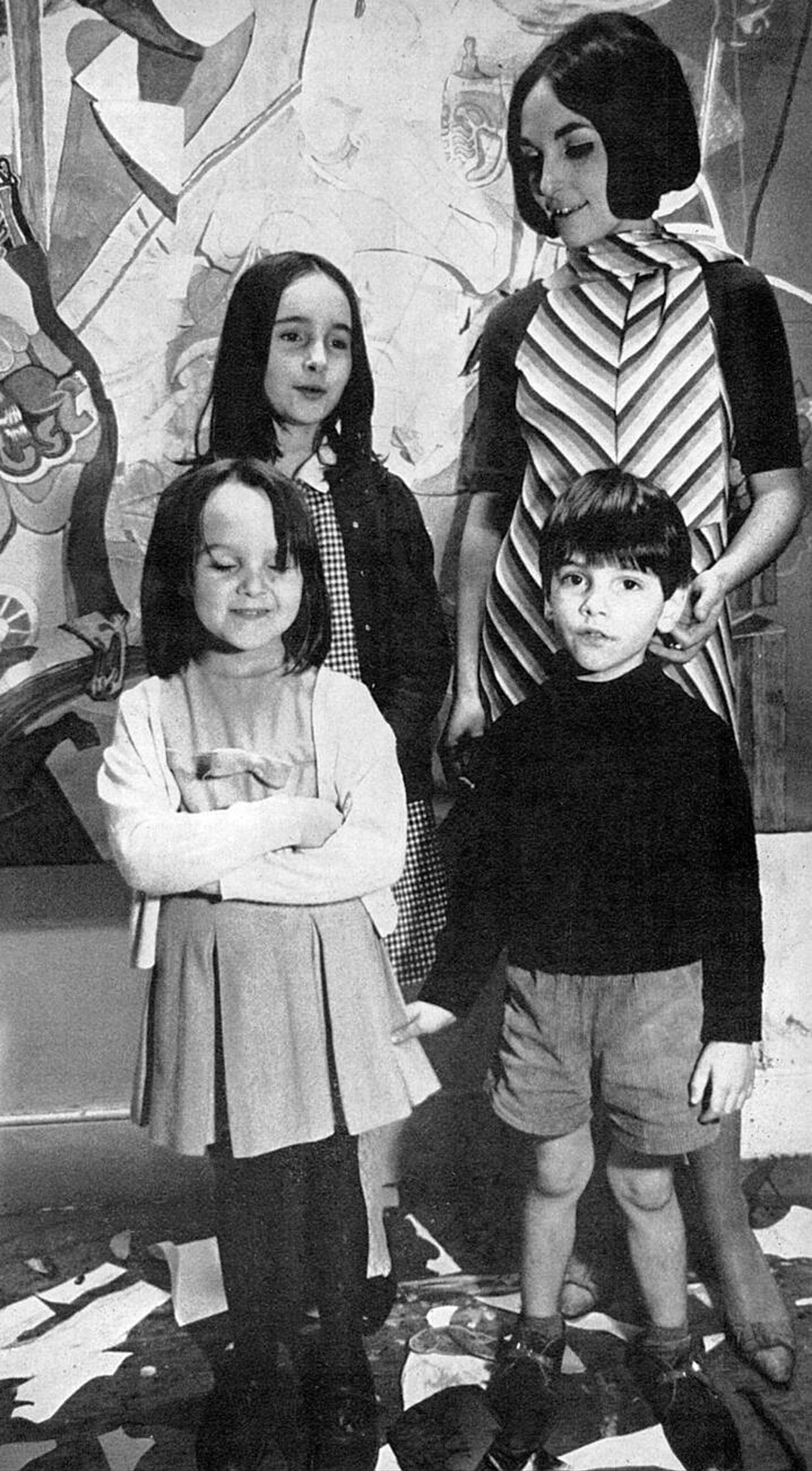
Rego with her son and two daughters
Willing also runs the Rego museum outside Lisbon, so he is often in Portugal. He has just cleared his mother’s old home in Estoril ready for sale, he says, brandishing one of the spoils. It is a small handmade cushion in the shape of an opened fig. “It was just lying on a sofa. This is my mother’s female thing – you can see all the sensory areas. It’s interesting, because she made this in 1969 and, at that time – in fact, well into the 1980s and 1990s – textile art was looked down on. So Paula became one of the first artists to turn to textiles, although she wasn’t really part of a feminist movement then.”
The fig cushion might have been stitched in the past decade, perhaps by a disciple such as Tracey Emin. “Tracey was taught by Mum and loved her,” says Willing. “A lot of artists I speak to say she changed their life, including Hew Locke [the London-based artist who confronts colonial history]. She encouraged him to paint his childhood memories of Guyana.”
The dominant influence on Rego herself was her husband, an artist she claimed was the better painter. “She was jealous of him because she admired him,” Willing says. “It was the most powerful and intense relationship I’ve ever witnessed. It was quite destructive, too, and when he became ill in the mid-1960s with multiple sclerosis and started to lose his powers, the effect on them as a couple was quick. The power dynamic between them changed. She had found him impossibly sexy, and then, as he became an invalid, that faded.”
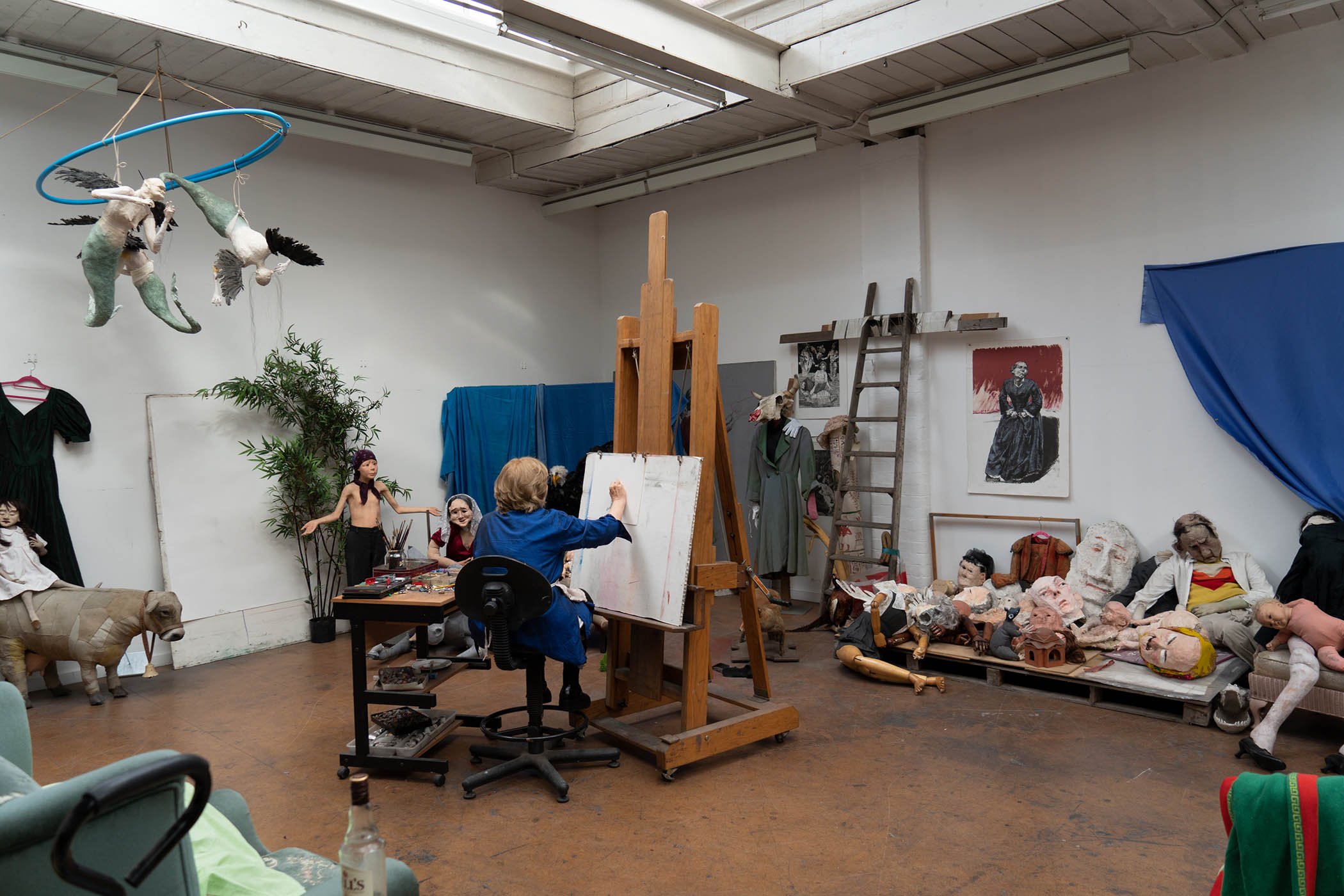
Rego at work, 2021
Rego literally drew her son into her marital relationship in her well-known picture The Dance. Willing stood in for his father in a work that spells out the problems in the marriage. “I have got my mother’s eyes, but my father’s everything else, so I had to pose as him. In the finished painting, he is dancing with Paula, then with a lover, and finally my mother dances alone in a Portuguese folk dress. In 1988, as we were halfway through the painting, he died. He fucking died. She was devastated.”
By then the family had moved from Albert Street in Camden, north London, to a flat in Hampstead, where Rego’s sorrowful moans rang out day and night. “It was the hardest summer of my life,” Willing recalls, “but I posed for her, because that’s the only way she could get over it. By the end, the image of her dancing alone was bigger and more confident. It says: ‘I’m all right now on my own, I can manage.’”
Willing was closest to his mother when he drew pictures for her in childhood, and they continued to use art to communicate. “She was always trying new things and we talked a lot about it. I saw her every Sunday, if I wasn’t in LA, where I lived for a while, or in New York. Whenever I saw her, we connected through her work.”
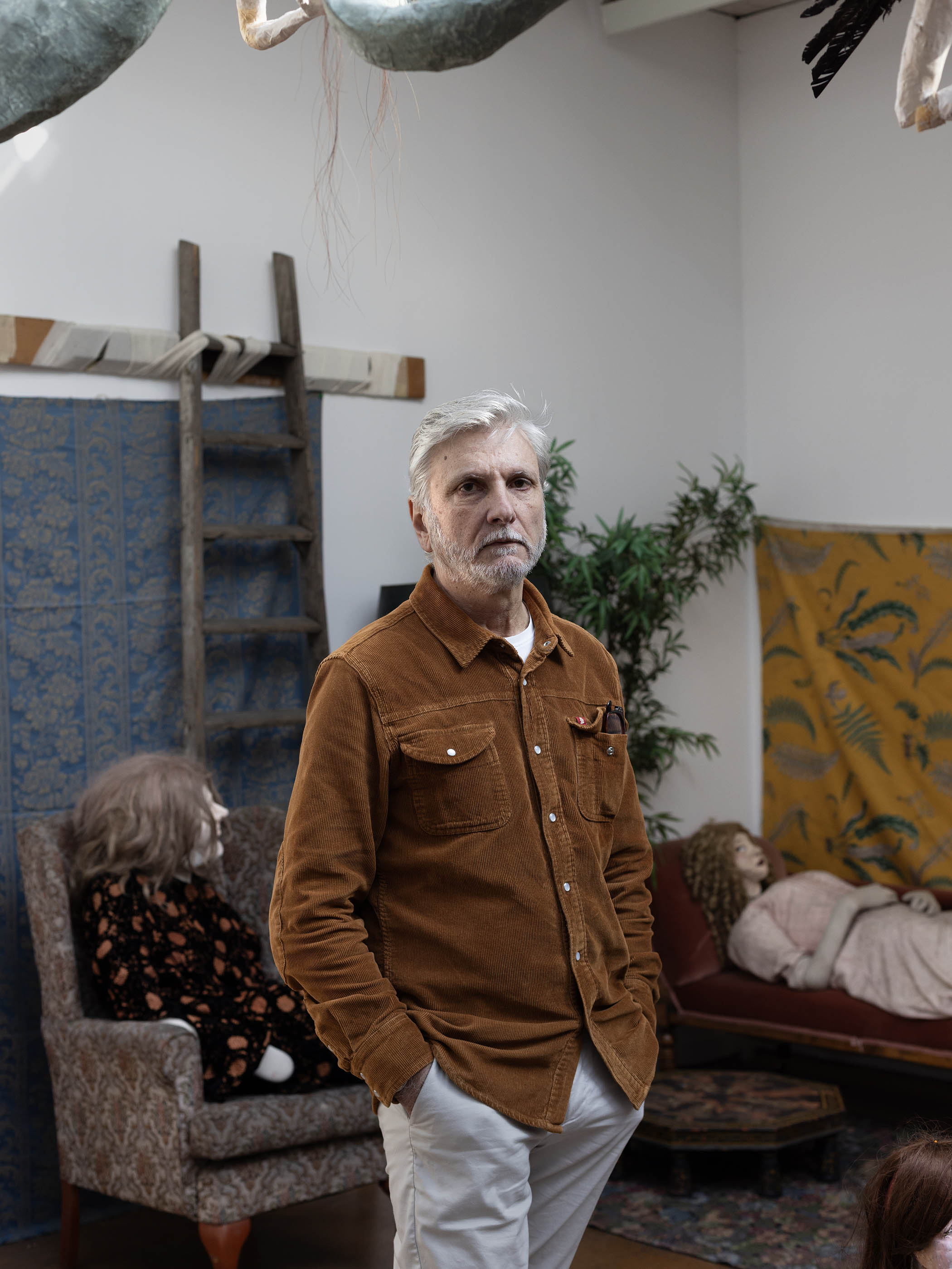
Willing runs the Rego museum outside Lisbon
In the basement library and archive, Willing makes a discovery while I look on. Between the pages of one of his mother’s antique illustrated books he finds a pencil study, untouched since Rego left it there. It is a magical moment, but he says it happens all the time. He recognises the image and files it away. The work never stops. “Once the foundation is set up, I can breathe air again. I mean, I love Mum, but – come on – it shouldn’t be everything inside my head,” he says. “It has overwhelmed me.”
It must be hard, I agree. It is not as if she painted little daisies.
Willing nods, and points over to the imposing dark puppet of an elderly woman, sitting in a chair. “Look over there. There she is, in a black dress. She never made self-portraits, but that’s a kind of self-portrait of her when she was suffering from depression. It looks just like her.”
A bout of real depression, Rego once said, was her worst fear. Making pictures couldn’t exorcise the pain inside her, she told her son, but it helped her live with it. Now her work stands on its quality alone but the stories hidden within are secrets worth discovering.
Paula Rego: Story Line is at the Victoria Miro gallery, Wharf Road, London, from 16 April to 26 May