No masterpiece by George Stubbs is more dazzling than Whistlejacket, that lifesize portrait of a racehorse rearing up on two legs without rider, backdrop or saddle. Brief shadows flashing behind the rear hooves are all that tether him to this Earth. Without them, Whistlejacket would rise in his magnificent levade outside time and space, a nearly mythical being. The glowing tawny light around him seems to emit from the horse himself.
Whistlejacket hangs at one end of the central corridor that runs the entire length of the National Gallery, so that visitors glimpse him over and again as they crisscross between rooms. Even on approach, many people hang back in awe. But there is a secondary urge, which is to get up close and see how the painting is made, to discover whether it is truly experimental, and this outer-space modernity is intentional; or whether the painting is in fact unfinished.
Is there an enclosing halo round the horse, do the shadows dissolve into nothing, or is there a hint of pasture? The enigma is controversial to this day.
Whistlejacket was most famous for winning a 2,000-guinea race in 1759 for his owner, Charles Watson-Wentworth, the 2nd Marquess of Rockingham. It has been conjectured that Lord Rockingham commissioned Stubbs (1724-1806) to paint an equestrian portrait of George III at the start of 1762, but that politics intervened that same year. Rockingham, lord of the bedchamber when George became king, was appalled at the monarch’s anti-Whig bias and resigned. This might be why the horse is riderless, or why the portrait is unfinished – if it is. But now we can see for ourselves what might have happened had Stubbs “finished” the painting.
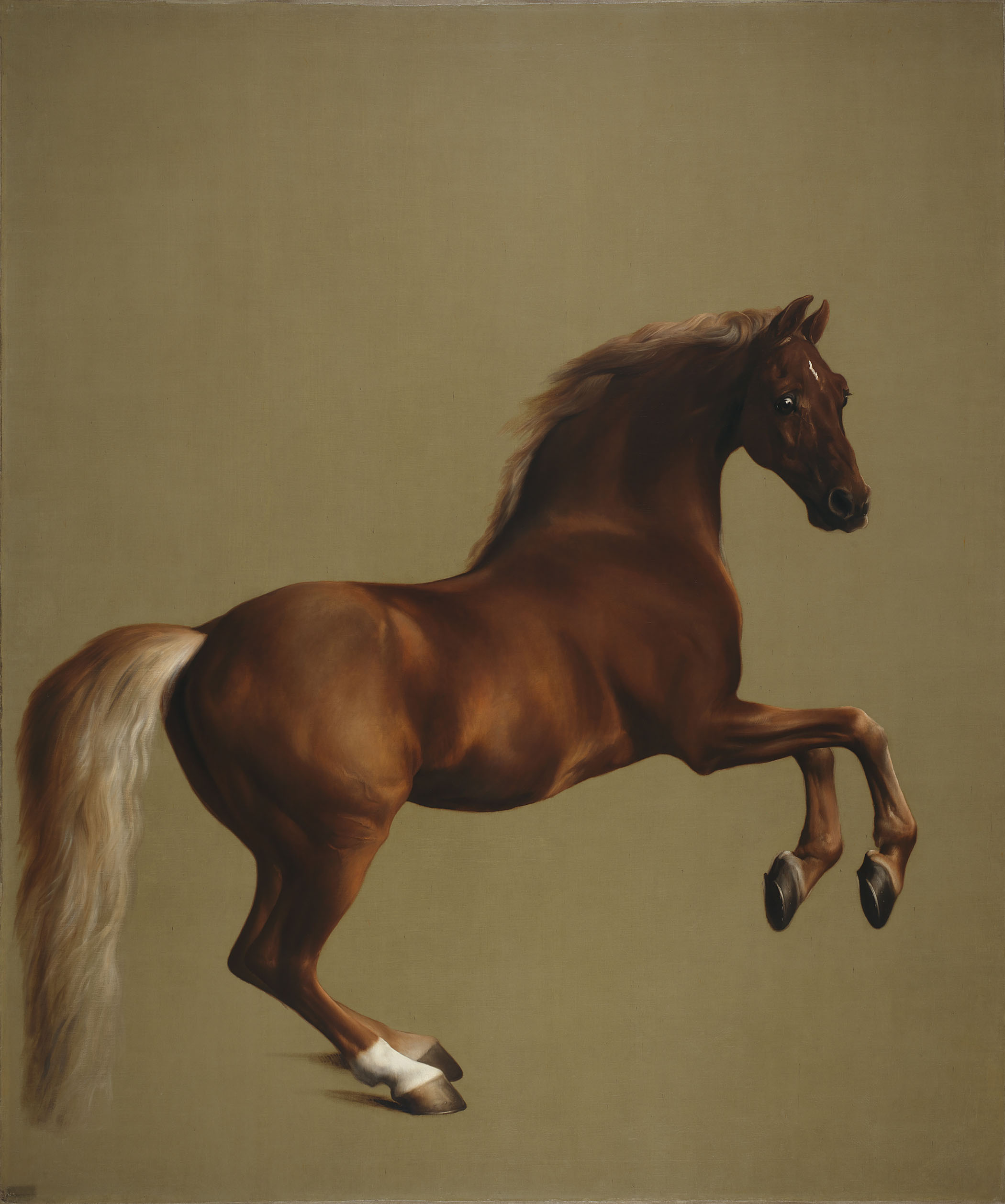
‘No masterpiece by George Stubbs is more dazzling than Whistlejacket’
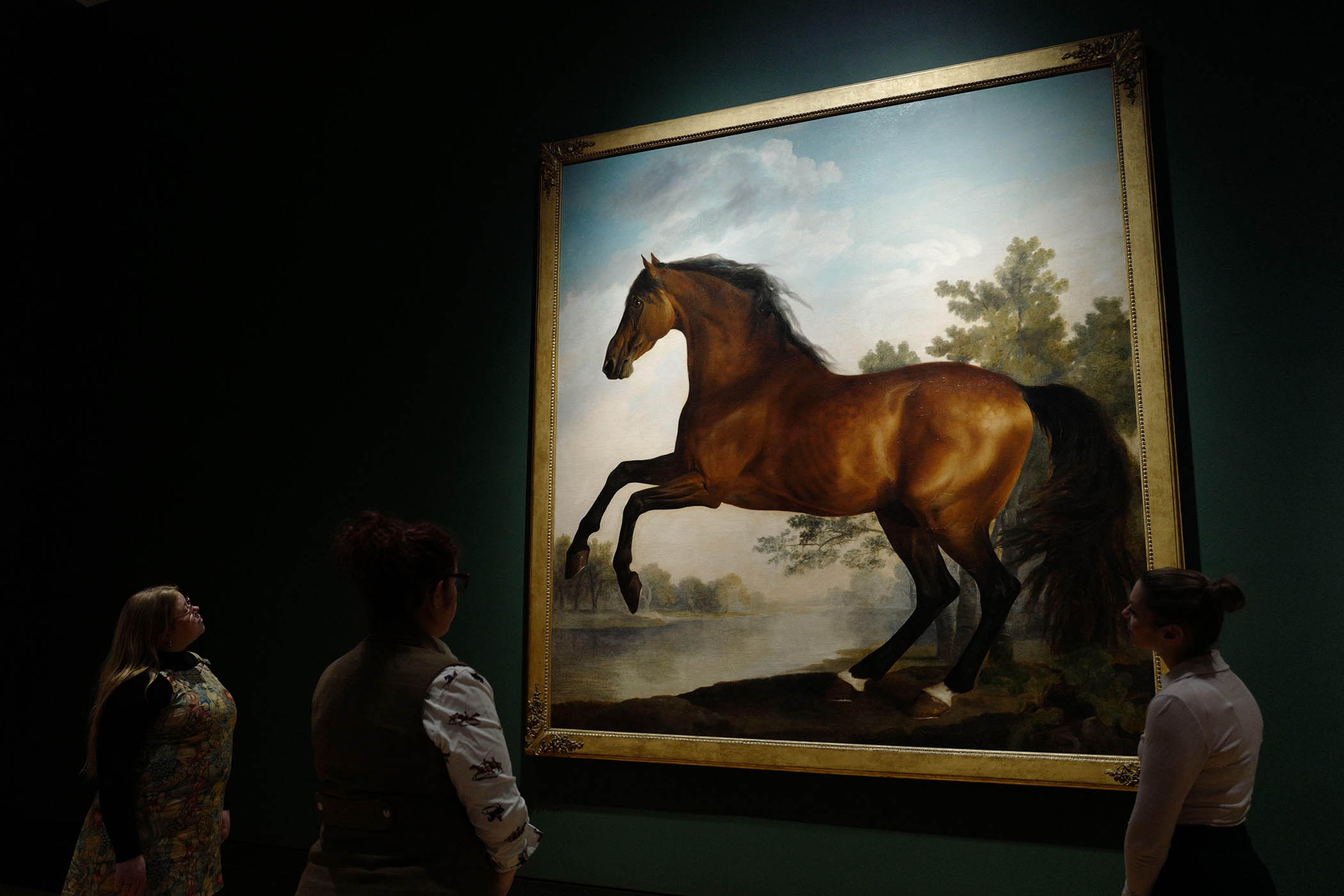
The National Gallery’s new show, Stubbs: Portrait of a Horse, sets before us a second solo steed, almost the size of life and fully as intense. Scrub, a Bay Horse Belonging to the Marquess of Rockingham, to use its full title, has only been shown in public once before. This horse is free of saddle and rider, too, a powerful liberated force rising on hind legs against an equal radiance. But in this picture, it is the light of an English day. For Scrub appears in a landscape.
The portrait is breathtaking, spectacular. Scrub is on the verge of a lake that recedes into hazy trees beneath a luminous sky reflected in the still waters below. His dark form – subtly haloed, just like Whistlejacket – is backlit by all this brightness. No shadows dart from his hooves, for Scrub has the actual bank beneath him. Stubbs puts the horse on the very edge, however, as if the pose was not already incredibly abrupt.
Stubbs spent 18 months studying the horses he had dissected, drawing their nostrils and limbs, depicting their muscles, arteries and pencil-sharp ankles
Stubbs spent 18 months studying the horses he had dissected, drawing their nostrils and limbs, depicting their muscles, arteries and pencil-sharp ankles
Scrub’s gleaming chestnut flanks seem to drain their colour into his elegant black legs. His dark mane, fluttering against the light, is soft as a girl’s long hair. He has the nervous thinness of a racehorse that has been too much sweated, yet he has escaped Rockingham and his riders, it seems, back into nature. He is his own master, wild and unbridled, yet powerfully disciplined. The obvious analogy is with Stubbs himself.
Stubbs spent 18 months studying the anatomy of horses he had dissected, drawing their nostrils and limbs, depicting their muscles, arteries and pencil-sharp ankles. These images – many on display here – were published in his 1766 book The Anatomy of the Horse. Some are meticulously numbered by ligament or fascia, for instance, but others have an almost supernatural grace and animation that transforms science into art. The only comparison is Leonardo.
All this knowledge underpins the great paintings like a form of homage. Stubbs would not portray a racehorse without knowing how its prowess was achieved, or how each differed in personality from the next. This is marvellously apparent in the exhibition, where portraits are paired together for comparison.
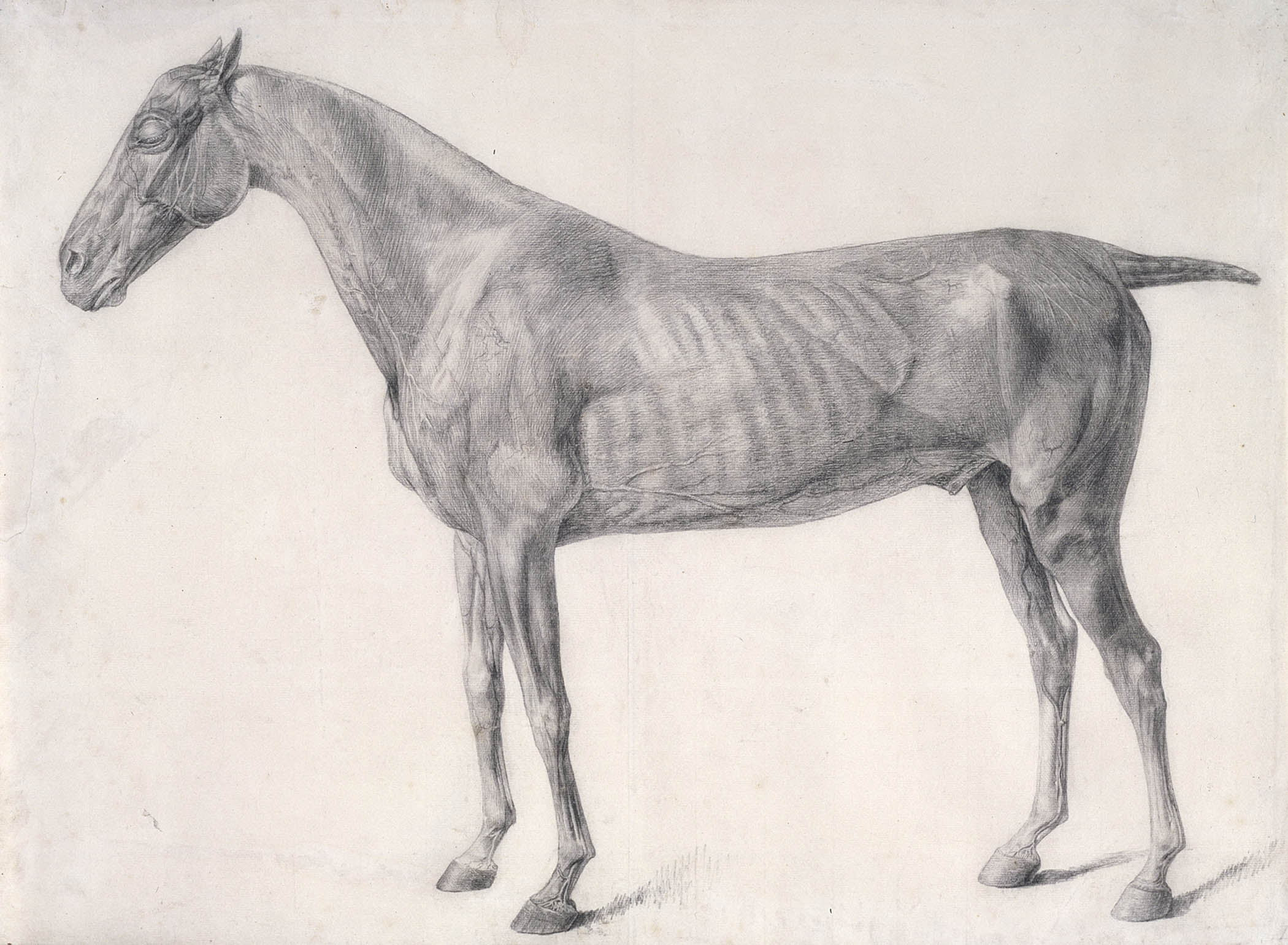
Finished study for the First Anatomical Table of the Muscles, Fascias, Ligaments, Nerves, Arteries, Veins, Glands, and Cartilages of the Horse. (1756-1758)
In Dungannon with a Lamb (1793), the bay horse towers over his little friend. The sheep looks stubborn and a bit stupid, as sheep often do. The horse turns our way with something like a wink in the catchlight of its eye, as if to introduce us to his tiny pal.
Newsletters
Choose the newsletters you want to receive
View more
For information about how The Observer protects your data, read our Privacy Policy
The wonderful old white horse Mambrino has done his time. There’s wisdom in his benign eye and a certain stockiness now he is out to pasture. He is nothing like Whistlejacket, except as an equal inspiration to Stubbs. Active admiration goes with inquiring fascination: Stubbs loves to praise these creatures.
On the other hand, Stubbs was justly wary of his patrons. Rockingham never bought the portrait of Scrub in the end. Stubbs kept it in his studio, except for a venture to India, from which the canvas returned unsold.
That Stubbs always painted the horse first is well attested and there are several other portraits without rider or backdrop. But Scrub and Whistlejacket are formidably larger. To see them both in the same building is to have a new sense of Stubbs’s own independence and originality.
There is a hoary old art story, of the kind that stretches back to ancient Greece, about Whistlejacket trying to attack his own portrait because it looked so realistic. Whereupon Rockingham instructs Stubbs to put down his brushes. My sense is that the marquis – a future prime minister in the making – was far too busy to bother with aesthetic detail and the decision to liberate the horse from country, if not king, lay with Stubbs.
A replica now stands in for the original in the Whistlejacket Room at Wentworth Woodhouse, Rockingham’s South Yorkshire seat. More fool him that he never had a Scrub Room to match. These great living creatures, so vast, are the peak of Stubbs’s strange, humorous, extraordinarily composed and entirely original art. Nothing like them was ever made before and these portraits have never been surpassed.
Stubbs: Portrait of a Horse is at the National Gallery, London, until 31 May