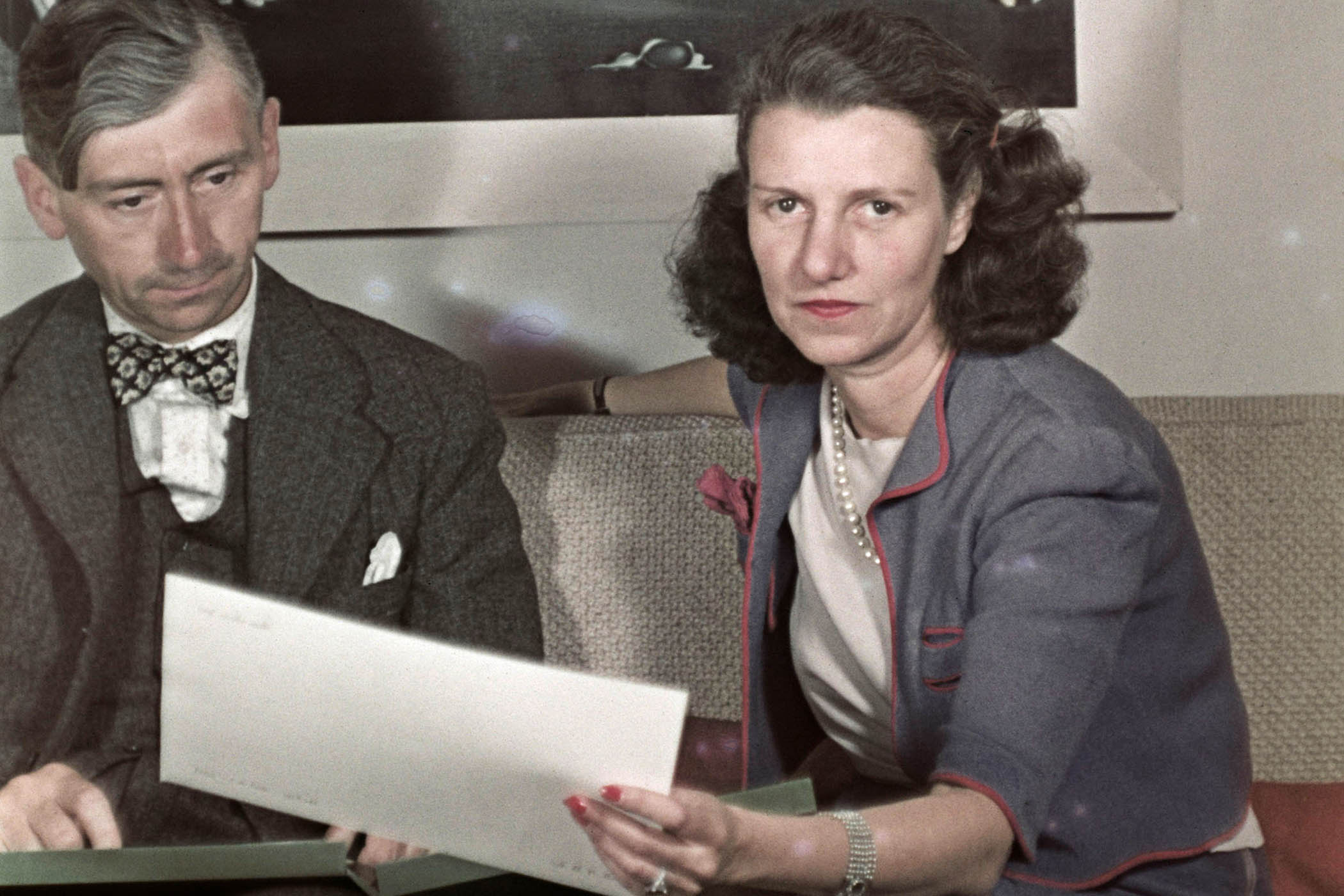
One day in late 1937 a slight woman with curly dark hair hurried down a street off Piccadilly in central London and headed inside a rundown building that until recently had housed a pawn shop. It was an inauspicious start to what seemed an unlikely dream. The woman was Peggy Guggenheim, and her ambition was to set the ball rolling on a British Museum of Modern Art, like the one that had opened a few years earlier in New York.
Peggy called her project MMMM – “My Much Misunderstood Museum” – and its first stepping stone would be the gallery she was about to open in the former pawn shop on Cork Street. Nearby were two other commercial contemporary galleries – the Mayor and the London – but the city was a desert when it came to modern art. Today, Tate Modern, the Frieze art fair and a plethora of cutting-edge galleries put Britain’s capital at the global heart of contemporary art, but in those prewar days the avant garde was centred on Paris, which often felt a million rather than a mere 200 miles away.
The Tate regularly turned down offers of contemporary pieces, and abstract sculptures by the renowned artist Jacob Epstein had been defaced by visitors who, according to press reports at the time, regarded them as symbolic of moral deterioration. Peggy herself, in a letter to a friend, bemoaned London’s “apathy” when it came to modern art.
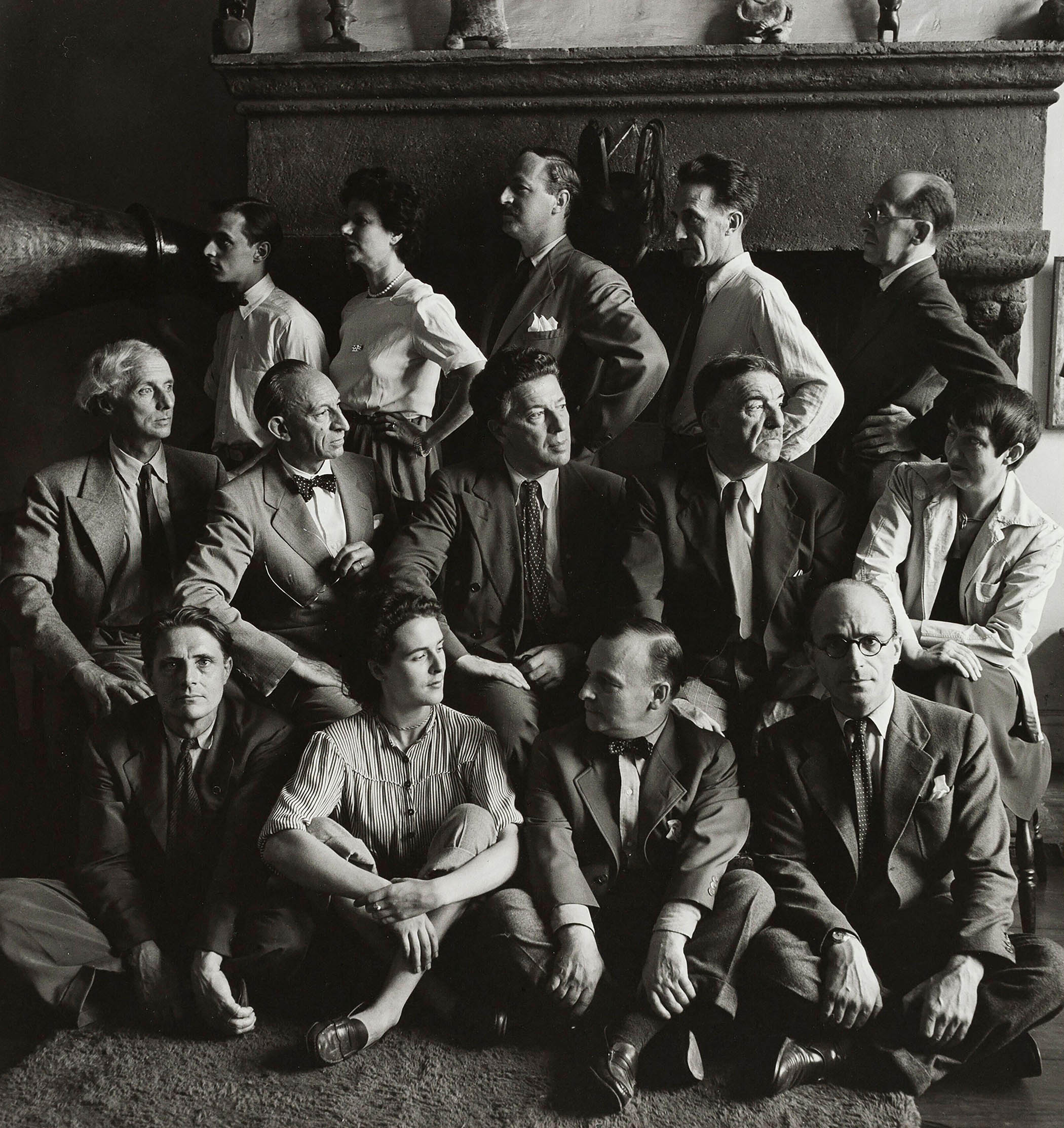
Guggenheim, back row second left, with assorted surrealists, including Marcel Duchamp (back row, second right), Max Ernst (middle row, far left) and Leonora Carrington (bottom row, second left) in New York, 1942
She, however, had recently decided to make it her life’s work. She had plenty of other options: although she wasn’t as wealthy as her uncle Solomon, who would go on to found the New York museum named after him, she had plenty of money. Peggy’s father, Benjamin, had gone down with the Titanic, and in 1919, aged 21, she inherited a sum equivalent to around £34m today. At 39, she didn’t need to work at all – she could have spent her days playing golf at the Westchester Country Club, as her sister Hazel said later. Or, she could have spent more time with her children, Sindbad and Pegeen – she had recently been living in a picture-postcard cottage in Hampshire, and had enjoyed being burrowed away there. Or she might have devoted herself to her love affairs, which were legendary: indeed it had been her latest amour, the writer Samuel Beckett, who had urged her to focus on contemporary – “living”, as he put it – art, rather than the works of those who were dead.
Peggy had been toying with the idea of a literary business, but by 1937 her mind was made up. The recently closed pawn shop off Piccadilly would be the canvas for a work that would soon outgrow its frame, and transform London. It would be called Guggenheim Jeune, a witty reference to her status as Solomon’s niece and a homage to the Bernheim-Jeune, one of Paris’s oldest, and in its time most groundbreaking galleries.
Things would not go to plan for Peggy’s new gallery, and what happened next is the focus of an exhibition called Peggy Guggenheim in London: The Making of a Collector, opening this month at the Peggy Guggenheim Collection in Venice, and transferring to the Royal Academy in London in November. The show will tell the story of the heady days and months after Peggy had signed the lease on 30 Cork Street, starting on 1 January 1938. Three weeks later she was opening her first exhibition: she had hoped it would be of the sculpture of Constantin Brâncuși, but when he wasn’t available she pivoted to a little-known artist who had never had a show in Britain, the French polymath Jean Cocteau.
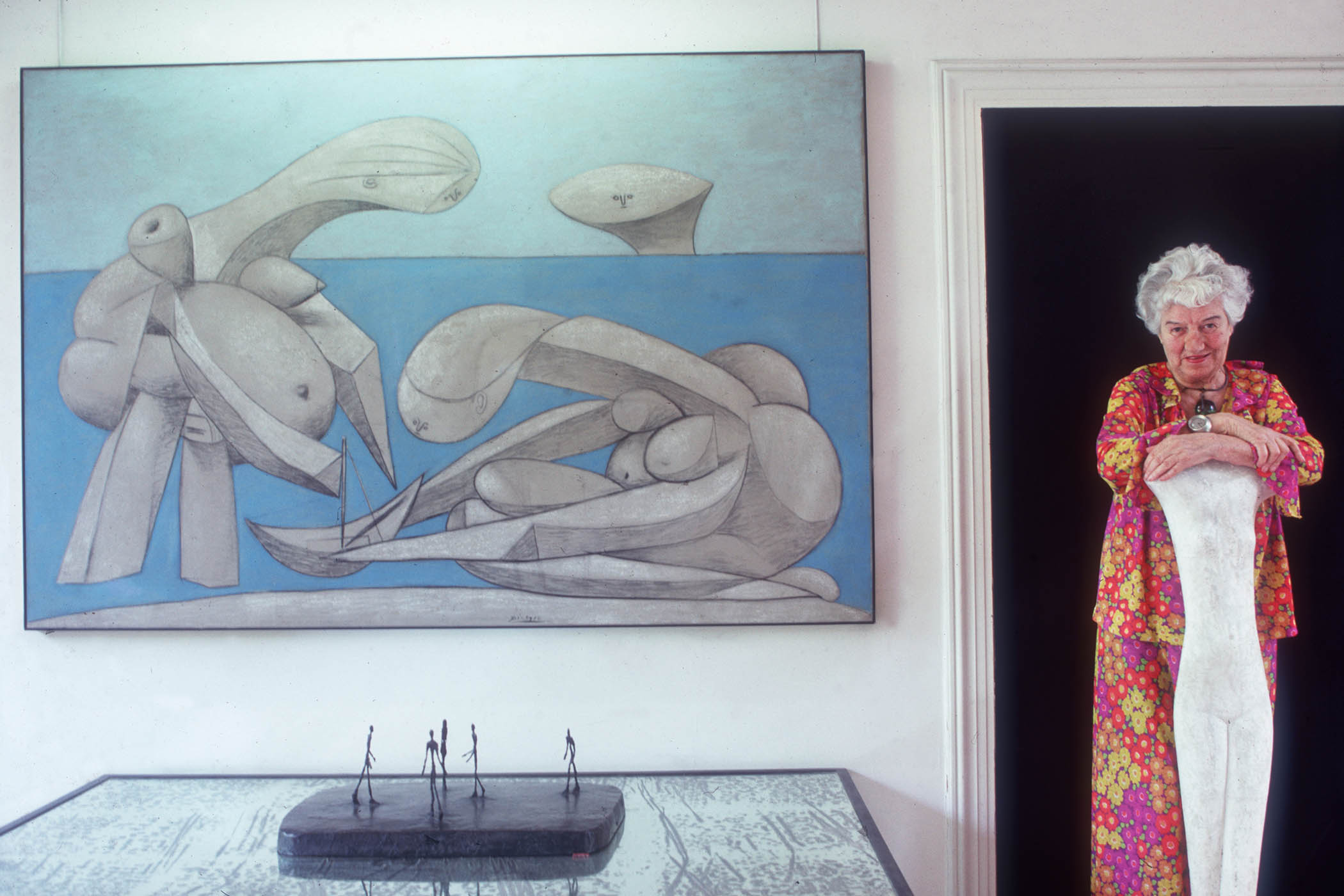
Guggenheim at her Palazzo Venier dei Leoni, with Picasso’s On the Beach, in 1978
The exhibits included a black chalk drawing on a bedsheet in which the subjects’ pubic hair is clearly visible, prompting shock and horror at customs, where officials said it couldn’t be allowed in. It was only when Peggy declared the work was for her private office that she secured its release. “Imaginative draughtsmanship” was the Manchester Guardian’s verdict on the piece.
The Cocteau exhibition closed on 12 February: six days later Peggy was back with her next great reveal, the first ever solo show in the UK of the work of the Russian-born Wassily Kandinsky, who had taught at the Bauhaus until the Nazis closed it. At the time, the 71-year-old Kandinsky was unknown in Britain; in the 21st century he has been the focus of major Tate Modern shows.
More exhibitions quickly followed: the Welsh artist Cedric Morris (whose work was so hated by some that catalogues were burned in protest); and in April, a show of abstract sculpture including works by Henry Moore and Jean Arp (a piece of his had been Peggy’s first purchase for her collection – it is called Head and Shell, and it will open the Venice show). Again, though, there was trouble getting some of the works into Britain: imported stone and sculpture were subject to taxation unless officially certified as art, and the director of the Tate, who was the arbiter, refused to recognise these pieces as such. The resulting furore prompted questions in parliament, and ultimately ended in Peggy’s favour, bringing plenty of publicity, which swelled the audience when the exhibition opened.
In October 1938 the gallery showed a collection of work by under-18s: one piece included was called Old Man Running, by a then 15-year-old Lucian Freud. It was his first publicly exhibited piece. There had never been a survey exhibition of collages in Britain until, that November, Guggenheim Jeune opened a groundbreaking show centred on that art form, with 94 works by 47 artists. And the chance to buy artworks at an affordable price, still a revolutionary idea in some sectors of the art world today, was something Peggy was already championing nine decades ago: a ceramics exhibition that December offered original pieces at moderate prices.
Newsletters
Choose the newsletters you want to receive
View more
For information about how The Observer protects your data, read our Privacy Policy
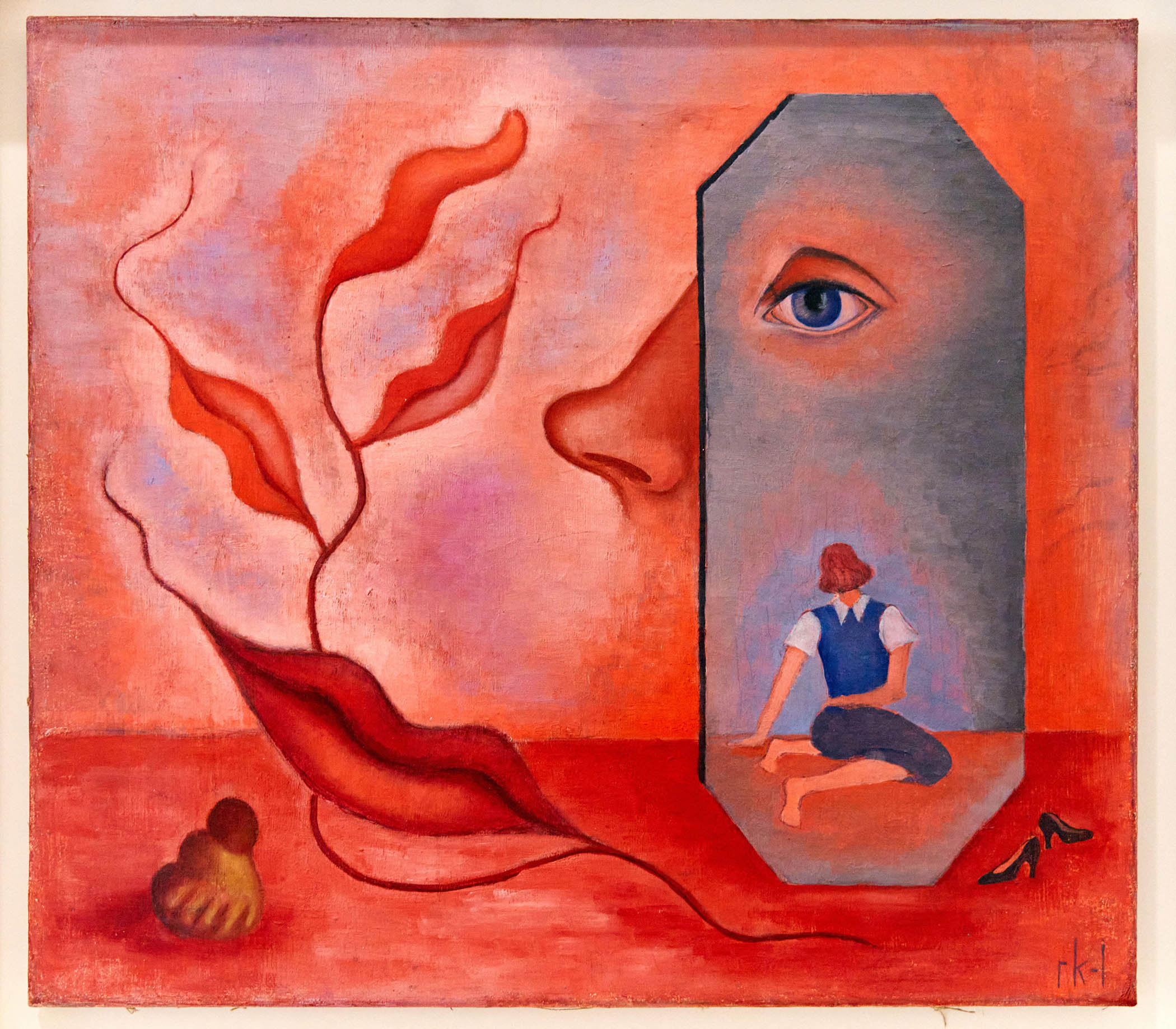
‘Peggy gave female artists visibility’: self-Portrait (Know Thyself), 1937 by Rita Kernn-Larsen
It wasn’t only the artists and artworks that were radical at Guggenheim Jeune. At a time when men dominated the art scene, Peggy’s gallery was run by women, and promoted the work of female artists. “She was inspired by women from early on,” says Grazina Subelyte, co-curator of Peggy Guggenheim in London. “When she was 20 she was an assistant at a bookshop called the Sunwise Turn in New York, run by a woman called Mary Mowbray-Clarke, whom she regarded as almost a goddess. The first abstract piece Peggy ever encountered was there – a work by Georgia O’Keeffe. At Guggenheim Jeune, her key aide was a woman called Wyn Henderson, and Mary Reynolds was another advisor, as was Nelly van Doesburg. Peggy valued women in her team, and she gave female artists visibility; at a time when London museums were conservative, she was bold. Among the women whose work she exhibited were the Danish surrealist Rita Kernn-Larsen and the British surgeon turned artist Grace Pailthorpe.”
Although it didn’t come off, Peggy was also planning an exhibition of the work of Mexican artists, which would have included the first showing of the work of Frida Kahlo in Britain. “That tells you where her mind was,” says Simon Grant, Subelyte’s co-curator in Venice. “She knew how important Kahlo was, at a time when most others didn’t.” One of Peggy’s great skills, he says, was surrounding herself with the “right” team of advisers: these included the artist Marcel Duchamp, who had a terrific international network, and the art historian Herbert Read, father of the writer Piers Paul Read.
Guggenheim Jeune was a bright spark in the then dull British art scene, but it didn’t burn for long. On 22 June 1939, Peggy organised a farewell party for the gallery, featuring the work of the photographer Gisèle Freund, who had fled Nazi Germany. Peggy’s aim was still to set up her London MoMA; she had Read earmarked as its first director.
But war was coming. Peggy went first to Paris – where she famously pledged to buy “a painting a day” – and then, in 1941, after German occupation, to New York, where she founded another gallery, Art of This Century – like Guggenheim Jeune, it would be mould-breaking. After the war she might have returned to London, but Peggy fell in love with Venice where, from the late 1940s, she moved into the Palazzo Venier dei Leoni on the Grand Canal. With her she brought works she had purchased from Guggenheim Jeune artists, including Arp’s Head and Shell; more than 300 of the 500-strong collection visitors see at the Venice gallery today were acquired by her.
Peggy had, however, created a space in London, especially for surrealist and abstract works, as well as for female curators and creators. Her MMMM, or MoMA, might never have materialised, but Peggy’s sojourn in Cork Street helped change art in Britain for ever. Golf might have missed her, and her children definitely did, but gallery-goers gained immeasurably from her decision to make modern art her raison d’etre.
Peggy Guggenheim in London: The Making of a Collector will be at the Peggy Guggenheim Collection in Venice from Saturday until 19 October, and at the Royal Academy, London, 21 November-14 March 2027
Photographs by Gisèle Freund/ IMEC/Fonds MCC/Getty Images; Alamy/AP