When words fall silent, cinema speaks. So reads the glorious red legend, in letters reminiscent of the Hollywood sign, at the start of Zineb Sedira’s transformation of the Duveen galleries at Tate Britain. It is the establishing shot for everything that unfolds through these vast marble halls, though it also doubles as the closing credit. At one end, the sign appears in English block capitals on its towering scaffold; at the other, in scrolling Arabic, it casts a tracery of beautiful shadows on the wall. It all depends, like those proverbial early movies, where you came in.
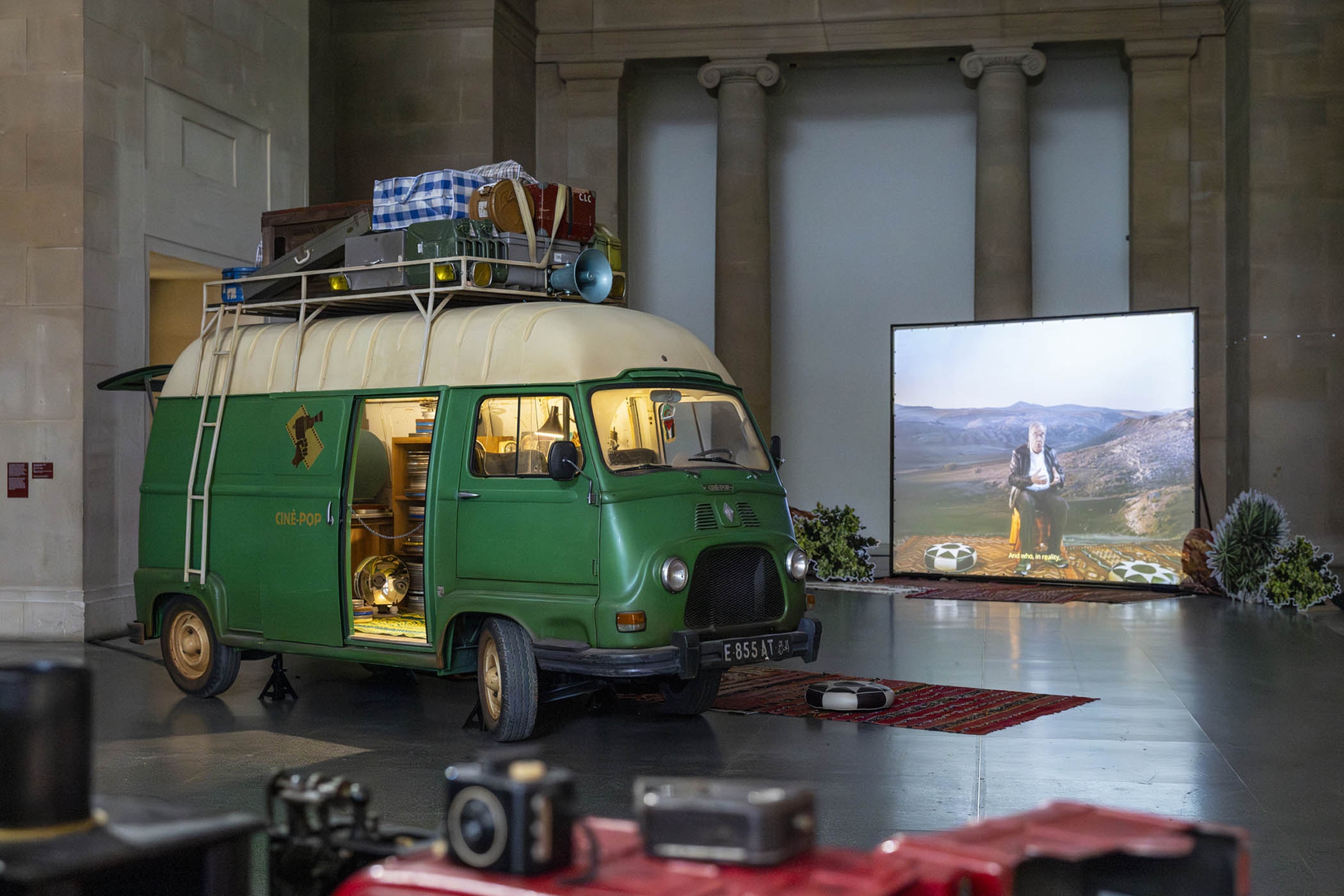
Visitors entering through the back of the galleries will see a travelling cinema in the form of a projector beaming its light from a tiny window piercing the side of a dusty green van. Canisters of old movies stack up inside; luggage is strapped high on the roof. You can watch the movie from a leather pouffe on a carpet that appears to stretch directly into the film, where its subject, the critic and historian Ahmed Bedjaoui, is telling the enthralling story of how Algeria became the epicentre of radical cinema after its independence from France in 1962. Bedjaoui is sitting on an identical pouffe. It seems we are all in this together.
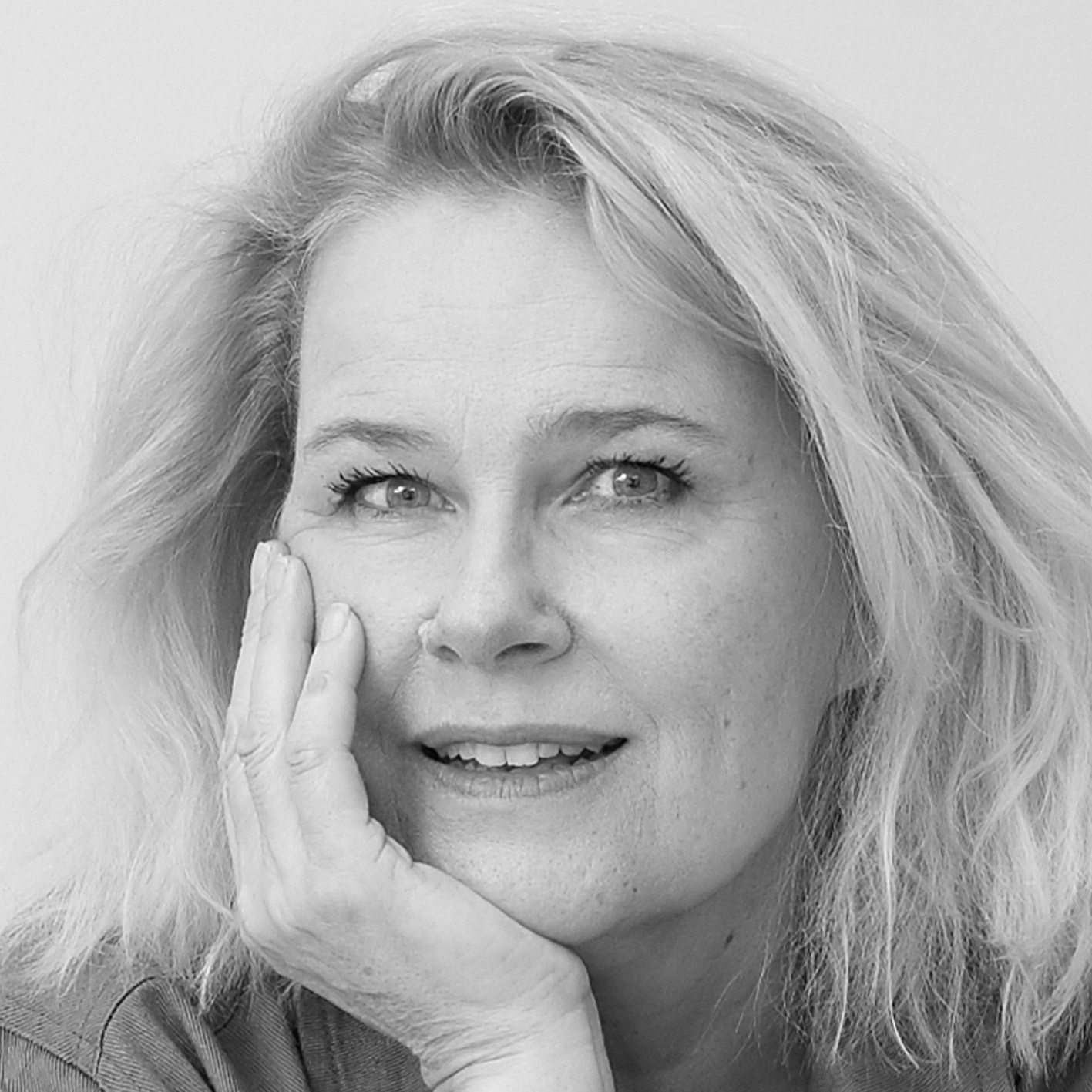
The artist herself makes an appearance, walking into the film to applaud at the end. This is Sedira’s great gambit. The French-Algerian artist, born in Paris in 1963, has found a way to re-enter the past through images, mostly moving, occasionally still, by literally turning up within them. You will see her on and off in her trademark red clothes as you pass through this cinematic tribute to Algerian cinema. Sometimes she is filmed as she is filming others, or she inserts herself into black and white sequences through ingenious editing. You see her seated before a computer, cutting the very film you are watching. “Editing,” she remarks, “is a way of entering the frame, no longer standing outside.”
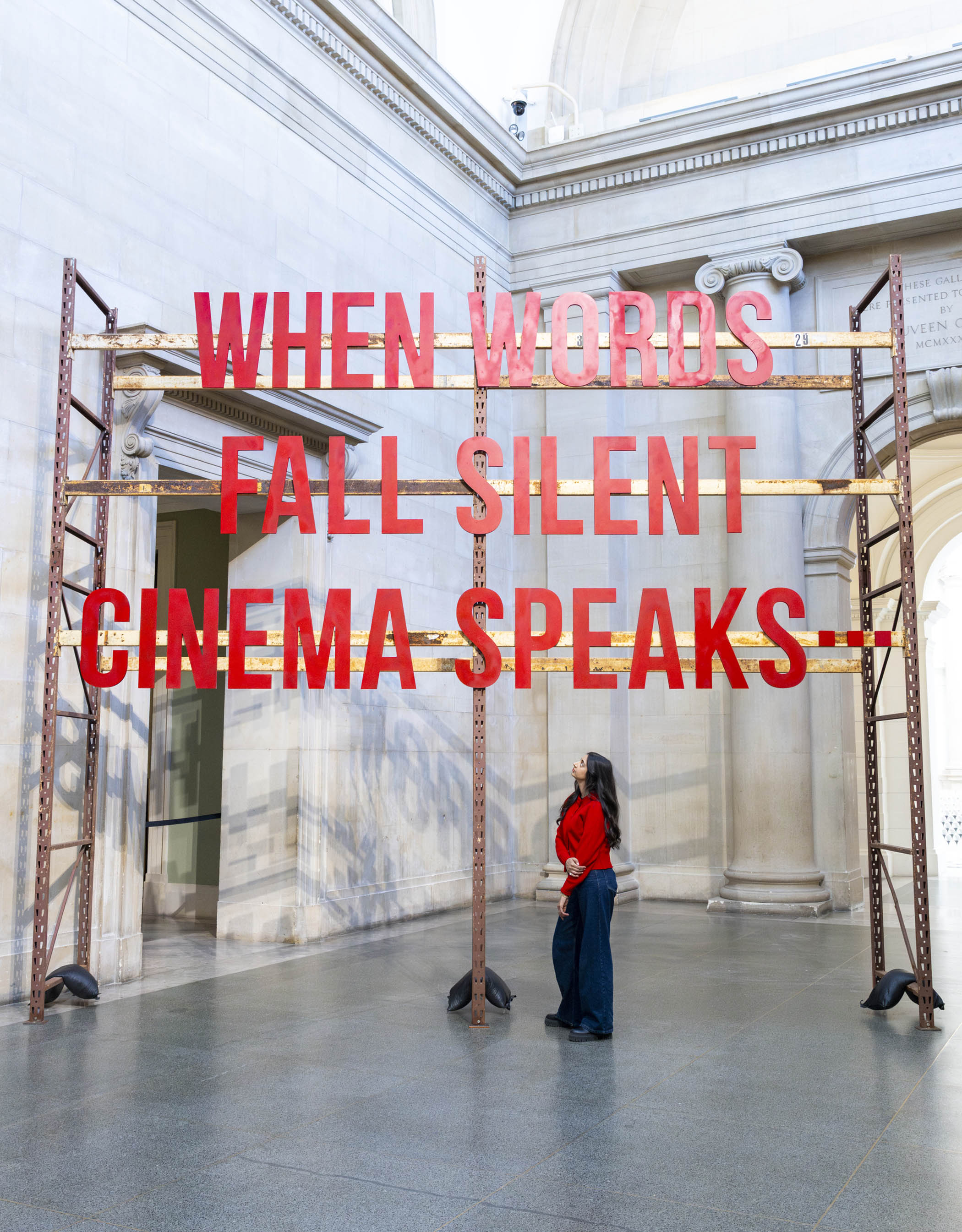
‘Glorious red legend’: Zineb Sedira’s letters, reminiscent of the Hollywood sign at Tate Britain
Sedira has commemorated her parents and grandparents this way; indeed, the countryside in the film behind Bedjaoui is the rural Algeria where her grandparents lived. In her captivating French pavilion for the 2022 Venice Biennale, she recreated an entire Parisian bar to look like a period film set, complete with a couple dancing to a yearning accordion. This opened into a living room in 1950s Algiers, the family’s Paris apartment in the 60s and her own 80s London home, all reprised on screen at the back of the pavilion.
Films spool all the way through this installation too. The ciné-pop van cedes to a Scopitone machine, a kind of movie jukebox beloved of Algerian migrant workers in France. Sedira has re-engineered it to play extracts from Agnès Varda’s 1963 short film Salut les Cubains, itself edited from film footage and photographs, syncopated to Cuban music so that it appears to dance. Press the right button and you could choose Vanessa Redgrave’s 1977 documentary The Palestinian, or Alain Resnais’ 1959 Hiroshima, Mon Amour. For you are turning into performers yourselves.
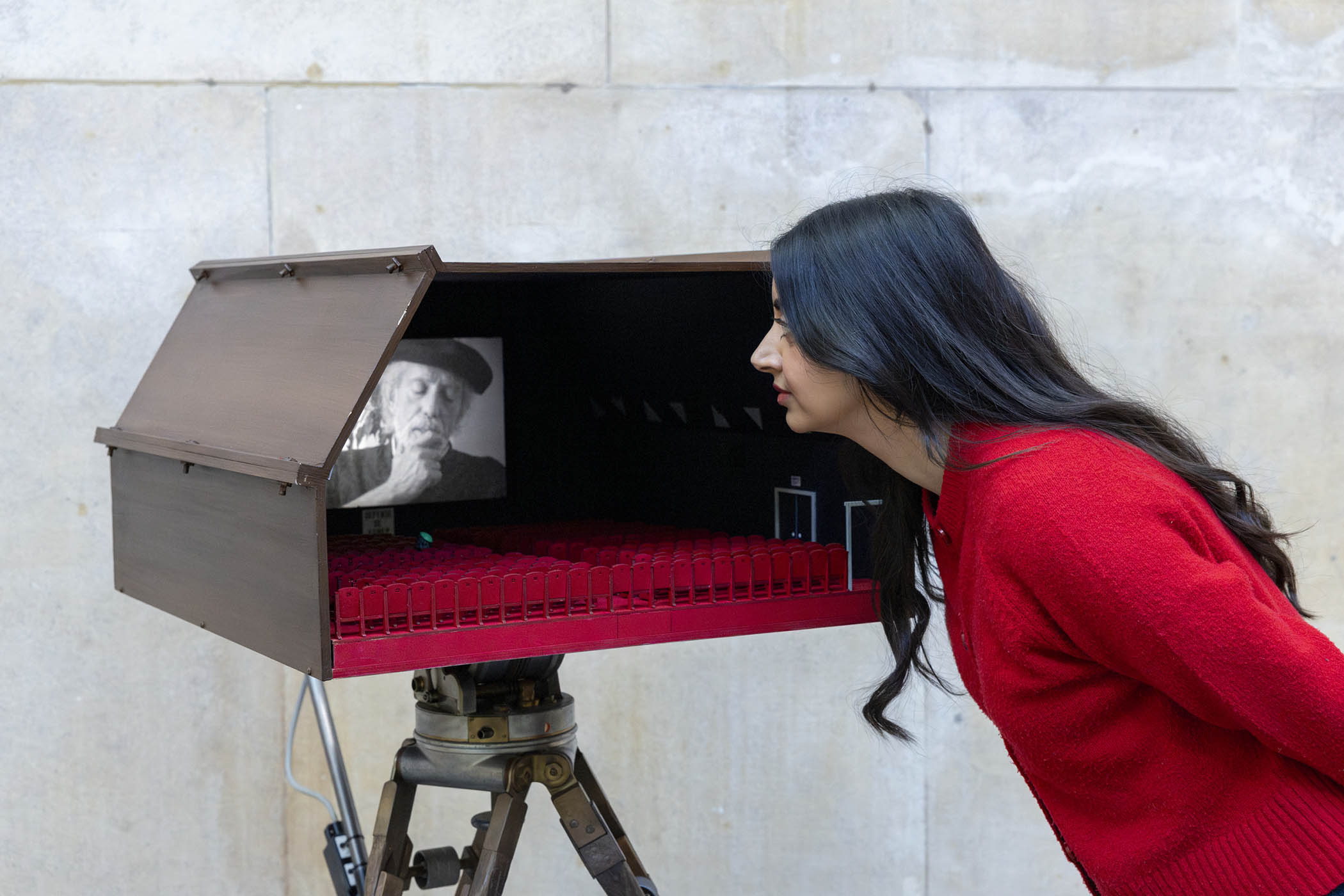
The whole installation is a film set’: top right, a miniature period cinema showing Algerian film-maker Boudjemâa Karèche
There’s a ticket booth where visitors can snap each other, and a wonderful period cafe where you can sit and talk over coffee (if the cups were not screwed to the tables). The whole installation is a film set. Its centrepiece is a period cinema of tip-up wooden seats before an arthouse screen, upon which appears a hero of Algerian cinema, Boudjemâa Karèche, remembering with electrifying verve the revolutionary films he screened as director of the Cinémathèque Algérienne from 1973 to 2004 – a cinema, you will not be surprised to hear, that resembled this one.
Sedira is commemorating an era of cinema so powerful it politicised its viewers, from Tunisia to Senegal, Algeria and Côte d’Ivoire. Karèche, now blind, but without any loss to his inner vision, tells of all the famous films and their makers. But what is missing here, alas, is actual footage. It is one thing to cite, record and praise, which is Sedira’s mission in this four-part narrative of rediscovery, and another to show the glory. Cinema, as the celebrated Senegalese director Ousmane Sembène used to say, was “the people’s night school”; but not here.
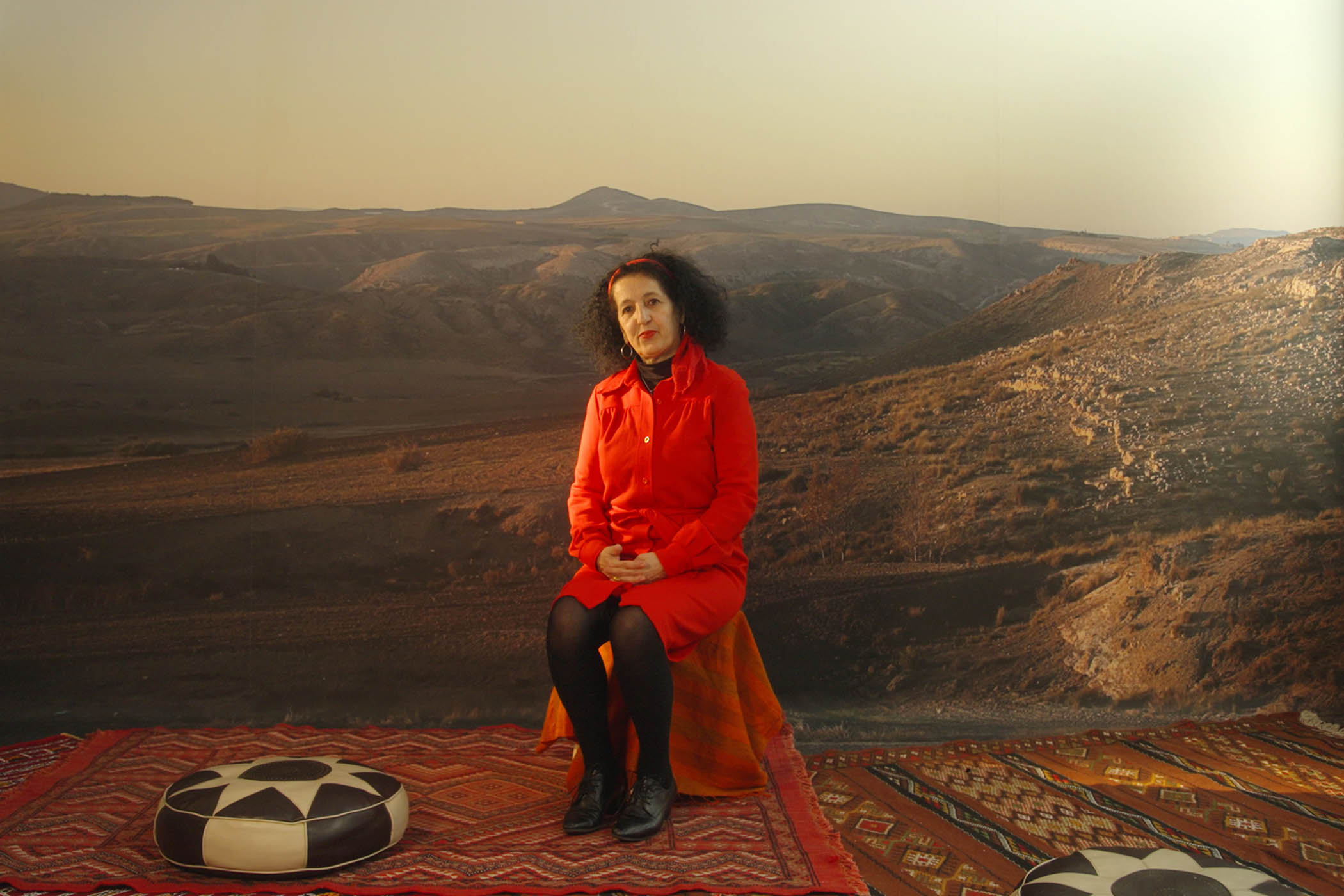
‘You will see her on and off in her trademark red clothes as you pass through this cinematic tribute to Algerian cinema’: Zineb Sedira
Tate Britain might have installed a cinema for round-the-clock screening of these Pan-African classics instead of a meagre one-day seminar proposed for September. It would surely have been jammed throughout, and Sedira’s installation would have become what it wants to be: inspiration as well as homage. As Karèche says, and as Sedira clearly also believes, cinema is an active medium, involving both the director and the viewer. He recalls, with joy, the sight of Algerian audiences with their eyes on the screen, rapt and reacting, bringing the films alive in Algeria through the decades.
And although that may happen at Tate Britain, as people sit before Sedira’s screen, it feels too much of an education as opposed to a movie in itself. This is the artist’s modesty, and her moral aim: to set before us these two veterans of Algerian cinema at either of the galleries so that we may listen and their stories will not be lost. But, still, there has to be something to look at in this para-cinema, while we pay the attention that these men deserve. History is told, it is true, but cinema itself is not speaking.
Zineb Sedira is at Tate Britain, London, until 17 January 2027
Newsletters
Choose the newsletters you want to receive
View more
For information about how The Observer protects your data, read our Privacy Policy
Photographs by Lucy Green/ Tate, Zineb Sedira