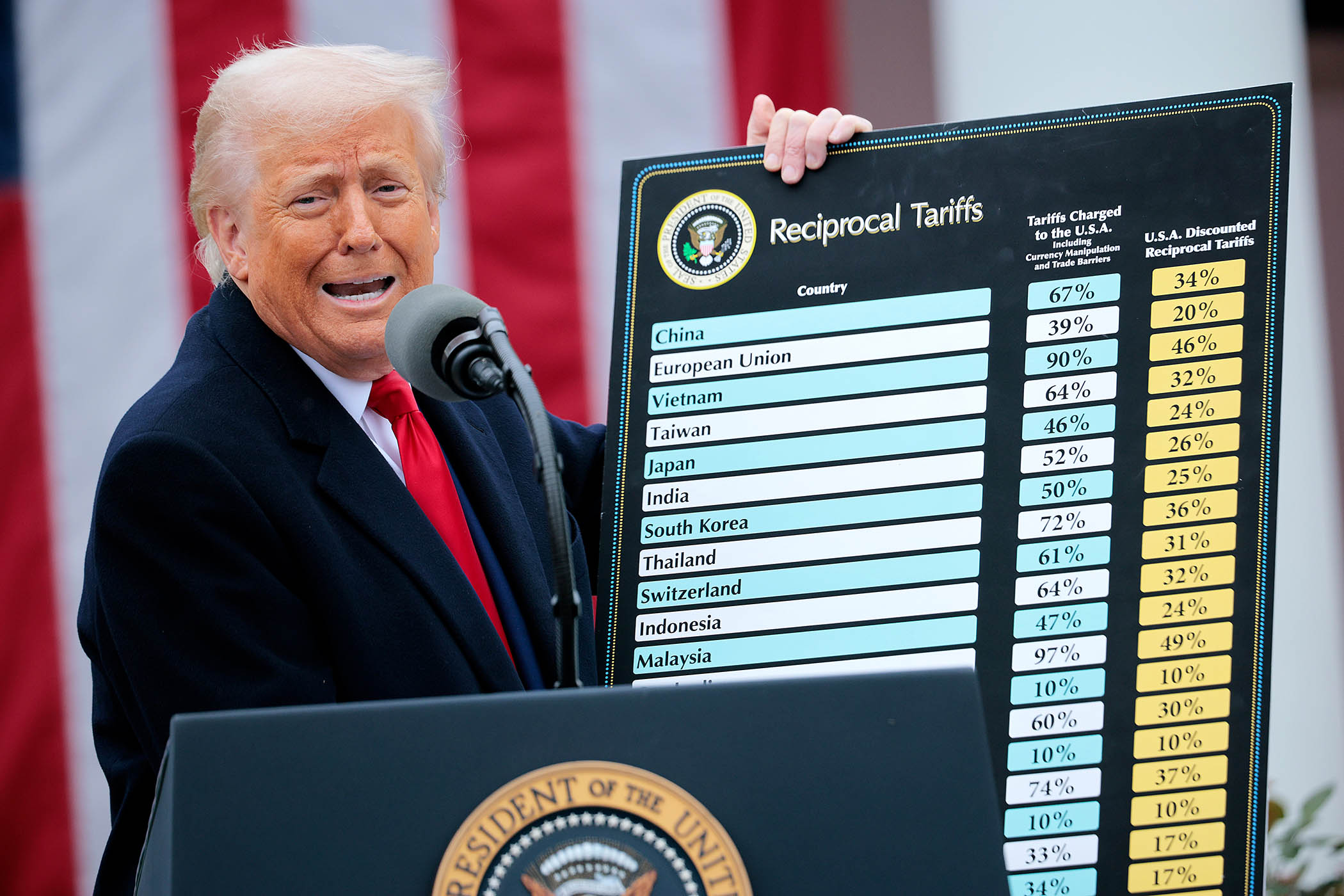



If there’s one image that captures the end of the old, rules-based global trading order, it’s Donald Trump in the White House Rose Garden on 2 April 2025 – what he called “Liberation Day” – wielding a large board depicting the reciprocal import tariffs he was proudly imposing on US trading partners. China: 34%. The European Union: 20%. Vietnam: 46%. And so on.
Trump has an inimitable sense of theatre, but this was merely the latest twist in a longer tale. The old global order – in which normal people, company bosses and even economists didn’t need to worry about the trading system, because it just worked – has been in retreat for some time. In their new book, Soumaya Keynes and Chad Bown mourn this loss, and provide an admirably readable guide to the less stable and less friendly trading environment that is replacing it.
The pair are determinedly, almost aggressively, lighthearted in their whistle-stop tour of what otherwise threatens to be a dry topic. They cheerily gloss over unnecessary details (“because life is short”) and “promise to keep technical terms to a minimum and metaphors to a maximum”. Government stockpiles are likened to “Reddit preppers” stashing away antibiotics and seeds in case of a natural disaster. Tariffs and trade barriers are described as “party drugs that deliver soaring highs and crushing comedowns”. Export controls are compared to curbs on an unruly teen’s social life.
The trade wars of the 2020s are global, but revolve around the rivalry between the US and China, with other countries – the UK included – under pressure to pick a side. One great strength of the book is its efforts to make sense of China’s economic model and the pressure this puts on other nations. This can be difficult for outsiders: the Chinese state is opaque and “about as relaxed about freedom of the press as Soumaya is about the fridge door being left open” (not very relaxed, you gather about the co-author). But the segues into Chinese corporate structures, local government incentives, rare earths and the semiconductor industry help to explain why the growing superpower behaves the way it does.
The authors also provide a masterful explanation of the fundamental macroeconomic forces and imbalances driving trade tensions between the rivals. China produces more than it consumes, and relies on other countries (especially the United States) to soak up its surplus production – often at ultra-low prices. The US, for its part, has accumulated growing debts to finance an insatiable appetite for spending and consumption. Both blame the other.
The authors cheerily gloss over unnecessary details and ‘promise to keep technical terms to a minimum and metaphors to a maximum’
The authors cheerily gloss over unnecessary details and ‘promise to keep technical terms to a minimum and metaphors to a maximum’
To explain this, Keynes and Bown use an example plucked from the toybox, in which one country produces video game consoles (that is, does the physical manufacturing side of things) and the other designs the video games and also does most of the playing (so, the knowledge-intensive services bit, plus consuming most of the end product). There are no prizes for guessing which country is which. This brings clarity and levity to a topic where, in the authors’ words, “fun often goes to die”. The explanation is reminiscent of Nobel prize winner Paul Krugman – and when it comes to popular economics writing, there is no greater compliment.
Not all of the book’s metaphors and analogies are quite so well crafted. I was left a bit baffled by what high school dating dynamics are supposed to have to do with government efforts to identify trade vulnerabilities. The instruction not to “put fish into a fruit salad”, in the context of subsidy design, muddles more than it illuminates. On some occasions, it’s hard to escape the fact that the book is trying a little too hard to be funny and irreverent. But for the most part, it is self-aware enough to carry it off.
Among the most interesting moments are when the two authors disagree. In recent years, national security concerns have been at the heart of trade policy. The fear is that Chinese-produced products (such as 5G equipment, electric vehicles and wind turbines) could be used for sabotage, spying, surveillance or stealing. Keynes is sceptical of the case for blanket bans in response. Bown, who served as an adviser to the Biden administration, argues vulnerabilities aren’t always easy to detect, and that the intelligence detailing the security risks can’t be shared publicly. It’s an insight into the dilemmas governments in the UK and Europe face, as they weigh security concerns against the demand for cheap Chinese tech, especially acute when navigating the transition to net zero.
One overarching message of the book is that the old rules-based order isn’t coming back, and we all need to adjust to that reality. Trump’s latest tariffs on 59 countries, purportedly due to concerns about forced labour, are a case in point. Another is that trade weaponry is dangerous and not to be used lightly, given the threats trade conflicts pose to livelihoods, prosperity and even peace. After all, trade wars can spiral into hot wars. You get the sense the authors wouldn’t be an awful lot of use in the hot kind, but their book provides a witty and invaluable guide to the economic conflict that could shape this century.
How to Win a Trade War: A Friendly Guide to an Unfriendly World by Soumaya Keynes & Chad Bown is published by Macmillan (£22). Order a copy from The Observer Shop for £18.70 (15% off RRP). Delivery charges may apply
Newsletters
Choose the newsletters you want to receive
View more
For information about how The Observer protects your data, read our Privacy Policy
Photography by Chip Somodevilla/Getty Images