
It is only a couple of miles as the crow flies from the village of Culcheth where Andy Burnham grew up to the street where he lives now, and only a hop and a skip from there to the southern border of Makerfield which he is fighting to represent. A crow would have to negotiate the thundering East Lancs road to make the journey, and the signs are that not all crows do it successfully, but Burnham has travelled it serenely.
This area has been his home for the vast majority of his life. He went to school here, became the MP for Leigh, just around the corner, and raised his family here. And he is standing not just on what he can do for the area, but on what it has done for him. If he goes all the way, he will be the first prime minister since Margaret Thatcher to be so intimately associated with a place or so clearly shaped by it. And like Grantham, Thatcher’s home town, this part of south Lancashire is largely unfamiliar, more often bypassed than visited; for many people, a collection of turn-offs from the M6.
The Liverpool comedian, John Bishop, played a gig in Manchester and told a joke about this part of the world which a lot of people in both cities can still remember almost word for word. “We have this rivalry between us and it’s unnecessary. Between Liverpool and Manchester, what is there?
(long pause)
“Warrington. And let’s be honest, before the Swedes built a shop we didn’t even know it was there.”
Thatcher, not IKEA, put Grantham on the map and she always maintained that the town taught her all she needed to know about self-reliance. “All my ideas about it were formed before I was 17 or 18. I learned it from my father, I learned it from my surroundings,” she said. In a place poised between Liverpool on one side and Manchester on the other, in an area that is culturally neither one nor the other but unique to itself, what did Andy Burnham learn?
Burnham has never claimed that he grew up poor. In the memoir/manifesto, Head North, which he wrote a couple of years ago with his friend and mayor of Liverpool city region, Steve Rotheram, he says there were no foreign holidays when he was a child but that was not unusual at the time. And Culcheth today would certainly not plead poverty. There are parades of smart shops, a butcher’s, a bakery, a dress shop, two Italian restaurants, a wine bar, a wellness academy and a natural therapist. In the various estate agents, houses are on sale for up to £1.2m.
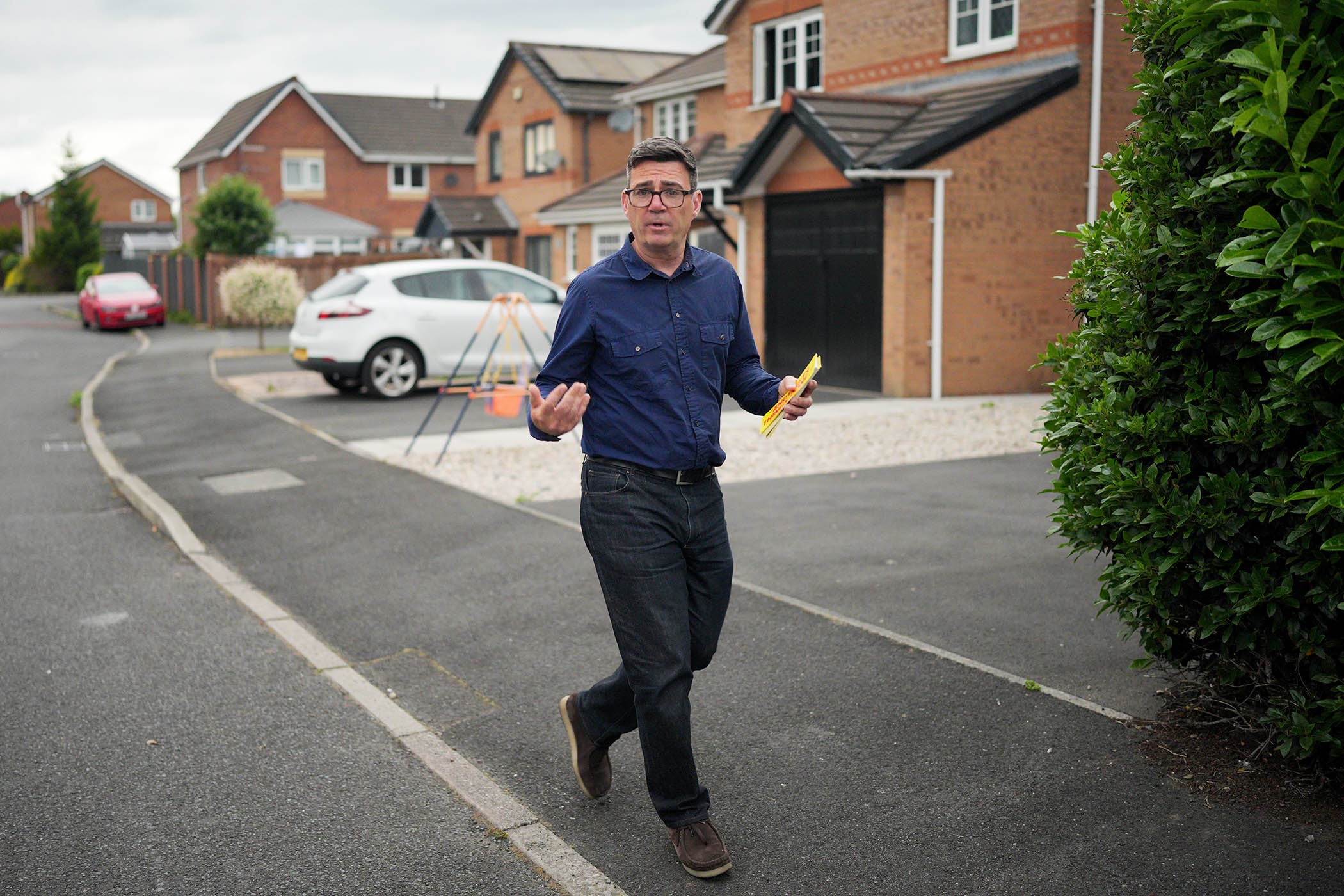
Near the playing field at the heart of the village, people happily acknowledge that they would be proud to have raised a prime minister but hurry on. “It would be a big feather in our caps,” says one woman, reluctant to give her name, “but I wouldn’t want it to change Culcheth.” She could be forgiven for fearing that the plague of international interest which has descended on Makerfield (a constituency where a few houses have signs in the window aimed mostly, but perhaps not exclusively, at canvassers, saying “Leave us alone”) might land here.
In Head North, Burnham acknowledges the gravity that pulls on Culcheth: “(It) leant more towards Manchester than Liverpool.” He leant in both directions – towards Liverpool because of his family history and Everton football club, and towards Manchester because it was having its musical moment when he was in his teens.
And there is a nod to a later, more significant tension, when he and Rotheram both became metro mayors: “He knew Liverpool needed to be a bit more like Manchester. More pragmatic and straight-dealing; less political and able to work with the government where possible…He is the first person to challenge what in the past has been a problematic political culture in the city.”
Newsletters
Choose the newsletters you want to receive
View more
For information about how The Observer protects your data, read our Privacy Policy
If there is an emblem of Manchester’s pragmatism and straight-dealing, as well as its rebirth, Sir Richard Leese is it. He led the city council from 1996 to 2021 and was deputy mayor to Burnham for the last three of those years.
The two men, reportedly, did not always see eye to eye, but Leese is generous about Burnham now. “I think he’s very people focused, which is why people like him. I think he’s very caring, and I think that’s genuine.”
Is there a straight line through the story that takes Burnham from Culcheth to mayor of Greater Manchester and on, potentially, to Downing Street, or are there wrinkles in the narrative? Some aspects of the ‘Manchester story’ fit beautifully with it, most obviously public control of the buses in the now-famous Bee Network. But others sit awkwardly in a Burnham manifesto that argues for countries and regions to take back control from the forces of finance. “The use of financial instruments was critical,” Leese says. “In a modern global economy businesses have the choice of where they go to. You can’t tell them where to go. So it’s about creating circumstances and places where they want to go.”
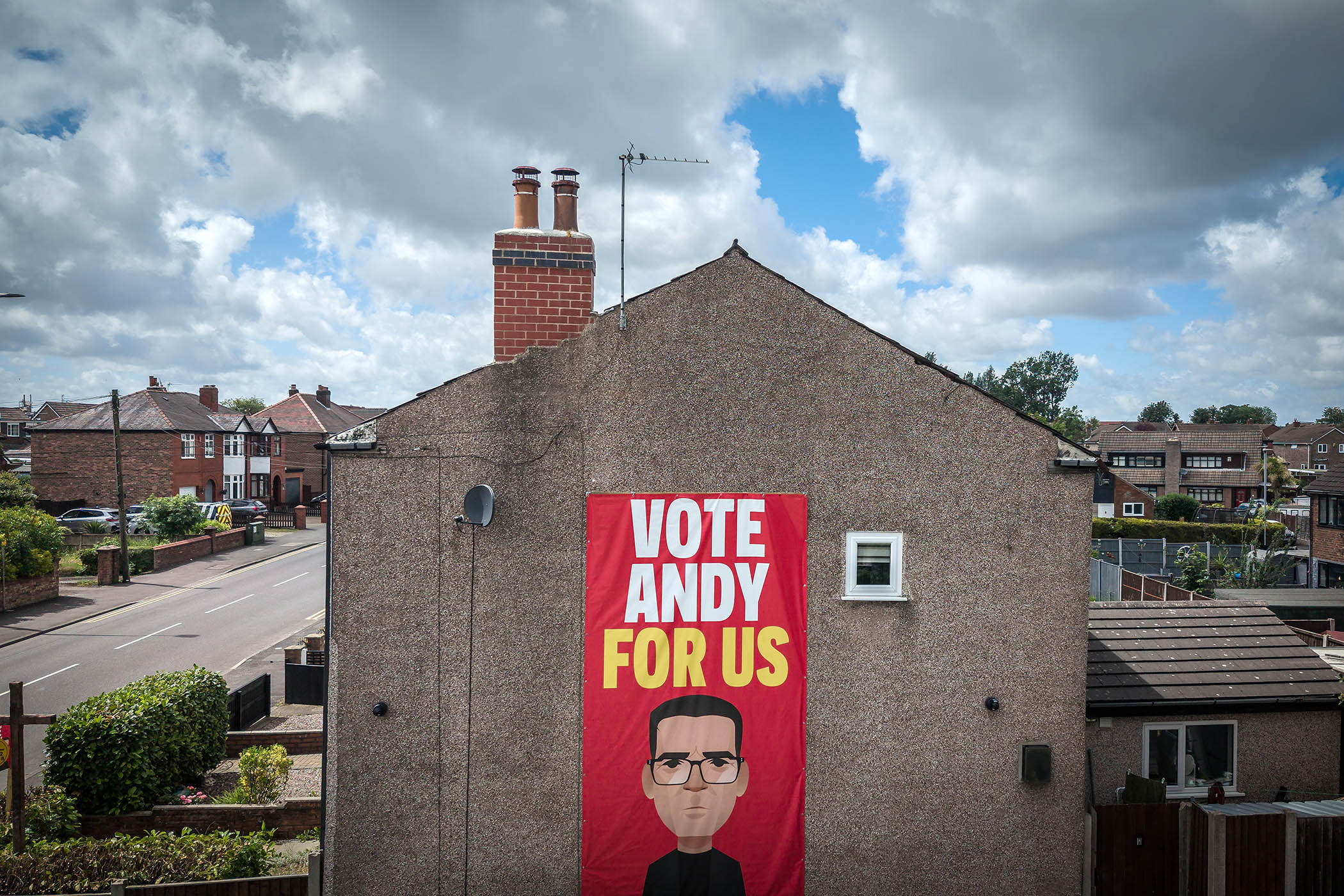
Retirement from front-line politics has not blunted Leese’s sharp sense of how the game has changed, and one of his observations neatly connects Burnham’s run for parliament to the place he wants to represent and what it has taught him. “Andy’s a particularly strong candidate in himself,” Leese says. “That’s undoubtedly the case, but I think part of the learning that ought to come from Makerfield is that this is not a battle of policies, it’s a battle of values.”
By his own account, Burnham’s values have three origins: his home area, Liverpool and Manchester. The first of those, south Lancashire, maintains a proudly introspective feel. As outsiders try to characterise it, all the emphasis on the importance of rugby league, for example, in Wigan and St Helens, in Warrington, Leigh and Widnes, is not trivial or wrong; this is a part of the world that has its own code. But, poised as it is between Manchester and Liverpool, it cannot avoid their influence.
Andy Burnham seems to feel it, too. Running for parliament on the platform he has built as mayor, his head inevitably belongs there even if parts of the economic recipe which have made it a success are not what he would have chosen. But in two short, emotional passages in the book he wrote with Steve Rotheram, his heart seems to sing a more Liverpudlian song: less steely and pragmatic than his depiction of Manchester.
“For all our lives,” he writes about the reasons he and Rotheram left Westminster to become mayors, “people in the North had been treated as second-class citizens. We had become used to both the micro-aggressions and double-standards.” And on the effect of coming together over the Hillsborough tragedy, “We became utterly focused on what had brought us into politics in the first place: securing justice for our people and our place.”
Here, on home turf, a body with a head that belongs to Manchester and a heart that has never quite left Liverpool can hang together comfortably enough. But Westminster has a habit of forcing prime ministers to rule with one not the other.
Photographs by Christopher Furlong/Getty Images