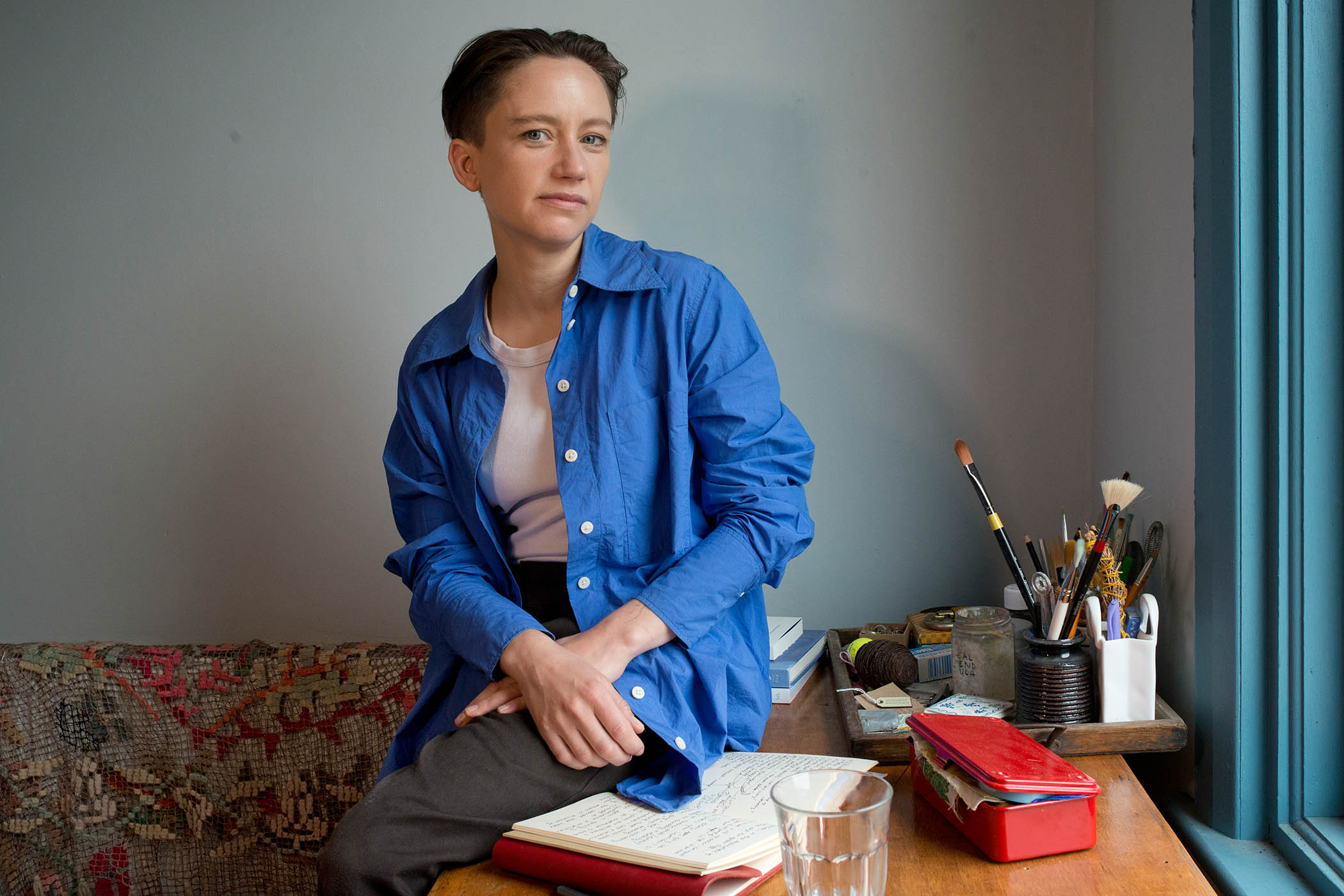



Portrait by Sophia Evans for The Observer
Alice Hattrick, 38, is an author and lecturer based in east London. Their first book, Ill Feelings, blended research and memoir to explore chronic illness and mother-daughter relationships. Their second, Fancy Work, combines biography and art criticism to forge a new story of the embroidery designer May Morris (1862-1938). In doing so, Hattrick presents a radical history of sewing that queers the Arts and Crafts movement and argues for the political importance of creating in the domestic sphere.
How did you first learn about May Morris?
It was during a period of time when I got into sewing, embroidery, and trying loads of different handicrafts. I’ve always been interested in historical figures, so I started reading. But the role of women in the Arts and Crafts movement is quite hidden. I didn’t know anything about William Morris’s daughter before then.
What made you want to write about her?
When I was reading about May Morris, I realised that she was queer in the way we would use that word now. After the deaths of her parents, and after she left Morris & Co – where she ran the embroidery department from the age of 23 – she had this other life that seemed to break away from gendered roles. She lived with a gender-queer Land Army-worker from the First World War onwards, living between London and a presumably quite straight village in Oxfordshire. I realised there was more to this story than was being told.
How did you view your role in retelling that story?
As someone who is a non-objective researcher, I thought I could ask questions about the queer aspects of May Morris’s life. I used that as my starting point: what would a queer researcher and writer find that someone else hasn’t?
What did you discover?
I started with the intention of finding evidence that I could identify as definitely queer, or definitely bisexual. I had this foolhardiness in the beginning. What I encountered in the archive were scraps of things that weren’t supposed to survive, that were wonderful in their own way but didn’t amount to anything we could consider hard evidence in the way that we can sometimes with historical queer lives – in diaries or letters. None of that exists here. So that became the story: that there isn’t evidence. But there isn’t usually evidence of queer lives. Writing about queer lives is always imbued with loss.
Newsletters
Choose the newsletters you want to receive
View more
For information about how The Observer protects your data, read our Privacy Policy
You write that you ‘experienced the pain of archival emptiness, of resistance, gatekeeping’. Some people might not want you to write about Morris’s queer life. Do you consider your work controversial for focusing on that?
To say it’s controversial is to say that our lives are controversial. The phrase “We’ve always been here” is so powerful because it’s an insistence that we’ve always been a part of these very influential movements. That was the story I wanted to tell: that in a movement that reinforces gender stereotypes, queer people were there. They might have been living with their “companions” but that terminology shouldn’t be frozen in time – that’s just a clue. [Today] we’re discouraged to think about our futures as queer people, and a lot of that for me is that we are not allowed to see ourselves in the past.
Tell me more about the current situation.
We’ve seen that recently with the guidance around the human right to use the bathroom when you’re not in your own place of residence. [Government guidance states toilets should be used on the basis of biological sex.] That feels like a sign of worse things to come, and that in our present moment, we as queer people shouldn’t exist, or at least we shouldn’t be out in public. But there’s also the concept of straight time. We don’t necessarily do the same things in life – getting married, producing children – that mark the progression of your life. Our lives don’t fit into linear time, so the way we see ourselves in the future, or our ancestors in the past… our time is queered as well.
What role does embroidery play?
It goes back even further, but in the Victorian period there was sensible stitching, or useful stitching, and then there was fancy stitching. It’s politicised because it is about a division of class. If you were trained to work in a domestic space – if you were a working-class girl – then you learned functional stitching. Only if you had extra time would you do fancy work. Now even functional sewing would be classed as indulgent, because we’ve become so divorced from making anything ourselves. But the value of sewing is really how long it takes. That’s why you would never be able to sell something that you had embroidered, really, for an amount of money that would equate to the amount of time that it had taken you to make it. It would be extortionately expensive, so it’s the kind of thing you only ever do for yourself or as a gift. That’s where I have found stitching really beneficial to my life: it is time away from thinking about work as something to be traded. Embroidery is a form of resistance because you’re making in resistance to indentured labour or commodified time.
What have you made recently?
I finished a quilt that is based on one May Morris made with her mum, Jane. It’s described as a cot quilt, but it’s massive. It depicts animals and mottoes that were important to the Morris family. I made my own version with our little house in the middle, our two cats and dog, and our plants and mottoes. I pieced it all together using scraps of silks from my partner’s granny, who ran a haberdashery shop.
Which books influenced the writing of Fancy Work?
I used Deborah Levy’s conceit of living autobiography – I wanted to apply that logic. The Subversive Stitch by Rozsika Parker and Queering the Subversive Stitch by Joseph McBrinn were really important. And My Autobiography of Carson McCullers by Jenn Shapland helped me think about how I could write in a way that incorporates both my experience and archival work.
Fancy Work by Alice Hattrick is published by Fitzcarraldo Editions (£14.99). Order a copy from The Observer Shop for £13.49 (10% off RRP). Delivery charges may apply