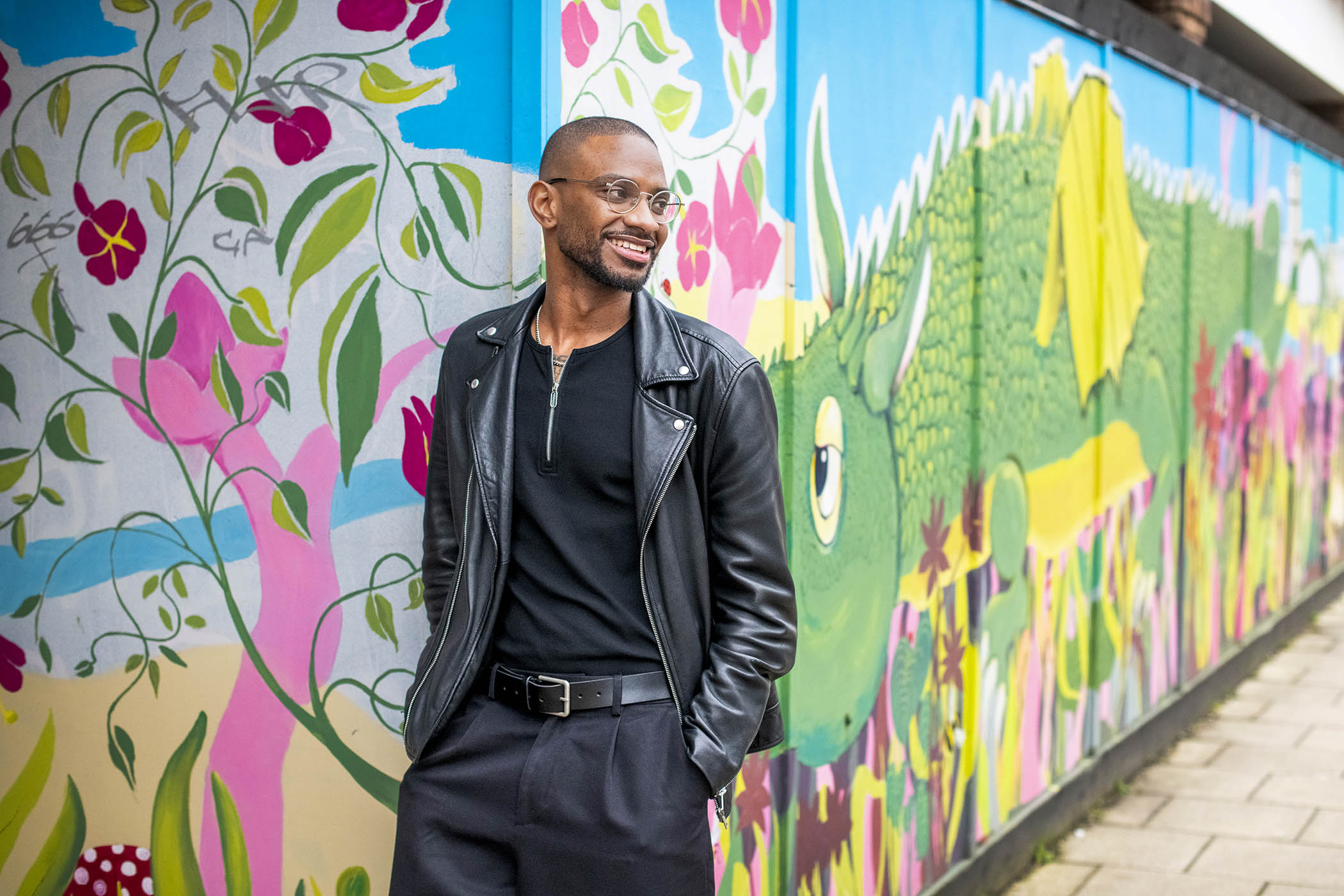
Ashley Hickson-Lovence, 34, grew up in east London and now lives in Norwich. He is the author of five books spanning poetry, YA fiction and the novels The 392, set aboard a London bus, and Your Show, a fictionalisation of the story of the trailblazing Black football referee Uriah Rennie. His latest title is About to Fall Apart, a novel in verse that follows sixtysomething Aidy over three days, as his relationships and sense of self begin to unravel.
Where did the idea for About to Fall Apart come from?
In 2015 my grandmother passed away. She was Irish, born in Donegal. I’ve always been fascinated by the fact that I grew up in a very Black community and I had this Irish grandmother. I used to quiz her about her Irishness, but she was resistant to say anything. Within a few weeks of her death, my granddad found a letter to her from a man in Donegal. It said: “I’m your son, I would love to connect.” None of us in the family knew who this man was. He had written the letter the year before she died, but she hadn’t replied.
What had happened?
My grandmother met a Ghanaian man in the 1950s, and from their brief relationship, my uncle was conceived. She was from an affluent background in Ballyshannon. So this brought great shame on to the family; not only was she pregnant out of wedlock, but to a Black man. She gave her son up for adoption and moved to London.
Why did you want to write about it?
I think every family has their secrets, but the added dimension was that there were people of colour involved and it was the 1950s – that complexity made me write about it. When you think of Ireland, there’s a certain imagery that’s evoked: a ruralness, a pastoralness, a whiteness. The image of this man of colour living there in relative isolation really stayed with me.
So your uncle inspired your character Aidy?
I try to see him in Ireland every summer now. There’s a sense of sadness there – that he never had a relationship with his birth mother, and nothing will change that. I sense an aching regret, and that’s what I wanted to capture in the book. I asked his permission. I drafted a text to him five times, and waited until I’d had a pint before I sent it. He replied enthusiastically.
The book is written in verse, with phrases broken up with forward slashes. How did you come to that form?
Individual lines are really important to me in terms of syntax, rhythm, cadence. I started writing About to Fall Apart as a list. Then I read Caleb Femi’s Poor, which uses the forward slash, and I saw it in poetry by Lewis Buxton, Mary Jean Chan, Joelle Taylor. I loved the energy it brought. My hope is that if readers are annoyed on page one, by page five they’re completely absorbed. I think the forward slash lends itself to that propulsion of movement.
What is your day job?
Outreach with teenagers. I go into secondary schools, sometimes PRUs [pupil referral units] or schools for students who have been kicked out of mainstream school, and I give workshops, assemblies and lead creative writing activities. I encourage students to use their voice and know that their words have value. I use a little bit of my story, my working-class background, to get our young people, especially boys and boys of colour, reading for pleasure.
2026 is the National Year of Reading. Do you think it will help?
I’m in two minds about it. I think it’s really good that there is noise around it. But I’d like to see more money for schools to make real change. And I don’t see enough boys of colour reading books that they can see themselves in. There are some brilliant authors: Nathanael Lessore, Matt Goodfellow, Margaret McDonald. But we need many more.
What were your teenage years like?
I grew up in a single-parent home in Hoxton with a loving but strict-ish mum. I think it’s because she had me so young; she was 18. I wasn’t a reader during school. Around that time, I was desperate to leave London. There were a lot of teenage stabbings, a lot of crime. I was quite a shy teenager anyway. Then I lost a friend to knife crime when I was in sixth form. I was terrified. I worked so hard to get to uni, just for safety reasons.
After studying in Brighton you returned to London. Why?
All my family live in east London. I’d never felt rich enough to veer too far away from that base. After uni I trained as an English teacher, and the day I started my in-school training, I was sleeping on my mum’s sofa.
Why did you leave teaching?
I loved being a teacher, but I found it very hard. It was draining – the planning, the data drops, the parents’ evenings. I don’t want to sensationalise this, but there was a moment when I was teaching PEE [point, evidence, explain] paragraphs in a classroom and I thought, I can’t do this any more. It gets too formulaic. You end up taking all the fun out of literature because you have to use the same topic sentences and rely on the same quotes.
Could a shake-up of the curriculum get young people reading?
I think a seismic shift needs to happen, but I don’t think the pressures should be on teachers. There needs to be more money, more time to revamp it at a holistic level. Teachers are overworked, overstressed and aren’t paid enough. They are the frontline heroes.
Which authors made you want to write?
Zadie Smith. I love how she uses proper nouns. You go, “Oh my God, I know that park.” Also Sam Selvon: The Lonely Londoners is written in a very specific Creole-Patois dialect, and before I read it, I didn’t know you could write like that. And Max Porter. I’m blown away by the risks he takes on the page, that white space.
About to Fall Apart is published by Faber (£12.99). Order a copy from The Observer Shop for £11.04. Delivery charges may apply
Photograph by Norfolk Ali Smith for The Guardian