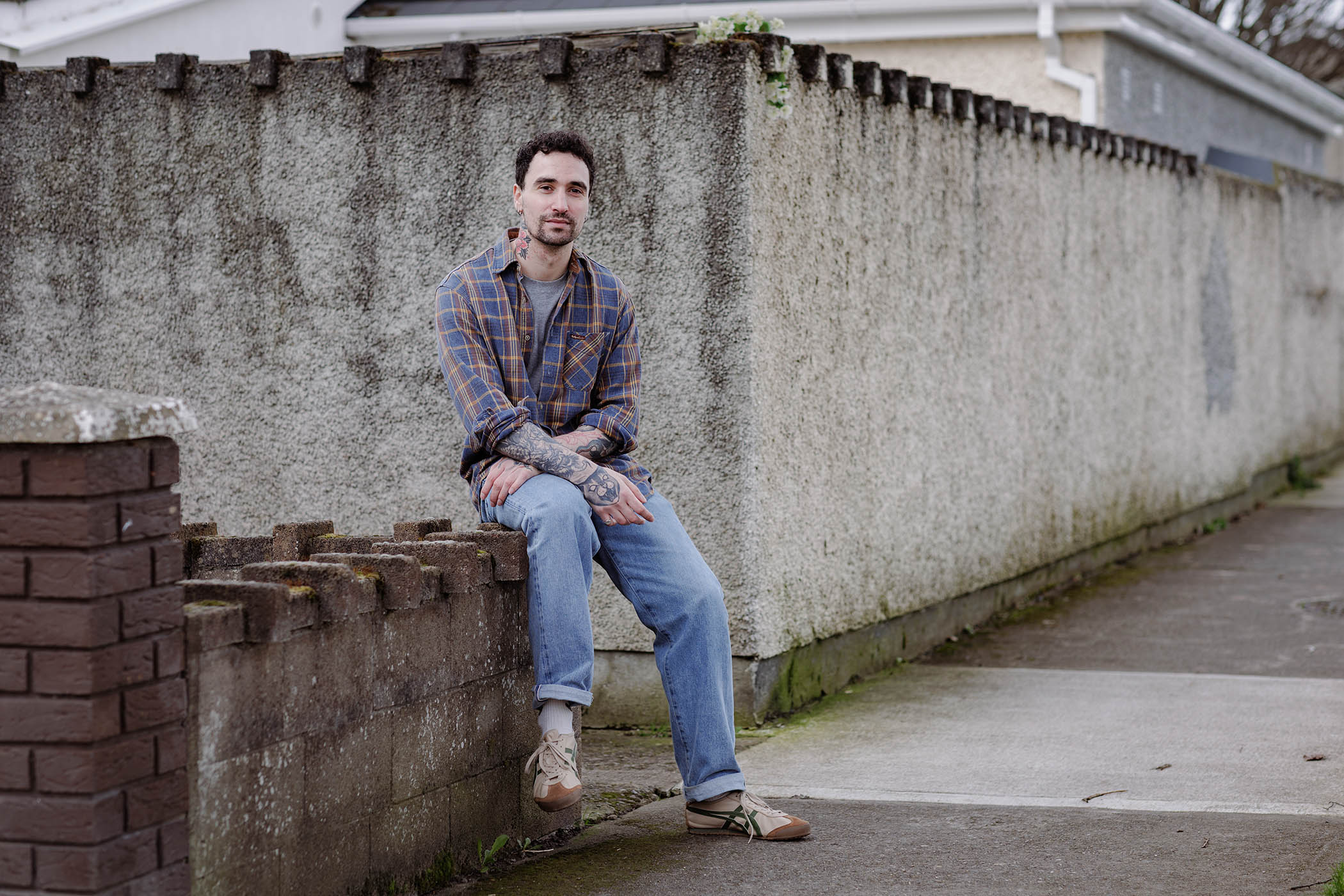

Portrait by Brid O’Donovan for The Observer
Djamel White was born in Dublin in 1997. He left school aged 17 and later returned to education to get an MFA in creative writing from University College Dublin, where he was mentored by Anne Enright. He also worked with Roddy Doyle’s non-profit literary organisation Fighting Words. White’s debut novel All Them Dogs is set in the west Dublin suburb where he was born and now lives. It follows a volatile young man called Tony Ward, who returns to the Dublin gangland he’d left behind – with explosive results. Marlon James called it “a book you inhale, devour, grapple with, and reel from more than read”.
Where did the spark for All Them Dogs come from?
I was obsessed with the idea of a character who doesn’t stop to think or examine his surroundings and was just moving off pure id. When I landed on Tony Ward, it all came together really quickly. I found his impulsiveness a good tool for moving the story along. My writing method was: I attacked it. I would wake up and have a coffee and write 1,000 words in the first hour, without being polluted by the day.
Did you know much about Dublin’s gangland?
I borrowed a lot from peripheral experience, I’d say, and people that I might have interacted with. There’s almost a folkloric sense to Dublin gangsters. They’re gossiped about like they’re celebrities, and the tabloids sensationalise that world and its feuds. My estate’s pretty quiet nowadays, but back in the day you could be woken up in the early hours and hear some interesting things. So there was a memory bank of things that I could draw on.
Was it a stretch to get Tony’s voice?
I sound the way I sound, but the rest of my family don’t. Whatever happened along the way in my development, I came out sounding quite posh. I had a bit of a problem with my “r”s as a young person, so I was self-conscious about the way I spoke. And I read a lot. Those are the things I try to blame for it. It could almost sound like I’m writing from somewhere up high, looking down. But, no, it’s very much my immediate world.
For all his vulnerabilities, you don’t shy away from making Tony a nasty piece of work. Tell me about the challenges of writing a character like that.
What I find interesting about Tony is that he can’t, under any circumstance, put his hands up and say, “All right, I’ve gone too far.” The only thing he can do is fight his way out or push deeper. As a young person, I found myself in those situations – not to the same extent – but situations where you’re so angry and, I guess, afraid of what you’ll admit about yourself if you back down, so you push through. [Writing it] there was some kind of mischief and glee in the things he gets up to. But trying to keep him sympathetic was the concern.
The book presents a different side of Dublin to what a lot of readers will have absorbed in recent years. This is not the Dublin of Sally Rooney’s Trinity-going characters.
I always say to friends visiting Dublin that the first thing you need to do is watch [TV crime drama] Love/Hate, because it’s going to be an image of Ireland you’ve never had before. A lot of working-class novels are about somebody breaking out of their background to become a writer, which is something I believe I have done. But it’s not what I wanted to offer. This story was close enough to my life for me to put genuine emotion into, but I also wanted to write something thrilling.
What got you interested in books?
When I was seven or eight, the teacher used to read to us at the end of each day. She’d read Roald Dahl and we’d put our heads on the desk and listen. I just absolutely fell in love. Eventually, I was able to read those books myself and realised that it was even better doing it on my own. I started writing and did it as a hobby all through school. It was a lifeline.
How did you get involved with Roddy Doyle’s Fighting Words?
I really struggled later in school, feeling like I was bumping up against things and just not fitting in. I found community and some kind of sense of self in drinking and doing drugs. When I left school, I joined a community training programme for early school leavers and a lot of that started to subside. But what really took me out of that was joining Fighting Words as a volunteer. They teach creative writing workshops in schools. I was given quite a bit of responsibility and it gave me a real sense of purpose.
Read anything good recently?
Yeah, for my sins, I’ve been reading Knausgård, going back and forth between My Struggle and the Morning Star books, which I’ve enjoyed a lot more. But My Struggle informs those books in a way that makes them very interesting to me. I’ve just finished Drive Your Plow Over the Bones of the Dead by Olga Tokarczuk. I did not expect a book with that title to be as charming as it was.
What are some other important books for you?
The Heart Is a Lonely Hunter by Carson McCullers. I love Cherry by Nico Walker – I think that informed [All Them Dogs] without me realising it. It gave me permission to write in a voice that isn’t adhering [to more conventional ways of speaking]. I love stories about communities and how different characters intersect, quiet stories that gesture to something much larger, [such as] Benediction by Kent Haruf, Richard Russo’s “Fool” trilogy, Ann Patchett’s Commonwealth and The Round House by Louise Erdrich.
Are you working on anything at the moment?
I’m working on something that’s set in the same place as All Them Dogs. Some characters may reappear, but it is mostly new characters in a new story – a bit more polyphonic, and in the third person. There’s a crime element, but again it’s very much in the background. It’s more concerned with families and relationships, divorce. There’s some younger characters in there that I’m having a lot of fun writing.
Is writing your job now?
It’s my job for now. I’ve started volunteering with [dog charity] DSPCA on the weekends. I am a dog person but I’ve never had a dog, and I think it shows. I get a lot out of doing that.
Do you find it difficult to focus when there’s so much craziness going on in the world?
Yes, absolutely. I’m on Reuters more than anything else. It consumes you. But I can’t turn away. I don’t know if it’s due to getting older, or things are escalating in a way that they haven’t before, but turning away seems like the worst idea. It feels like you have to prepare yourself mentally for what’s around the corner.
All Them Dogs is published by John Murray on 26 March (£18.99). Order a copy from The Observer Shop for £17.09. Delivery charges may apply
Newsletters
Choose the newsletters you want to receive
View more
For information about how The Observer protects your data, read our Privacy Policy