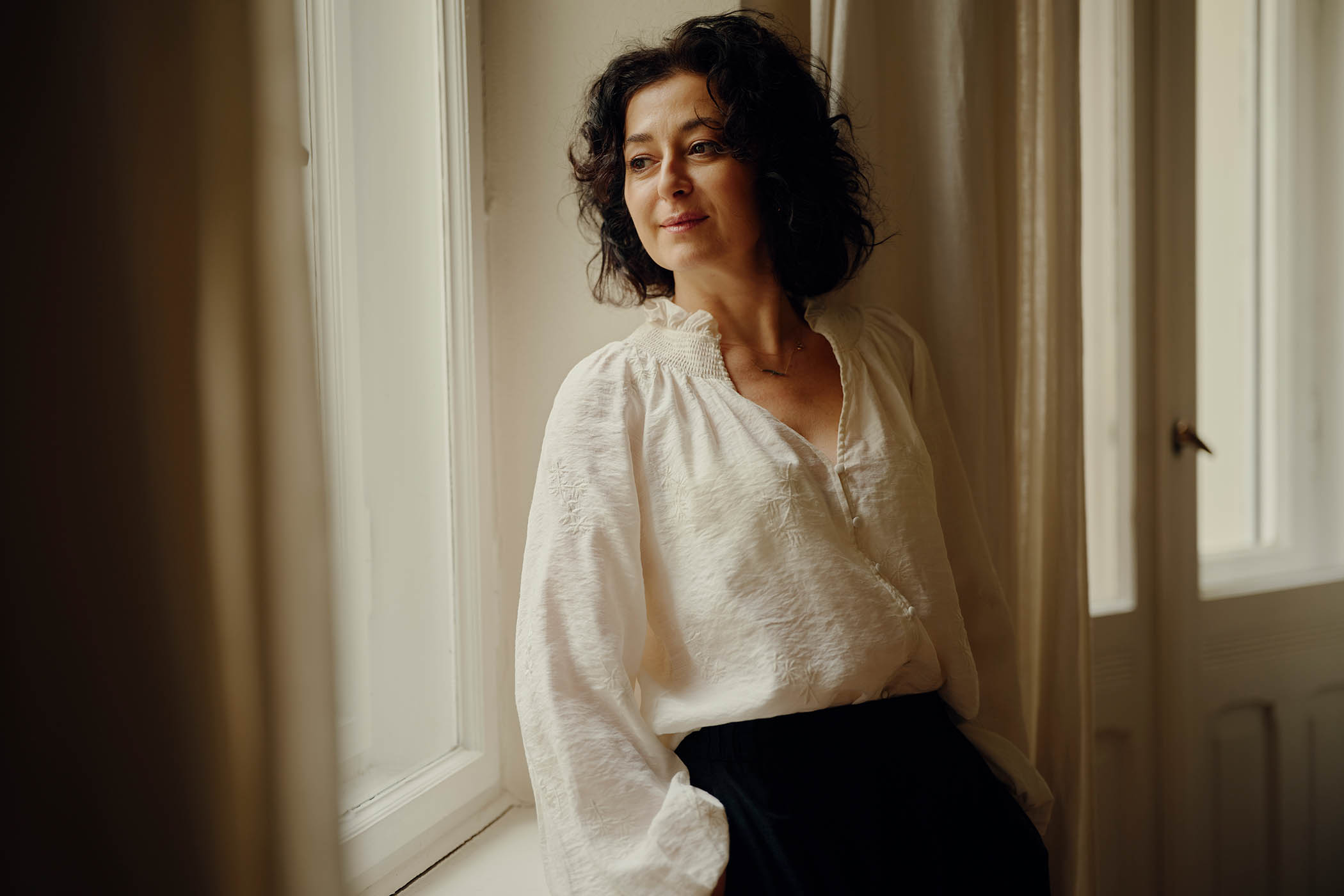

Ece Temelkuran is a Turkish writer, political thinker and activist. She has written two novels, Women Who Blow on Knots and The Time of Mute Swans, but is best known for her political nonfiction. In 2019, she published How to Lose a Country: The 7 Steps from Democracy to Dictatorship. It was the first book she wrote in English following her decision to leave Turkey after learning that she was in danger of being arrested for criticising the authoritarian regime of President Erdoğan. Together, an exploration of how to counter the global rise of fascism, was published in 2021. Her new book, Nation of Strangers: Building Home in the 21st Century, longlisted for this year’s Women’s Prize for nonfiction, charts her personal experience of becoming “unhomed”.
In Nation of Strangers, I found it intriguing that you use the word ‘unhomed’ rather than ‘exiled’ to describe your experience since you left Turkey in 2016.
I think there is a certain romantic exoticism attached to the word “exile” that I am deeply suspicious of. In my case, it lends itself too easily to a narrative in which I am this exotic damsel in distress fleeing from a tyrant and finding a refuge in the civilised west. That story makes people feel good about themselves even if their own home country is in political turmoil. So, in the book, I wanted to make it clear that, whenever I speak about myself, I am also speaking about the human condition – and not just as it is experienced by refugees and immigrants.
What I want to get across is that, even if you are living in your own country, and in your own house, you are already in danger of losing your home morally, politically, spiritually. You just need to look at Trump’s America to see that this is already happening. In terms of the old world we knew, there is no going back to what was before.
For all that, the book does give the reader a profound sense of what it is like to find yourself suddenly unmoored from home and all you once took for granted.
Well, the actual loss of home does something strange to your brain. It splits the self in two and you numb yourself in order to be able to survive that fracture. Also, your sense of time becomes problematic because you feel like you are in a state of constant waiting. You tell yourself that the good days will come again and you will be able to live as you did before, which is what many of us want to believe. I think it is becoming clear that is not going to be the case. Even in Davos recently, they finally admitted that the old world order is no longer relevant.
When Brian Eno hosted an event with you recently, he said you were the first person to use the f-word – fascism – to describe what was happening, rather than terms like alt-right or extreme right.
Well, I’ve been going around like a Cassandra for the last 10 years, telling people that fascism will come to them in the west. I don’t understand why people needed to see that guy from ICE [US border patrol officer Gregory Bovino] wearing an actual Nazi-style uniform to recognise that what is happening is fascism. People – usually establishment white men – constantly ask me why I use the word, and my answer is: “Why don’t you?” The reason people don’t call it fascism is because once you recognise it as such, you have to do something about it.
Nation of Strangers takes the form of a series of letters from one stranger – you – to another: the reader. Why did you choose to structure it that way?
First of all, I really believe that we can start to build our new political, moral – and even actual – home with words. I think we should begin this big conversation by asking: what have we lost? And, more importantly: what kind of world do we want to build? In a way, I see Nation of Strangers as a kind of whisper amid all the noise of the current moment. I’m saying we need to be humble, but also to have faith in ourselves in order to make a big leap away from the pervading cynicism of these times. For that to happen, we will have to learn to live on the kindness of others, the kindness of strangers.
Newsletters
Choose the newsletters you want to receive
View more
For information about how The Observer protects your data, read our Privacy Policy
The term ‘stranger’ is an interesting one, not least because in May 2025 Keir Starmer caused controversy by saying that, unless stricter immigration controls were imposed, the UK risked becoming an ‘island of strangers’. Against that, your book reimagines the word in a more positive, and indeed empowering, way.
Well, in terms of talking about foreigners or immigrants, I wanted to turn the tables and say: “Yes, we are strangers, but we are here carrying the most important knowledge that everyone will need very soon, which is the morality of survival. We have lost our homes and we have had to rebuild them. We have learned to live with dignity, while surviving as nobodies.” What I am saying to the reader is: “You will also need this knowledge very soon.” We will have to find new ways of making a home in the world. And, in doing so, we also will need to learn how to stay human. The reason I embrace the term “stranger” is because it is not only about foreigners, it refers to all of us.
The book is interesting, too, for the myriad ‘strangers’ you meet on your travels. At one point, you find yourself being interrogated by Miquel, a homeless man. You write that the conversation caught you off guard ‘in its blunt directness’.
Yes, that was a moment when I thought there really is a language of strangers and that we should all learn to talk in that language. It’s the language of truthfulness: a direct assessment of reality without compromise or embellishment.
But that conversation also brought home to me that I had been living in two spheres: the sphere of intellectual debate, where we constantly debate the world’s problems using a completely different vocabulary; and the sphere inhabited by people who are living the hard reality of being unhomed. The contrast between the two is stark. For instance, no one from the former sphere, except maybe [the Greek economist and politician] Yanis Varoufakis, ever asked me if I had any money. When you meet an immigrant, the first thing they ask you is what is your status and do you have money. It was very strange to suddenly live between those two worlds.
Did your understanding of home alter dramatically while you were writing Nation of Strangers?
It did, yes. For me, home is now less connected to place and more about people. I will give you an example. Berlin is my home now, but over the Christmas period, everybody I knew [there] went somewhere else, mainly back home. So for me, in a way, there was no Berlin at that time. To see home as people makes the idea of home very fragile, but also very powerful. It is also what home is for many of us now, I think.
How to Lose a Country was the first book you wrote in English rather than your native Turkish, and you have been writing in English ever since. How difficult has that transition been?
It’s interesting because English has become a performative language for me. Whenever I speak, whether on stage or off, I find myself performing because I am constantly having to think about the words, the grammar and so on. It’s only with this book that I finally made myself at home in this language and that was important to me, because if you don’t feel at home in a new language, that is almost a schizophrenic existence.
It must have been painful to abandon your native language. Was that not another kind of unhoming?
Well, right now, I’m going through the Turkish translation of my own book and that is such a painful process. When you have built your life on language as a writer, it’s a different kind of pain to somehow break ties with your own language. You wonder, will I ever go back home to my mother tongue?
In the introduction to the book, you write, ‘When our moral values don’t match up to the blunt cruelty of the new world order, we become morally homeless.’ Like the Dutch historian, Rutger Bregman, who delivered the recent BBC Reith lectures, it seems as though you are calling for a moral reset, a moral revolution.
In Nation of Strangers, I’m specifically talking about the point where you decide, how do I survive? Do I survive like an android or do I survive like a human being? Because, if we are not careful, this system can make us inhuman very, very quickly. But there is also another thing I have learnt: when you lose your sense of home, as I did, you feel like beauty becomes a luxury. You think you don’t need beauty, you just need to survive. But as I gradually came to understand while writing this book, beauty – our urge to create any kind of beauty – is the thing that keeps us human when we are trying to survive.
This is crucially important because it is the opposite of the definition of human in neoliberal morality. Neoliberalism tells us that humans are selfish, self-centred individuals, and we can only survive by stepping on each other. Whereas I am saying exactly the opposite: we can only survive by seeing beauty in each other, and creating beauty together.
Nation of Strangers is published by Canongate (£18.99). Order a copy from The Observer Shop for £17.09. Delivery charges may apply
Portrait by Robert Rieger for The Observer