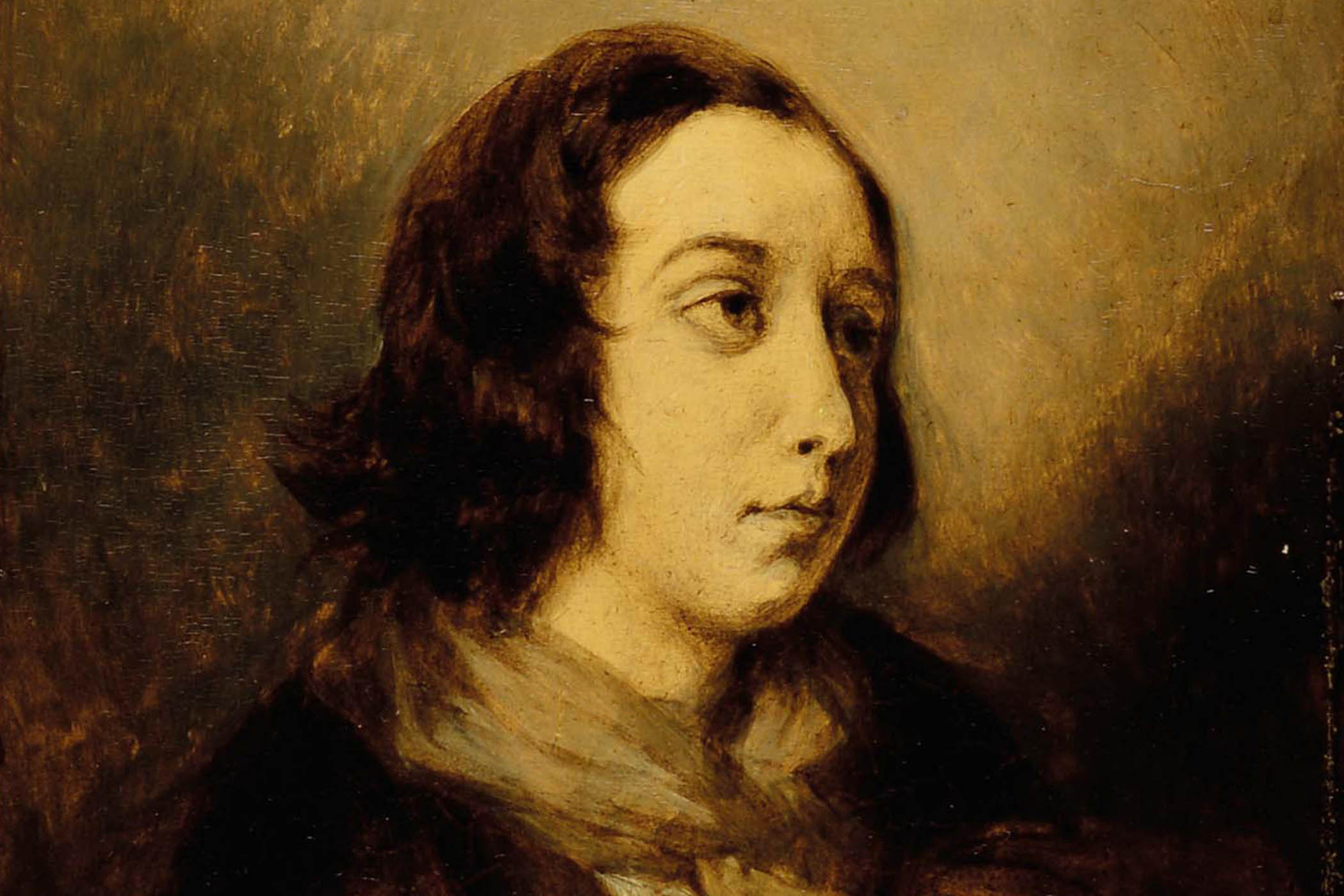



George Sand exploited and tested the possibilities offered by her turbulent century more vigorously than perhaps any other woman of her times. She’s best known now for her choice to wear men’s clothes and wander the streets of Paris at night in ways that were inconceivable for aristocratic women in 1830s London. But this was just part of a much larger, astonishingly casual assault on convention that was possible because she emerged into adulthood at a turning point between two worlds and understood exactly what this meant.
She was born Amantine Lucile Aurore Dupin in 1804, into a high-bourgeois French world that gave her all the certainty of inherited authority. She used this to claim the new freedoms opening up both in bohemian radicalism and in the new republican, egalitarian politics that were on the move in 1820s and 30s France. She was the apotheosis of the romantic female novelist, writing books that were open about female desire and that claimed the right of women to love where they chose. She was also a jobbing newspaper hack; within weeks of deciding to write, she had a column and a desk at Le Figaro, jostling alongside the male reporters as they competed for column inches. “I claim to possess, today and forever, the superb and complete independence which you alone believe you have the right to enjoy,” she informed a male correspondent. “So take me for a man or a woman as you wish.”
Sand had a succession of open affairs with younger men, as well as with a woman, and she engaged, just as radically, in sexless but fervent and absolutely equal friendships with many of the prominent men of her day. She was a passionate mouthpiece of the 1848 revolution, who then – always a pragmatist as well as an idealist – became an adviser to Napoleon III on how to make peace with the cultural establishment. She was the ultimate romantic traveller, throwing herself into landscapes and the drama of traversing them. She rode for thousands of miles astride a horse on the most dangerous precipices of the Pyrenees and walked for miles along the river Indre, plunging in and swimming in all her clothes when she got too hot. And she managed, uniquely for her times, to win custody of her children as a known adulteress. In Fiona Sampson’s stylish and insightful new biography, she is presented as the ultimate self-inventor, an icon for our era of Instagram and performed identity. “One of the boldest precursors of that perhaps final hope modernity holds out: that we might choose what we become.”
Sampson’s biography is concentrated on Sand’s years of becoming. She tells the story of the young Dupin’s education at the hands of her revolutionary aristocrat grandmother and the teachers at her convent, and of the early marriage to Casimir Dudevant that made her a mother but revealed the constrictions of bourgeois life with an ill-matched mate, leaving her ready to make the transformation into George Sand when she began publishing as a journalist and novelist. From here, Sampson charts Sand’s rapid ascent from enfant terrible to grande dame, which left her with a stature unimaginable in literature today. “Her name will live in unique glory as one of the great figures of France,” her friend Flaubert wrote after her death.
Sampson alternates narrative chapters and improvisatory interpretative “impressions” with something of the complexity that Sand herself brought to the drama of her own becoming. Sampson examines images and portraits of Sand, skilfully teasing out their hidden meanings. This is all part of her larger attentiveness to the cultural scene surrounding Sand; Sampson moves fluidly between literature, fine art and music. She’s especially good on the music of Sand’s most famous lover, Frédéric Chopin, which she describes as “deferring and modulating gratification for all the world like a sexual tease”.
She was the ultimate romantic traveller, throwing herself into landscapes and the drama of traversing them
She was the ultimate romantic traveller, throwing herself into landscapes and the drama of traversing them
Sampson writes with snazzy, often anachronistic prose, so that an image can be described as “very dykey” and Sand goes from “disappointing teenager” to “yummy mummy”. She surveys Sand from a social distance, rather than inhabiting the world alongside her, which allows for brisk, deliberative judgments of a kind I sometimes quailed from, being perhaps more disposed to identify with Sand. “This is graceless stuff,” Sampson writes when Sand issues her husband an ultimatum: change or the marriage is over. “It’s hard not to feel some impatience with George at this point,” she says when, exhausted by nursing her debilitated drama-queen lover Alfred de Musset, Sand gets together with his more practically capable doctor. “Despite her experience of being pilloried by gossip, she still doesn’t seem to realise that she is her own worst advertisement.”
Becoming George brings out the brief optimism of the marriage with Casimir, arguing that the early years weren’t as bad as other biographers have suggested. And Sampson is convincing on the hopelessness of Sand’s relationship with Chopin, suggesting that he may have been a homosexual all along – a possibility that Sand perhaps avoided acknowledging by fixating (with very little evidence) on the idea that Chopin was in love with her own daughter when they split up.
When faced with a life as vast and as resonant as Sand’s, we all bring our own preoccupations. Mine is with Sand as a mother, and I wished that Sampson could grapple more with the odd extremities of Sand’s love and carelessness when it came to her two children. One of the great tragedies of Sand’s life was the death of her granddaughter, Nini, as a result of Nini’s father’s neglect during a custody battle that he fought as a blatant assertion of power rather than an offering of paternal love. Sand was so destroyed by this death that she didn’t think she could write again. “She carried away with her so much of my being that I do not know what is left to me, and I have not yet had enough courage to make the examination,” she wrote. Sampson makes little of this tragedy.
What kind of case can we make for Sand’s work now? She wrote so many novels that it can be hard to identify any as standout masterpieces, but the greatest come in two phases. There are her 1832 debuts, Indiana and Valentine, which bring a unique combination of realism and idealism to the depiction of contemporary marriage, diagnosing women’s predicament and offering a better version of the world as something between a consolatory ideal and a call for radical change. And then there are her great, subtler and more casual 1840s novels of rural life in the Berry region, where Sand grew up and which remained her base and centre. In Sampson’s account, these are parables that construct a new moral vision that simultaneously interrogates and upholds community.
Sampson reminds us of the importance that François le Champi will play in Proust’s À la recherche du temps perdu, where Sand’s novel comes to represent a whole lost ideal of innocence and maternal love. Proust read and reread Sand’s fiction throughout his life, and Sampson’s vivid and innovative biography will hopefully send a new generation of readers to Sand’s work to grapple as he did with her combinations of audacious modernity and old-fashioned storytelling.
Lara Feigel is the author of Custody: The Secret History of Mothers (William Collins)
Becoming George: The Invention of George Sand by Fiona Sampson is published by Doubleday (£22). Order a copy from The Observer Shop for £18.70. Delivery charges may apply
Etching of George Sand dressed in men’s clothes in 1834 by Heritage Image Partnership Ltd/Alamy
Newsletters
Choose the newsletters you want to receive
View more
For information about how The Observer protects your data, read our Privacy Policy