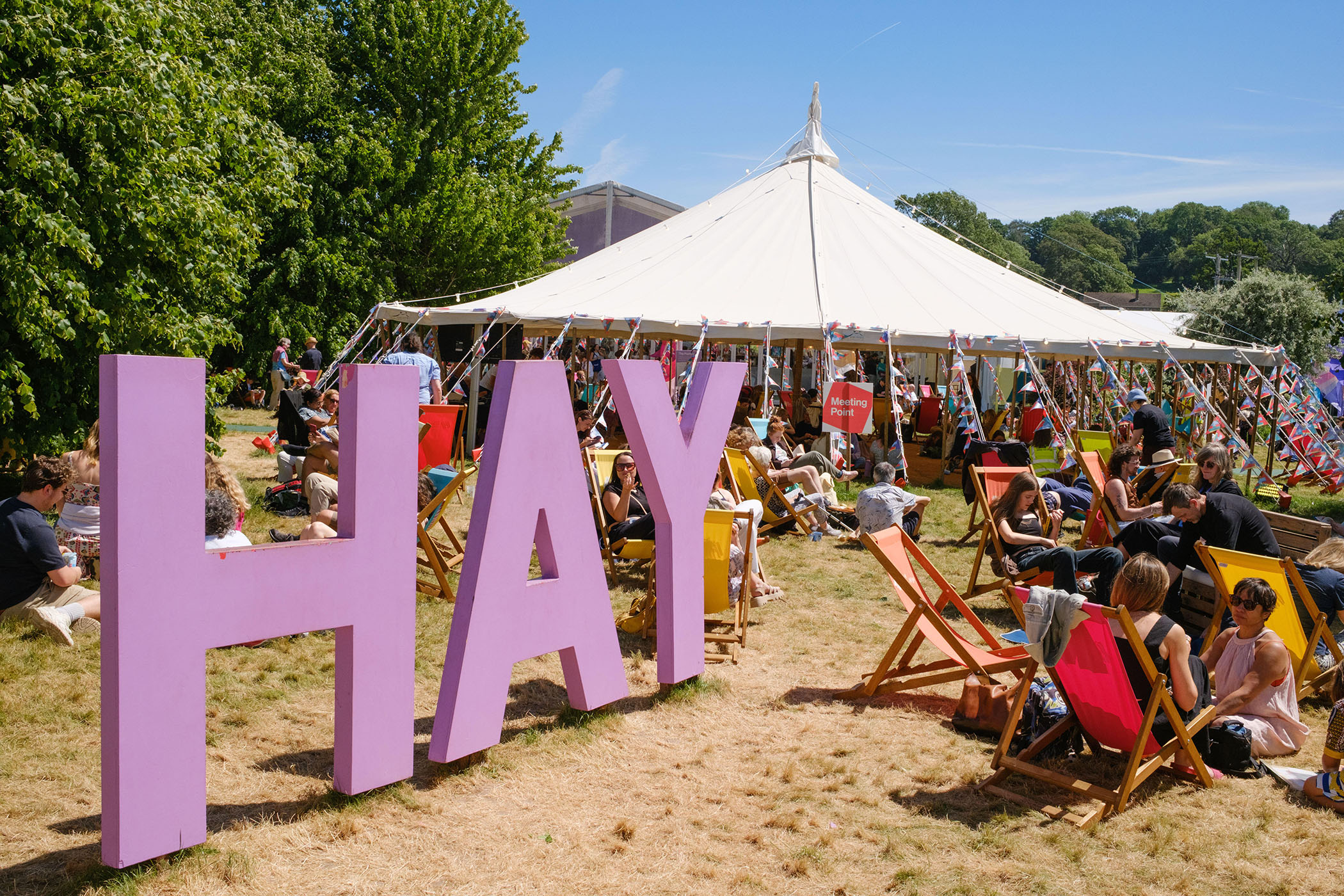
Photograph by Sophia Evans for The Observer
In the summer of 2024, the British literary festival scene seemed on the brink of collapse – or at the very least, in the middle of an existential crisis. Between late May and early June, nine book festivals – including Hay, Cheltenham and Edinburgh – announced the end of their partnerships with investment manager Baillie Gifford, a large book industry sponsor, after a year of protests over its links to Israel and fossil fuel companies.
In the preceding months, a movement had grown among authors and publishing professionals that called into question the industry’s reliance on Baillie Gifford, which also sponsors the UK’s main nonfiction prize. A writers’ collective, Fossil Free Books, emerged. It encouraged authors to boycott festivals with links to Baillie Gifford and published open letters – signed by hundreds of authors, including Sally Rooney, Naomi Klein, Zadie Smith and Ali Smith – urging the company to divest funding away from what it considered unethical investments.
The problem, of course, was money. The nine festivals that received sponsorship from the company were clear: they could not rely on public funding to survive; they needed private investment – and Baillie Gifford offered it. As Nick Barley, then director of Edinburgh book festival, argued: “We wouldn’t have enough funds to operate without private sponsorship. We looked very closely at the work of Baillie Gifford and it seems to us that they are in fact investing in companies that are seeking to resolve the [climate] crisis.”
Baillie Gifford denied it was a significant fossil fuel investor, stating that 2% of its investments were in business relating to fossil fuels, compared with a market average of 11%. But after months of protest and media speculation, the investment manager withdrew its funding. Nine festivals suddenly found themselves without the money they had said they couldn’t survive without. Where could they go from here?
“The whole period was awful because you thought it was going to bring you down,” says Fiona Razvi, chief executive and director of Wimbledon BookFest, one of the events Baillie Gifford sponsored.
The remarkable thing is that, two years on, it hasn’t.
“Last year was actually the biggest return post-pandemic, but also an increase on pre-pandemic,” she adds, something she puts down to the sponsorship debacle and the conversations that surrounded it in the aftermath. “There was a real concern – people didn’t want to lose [festivals].” But since then, the challenges and thrills of running a festival in this economic climate have continued as usual. “I would say we’re not living in the shadow of Baillie Gifford at all now.”
It has been a similar story elsewhere, including at Cambridge literary festival, whose chief executive and artistic director, Cathy Moore, says that last year’s winter event was an “epic”, with 86% of tickets sold – “probably our biggest capacity ever”. At the spring edition in April, for the first time, the festival moved into a larger venue, the city’s 666-capacity Arts Theatre, selling out events with Jung Chang, Elif Shafak and Zadie Smith.
Meanwhile, Hay festival issued 210,000 tickets for this year’s event, which took place in May; 5% more than in 2025, which was already 9% up on 2024. “We’re very pleased with ticket sales and how they’re holding,” says Julie Finch, the festival’s chief executive. “Hay is still hugely valued by our audiences. Ultimately, we are looking at growth – more bums on seats.”
Newsletters
Choose the newsletters you want to receive
View more
For information about how The Observer protects your data, read our Privacy Policy
It’s good news for festivals, authors and readers alike. But, after the furore of 2024, it feels anticlimactic. As the author Max Porter said in his Pen lecture in April: “When writers correctly and calmly suggested a festival funding model could be found without the support of hedge funds explicitly profiting from fossil fuel and military investment, weren’t we mocked, attacked, ridiculed; weren’t we told we were ruining the lovely, sweet egalitarian fairytale innocence and sweet, wine-sloshing delights of book festivals for everyone? But [...] didn’t the festivals have their most successful year ever last year, because, of course, change is possible?”
Mohamed Tonsy, an Edinburgh-based writer and bookseller who is an organiser with Fossil Free Books, says that Baillie Gifford cutting ties with the festivals was “a victory of solidarity and freedom of speech over corporate capture of important literary institutions”. That the festivals have had their most successful events without the investment manager shows “that public funding was always possible”, he adds, referring to the £300,000 grant that Edinburgh international book festival received from the Scottish government last year.
The organisers acknowledge that the Baillie Gifford affair significantly changed proceedings. Razvi explains that most literary festivals – which typically operate as charities – receive about 50% of their revenue from earned income, such as ticket sales, and 50% from grants and sponsorships. In 2024, sponsorship made up 15% of Wimbledon BookFest’s income, and Baillie Gifford’s contribution was about a quarter of that. “Our funding model wasn’t dependent on Baillie Gifford,” Razvi says, “but what they had given us was a two- or three-year commitment – continuity in our financial model.”
So, since 2024, festivals have had to make up the shortfall, as well as find ways to keep up with other rising prices. Razvi reduced costs by moving the event away from a marquee “village” site on Wimbledon Common to hired buildings in the town centre, by becoming the sole permanent member of staff (hiring others on a freelance basis for the busiest times of the year) and by introducing more differentiated ticket pricing.
In Cambridge, Moore increased general ticket prices from £14 to £17, but kept concessions at £10. “And we’ve doubled down on fundraising,” she says. “We’ve managed to cover the loss by picking up a couple of other partners and sponsors. We’re over the shock and in a steady state, but you’re only as good as your last festival.” And, she says, new sponsors are now trickier to come by, after seeing the public knock that Baillie Gifford suffered. “It’s made people more cautious.”
But one organisation has been willing to step in: the Hawthornden Foundation, a private charitable foundation based in the United States, which has filled the Baillie Gifford-sized hole in the nine festivals’ accounts. It was established by Drue Heinz (1915-2018), a British-born American actor and arts patron, who was the publisher of the Paris Review and the co-founder of Ecco Press; her third husband was HJ Heinz II, heir to the Heinz food company fortune.
The foundation also funds writers’ retreats and the annual £25,000 Hawthornden prize for “imaginative literature”. Its mission is vital, says its executive director, Ellyn Toscano, because literature “is a regrettably underfunded, undersupported sector, even as compared to other arts organisations. In the UK, it gets 3% of cultural funding.” Evidently much needed, the Hawthornden endowment is designed to support literary ventures “in perpetuity”, Toscano says. Fossil Free Books is yet to release a public statement on the ethics of its funds.
Despite all the brouhaha, the Baillie Gifford saga brought important questions about the future of literary festival funding to the fore. Razvi says organisers “are now working more collectively as a sector to work out: how does the arts articulate its value?”
To regular attendees, the value is clear: festivals offer readers a way to come together to better understand our tumultuous world. “People want in-person contact,” says Finch. “They want to be in that community space with other audiences, listening and experiencing and gaining a deeper view of the world.” Festivals, to this end, are “absolutely vital to understanding our futures”.
She adds that there is also a social value, key to the mission of literary festivals, that is often overlooked. “One in five children don’t have books at home, let alone visit festivals. So the work we are doing with those children – bringing them to the festival for the first two days, working with them year round – is vital for social inclusion.”
The Arts Council offers support to some festivals, but it is irregular and certainly not widespread. “We really need the government to understand that, without this glue, parts of society begin to fall apart, and the economy is damaged,” Finch says. “Ultimately, core funding to literature festivals is needed because the work we are doing is supporting the social cohesion agenda.”
On this point, everyone is in agreement. “If we want festivals and the books industry to thrive into the future, then state funding is the best way forward,” says Tonsy, “with the option of diversified private sponsors that meet an agreed ethical policy.” He argues that public money protects freedom of speech, and is more trusted because with it comes an accountability that does not exist to the same degree in the private sector. “Public funding is subject to the democratic process.”
For now, the festival directors’ mission to make the government realise the benefits of investing in literary festivals continues. And Fossil Free Books has shifted its focus within the publishing sector. “Building worker power through unionising [is] a top priority, as this is our best route to effecting wider material change across our industry, whether on author pay, AI or divestment,” Tonsy says.
Fossil Free Books might have had a quiet couple of years since 2024, but these organisers are not done yet.
Additional photograph by Richard Downs/Alamy