
Related articles:


In September 1982, the cartoonist Garry Trudeau announced he was taking a break. His four-panel comic strip, Doonesbury, which ran six days a week in more than 700 newspapers mostly in the United States (and the Guardian here), would go on hiatus from the following January until September 1984.
It was the end of one era and the beginning of another. Since 26 October 1970, Trudeau’s scratchy cartoons had chronicled the rise of liberal America. In what he has described as his first wave, his cast of characters lived a version of what many young Americans experienced – university, the draft, peace protests – against a background of the war in Vietnam, Nixon, Watergate and their country’s impending bicentennial celebrations.
Mike Doonesbury (a version of Trudeau himself), BD the star quarterback, Mark Slackmeyer the radio radical, Zonker Harris the ageless hippy and Joanie Caucus the proto-feminist all had established roles by the time their creator won the Pulitzer prize for editorial cartooning (the first comic-strip artist to do so) in 1975. By then, many newspapers had moved Doonesbury from the comics page to the comment section.
Doonesbury’s second wave recorded the election of a Democrat, Jimmy Carter, to the White House and the decline and swift fall of that administration. It was followed by the ascent of a Republican, Ronald Reagan, whose rightwing politics could hardly have been less appealing to the cartoonist. Perhaps that’s why he announced the hiatus. In any case his personal life was changing, with marriage to the brilliant television presenter Jane Pauley and then the arrival of twins.
Trump’s ascent to the presidency, not once but twice, represents something of a personal reproach to Trudeau, who had always been stumped by his hair
Trump’s ascent to the presidency, not once but twice, represents something of a personal reproach to Trudeau, who had always been stumped by his hair
By the time he returned, just in time to cover Reagan’s landslide second victory in the 1984 election, both the tone and appearance of his strips had subtly changed. There were now closeups and silhouettes, daring changes for an artist whose drawing was often criticised by his fellow cartoonists. The syndication numbers rose to 776 newspapers. And there seemed to be a greater authorial interest in the development of his characters, who had now grown up and left university or the army or the commune to engage with the real world. Doonesbury became a sort of Dickensian epic, with the lives of its fictional characters mingling freely with actual events and public figures.
As the big, controversial issues – politics, abortion, wars, race, gay marriage – played out, they began to affect Trudeau’s characters directly. Andy Lippincott, who had come out in 1979, contracted Aids and in due course died; BD, veteran of Vietnam and the Gulf and Iraq wars, lost a leg and suffered PTSD; Joanie broke through a wall of sexism and ageism to become a lawyer; Mark realised he was gay. Rick Redfern, a fictional Washington Post reporter, lost his job as newsprint gave way to digital publishing. Several characters died, others had children. Some got rich, others did not.
Trudeau himself came from a privileged background: private school, then Davenport College, Yale, and he avoided the draft thanks to advice from his father, a distinguished doctor. Success came swiftly. His first syndication contract in 1969, when he was just 20, paid him the equivalent of $1,800 a week. Within six years that rose to $12,000 a week. He also retained copyright and the 60 or so anthologies and collections of his work are said to have sold seven million copies.
Newsletters
Choose the newsletters you want to receive
View more
For information about how The Observer protects your data, read our Privacy Policy
Joshua Kendall’s biography is not authorised but clearly has the cooperation of its subject. Trudeau’s life has been a charmed one. From the start, he showed scenarios considered so taboo – an unmarried couple in bed, for example, or a character coming out – that his strip was dropped by newspapers. He never backed down when it might have been easier to retreat into his own prosperous world. The only real personal sadness visible in these pages is the mental illness suffered by his wife, but she has recovered and their marriage has survived.
Related articles:
There is much to admire in this book, especially for Doonesbury devotees. Many of the characters were clearly modelled on real people, friends and acquaintances, who are identified here. And if there is a whiff of cosiness in his account – Kendall, too, is a “Yalie” – there is also much that is new and revealing.
In 2014, Trudeau stopped the daily cartoons but his weekly colour strips on Sunday continue. Throughout the years, the cartoonist, a satirist in the tradition of Swift, has been acknowledged for good or ill by all the US presidents he has covered, from Nixon to Trump. The latter has been appearing – reluctantly no doubt – in the strip since 1987 and his ascent to the presidency, not once but twice, represents something of a personal reproach to Trudeau, who has always been stumped by Trump’s hair. “It’s an unknowable triumph of weaving, lacquering and taxidermy, and I’ll never quite get it right,” he admits. Trump’s view of Trudeau: “Mediocre at best.”
Trudeau & Doonesbury: A Biography – The Cartoonist Who Turned the News into Art by Joshua Kendall is published by Abrams Press (£26). Order a copy from The Observer Shop for £23.40 (10% off RRP). Delivery charges may apply
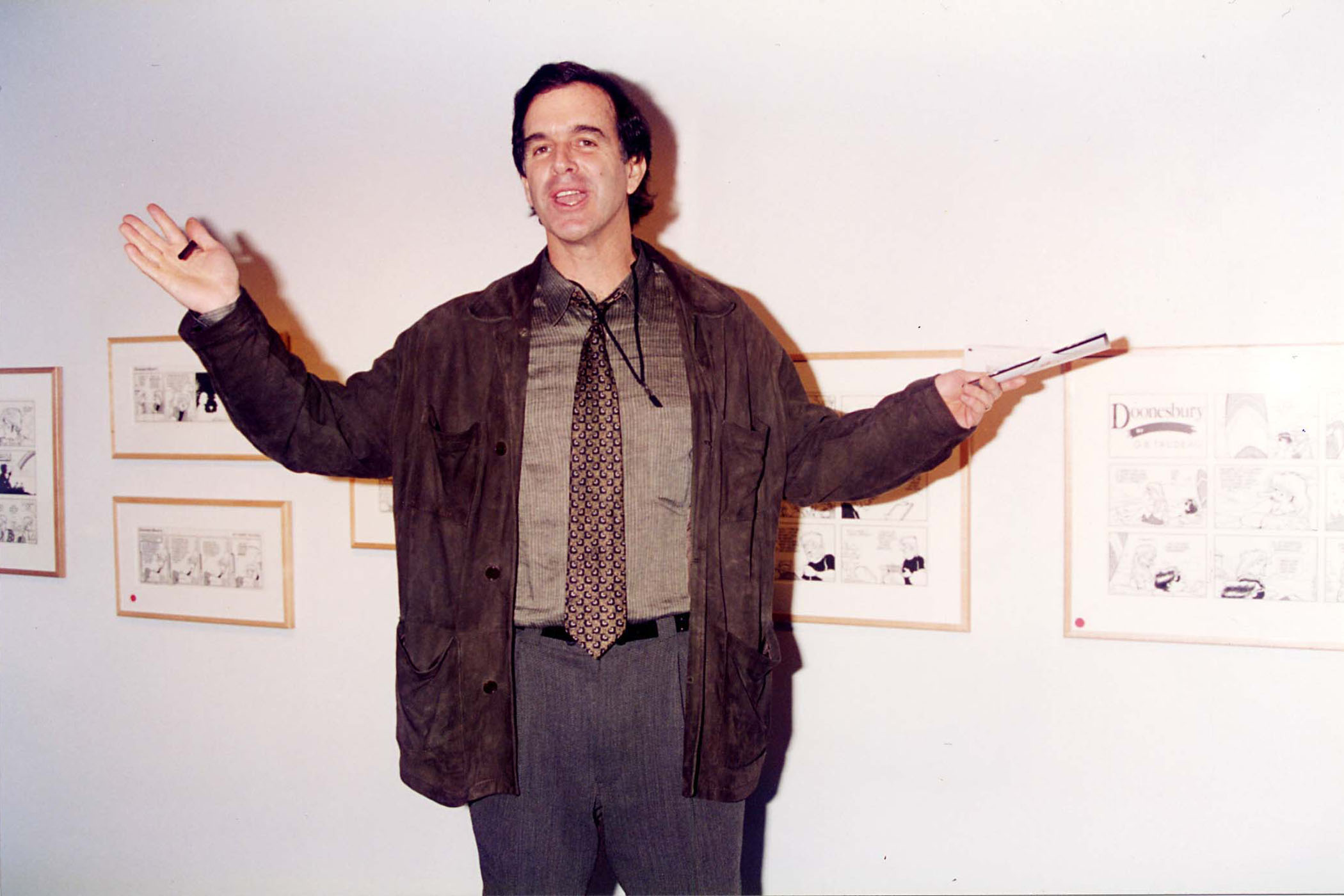
Photograph by Jeff Kravitz/Film Magic Inc