It is as if a giant switch has been thrown under the stage. Everything in The Oresteia – like everything in all productions written and directed by Simon Stone – moves to a distinctive, disruptive rhythm.
Stone, who 10 years ago created a memorable Yerma, starring Billie Piper, and three years ago, a phenomenal Phaedra with Janet McTeer, works plastically, perilously, beginning without a fixed text and action, building them in the course of rehearsal, changing things up to the last moment. The result is an electric immediacy.
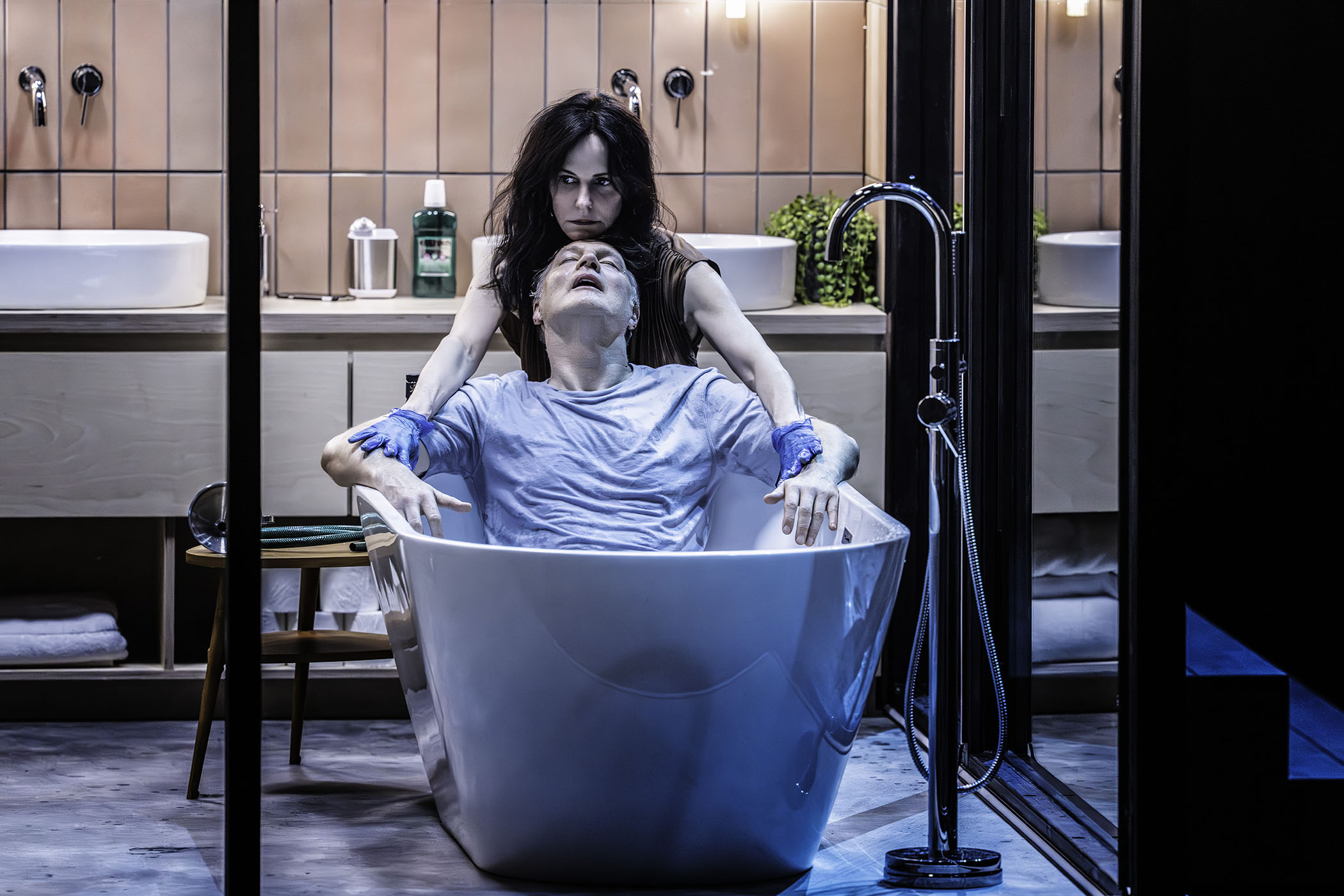
The unsettling begins before a word is spoken. The stage is encased in a huge transparent box; so regular a feature of Stone’s stagings that it gets a nod in the National Theatre’s production of The Misanthrope. Handsomely, tellingly designed by Lizzie Clachan, it revolves slowly to reveal the different parts of a sumptuous 21st-century house: chic bedroom, bathroom, stairway, well-appointed kitchen. It lets in the light but proves a tinderbox for the characters. David Morrissey, the patriarch of the family, walks silently through the rooms – against the direction of the revolve. Pacing against fate.
This Oresteia opens halfway through a tangle of intensely realistic overlapping family dialogue: father grandstanding, mother lashing out, daughter imitating the grandstanding. The first word is “dishwasher”, not celebrated as a quote from Aeschylus, but then this production is more a response to the Greek trilogy than a version: Stone describes it as “after Aeschylus & others”.
There is no chorus. The dynamic of revenge killings in a family is unchanged. The same people end up dead, but they do so having used burner phones and emojis, fought in Afghanistan and enabled the supply of arms in unsavoury wars. Pilates and Uber are mentioned, sounding like minor characters. It is hard to know what significance to attach to the family’s name: Middleton.
This is a giant undertaking, running to more than three and a half hours – all in the glass box set. Stone has torn up the chronology, flipping back and forwards, with the years – 2016 to 2026 – flagged up in neon. The structure echoes the content, summed up eloquently as dismembering and remembering.
There are patches of confusion but the evening is driven by a double compulsion: that of a thriller-like uncertainty and a grand inevitability. Some reinventions are improvements. It is hard always to make the death of Iphigenia (here called Isabel) convincing, though perhaps those with a Christian faith have less trouble than I do. Ingeniously, she is here not actually put to death by her father but driven to kill herself by his betrayal: he sacrifices her on the altar of his public pride.
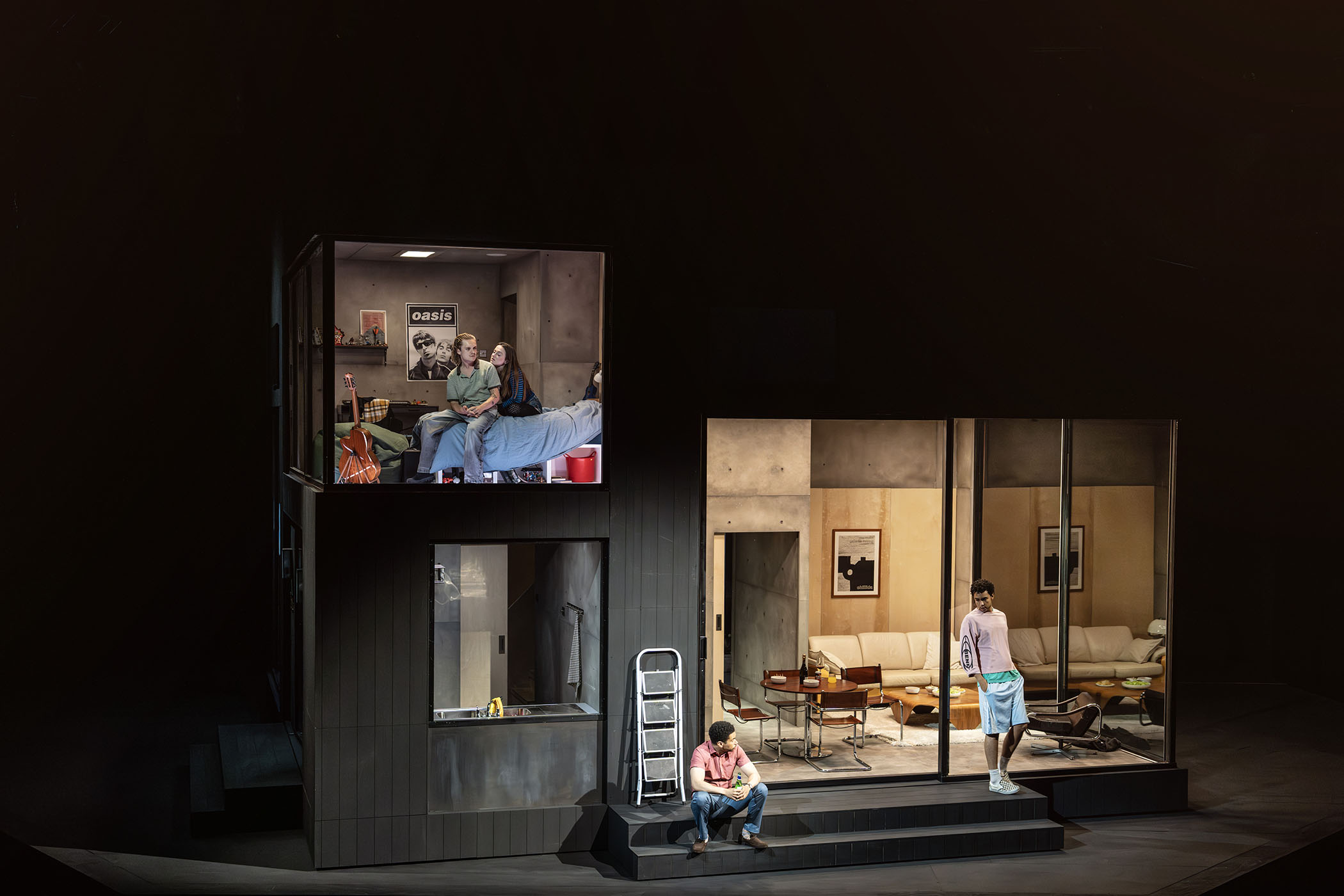
The stage revolves slowly to reveal the different parts of a 21st-century house
Hard to imagine this better acted than by this cast, elaborately interconnected yet each completely distinct. Morrissey has been away from the stage too long. He is as thunderous as he is on screen: storming and tearful, always looking as if he is being filmed in monochrome. He manages to make an audience, though yards away, see his face – rueful, melting – as if in close-up. As Isabel’s less noticed twin sister, “adequate Alice”, Rosie Sheehy does a tremendous takeoff – roaring voice, fighting stance, Liverpool accent – of her domineering dad; one of the moments that makes it clear early on that this is an anti-patriarchal drama.
Sheehy first took my breath eight years ago, as a furious teenager in The Whale at the Ustinov in Bath. She is at her varied best here: funny and raging, benefiting from some strongly written speeches as she tries to wrestle herself out of a miasma, “waiting for the fog to lift”. As her murderous, sharp-tongued mother, Mary-Louise Parker is outstanding: dreaming of flight, planning revenge, she becomes like a raptor – stretching her arms as though they were angular wings.
It is 11 years since Robert Icke shook the dust off The Oresteia with a mesmerising production at the Almeida. Now Stone proves the multiple force of the drama again: the way public life presses on the private, the way everyone in a family fights for a place. Tom Glynn-Carney is a whipped-to-the-bone modern equivalent of Orestes, John Macmillan a fine, vain boyfriend. The costumes created by Emma White do some neat satirical work. Archie Madekwe (teal designer suit) skilfully dispenses lolling youth contempt.
Newsletters
Choose the newsletters you want to receive
View more
For information about how The Observer protects your data, read our Privacy Policy
There are flaws: the not always knowing where you are, and a ridiculous pop-up medieval knight. The action hovers always on the edge of melodrama and does not need tempting over. Yet there is no feebleness. Like the murderous assaults described by Orestes, the evening strips and flays, and rips and tugs.
The Oresteia is at Bridge theatre, London, until 19 September