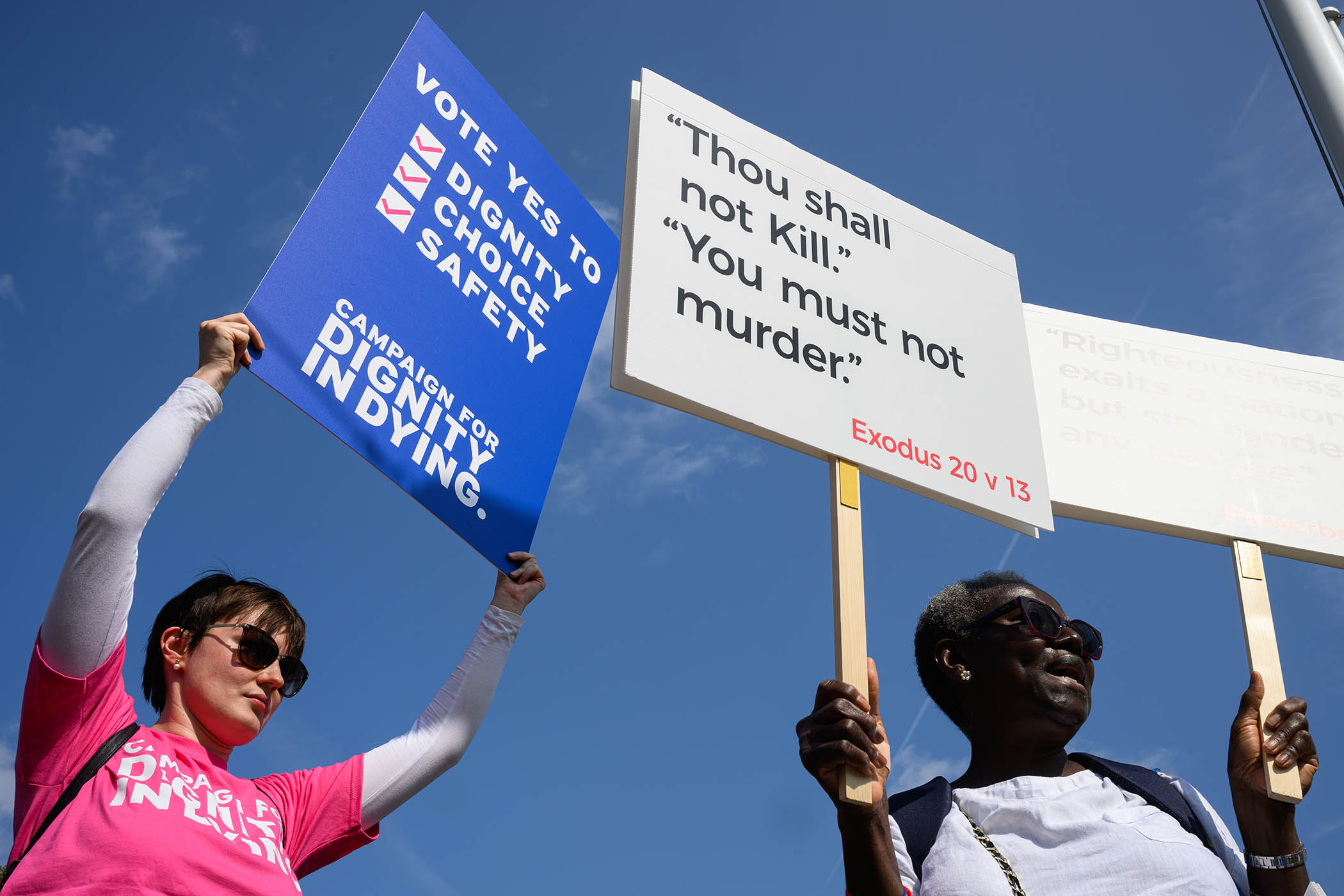



Like too many current political debates, the arguments around Kim Leadbeater’s Terminally Ill Adults (End of Life) bill were presented in starkly polarising terms before it ran aground in the Lords last month. It’s not just that both sides saw the other as wrong, but effectively as handmaidens to evil. In this emotive rendering, opponents of the bill become supporters of torture, and its proponents endorsers of murder: two mutually reinforcing tribes of inflexible moral certainty.
Few have more intimate experience of the dangers of impassioned groupthink than the philosopher Kathleen Stock, who was hounded out of the University of Sussex for expressing gender critical views. In Do Not Go Gentle, she seeks to expose the philosophical underpinnings of the assisted dying argument, the better to show its practical flaws.
It’s a promising approach, full of learned references, that is needlessly compromised by her simplistic characterisation of supporters of assisted dying, or as she prefers, assisted suicide. According to her, they fall into two conflicting archetypes: the Freedom Lover and the Merciful Helper. The first represents those in favour of personal autonomy who see suicide, assisted or otherwise, as a form of self-determination. The second epitomises the interventionist instinct, the belief in a paternalistic state ever-vigilant to its responsibility to ease suffering.
Stock maintains that these archetypes are not just contradictory but lead to confused thinking and bad law. That may well be true, but because these categories are Stock’s own inventions, it’s hard to gauge their real-world relevance. The views she ascribes to them would no doubt be rejected by her targets.
Who among the Leadbeater bill’s leading proponents, for example, believes “that any individual who asks for help to die should just be given it” (Freedom Lovers)? And are their ranks crowded with people who are “uninterested in thinking about less drastic alternatives to death” (Merciful Helpers)?
Stock raises many salient points. The understanding that some lives are suitable for termination is likely to affect how we value life itself. The bill takes as a given a high-functioning NHS and legal system, when in fact both are already struggling at the limits of their capacity.
She can be an entertainingly caustic writer, as when she wryly notes the proliferation in recent years of the word “dignity” among assisted dying activists. In this country, pressure group the Voluntary Euthanasia Society, briefly known as Exit, became the far more euphonious Dignity in Dying. There’s also Death With Dignity in the US, Dying With Dignity in Canada and, of course, Dignitas in Switzerland. The word, writes Stock, is a “big rhetorical hitter” but a nebulous concept that is seldom defined. “People are usually more able to identify a loss of dignity than the possession of it.”
Kathleen Stock wryly notes the proliferation in recent years of the word ‘dignity’ among assisted dying activists
Kathleen Stock wryly notes the proliferation in recent years of the word ‘dignity’ among assisted dying activists
Such incisive observations serve to increase the disappointment that she has resorted to straw man tactics. There is enough muddled thinking by real people to focus on without having to construct crude caricatures.
Take, for instance, Jonathan Romain, the former chair of Dignity in Dying, and a rabbi, broadcaster and the author of A Better Death. Or Esther Rantzen, the doyenne of assisted dying supporters, who provides his foreword. Rantzen tells us that at the age of 82 she received a diagnosis of stage four lung cancer. She says that she encouraged Keir Starmer to commit to allocating time to a private member’s bill on assisted dying, and that she didn’t think that she’d be around to hear the debate. The subsequent bill was backed by MPs but ran out of time in the Lords after more than 1,200 amendments were tabled (thought to be a record for a private member’s bill). Its supporters aim to resurrect the legislation in the next session of parliament, but as the bill stands it is restricted to those who are estimated to have six months or less to live.
As Rantzen has discovered, three years on from her diagnosis, life expectancy is not always easy to estimate. Ignoring this fact, she confides that for her and her late husband a swift and merciful death was always preferable to “leaving loved ones with last and lasting memories of us dying in agony”. Romain echoes the point when he writes that families “should be able to look back fondly on their loved one with memories of a life well lived” but that “ghastly images of the person’s final days dominate, and comfort is replaced with guilt”.
Newsletters
Choose the newsletters you want to receive
View more
For information about how The Observer protects your data, read our Privacy Policy
None of this sounds like an argument for autonomy or mercy, unless we’re talking about the autonomy of and mercy for the family. One of the widely expressed concerns of opponents of the bill is, as Romain notes a few pages later, that it would “lead to others feeling obliged to follow suit” out of fear that they are being a burden to their loved ones. He quickly dismisses this idea, insisting that while such feelings are natural, no consequences will stem from them. I’m not sure that I follow. Either the loved ones need to be protected from these ghastly final days or there is no cause to feel a burden. But surely you can’t have both.
A far more nuanced and thoughtful book is Do We Have the Right to Die? by Brenda Hale and Rowan Williams, featuring pro (Hale) and anti (Williams) arguments that acknowledge the strengths of the other side’s position while meticulously identifying its weaknesses.
Lady Hale is a senior judge and legal academic, and it shows in her elegantly constructed argument. Logic, however, is a weapon that is hard to re-holster. Her own analysis leads inexorably to questioning why only the terminally ill qualified in the bill and why there was no specific allowance for physical suffering.
She cites, as does Romain, the disturbing case of Tony Nicklinson, who suffered locked-in syndrome after a stroke in 2005. Although completely conscious, he was unable to speak or move at all, and could communicate only through blinking his eyelid. As his vital organs were in working order, there was no prospect of an imminent demise. Thus he sought a legal guarantee that any doctor who assisted his death would not be charged with murder.
The various court cases went on for many years, but after seven years of unimaginable torment, in 2012 Nicklinson refused food and six days later he died. It was a horrible way to go, but it was the only method of suicide he had open to him. His family continued his fight posthumously but the supreme court ultimately rejected it, while recommending that the government should take another look at the legislation.
Nicklinson would have found no comfort in the proposed law. Under its terms anyone in his position would be refused assistance in dying. In other words, someone who is not in pain or discomfort, but is expected to die in six months, can receive help in cutting that term short. But someone who is utterly immobilised and speechless is condemned to remain in that state until death takes its natural course or through a process of self-willed starvation. The longer the prognosis of being in purgatory, the longer you must remain there.
While Romain acknowledges the moral inconsistency of this stricture, his stance is not to make the perfect the enemy of the good. It’s this kind of pragmatism that makes opponents of the law suspect that, once passed, it will open the way to further amendments and more extensive qualification. As Hale admits, to accept that something is better than nothing “is to reinforce the ‘slippery slope’ arguments of those who oppose any change in the law”.
That hasn’t always happened in jurisdictions that have adopted similar laws (Oregon is cited as the prime example), but it has in some (Canada and the Benelux countries). What is inevitable, as Williams delicately argues, is that establishing assisted death as a “right” begs the question of why it is denied to other groups: the profoundly incapacitated, the mentally ill, terminally ill children.
Stock offers a notional limitation to address such fraught questions: “The most persuasive Freedom Loving case for an assisted death service – still insufficient but at least consistent – would be one that offered it exclusively to people who are genuinely so incapacitated they are unable to end their own lives.” But as that isn’t anyone’s campaigning position, it leads her to conclude that activists are less interested in ending real suffering than they are in using the plight of the severely disabled to “railroad through assisted death services for a much wider group”.
The accusation of bad faith is itself an act of bad faith, a symptom of a debate in which assuming the worst of an opponent is a standard rhetorical device.
The only simple answers are unworkable or unacceptable: allow anyone assistance who asks for help to die, or offer it to no one. Somewhere between those extremes is a compromise that may just provide closure to people in unbearable circumstances, without devaluing the life of those who prefer to hold on to it. Let’s hope both sides can find their way there.
Do Not Go Gentle: The Case Against Assisted Death by Kathleen Stock is published by Bridge Street Press (£22). Order a copy from The Observer Shop for £19.80.
A Better Death: The Case for Assisted Dying by Jonathan Romain is published by Reaktion Books (£12.99). Order a copy from The Observer Shop for £11.69.
Do We Have the Right to Die? by Lady Hale and Rowan Williams is published by Bodley Head (£16.99). Order a copy from The Observer Shop for £14.44.
Delivery charges may apply
Photograph by Leon Neal/Getty Images