
Portrait by Jane Hilton
I first met Anita Lasker-Wallfisch in the early 1990s, having been introduced to her by my mother. They were two ladies from the circle of European émigrés who ended up in Britain after the horrors of the Nazi era. I knew little of her – it was the pre-internet age – but she left a deep impression. Maybe it was the voice: forthright, with no hint of self-pity or victimhood. She’d been at Auschwitz and Bergen-Belsen, I was told.
She hadn’t yet written Inherit the Truth: The Cellist of Auschwitz, which was first published in 1996. Anita’s written voice is equally distinct: direct and strong and offering a more complete account, accompanied by the power of brutal detail and contemporaneity. She supplies a chronology of places and people, of family and friends, of perpetrators and criminals. We learn of the lawyer father and musical mother, the destruction of a family, the concocted legal processes that caused her to be incarcerated and then transported to Auschwitz in December 1943, where she played the cello in the orchestra led by the remarkable Alma Rosé, then Bergen-Belsen, then liberation and more legal processes.
The account is as intense and intimate as any I have read, original and affecting, an interspersing of later recollection with contemporaneous material – letters, documents, a transcript, images – that was recorded as events unfolded. The contemporaneity adds edge to the force of the journey taken by Anita – a reminder and a warning of what we are capable of.
The memoir ends with Anita’s arrival in Britain. Reading the narrative, 30 years after it was first published, catalysed me into further excavation, looking for the reactions of others.
Liberation came on 15 April 1945, 81 years ago this week, announced by a handful of British soldiers at the gates of Bergen-Belsen. “When I heard the first announcement through a loudhailer and saw the first British tank, I flatly refused to believe my eyes,” Anita recalls. Her sister Renate brought her outside to sit with the corpses. It was midday, a time of confusion and excitement as they observed their liberators in silence. “We were deeply suspicious,” Renate writes.
Anita could not “believe that we were not dreaming, that we really were alive, and that we had a future”. There was also hope of finding her family. One day after liberation, a BBC van arrived, and Anita sent a message to the world. “This is Anita Lasker speaking, a German Jew,” were her opening words, as she proceeded to describe her experiences in two places of mass murder that she feared people would simply not believe existed. “There was a doctor and a commandant standing at the ramp when the transports arrived, and they were sorted before our eyes… Right, left, right, left. Right is to life, left is to the chimney.” She spoke of the sounds. “I myself was in the orchestra,” she says, and “music was played for the most terrible things.”
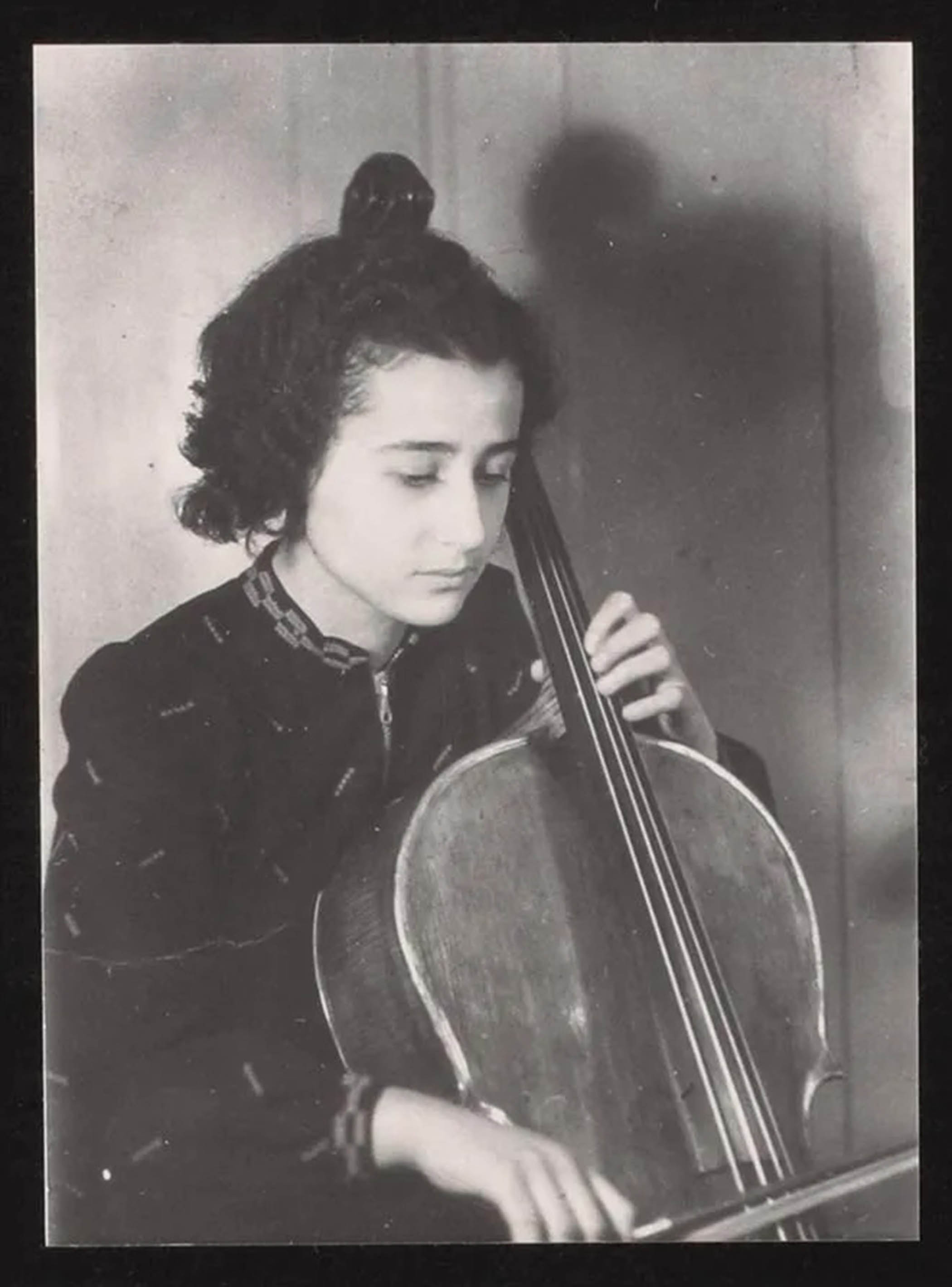
Anita Lasker-Wallfisch playing her cello before the war
She mentions the names of the guards and the commandant, Josef Kramer. “Here was typhus. Here was dirt, lice. No hygiene, no ambulance, no medicines.” She speaks of a liberation they had long hoped for. “We see the English driving through the camp, people who mean us no harm, people who want to help us. We can’t understand it… But we are looking forward now, we are full of hope, full of new courage.” The message reached her sister Marianne, who lived in England.
Anita’s account will alert the world to the truth of what has passed. Reading it seven decades after the events she described prompted me to find an interview with the young army major who led 25 British soldiers into the camp, a place of barbed wire and corpses, explaining how he had no warning about, or knowledge of, the existence of concentration camps.
“It was a beautiful April day, the first day of spring, and inside the gates there was this mob of people, some of them completely naked and skeletons, and there were people lying around dying or dead, and I had absolutely no idea what to do.” This was Brian Urquhart. The experience caused him to devote his life to public service, and he became a key figure in the establishment of the United Nations.
Newsletters
Choose the newsletters you want to receive
View more
For information about how The Observer protects your data, read our Privacy Policy
The military barracks at Bergen-Belsen became a displaced persons’ camp after the war. Three months on from liberation, Anita was still living there when Yehudi Menuhin arrived to give a concert. It was Friday 27 July 1945, and the famous violinist was accompanied by a pianist. “We wanted to play there,” he would later explain, but “underestimated… the extent to which these survivors were waiting to hear music!”
Anita was there that day. “[W]ho would ever have believed that Belsen camp would hear Yehudi Menuhin playing?” she wrote in a letter to her cousin. It was “a wonderful evening” of Bach, Beethoven, Mendelssohn, Debussy and “several smaller, unfamiliar items”.
Anita’s eye for detail is unsparing. Menuhin’s attire: “bordering on the slovenly, which matched the surroundings perfectly”. His performance: playing “faultlessly” but holding back, without “the soul” that cellist Pablo Casals might have displayed. Perhaps he was not inspired by the atmosphere, she mused, then added another thought: “As for his accompanist, I can only say that I cannot imagine anything done more beautifully. He was completely unobtrusive and yet I found myself transfixed by him sitting there as if he wouldn’t say boo to a goose – but playing to perfection.”
Anita was fascinated by “the guy who played the piano”, she recalled, seven decades later. “I wrote to my cousin, I couldn’t take my eyes off that guy… and that was Benjamin Britten.” (The Belsen experience, of which he rarely spoke, would have a profound impact on Britten, causing him, upon his return to Britain, to compose new works – The Holy Sonnets of John Donne and The Rape of Lucretia – that were influenced by it. Menuhin, too, was deeply affected. “After Belsen, Yehudi was never the same again,” his sister, Yaltah Menuhin, would say.)
Two decades after the Belsen concert, Anita performed with “the guy who played the piano”. She did so as a cellist in the English Chamber Orchestra (founded, by her and others, in 1948 as the Goldsbrough Orchestra), performing at the Aldeburgh festival, with Britten as piano soloist and conductor. “Britten was very much a man apart, you didn’t chat to him, really,” she would say. “You accepted Britten as Britten, and that was that!”
In 1969, just before the festival’s opening night, Anita gave Britten the letter she had sent to her cousin from Belsen. “I said to Ben: ‘If you’d like to read a letter about your piano playing, by somebody who didn’t know at all who was who…’ – very unbiased criticism. He was fascinated with the letter. He said: ‘Can I borrow it?’ I said: ‘Of course you can borrow it.’”
A few days later, the Snape Maltings concert hall was destroyed by a fire. The next morning, the musicians gathered in Thorpeness, a nearby village, to rehearse, for the show must go on. “He came in and the first thing he said was: ‘Anita, I’ve got your letter.’” She was astounded: his piano was lost, the Maltings was lost and still he wished to talk of the letter! “He was a completely different person; he was probably much more himself as he would like to be.”
Family photos at her home in Kensal Rise, north-west London
Six months after liberation, Anita was still at Belsen, working as an interpreter and hoping to be allowed to move to Britain. In September 1945, she wrote to her sister Marianne about the trial of those who had worked at Auschwitz, held at Lüneburg in Lower Saxony, which she attended as a witness. Decades later, the experience still hurt. “The trial struck me as a huge farce,” she wrote, having come face to face with “British justice” and the idea that “you are innocent unless proven guilty”. It’s a “commendable principle”, she accepts, but difficult to apply to crimes on such a scale, in a trial – an “overblown theatre” – that addressed events that were “incomprehensible to the rest of the world”.
Anita faced the perpetrators, identified them, described their actions and answered questions as truthfully as possible. She struggled with dates and times, with the fact that “these criminals actually had a counsel for their defence”, with the notion that the kapos (prisoners who supervised inmates) “should be tried alongside the people whose system had turned them into the animals they had become”. The transcript of her questioning by Col Thomas Backhouse, the lead prosecutor, merits a close read.
A profound scepticism impregnates her recollections. Sure, the trial allowed “barristers to display their ability”, but for those who’d been on the receiving end of a “murder machine”, the experience was “sick-making” and left “a bitter after-taste… Is it possible to apply law in the conventional sense to crimes so far removed from the law as the massacre of millions of people, which were perpetrated in the cause of ‘purifying the human race’?”
How the law deals with horror on such a scale is a decent question – one I often ask myself – and it turned out that Anita was right to be sceptical (about some of the participants, at least). A decade after commandant Kramer was convicted and hanged (in part thanks to her testimony), prosecutor Backhouse stood for parliament and attended hustings, in the course of which he described Kramer as “an awfully nice chap”.
Backhouse would later admit that he should have chosen his words more carefully, but would go no further than that. “I shall maintain that he was a decent type of fellow,” he told the Lancashire Post. He added: “It never occurred to him that he was doing wrong in obeying his orders,” noting that no “individual act of cruelty” was proven and that his children worshipped him. He was, Backhouse said, merely “typical of the men who were turned into Huns by the Nazi system”.
To be allowed into Britain, Anita and her sister were required to prove they were under the age of 21 and had no relatives. The age requirement was a problem, so they arranged for someone at the register office in Belsen to reduce their ages on the paperwork: in exchange for 50 cigarettes, their dates of birth were amended, making each sister two years younger. The alteration allowed them to come to Britain. “I should have been able to claim my free bus pass two years earlier, and other OAP advantages,” Anita writes. “But I have gained more than I have lost.”
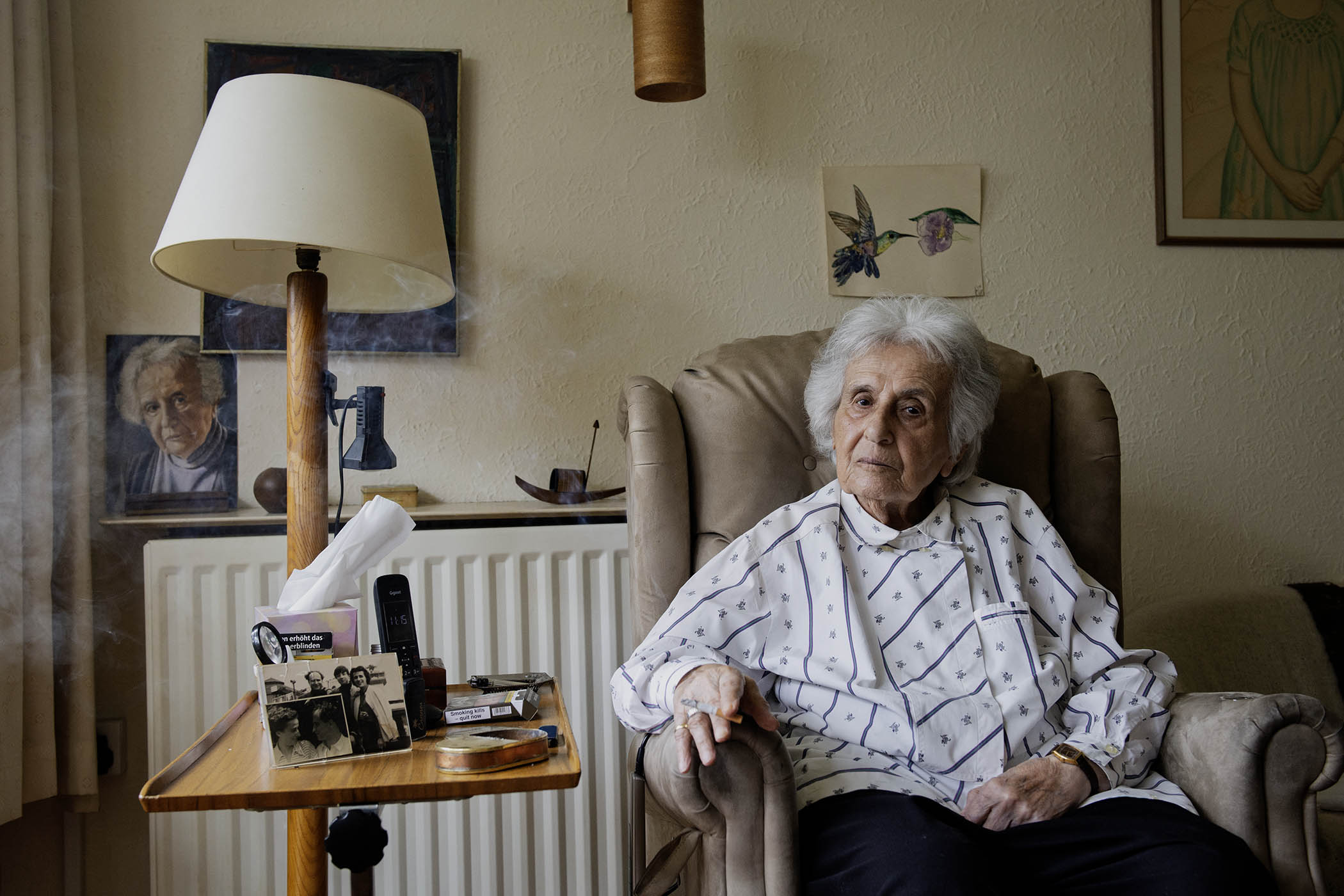
Eight decades after her arrival, I spent an afternoon with Anita in her living room in Kensal Rise, north-west London. This was the home she once shared with her late husband, Peter Wallfisch, a professor of piano at the Royal College of Music. “A good house for musicians,” she explains, with a music room far enough away to allow them to play without disturbing others.
I tell her about Brian Urquhart, who liberated Belsen.
Would you like to hear his voice, I ask?
“Yes.”
On her iPad, we listen to Urquhart describing his experience. She is attentive, concentrated. Urquhart talks about the arrest of Kramer, the commandant. “We found an enormous meat locker. The electricity had been off for some days. We put him in there.”
“I remember that,” Anita interjects, with a throaty chuckle. How extraordinary that so distant a moment remains so vivid, in the aftermath of so terrible a time. How extraordinary to be in the presence of someone who lived through it.
She recalls the interview she gave to the BBC, the day after liberation. “Let me read it,” she directs.
I hand over a single sheet of paper.
“So childish. I would never say this now.”
So raw, so truthful, I respond.
“If you think so,” she says, then tells me of the recent visit by King Charles III, longtime patron of the English Chamber Orchestra, who wished to honour her on reaching 100 years of age.
“He sat in the chair you are sitting in,” she says.
She shows me a photograph.
The voice is undimmed, so is the spirit.
I mention the letter she sent to her sister on 16 July 1945, the day before she turned 20. “My age will never again start with a ‘1’ (unless I live to 100),” she wrote.
And now, once again, your age starts with a 1, I say.
“Yes,” she says, reminding me of the 50 cigarettes that shaved a couple of years off her age and allowed her to come to Britain. “Can you imagine what would happen today?” she asks with a smile, then lights another cigarette. “What would they do now?”
The question needs no answer.
She has other questions and anxieties – on the state of the world, xenophobia, the loss of memory, the rise of antisemitism. “I ask myself what was the point of it all, my efforts to tell people what happened?”
That’s why your book is important, I say. It’s a long game. The truth matters.
She looks at me, takes a lengthy drag on the cigarette, offers a sceptical glance and raises her hands to the air.
Photographs by Daily Mail/Jane Hilton for The Observer
Inherit the Truth: The Cellist of Auschwitz is published by Faber (£10.99). Order a copy from observershop.co.uk for £9.89. Delivery charges may apply
Anita’s words to the world: BBC Radio broadcast, 16 April 1945
“This is Anita Lasker, speaking. A German Jew. I have been in prison with my sister for three years. I am a political prisoner. I helped French prisoners of war escape. First we were locked up in prison. My sister was sentenced to three-and-a-half years in prison. I was sentenced to one-and-a-half years in prison. After one-and-a-half years we were both taken to the most terrible concentration camp: Auschwitz.
I would first like to say a few words about Auschwitz. The Auschwitz prisoners, the few who remained, all fear that the world will not believe what happened there. They threw living, healthy people alive into the fire. My barrack was about 20 metres from the chimney, from one of the five chimneys that were there.
I witnessed everything with my own eyes. There was a doctor and a commandant standing at the ramp when the transports arrived, and they were sorted before our eyes. That is, they asked the age and the state of health. The ignorant arrivals used to declare any ailments and thus sign their death warrant. Especially children and old people were targeted.
Right, left, right, left. Right is to life, left is to the chimney. At night the fire burned up to the sky. Children were thrown into it alive, and out of humanity the others were gassed, that is, stunned. But if there was too much work, they used to burn everyone alive. We could hear the screams all the way to our barracks.
Music was always played. I myself was in the orchestra. Music was played for the most terrible things. Maria Mandel, Margot Drexel and commandant Kramer, who was also camp commandant in Bergen-Belsen, deserve a special mention in connection to the treatment of Jews in Auschwitz.
After a year’s stay in Auschwitz, my sister and I were very ill, and escaped death only with difficulty. We were sent to Bergen-Belsen, which is now called the most terrible concentration camp. And it doesn’t even come close to Auschwitz. There is no chimney in Bergen-Belsen. That is, the misery is not burned up, as it was in Auschwitz. Here people were starving. Here was typhus.
Here was dirt, lice, no hygiene, no ambulance, no medicines. For 14 days we stayed without bread. Rations were beets with water without salt.
Finally, on the 15th liberation came. The liberation we had hoped for for three years. We still can’t understand it. We still believe we are dreaming.
We see the English driving through the camp, people who mean us no harm, people who want to help us. We can’t understand it. They brought water. Water! We were without water for three weeks. People died of thirst. This morning another of my comrades died, in the face of the liberation.
My parents were also killed.
But we are looking forward now, we are full of hope, full of new courage. We are liberated. Hopefully we’ll see some relatives again.”