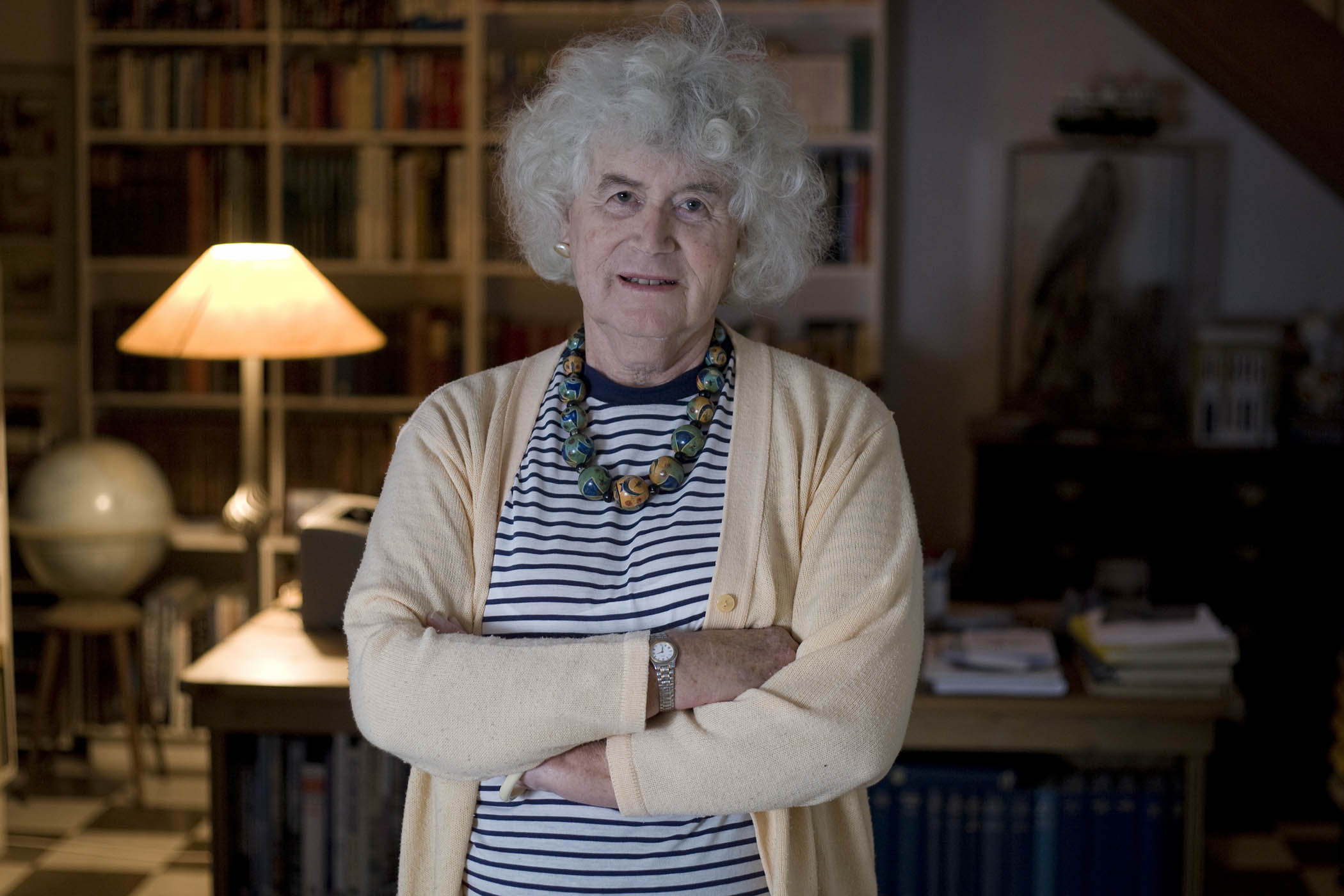


In 1978, the writer Jonathan Raban encountered Jan Morris in Cairo. Surprising, perhaps, that the two hadn’t met before, given their standing in the field of what is called – too often dismissively, as Morris was particularly well aware – “travel writing”. Raban was researching his book Arabia Through the Looking Glass, which was published the following year; Morris was writing for Rolling Stone, its co-founder and editor Jann Wenner having taken a shine to her.
Morris had first been in Egypt more than 30 years previously, in the last days of the Palestine Mandate. At the time, Morris was regimental intelligence officer of the 9th Queen’s Royal Lancers, and known as James Morris, for Jan Morris did not finally come into full being until 1972, when she completed her transition in Casablanca. She recounted that odyssey in Conundrum, published in 1974 – one of the very first mainstream narratives of the trans experience. Sara Wheeler, in her engrossing, sensitive and fair-minded biography of Morris, manages the shift with clean simplicity. The pronouns change in chapter nine and that is that. Reductive categories never mattered to Morris. In the introduction to the 2002 edition of Conundrum, she wrote: “I never did think that my own conundrum was a matter either of science or of social convention. I thought it was a matter of the spirit, a kind of divine allegory, and that explanations of it were not very important anyway.”
Wheeler offers Raban’s description of Morris in her prime, and it captures her perfectly: “She was a proper traveller with the traveller’s gift for swimming in the stream without drowning in it… sensible jeans and sensible blouse, a sensible headscarf… She spoke in an eager alto, with a trace of dry rust around its edges, leaping from emphasis to emphasis, alighting for a second on a word in italics, like a chalk-hill blue in a meadow of dogroses… I felt sincere, unstinting admiration for the careless, artful style with which she had made herself at home in this singular and alien landscape.”
Morris was born in 1926 in Clevedon, Somerset. Her formidable mother, Enid, was English. Her father, Walter – a decade younger than his wife and his health permanently damaged by the first world war – was Welsh. The couple’s three sons – James was the youngest – all benefited from Enid’s determination to educate her boys to the highest standard.
“The world of British class was central to my father’s personality,” Morris’s son Mark tells Wheeler. “His mother, the daughter of a bank manager, from an upper-middle-class family of important engineers, even upper class ones, married into a tribe of house painters and labourers. My father had something to prove.”
Work was the arena in which to do the proving: and her very best work endures. Venice, an imaginative hymn to that extraordinary city, was originally published in 1960. Morris revised it several times and a new edition, with an introduction by Tracy Chevalier, is due for release in April. Next year, Trieste and the Meaning of Nowhere will get a new preface by Robert Macfarlane. And then there is Pax Britannica, her extraordinary trilogy of empire. Morris “did no primary research bar a stint at the British Library reading General Gordon’s diary”, Wheeler writes, and refused to deal with the cost of Britain’s imperial venture (the books “sweep butchery and appropriation aside to the tune of a bugle reveille”). The way we talk about the British empire has rightly changed in the years since the three volumes were published (in 1968, 1973 and 1978, respectively), but despite their flaws and idiosyncrasies they remain miracles of narrative art. As Sathnam Sanghera, author of Empireland, has said: “If I had to give one book to someone to understand empire, it would be Pax.”
And that’s before we get to the fact that as a reporter for the Times, and working in code, she broke the story of Hillary and Tenzing’s ascent of Everest just in time for the Queen’s coronation in 1953. Or that she covered the trial of Adolf Eichmann and was on the ground in Suez during the crisis of 1956. “As a descriptive writer I believe she will always be up there among the best,” Wheeler writes. “And I still think she lived an almost insanely interesting life. She was the 20th century.”
Morris could not have hoped for a better chronicler than Wheeler, whose books include Terra Incognita: Travels in Antarctica and a biography of the polar explorer Apsley Cherry-Garrard. Wheeler understands Morris’s roving life and the determination to show readers places they may never see for themselves – and allow them to feel them, to know them.
Morris had no interest in a trans ‘community’: she had no community beyond herself
Morris had no interest in a trans ‘community’: she had no community beyond herself
Morris died in 2020, aged 94. Wheeler’s biography was written with the cooperation of her family, and pulls no punches about what they endured. Morris first encountered Elizabeth Tuckniss as a beautiful young woman when they were both in their early 20s. From the very beginning, Elizabeth understood that her new husband was longing to be someone other than one he appeared to be; the couple had five children, one of whom, Virginia, died in infancy. Undoubtedly they were devoted to each other; undoubtedly, too, Elizabeth paid a high price for her partner’s extraordinary self-absorption.
Elizabeth – who died in 2024 at the age of 99, and who had descended into dementia by the time Wheeler started her work – is a haunting presence here, as she holds the fort at home while Morris sets off on yet another glamorous, hair-raising journey. “What it cost [Elizabeth], no one can know” is a recurrent theme, and when it comes to Morris’s transition, Wheeler writes: “One can only try to imagine what it was like for Elizabeth.” Her absence, and the mystery of her own life, leaves a gap in the story. Their son Mark says: “It’s harder for a narcissist not to have a wife than to have one. A codependent wife is a good target.”
Newsletters
Choose the newsletters you want to receive
View more
For information about how The Observer protects your data, read our Privacy Policy
Wheeler calls Elizabeth the family enabler, and their surviving daughter, Suki, the scapegoat – often at the receiving end of a kind of awful, careless cruelty from Morris. As far as their daughter was concerned, her dismay was nothing to do with Morris’s identity. “Transition doesn’t mean a cost has to be paid by others. If she’d been nice to us, there wouldn’t have been a cost,” she tells Wheeler. Morris had no interest in a trans “community”: she had no community, really, beyond herself.
The best of her work astonishes. I remember lying in the bath at the age of 19 reading Pax Britannica: the water grew cold and I kept turning the pages. Until then I hadn’t understood how nonfiction could have the same pull, the same energy, as fiction.
In her best books she is the reader’s true companion, the ideal guide and voice in your head. Late in her life, Morris said: “I’ve come to think there’s nothing different between truth and the imagination – it’s a central tenet of my art now.”
It’s a precept that is either a flaw or a wonder, depending on your point of view. My mother, a New Yorker through and through, adored Morris’s work and it’s very possible that I am writing this piece, working at a newspaper, living in Britain, largely thanks to Morris’s influence. I commissioned her when I was at the Times, the paper that made her name, and remember her just as Raban described, with what would be called, these days, main character energy.
She wrote obsessively. It was her meaning, the source of that energy, perhaps as her own energetic mother had intended. Quantity does not always mean quality, and Wheeler is unsparing in her brisk remarks about some later work: 1988’s Hong Kong is “weak”, while 1993’s A Machynlleth Triad, an attempt at a Welsh nationalist novel, is “regrettable”. (In the latter part of her life, if she chose to identify as anything at all, it was as “a fierce Welsh patriot”.)
Wheeler closes with a brilliant expression of the biographer’s tricky art. “At the finish line I have accepted the tensions that exist within any presentation of Morris that seeks ‘truth’. The gulf between the monster and the humane, lovable companion on and off the page is one that cannot be bridged – I only hope I have shown, in this book, a few currents of desire, thought and energy that might connect the two. ‘Do you like her?’ is the question I am most often asked. But it’s not like that. I am human. So was she.”
Jan Morris: A Life by Sara Wheeler is published by Faber (£25). Order a copy from The Observer Shop for £21.25. Delivery charges may apply
Photograph by Colin McPherson/Corbis via Getty Images