


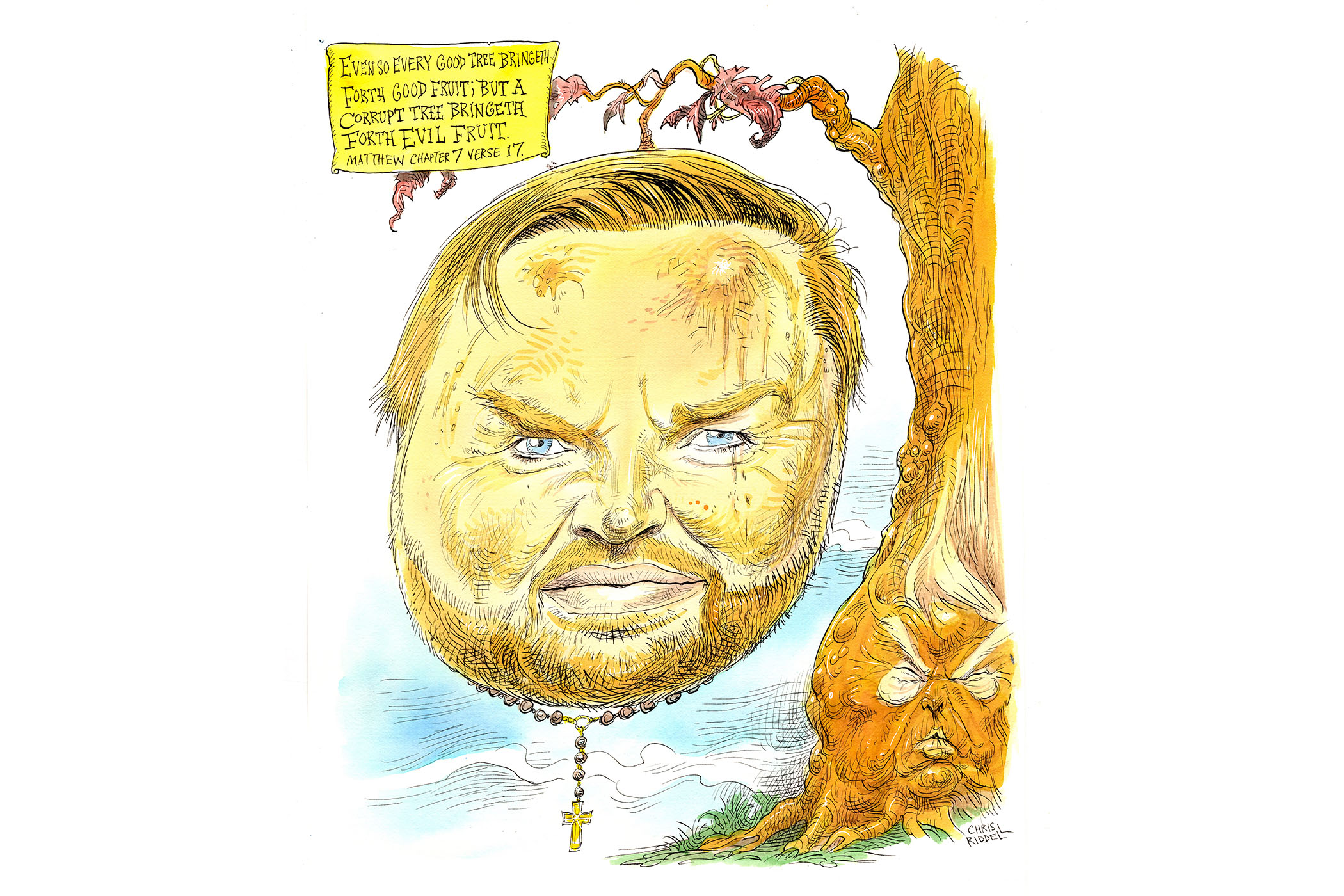
Illustration by Chris Riddell
Being more Catholic than the Pope is tough going at the best of times. But it is even harder when your day job is being chief courtier to a violent, reckless, predatory and infinitely mendacious autocrat. Undaunted by these challenges, Donald Trump’s vice-president JD Vance managed in April to wag an admonishing finger at Pope Leo XIV, who has emerged as arguably the most powerful moral voice to be raised against Trump: “I think it’s very, very important for the Pope to be careful when he talks about matters of theology.”
The first thing to be said about Vance’s Communion – a book he says he started writing in 2017, presumably as a follow-up to Hillbilly Elegy, the memoir that catapulted him to fame and national office – is that very few people would bother reading it if he were not Trump’s second-in-command and possible successor. It is too dull to be innately interesting and too evasive to be taken seriously as an honest mapping of a spiritual voyage.
Its significance lies rather in Vance’s political positioning: his attempt to lay the ground for the future of Trumpism beyond Trump. Unless there is an earthquake, the Republican presidential candidate in 2028 will be either Vance or the current secretary of state Marco Rubio. When Vance reminds readers that he is “the most senior Catholic in the United States government”, we are also tacitly reminded of who his immediate junior might be.
It is striking that both Vance and Rubio, as adults, turned to Catholicism from complex religious backgrounds: Vance in various forms of evangelical Christianity, Rubio as a Mormon and then as a Catholic with ties to the Southern Baptist denomination. The contest for the soul of Maga – a movement created by the first obviously nonreligious president – will be between two converts to the church of Rome. To anyone with a passing acquaintance with the history of the far right in America, this is quite a turn of events.
Trumpworld is heartless – cruel, cynical, vindictive, performatively malicious. But its sadistic pleasures are wearing thin
Trumpworld is heartless – cruel, cynical, vindictive, performatively malicious. But its sadistic pleasures are wearing thin
Thus, at the most superficial level, Communion functions as Vance’s first move in his struggle with Rubio over the Trumpian apostolic succession. But it does prompt a deeper question: why do these claims on Catholicism – or indeed any religion – matter so much? Trump has shown that vast numbers of churchgoing Christians will vote for an irreligious man and a flagrant sinner. Why do his would-be heirs need to be godly?
The answer may lie not so much in Karl Marx’s dictum that religion is the opium of the people as in the deliberate paradox with which he precedes this claim: it is “the heart of a heartless world”. Trumpworld is heartless – cruel, cynical, vindictive, performatively malicious. But its sadistic pleasures are wearing thin. The internal violence of ICE was countered by the people of Minneapolis; the external violence of the war on Iran has dissolved into black farce.
Vance is not wrong, therefore, to think that Trumpism needs a heart transplant. Or to surmise that if it is going to be given a religious pulse, Catholicism’s historic continuity and appeal to natural order might fit the bill. He admits to being “drawn to the hierarchy and sense of authority in Catholicism” and that side of the church could indeed help to validate political authoritarianism.
The return to religion that culminated in his baptism at age 35 in 2019 undoubtedly helped Vance to settle his own life and to heal the wounds of the often chaotic childhood he endured as the son of an absent father and a drug addicted mother, described so touchingly in Hillbilly Elegy. (“Therapy didn’t work for you,” he says his wife Usha told him, “but church does.”) If conservative Catholicism stabilised Vance, could it not help sustain a more durable and less frantic version of Maga?
Unfortunately for the vice-president, Communion answers that question all too definitively – and negatively. As a religious text with a political purpose, it completely fails, in three different ways. Together these flaws illuminate a larger reality: that the struggle for the soul of American Catholicism won’t just be between Vance and Rubio. There’s another American Catholic who will have some say in it – and he happens to be the Pope.
Newsletters
Choose the newsletters you want to receive
View more
For information about how The Observer protects your data, read our Privacy Policy
The first great failure of Communion lies in the feebleness of its author’s attempts to persuade the Maga base that he has been chosen by God. Vance pompously refers to himself as a “Christian statesman” – no mere politician now that the Lord has elevated him to a higher plane. But he seems to understand that elevation is not really what the punters want. They want proof that Vance, like Trump, has the mysterious mandate of heaven.
His boss has demonstrated that he is part of the divine plan by miraculously surviving attempted assassination. Vance reaches for a similar stamp of approval by recounting a moment in 2005 when he lost control of his car on an Appalachian mountain road. He slid towards the guardrail that was all that stood between him and a potentially lethal plunge when the car came to a sudden halt. “Something stopped it – something beyond my comprehension or control.” He is too coy to say that Jesus literally saved him but the implication is as clear as it is phoney.
The other two moments of supernatural intervention are unintentionally comic. Vance calls in to a Dominican chapel to discuss his growing interest in Catholicism and – OMG! – the choir is chanting the exact same psalm he was listening to on the train earlier! He is discussing Catholicism late at night in a pub “when suddenly a wine glass seemed to leap from a stable place behind the bar and crashed on the floor in front of us”. He and his interlocutor agree that “maybe God was trying to send a sign”. A pity that whoever knocked over the glass didn’t announce in a Morgan Freeman voice: “JD, thou shalt not become a reactionary asshole!”
Second, Vance tries to convince us that he is now deeply “focused on the church’s social teachings”. He cites in particular its emphasis on “the dignity of workers and the jobs they did”. He does not bother to explain why the Trump-Vance administration has removed collective bargaining rights from more than a million federal workers and cut the minimum wage for federal contractors from $17.75 to $13.65.
Vance cites as an example of his faith the teaching of Pope Leo XIII (“not”, he emphasises, “to be confused with the current Pope”) that “employers have a duty to pay a wage sufficient for [workers] to live a good life”. Does he truly believe anyone is living a good life on $13.65 an hour in his and Trump’s high-inflation economy? Or is all of this just pseudo-Catholic claptrap?
Vance declines to tell us because in order to do so he would be forced at least to outline some connection between his professed faith and his political actions. He would have to join the dots between his moral outrage at his beloved Mamaw’s experience of “not being able to afford medicine” and his administration’s slashing of $1tn from Medicaid and the Affordable Care Act over 10 years to fund tax cuts for billionaires.
Vance’s values – supposedly derived from his religion – always float off into a gravity-free space where they need never touch the ground of real-world consequences
Vance’s values – supposedly derived from his religion – always float off into a gravity-free space where they need never touch the ground of real-world consequences
He would have to relate his righteous insistence that “the ubiquity of social media, enabled by constant exposure thanks to smartphones, appears to be taking its toll, particularly on teenagers” to his attacks on European democracies for daring to attempt to regulate American social media corporations. Vance’s values – supposedly derived from his religion – always float off into a gravity-free space where they need never touch the ground of real-world consequences.
This is the third great failure of Communion. The conversion narrative, if it is to be worth reading, has to be a drama with high stakes. In the classic version, that of Saint Paul, the force of divine revelation is radically unsettling. Paul’s whole life is upended – the road to Damascus is also the road to his persecution and execution. The test of conversion is the willingness to pay the price of new beliefs.
In Communion, nothing is really at stake. Vance tries to paint his youthful vacuity as a result of his drift into religious scepticism. This would be a lot more convincing if he seemed ultimately less vacuous now that he has found God again.
His faith makes no demands on his public life. He can scold an anonymous friend whose “words lack Christian humility” but has nothing to say to his boss who projects himself as Jesus Christ and Julius Caesar all in one. He writes of the liberating power of guilt while serving the most shameless man on the planet.
He declares his devastation at “news of a school shooting” but does nothing to change the atrocious gun laws. He bemoans the loss of Christianity in America without acknowledging that most of the immigrants his government are persecuting are Christians – indeed his fellow Catholics, the very “communion” of the faithful he pretends to exalt.
He expresses sorrow for the time when, as a younger man, he and his friends were “mired in the swamp of social media” – “we would identify a scapegoat and digitally pounce” – while pretending not to know what Trump stays up half the night doing. He acknowledges that “don’t lie” is one of the “moral dictates” of his religion, but does not tell us whether he went to confession after lying brazenly about immigrants in Ohio eating people’s pets.
Half a dozen times in the book, Vance quotes what he says is his “favourite parable”, from the gospel of Matthew: “a corrupt tree bringeth forth evil fruit… by their fruits ye shall know them.” The fruits of his conversion are his gutless adherence to the most corrupt administration (financially and morally) in US history. Their bitter taste is a much more accurate indicator of the quality of his faith than the blandness of his self-serving narrative.
Communion: Finding My Way Back to Faith by JD Vance is published by William Collins (£20). Order a copy from The Observer Shop for £18 (10% off RRP). Delivery charges may apply
Photograph by The Washington Post via Getty Images