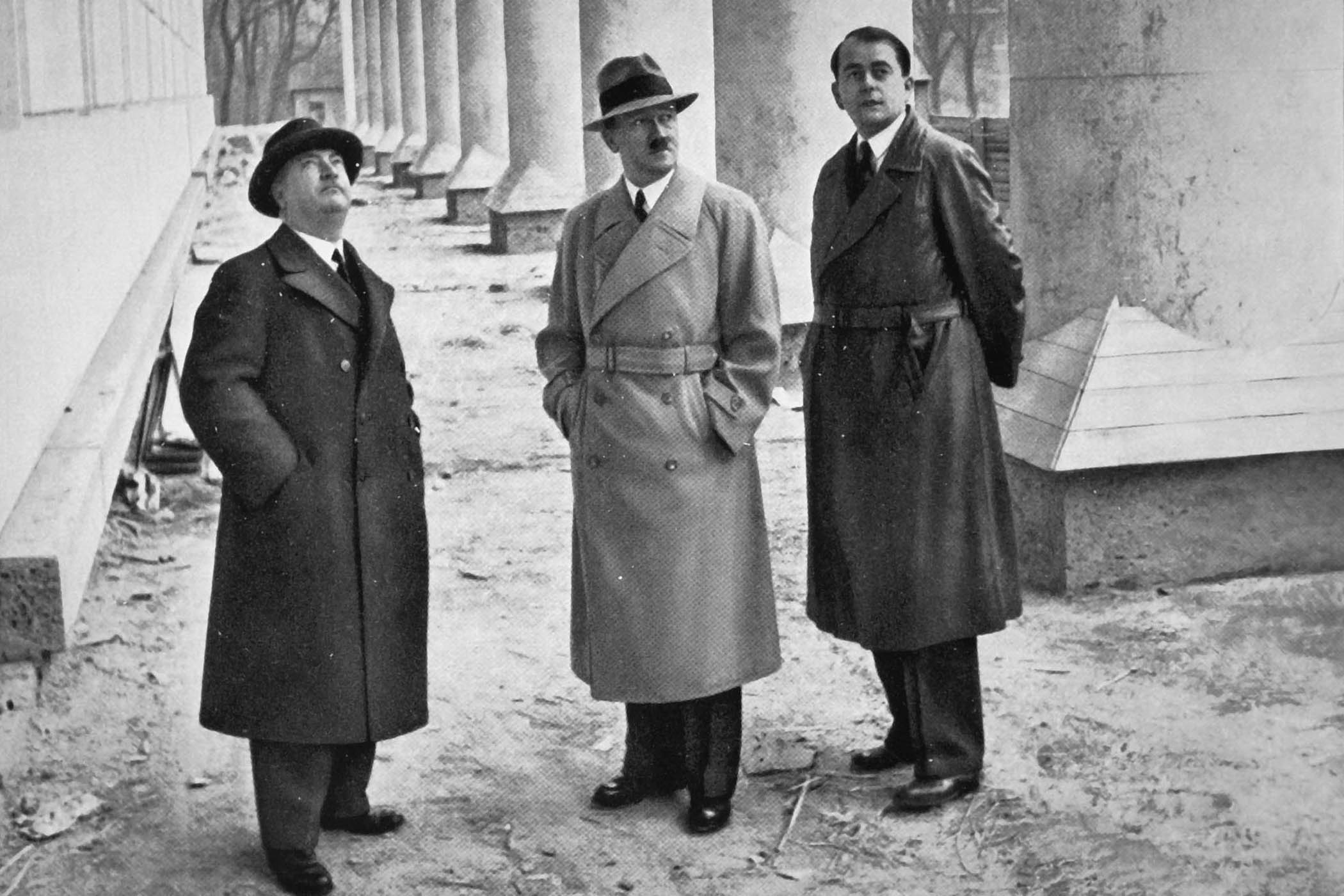


Albert Speer was an architect who became the most favoured of Hitler’s courtiers in the 1930s, and the Reich minister of armaments and war production in the 1940s. He escaped the gallows at Nuremberg by portraying himself as a technocrat rather than a fanatic, accepting collective responsibility for Nazi crimes but insisting he had not known about the death camps.
Imprisoned in Spandau for 20 years, on release he became a bestselling author with Inside the Third Reich, a detailed account of the workings of the Nazi regime, and Spandau: The Secret Diaries, which interspersed an account of his jail years with memories of his relationship with Hitler.
That relationship is one of two central to You Are the Führer’s Unrequited Love, Jean-Noël Orengo’s fifth novel and the first to appear in English (translated from French by David Watson). Its sections – Honeymoon, Offspring, Separation, The Merry Widower – accentuate the sense of a twisted romance that baffled, angered and alarmed the other members of the Nazi inner circle, a snake pit of manoeuvring and backbiting. Who was this young, handsome, stylish bourgeois, and under what kind of spell had he put their leader? They resented the hours Hitler and Speer would spend – like boys with a train set – poring over their scale model of Germania, the Nazi capital that would replace Berlin.
In telling Speer’s story, Orengo’s novel, shortlisted for the Prix Goncourt in 2024, largely forsakes traditional fictional techniques of scene and dramatic metaphor in favour of summary; it reads like a Wikipedia entry written with immense style. This allies it with several other self-consciously historical novels, or novelistic histories, that have appeared in the last decade or so, including Laurent Binet’s account of Reinhard Heydrich’s assassination, HHhH, Éric Vuillard’s The Order of the Day, which describes the union of the Nazi project with German industry, and The Maniac, Benjamín Labatut’s story of the Manhattan Project, John von Neumann and the roots of AI.
Hitler and Speer spent hours poring over a scale model of Germania, like boys over a train set
Hitler and Speer spent hours poring over a scale model of Germania, like boys over a train set
The arresting title of Orengo’s novel is a line supposedly said to Speer by an SS officer before the war: an intended jibe that turned out to be true, or as true as anything can be said to be in relation to Speer. Gitta Sereny, the historian and investigative journalist who specialised in Nazis and child murderers, chose the subtitle of her definitive biography of Speer – His Battle With Truth – very carefully. As Orengo serially points out, the version of Speer one encounters in so many histories is the one he created.
Sereny’s relationship with Speer (she conducted more than 100 hours of interviews with him from 1978) dominates the final third of the book, and is where it really takes flight. My attention began wandering during Orengo’s account of the war years, but Sereny’s involvement boils things down to a conflict and a question. While she isn’t antagonistic towards Speer (her biography begins, “Albert Speer, whom I knew well and grew to like…”), her honeymoon period with him ends when he tells her over dinner that she is like all the others: “You have this question in your head. Why not ask it now and have done with it?” As Orengo makes clear: “That question was the one about the Jews, the extermination of the Jews.”
It’s a moment that electrifies the book, and brings a friction missing from earlier chapters. At last (regrettably late), the ingenious idea – that Orengo’s task is the same as the one Sereny faced nearly 50 years ago – isn’t only described but enacted.
In historical fiction, truth is typically malleable. The novelist applies the alluring glaze of fiction with a dab of interiority here, a tweaked timeline there. But in this case the subject has performed these manoeuvres himself – “the author not merely of falsifying memoirs but of the most radical aesthetic and political autofiction ever written” – and it’s the novelist who must attempt to disentangle the real story from within Speer’s webs of invention.
You Are the Führer’s Unrequited Love by Jean-Noël Orengo, translated by David Watson, is published by Penguin Classics (£14.99). Order a copy from The Observer Shop for £13.49. Delivery charges may apply
Photograph depicting Albert Speer (right) with fellow architect Leonhard Gall and Adolf Hitler inspecting the construction of the House of Art in Munich, 1937, by Photo12/Universal Images Group via Getty Images
Newsletters
Choose the newsletters you want to receive
View more
For information about how The Observer protects your data, read our Privacy Policy