
It is rare to read a politician’s memoir that hardly mentions politics but The Colour of Home is one such book – and it is all the better for it. Sajid Javid’s account of growing up in 1970s Britain is as much a portrait of a country adapting uneasily to immigration, and a family navigating the associated culture clashes, as it is the autobiography of one man. The former home secretary and chancellor, whose parents came to the UK from Pakistan in the 1960s, writes with honesty, humour and vulnerability about the racism he experienced as a boy. He charts without self-pity the extraordinary resilience and determination required to escape from a childhood characterised by poverty, violence and low expectations and reach the highest levels of the government. “This perspective isn’t one many fellow Conservative MPs shared,” he admits. “I’m not the only Tory from a Pakistani background but, on the whole, my party is a homogenous collection of people from some of the finest educational institutions money can buy.”
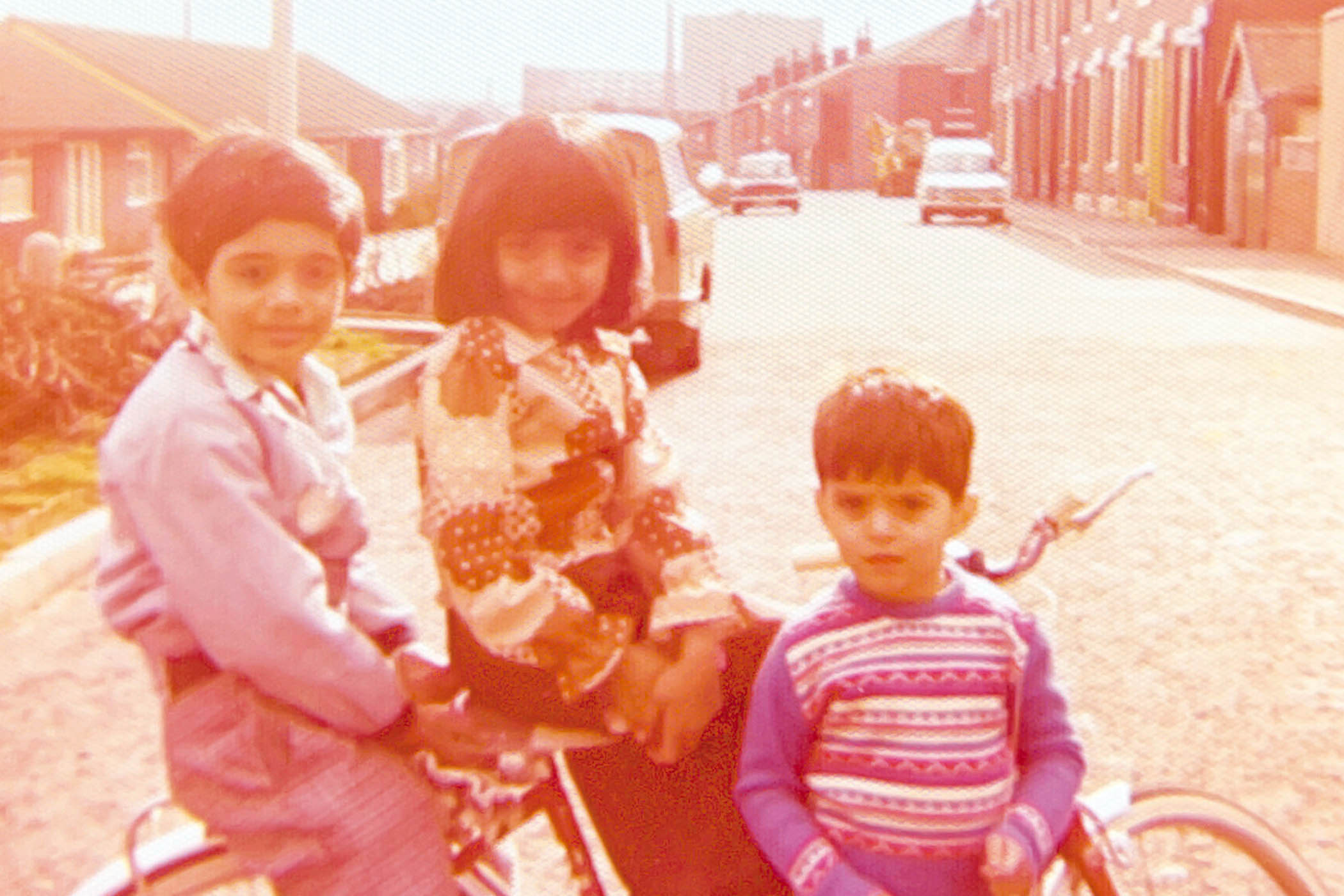
The book opens with a five-year-old Sajid and his young cousin Rozina being chased through an underpass by skinheads shouting: “Run, Paki, run.” Even at that age, Javid understood the colour coding of Dr Martens laces. “Red laces indicated that someone was a supporter of the National Front and was probably a racist. Yellow laces were the worst. They meant that someone particularly hated Pakistanis.”
Javid, the middle child of five sons, was born in Rochdale in 1969; the family moved to Bristol when he was five. There is a nostalgia for the tastes and sounds of the 1970s woven through the text – it was the era of cola cubes, fruit salads and lemon sherbets; of playing knock-down ginger on the way home from school. But, Javid says, “the ‘othering’ of racial minorities was extreme”. He remembers the “rage and sense of injustice” he felt when he and his brothers saw his father’s women’s clothes shop smeared with the words: “Paki go home.” They would play rock-paper-scissors to decide who would tell their parents. He recalls “the pit-of-my-stomach feeling as I walked into the kitchen and told Mum, ‘It’s happened again.’”
When Javid started school he spoke no English, having always used Punjabi with his family at home. The racism was overt. One teacher described his mother tongue as “gibberish” and hid sausage in his mashed potato to try to force the Muslim pupil to eat pork. Javid was beaten up in the playground by another pupil in a racist attack. He recalls finding a black boy using sandpaper to try to remove the colour of his own skin.
Javid’s father, who was a bus driver before running a series of businesses, could be violent towards the children. “He would sometimes use his hand but often opted for an implement like his leather slipper or a wooden spoon from the kitchen.” There was also, however, an astonishing work ethic in the family. His father was known as “Mr Night and Day”, because he would so often do double shifts. His mother would stay up late sewing clothes for her husband to sell at the market. Although she could not read, she took Sajid and his four brothers to the library every Saturday. “I think my parents thought that education would become my protection as racist people could question my character and personality but never my grades,” Javid writes.
Even this became a struggle. One careers adviser told the future chancellor that he should aspire to become a TV repairman. When his school refused to let him do maths O-level, he found a tutor to help him pass the exam, then switched to a further education college in order to take three A-levels. His old teacher told him “you’re setting yourself up for failure”, but he got two As and a B. Inspired by reading copies of the Financial Times left on the bus, he went to Exeter University to read economics and politics.
He was almost written off again after graduating. During an interview for a job at Rothschild by a panel of five “identikit” white men in pinstriped suits, he was asked what his father did for a living. He told them he had been a bus driver and now ran a shop. There was a “grimace” and he realised that “they weren’t going to let me into their world and I wasn’t convinced I wanted access”. Instead, he was hired by a more egalitarian American bank, Chase Manhattan, and become a millionaire.
One careers adviser told the future chancellor that he should become a TV repairman
One careers adviser told the future chancellor that he should become a TV repairman
Javid writes movingly about the emotional impact of living between two cultures. When he told his parents that he had fallen in love with Laura, a “posh, beautiful white girl”, they said that he could not marry her because he was “already engaged” to his Pakistani cousin. Again his stubbornness won through: he married Laura and a Sikh DJ played a mix of western and Bhangra music at their wedding.
The shock of his brother Tariq killing himself in 2018, when Javid was home secretary, is laid bare with brutal honesty. “In Muslim culture, to kill yourself is sometimes seen as an unforgivable thing that brings shame to your family,” he writes. “We told Mum that she mustn’t think of it in that way.”
His election as an MP and his government roles are mentioned only in passing, as a backdrop to family moments. Mostly, this is a good thing – there are too many self-justifying memoirs by retired politicians going into every detail of who said what to whom in the House of Commons. But there is one area where it feels like an omission.
Newsletters
Choose the newsletters you want to receive
View more
For information about how The Observer protects your data, read our Privacy Policy
Javid expresses the “deep sense of gratitude” he feels towards his parents, who sacrificed so much to move to a new country so that their children could have a better life. He writes that he was drawn to the Conservative party by the belief that “anything could be achieved with tenacity”. He describes Britain as “the most successful multiracial democracy in the world” and “a place where people from all backgrounds can rise, contribute and belong”.
It is true that Javid, the son of immigrants, raised in a modest home above a shop, was able to rise to hold two of the great offices of state. But today there is a growing undercurrent of racism and violence. Sadiq Khan, the Muslim mayor of London, receives so many Islamophobic death threats that he is not allowed to leave his home without an armed guard. Social media is a sewer of extremism and politicians from all parties are now competing to sound tough on immigration, in an attempt to see off Reform UK. Javid’s parents would almost certainly not be allowed to come to Britain legally now. Yet the former home secretary does not address this issue at all.
Javid writes powerfully about overcoming adversity. “There is hope to be found in such hardship. Difficulties didn’t preclude me from success and I believe that’s the same for everyone.” His story is inspiring, but the question left unaddressed is whether it would be harder for a boy with parents born in Pakistan to replicate the same journey today – however much resilience and determination they have.
The Colour of Home: Growing Up in 1970s Britain by Sajid Javid is published by Abacus (£25). Order a copy from The Observer Shop for £22.50. Delivery charges may apply
Photograph by Sajid Javid