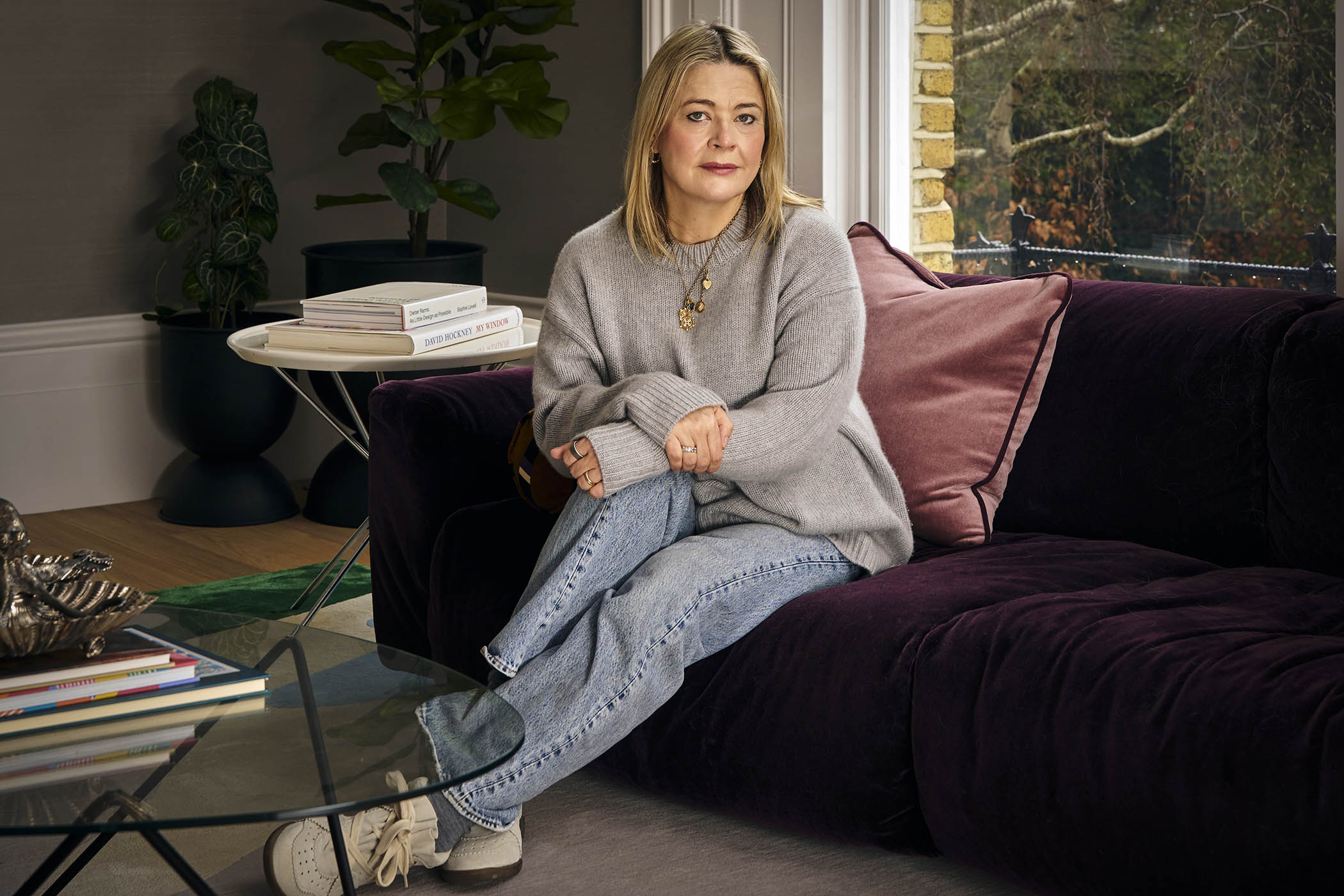
Portrait by Suki Dhanda
When Harriet Tyce was a child, she visited the National Museum of Scotland in Edinburgh and saw a calf’s heart studded with nails, a witch-haunted relic that had been unearthed somewhere near Arthur’s Seat, the extinct volcano that towers over the city.
“It scared the life out of me,” says Tyce, now 53. “To be honest, I scare easily. I didn’t spend my teenage years doing ouija boards. I’ve always steered clear of the occult. I wouldn’t say I believe, but I wouldn’t say I don’t. I just worry that bad things will happen, and I know enough about horror that, you know, you don’t go into the basement, you don’t stay in a cabin in the woods.”
But for her latest book, out this month, the former barrister had to immerse herself in the occult, the supernatural, and the history of the women accused of witchcraft in Scotland. Witch Trial, Tyce’s fifth thriller is a contemporary courtroom drama about two teenage girls accused of causing the death of another through witchcraft.
Not long after she finished the book, Tyce found herself immersed in another situation soaked in gothic imagery: she was in the latest series of the hit BBC1 show The Traitors, which concluded last month.
She was one of “the faithful”, and quickly made a name for herself as a consummate hunter of the secret traitors in an effort to be last player standing and win £95,000. Tyce led the banishment of the first traitor, Hugo, and became the bookies’ favourite to win the show.
However, while pushing for the banishment of another contestant, Rachel Duffy – who was also a traitor and went on to jointly win the show – the tables were turned and Tyce’s fellow faithful were persuaded to vote her out in the seventh episode.
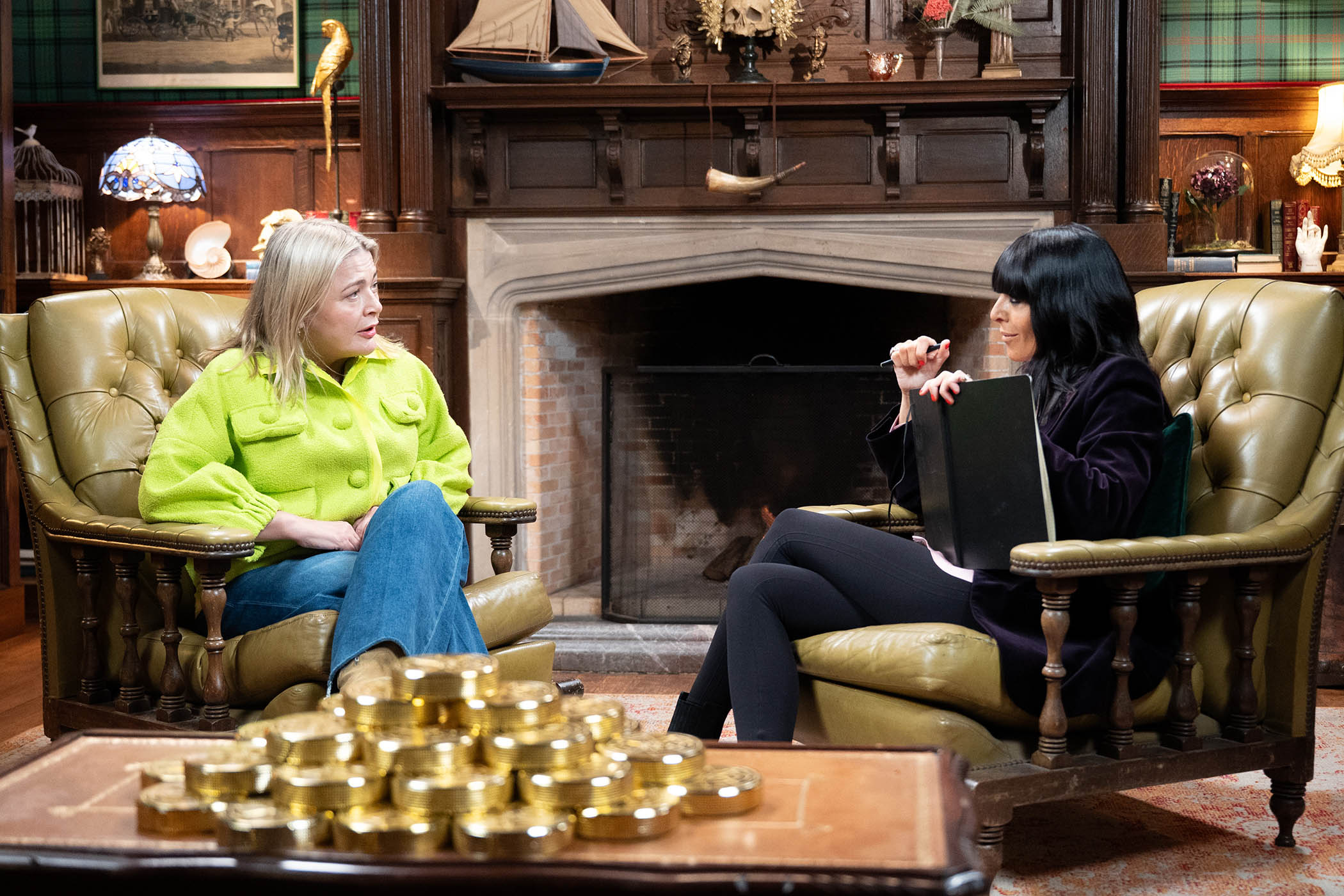
Harriet Tyce speaking to Claudia Winkleman on The Traitors
Tyce’s downfall was largely down to an incident when the players gathered for breakfast and Tyce went for suspected traitor Rachel in a big way. There’s an unspoken consensus that the contestants play nice with each other during the day, until the gloves come off at the nightly roundtable meeting, where accusations fly. But Tyce upended that convention by going in all guns blazing over croissants and coffee in “the most dramatic Traitors breakfast ever”.
It was deemed a kamikaze move; does she regret the angry scenes that cost her her place on the show now?
“You can’t understand until you’ve been in the game quite how intense it can become,” she says. “People get heated, and decisions are made. Do I regret what happened, or would I do things differently? I don’t think you can do that. You just have to accept how the dice have fallen.”
She followed up her breakfast barrage by, that night, challenging fellow contestants to vote her off the game, so she could prove she was right. They did. Social media was divided about Tyce’s tactics, but Tyce is taking that as a win.
She says, “I think it has been empowering for younger women to see someone like me get angry. Even if I think the anger was misplaced at the time, there is an awful lot of societal pressure to make women tone themselves down. And in the end I did not do that.”
There is a lot of accidental synergy between The Traitors and Tyce’s new novel. The banishment roundtable has echoes of the deliberations of a jury, weighing up the evidence presented to them, and Witch Trial is told almost exclusively through the eyes of Matthew Phillips, a surgeon called to jury duty in the case of teenagers Eliza Lawson and Isobel Smyth.
Eliza and Isobel are accused of the murder of classmate Christian Shaw, and as the trial unfolds it becomes apparent the group of girls was heavily involved in witchcraft and the occult.
As the jury, and the reader, are drip-fed information through the testimonies of witnesses and the accused, Matthew’s mental state begins to unravel as he finds himself obsessed with the case.
It has been empowering for younger women to see someone like me get angry
It has been empowering for younger women to see someone like me get angry
It’s a tense, gripping novel, the reader’s allegiances and opinions shifting with every new revelation from the witness box.
The court case takes place in Edinburgh, where Tyce grew up with her academic mother, Jennifer, and her crown court judge father, Lord Nimmo Smith. Initially she meant to set it in the Old Bailey, but from her father learned that, crucially, Scottish courts do not have opening speeches, as their English counterparts do. This allowed Tyce to dump the jury and the readers into the action without having a spoiler y summary of the case before the evidence was unveiled.
That, and Scotland’s long history of actual witch trials in the 1600s. Putting her innate childhood fear of the occult aside, and burying the memory of the calf’s heart in the museum, Tyce began researching the history of those cases.
“When I saw the number of people who had been executed, it’s horrific,” she says. “When you actually read about the execution of predominantly women in Scotland and across Europe, it was mindblowing.”
The genesis of the book came when an editor suggested she might want to write something about teenage serial killers. Tyce dismissed the idea – “I’m not really interested in serial killers because I think they’re essentially all the same” – but the idea of teenage murder suspects stuck.
Then she went to see a West End production of Arthur Miller’s The Crucible, set during the Salem witch trials, and the idea for the novel crystallised in her mind.
Tyce came to prominence in 2019 with her debut novel, Blood Orange, about a hard-drinking barrister, Alison, whose life spirals out of control as she defends a woman accused of murdering her husband.
The novel was drawn from experience: Tyce quit drinking four years ago, and has spoken candidly about the 35-year relationship with alcohol that brought on blackouts and texts from friends detailing things she could not remember from the night before.
Newsletters
Choose the newsletters you want to receive
View more
For information about how The Observer protects your data, read our Privacy Policy
Tyce was also, prior to becoming a bestselling novelist, a barrister. She served for almost 10 years, but claims she was “too emotional” to do the job for longer.
“I was never what you’d call a top barrister,” she says. “And what I learned about myself was that I found it hard to detach when I thought people were lying to me. It was difficult to put across a case when something didn’t make sense and clearly wasn’t true.”
Tyce, married to financier Nathaniel, then had her two children, and tried to work part time, but ended up leaving the law in her early 30s.
She started a night class in creative writing in 2009, which led to her doing an MA at the University of East Anglia, specialising in crime fiction. A decade later, her debut was picked as a Richard and Judy book club choice and propelled her to the bestseller lists.
Tyce deliberately kept both her careers as a barrister and a novelist secret when she joined the 22-strong cast of The Traitors for filming at Ardross Castle in the Scottish Highlands.
If being a barrister involved playing a role, was she doing the same in The Traitors? Was Harriet the faithful, in fact, the best fictional character she has created?
“To begin with, I suppose so,” she says. “I toned down. I was putting forward a less successful version of myself. I was just seen as a nice lady in a scarf. There’s an invisibility veil over a middle-aged woman.
“But when I went after Hugo at first and then Rachel, I marked myself out. And by the end, I wasn’t playing a role or a character. That was just me. I was pure Harriet.”
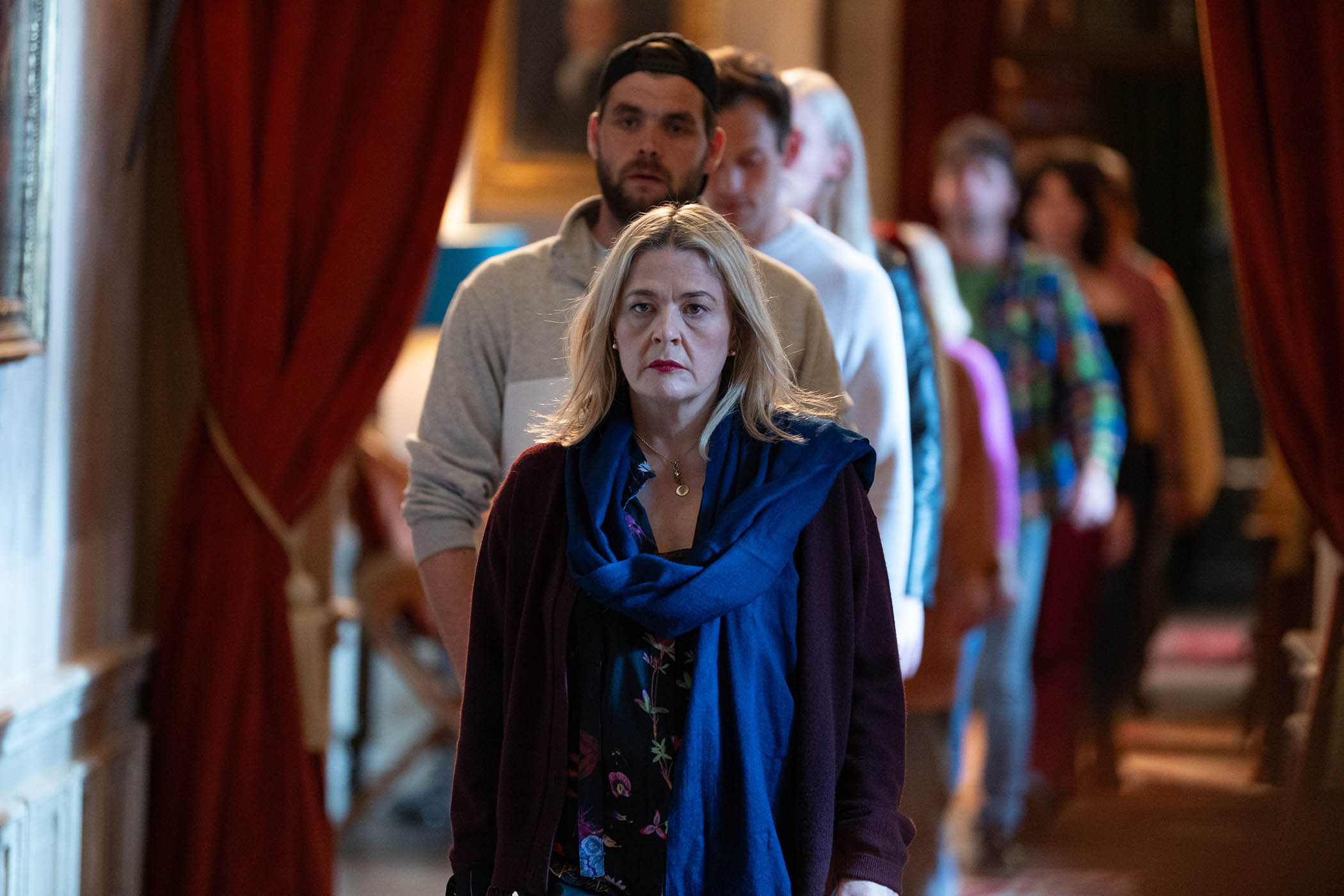
Tyce has written five novels
Was she disappointed that none of the other Traitors contestants recognised her as a chart-topping author? She laughs. “Before we filmed I asked AI to calculate the odds of 21 strangers from the UK recognising my name. It was very uncomplimentary.
“Despite Blood Orange doing so well, I do bookshop events where I’m lucky if there are 15 tickets sold. I just don’t think people recognise writers.”
That’s changed post-Traitors. A forthcoming bookshop tour to promote Witch Trial is practically sold out. Publishing trade magazine the Bookseller reported in January that sales of Tyce’s books were up 96 per cent during the series being broadcast. And despite spectacularly crashing out of the show, she earned herself a lot of fans.
Traitors host Claudia Winkleman said Tyce’s breakfast outburst was “magnificent”, and sports pundit Clare Balding, appearing on the analysis companion show The Traitors: Uncloaked, said she thought Tyce was winning at life, if not the game.
Writers are often deemed to be insular, isolated types, not the sort to put themselves in the spotlight on a TV reality game show. Not so Tyce.
“I’ve always loved Traitors,” Tyce says. “I have an ego, obviously, and I clearly like the idea of myself on telly. Back in the 2000s, there was a small part of me that thought, ‘Oh, Big Brother looks interesting’ but then it turned into a monster and going on that would be like throwing yourself to the wolves.” She’s not done yet, though.
“Well, I have applied for The Great British Bake Off,” she says. “I love that show too and I can cook, so we’ll see.”
Witch Trial is published by Wildfire Books (£18.99) on 26 February. Order a copy at The Observer Shop for £17.09. Delivery charges may apply.
Additional photographs by BBC/Studio Lambert/Euan Cherry