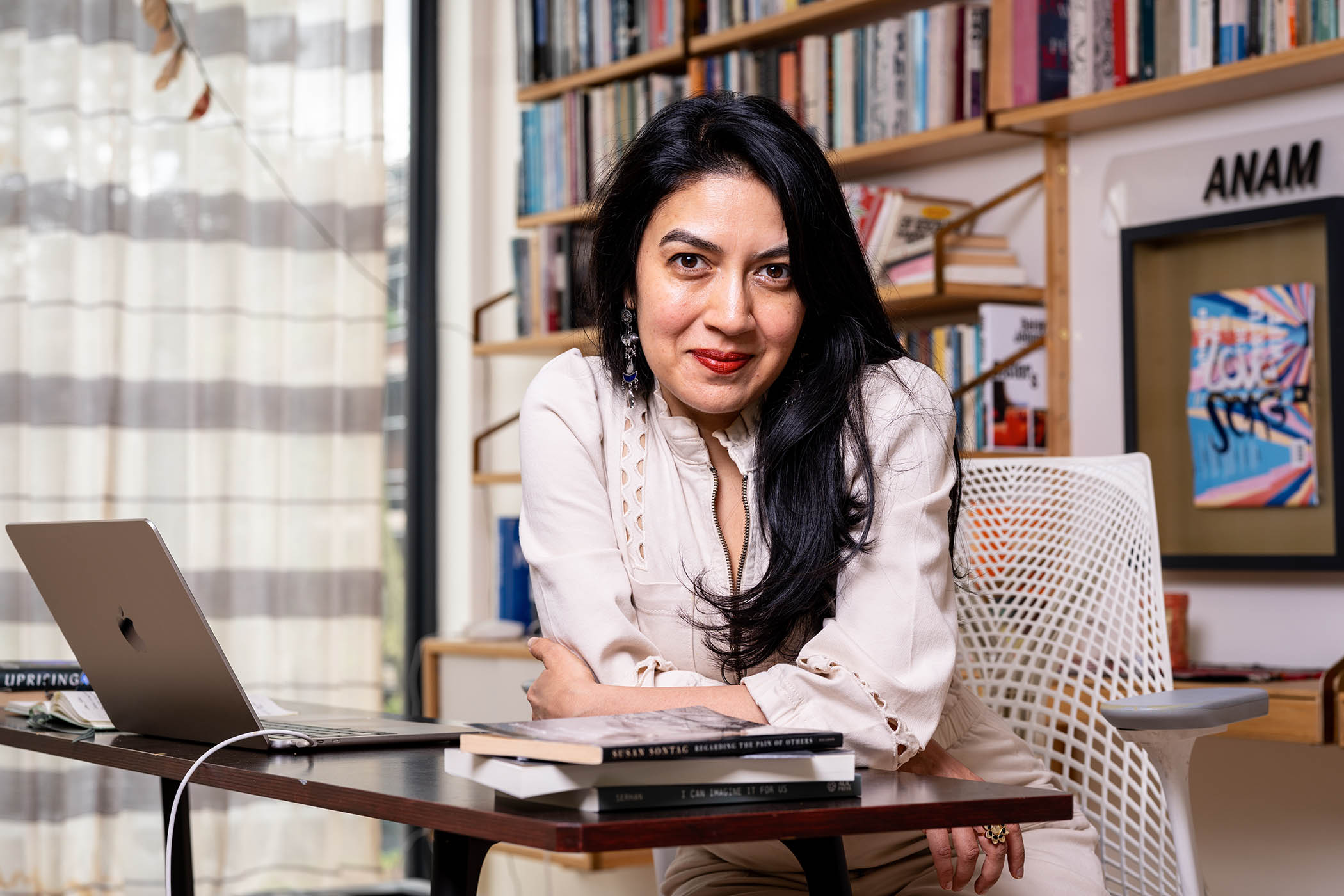
Portrait by Antonio Olmos for The Observer
The novelist Tahmima Anam, 50, was born in Dhaka, Bangladesh, trained as an anthropologist at Harvard University and now lives in London. Her debut novel, 2007’s A Golden Age, was awarded the Commonwealth Writers’ prize for best first book and began her Bengal trilogy. Her latest novel, Uprising, was published earlier this month and is a finalist for the Orwell prize for political fiction. Set on an island inhabited by sex workers, to which men travel by boat, it follows an educated woman called Kusum who galvanises her fellow women in a bid to remove the island’s cruel madam.
Uprising has its basis in fact. Tell me about that.
I got married 15 years ago. My husband and I took an overnight bus from Dhaka, where we’d had this big Asian wedding, to the south of the country to go on a cruise to the mangrove forest. We got into our boat, and as we were heading out into the forest, one of the guides said: “Look, that’s the island of prostitutes.” I couldn’t see anything. It looked just like a bare strip of land. When I came home, I looked it up.
What did you find out?
Bani Shanta is an island where about 100 sex workers live with their children. Prostitution is legal in Bangladesh, so it’s a state-licensed brothel. But there was a period of time when a lot of the women were trafficked to the island. Only after I finished the book [did I travel there] – I wanted to use my imagination to write it. [But when I did,] I met many of the women.
What did you learn?
There is both a sense of them feeling extremely trapped there – they have family members outside the island, but nobody knows that they’re sex workers; they think they’ve gone away to work in a factory, and [the women] send money home – but also a sense that the idea of shame does not exist, because everybody is a sex worker. There isn’t a larger society to shame you. There is a power to that. But it’s also true that the women who live there are in incredible pain and are the victims of a larger system, whether it’s trafficking or poverty or patriarchy, or all of those things.
How did that story become Uprising?
At first, I thought: “I can’t write this novel, because what would I say – that this is a terrible place with a lot of human suffering?” What would be the point?
What changed?
I sat with it for a long time, but it didn’t leave me. I wrote a bunch of other books. And then I had this idea that I would make the novel about a rebellion – the end of the suffering. I’m fascinated by movements of protest. My parents were both very involved in the Bangladesh war of independence and are deeply political activists. That protest spirit is the main characteristic of my family life.
Is that spirit in you too?
Of the members of my family, I am the least directly an activist. I chose writing, and writing novels is an act of inhabiting other selves. When you write a novel, it’s not helpful to occupy a black and white position: it’s helpful to ask questions, to pose problems. I consider myself an activist in spirit, but I’m a writer first and foremost, and that is where I live – in the grey areas.
You tell the story from the perspective of the children of the women on the island, as ‘we’.
The voice of the children arrived almost fully formed. I welcomed it, because if you tell the story from the perspective of the women, you have to describe things that I did not want to describe. This gives the reader a tiny bit of distance from the violence.
It also gives the book a mythic quality.
When my editor read the book, she said: “This story was sent to you by the ancestors.” It did feel that it was a story beyond time.
Were there real-life models for Kusum’s protest tactics?
She has a few influences. One is the 4B movement in South Korea, in which women eschew interaction with men. Another is the dirty protests of the 1970s and 80s, when Irish republican men who were protesting the conditions of their incarceration smeared their faeces on the walls of their prison. When the women did it, they smeared their faeces and their menstrual blood on the walls, and that was considered to be way more disgusting.
Which books inspired Uprising?
One is a novella called Sultana’s Dream by Rokeya Sakhawat Hossain [1905]. It is probably the first ever depiction of a feminist utopia. It’s about a woman who has a dream about a place called Ladyland, where the women rule society through the use of technology and the men are cloistered and basically imprisoned. It’s pre sci-fi.
Describe the experience of writing Uprising.
I have two children, and I always have enjoyed writing in the mess of family life. But when I sat down to write this book, I had to go to a very dark place in my mind. One time when I was writing a passage about Amma [the island’s madam], I was physically ill. I wrote the passage, and then I vomited violently into the toilet. I thought to myself: “Am I a psychopath? Why did my brain go there?” It was really disturbing to me. But sometimes when you write, you have to plumb the parts of yourself that you’re ashamed to admit exist. And I couldn’t do that around the children.
Where did you go?
My sister-in-law lives in Paris. She said: “If you rent a room in my neighbourhood, I will feed you dinner, but I won’t make you stay and clean up or talk to me.” It was such a gift. I rented a room that was so small, it was like a garret. I went there three or four times for a week at a time and I would write for 10, 12, 15 hours a day.
What are you reading at the moment?
On Morrison, a book of essays by Namwali Serpell about Toni Morrison. It’s like attending a graduate seminar on Toni Morrison, and she is one of my writerly and moral idols. That’s been my greatest joy in the last few months.
Uprising by Tahmima Anam is published by Canongate (£16.99). Order a copy from The Observer Shop for £15.29 (10% off RRP). Delivery charges may apply
Related articles:

Newsletters
Choose the newsletters you want to receive
View more
For information about how The Observer protects your data, read our Privacy Policy