
In the second chapter of Dark Renaissance, Stephen Greenblatt’s dazzling new biography of Christopher Marlowe, there is a vivid account of the verse “libel” that, in early May 1593, was nailed to the wall of the Dutch Church in London. This was the place of worship of Protestant refugees who had crossed the channel in small boats, escaping from brutal sectarian wars in France and the Netherlands. The poem ends chillingly:
Since words nor threats nor any other thing
Can make you to avoid this certain ill,
We’ll cut your throats, in your temples praying.
Not Paris’ massacre so much blood did spill
As we will do just vengeance on you all.
Greenblatt paraphrases its purport in modern English: “You have caused our rents to rise. Your cheap, gawdy goods drive ours out of the market. You live far better here than you did back where you came from. Our soldiers are sent abroad to fight in your wars. You have forced us out on to the streets. You will make us all starve and die.” His rendering of these sentences in italics needs no more explanation than the timeliness of his previous book, written during the first Trump administration, Tyrant: Shakespeare on Politics.
In his closing acknowledgments, Greenblatt explains that in the 1990s the screenwriter Marc Norman sought his expertise in connection with the script of a movie about Shakespeare that he was working on. The professor’s response was: give it up and write a biopic of Marlowe instead. This excellent advice was ignored, then mercifully the studio brought in Tom Stoppard for a makeover and the result was the glorious, Oscar-winning Shakespeare in Love, in which Rupert Everett has a bit part as the Canterbury-born rival of the Stratford man. There is a memorable moment when “Kit” gives some advice to Will, who is suffering from writer’s block: “Start with something lovely, temperate and thoroughly trite. Gives you somewhere to go.” This, of course, becomes “Shall I compare thee to a summer’s day?” The film plays ingeniously with the idea that Marlowe’s premature death in 1593 – stabbed above the eye with a twelvepenny dagger during an argument over the tab at a pub in Deptford – was to Shakespeare’s advantage, giving him a clear run as the stage’s top writer.
The similarities have long been noticed. Both were born in the same year, 1564; both came from lowly trade families (glover’s son in the Midlands; cobbler’s in east Kent); both attended their local grammar school; both had siblings who lived undistinguished lives (one of Marlowe’s sisters was made pregnant at the age of 12). And the line of influence is clear: Shakespeare’s Richard II is a response to Marlowe’s Edward II, minus the screaming homosexuality (the gay king put to death by means of a red-hot poker up the arse); Shakespeare’s Shylock is a riposte to Marlowe’s Barabas, Jew of Malta, with the antisemitism leavened in the former by “Hath not a Jew eyes?” Shakespeare seems to have learned from Marlowe’s grisly end. He was less melodramatic, more humane and always politically cautious – the only major dramatist of the period not to have been imprisoned or censured for a misstep. Marlowe, by contrast, threw caution to the wind and relished the art of empathising with rapists, murderers, atheists and the devil himself.
Some time after leaving Corpus Christi College, Cambridge, Marlowe entered the theatre world and staged a two-part blockbuster that revolutionised the Elizabethan stage. Its full title when published – the only one of his works to appear in print in his lifetime – was Tamburlaine the Great. Who, from the state of a shepherd in Scythia, by his rare and wonderful conquests, became a most puissant and mighty monarch, and (for his tyranny and terror in war) was termed, the Scourge of God. It was a huge hit, with audiences not even deterred by a health-and-safety-defying incident in which misfired arrows in one of the battle scenes flew into the crowd and killed a child and a pregnant woman (interesting evidence that theatre was beginning to be regarded as an afternoon out for all the family). But what caught the ears of the cognoscenti was how Tamburlaine soared with verse of an audacity and beauty unprecedented in the language:
Newsletters
Choose the newsletters you want to receive
View more
For information about how The Observer protects your data, read our Privacy Policy
Nature, that framed us of four elements
Warring within our breasts for regiment,
Doth teach us all to have aspiring minds:
Our souls, whose faculties can comprehend
The wondrous architecture of the world
And measure every wandering planet’s course,
Still climbing after knowledge infinite,
And always moving as the restless spheres,
Wills us to wear ourselves and never rest,
Until we reach the ripest fruit of all,
That perfect bliss and sole felicity,
The sweet fruition of an earthly crown.
Marlowe’s essence is here. To make an earthly crown the “bliss and sole felicity” that customarily belongs to heaven was a shocking blasphemy in an essentially theocratic age. As Greenblatt writes, “The lust for power – secular ambition at its most naked, with no end other than its own realisation – is here given its supreme expression.”
His book begins with a chapter on England as a cultural backwater in the reign of Queen Elizabeth I. Greenblatt makes the excellent point that swathes of Italian, French and Spanish works, as well as Latin and Greek, were translated into English during the 16th century, but virtually no English works translated into European languages. There were hardly any writers of merit prior to Marlowe. Apart from a brief flowering of court poetry in the reign of Henry VIII – the Earl of Surrey and Thomas Wyatt, who introduced blank verse and the sonnet into English – nothing else has survived the test of time until the boom in theatre and poetry in the final decade of the century. The staging of Tamburlaine in 1587 was indeed a breakthrough – though Greenblatt perhaps underestimates the importance of Edmund Spenser’s poetry in the previous decade.
Audiences were not deterred by an incident in which misfired arrows in one of the battle scenes flew into the crowd and killed a child and pregnant woman
Audiences were not deterred by an incident in which misfired arrows in one of the battle scenes flew into the crowd and killed a child and pregnant woman
Another of the best lines in Shakespeare in Love was that of the water-taxi man: “I had that Christopher Marlowe in my boat once.” This was astute as well as funny, because in the early 1590s, Marlowe was famous in a way that Shakespeare would not be until at least the end of the decade. One should rather say infamous – and that was witnessed by the Dutch Church libel, since it bore the signature “Tamburlaine” and pointed to Marlowe in its reference to The Massacre at Paris, his dramatisation of the St Bartholomew’s Day pogrom of Protestants, and its juxtaposition of “Machiavellian” and “the Jews”, evoking his hugely successful The Jew of Malta, which begins with a prologue spoken by a personification of Machiavelli.
Greenblatt provides a gripping narrative of what followed the posting of the libel. Within days, officers of the Star Chamber – the powerful judicial arm of the Queen’s Council – raided the lodgings of Thomas Kyd, Marlowe’s former roommate (and possible writing partner), author of the other hit play of the time, The Spanish Tragedy. Kyd, who was subsequently tortured, handed over a document assumed to be Marlowe’s, claiming that Jesus Christ had a sodomitical relationship with John, the disciple “whom he loved”. Marlowe was called in for questioning, but before he could defend himself he met his end at the widow Bull’s place in Deptford, in the company of the deliciously named villains Robert Poley (a government spy), Nicholas Skeres (a conman) and Ingram Frizer (the knifeman, who was acquitted of the murder). The presence of these shadowy figures has led to many a conspiracy theory about Marlowe’s death. Was it entrapment? Assassination ordered by the queen herself? Extraordinary rendition, with a substitute body presented to the coroner? Greenblatt sensibly keeps an open mind, but there is no doubting that Marlowe was himself a government asset.
Another of the most striking moments in this biography, which does indeed at times read like something out of Le Carré, is the account of how Marlowe was denied his MA for failing to fulfil Cambridge University’s residence requirement. But then the university authorities received a letter from the highest ranking members of the Privy Council, “some of the most powerful people, next to the queen herself, in the land: Lord Archbishop, Lord Chancellor, Lord Treasurer, Lord Chamberlain, Master Comptroller”. It said that his absence from college was due to his having “done her Majesty good service”. The rumour that Marlowe had been dabbling with Catholicism at the English college in Reims should be quashed forthwith, the letter insisted, and “he should be furthered in the degree he was to take this next commencement”.
Years ago, an excoriating essay in the New York Review of Books by the venerable Cambridge scholar Anne Barton accused Greenblatt of carelessness as to detail, so swept up as his work was with stylish and novel claims. Reviewers are duty-bound to search for errors and wild assertions, but on this occasion the research seems to me as impeccable as the book is readable. Whereas Will in the World, Greenblatt’s bestselling biography of Shakespeare, did have a surplus of the words “might”, “may have”, “perhaps” and “must have”, here nearly all the speculations are grounded in evidence. The most fanciful claim – that Marlowe’s exceptionally well-read headmaster at the King’s School, Canterbury, might have granted the clever little boy access to his personal library in return for sexual favours – is presented as just that, a fancy with the symbolic purpose of emphasising Marlowe’s prodigious learning.
As for errors, the only cross I was able to pencil in the margin was the claim that among the many accomplishments that made Renaissance Italy superior to England before the Marlowe revolution was “the founding [at Padua in 1545] of the first botanical gardens for the scientific study of plants”. This ignores the sophistication of earlier Aztec culture – the botanic gardens of Nezahualcoyotl at Texcotzingo and Moctezuma at Oaxtepec were founded in Mexico a century earlier. But of course they were wiped out by the Tamburlaine-like depredations of Hernán Cortés and his followers, a reminder of the long history of empires, conquests and the concomitant plight of refugees. Which sends us back to the Dutch Church libel and Shakespeare’s very different attitude to asylum seekers, as expressed in the collaborative play Sir Thomas More, to which Marlowe was not a contributor:
Grant them removed, and grant that this your noise
Hath chid down all the majesty of England;
Imagine that you see the wretched strangers,
Their babies at their backs and their poor luggage,
Plodding to the ports and coasts for transportation,
And that you sit as kings in your desires,
Authority quite silenced by your brawl,
And you in ruff of your opinions clothed;
What had you got? I’ll tell you: you had taught
How insolence and strong hand should prevail,
How order should be quelled; and by this pattern
Not one of you should live an aged man,
For other ruffians, as their fancies wrought,
With self same hand, self reason, and self right,
Would shark on you, and men like ravenous fishes
Feed on one another.
Dark Renaissance: The Dangerous Times and Fatal Genius of Shakespeare’s Greatest Rival, Christopher Marlowe by Stephen Greenblatt is published by Bodley Head (£25). Order a copy from The Observer Shop for £22.50. Delivery charges may apply
Editor’s note: our recommendations are chosen independently by our journalists. The Observer may earn a small commission if a reader clicks a link and purchases a recommended product. This revenue helps support Observer journalism
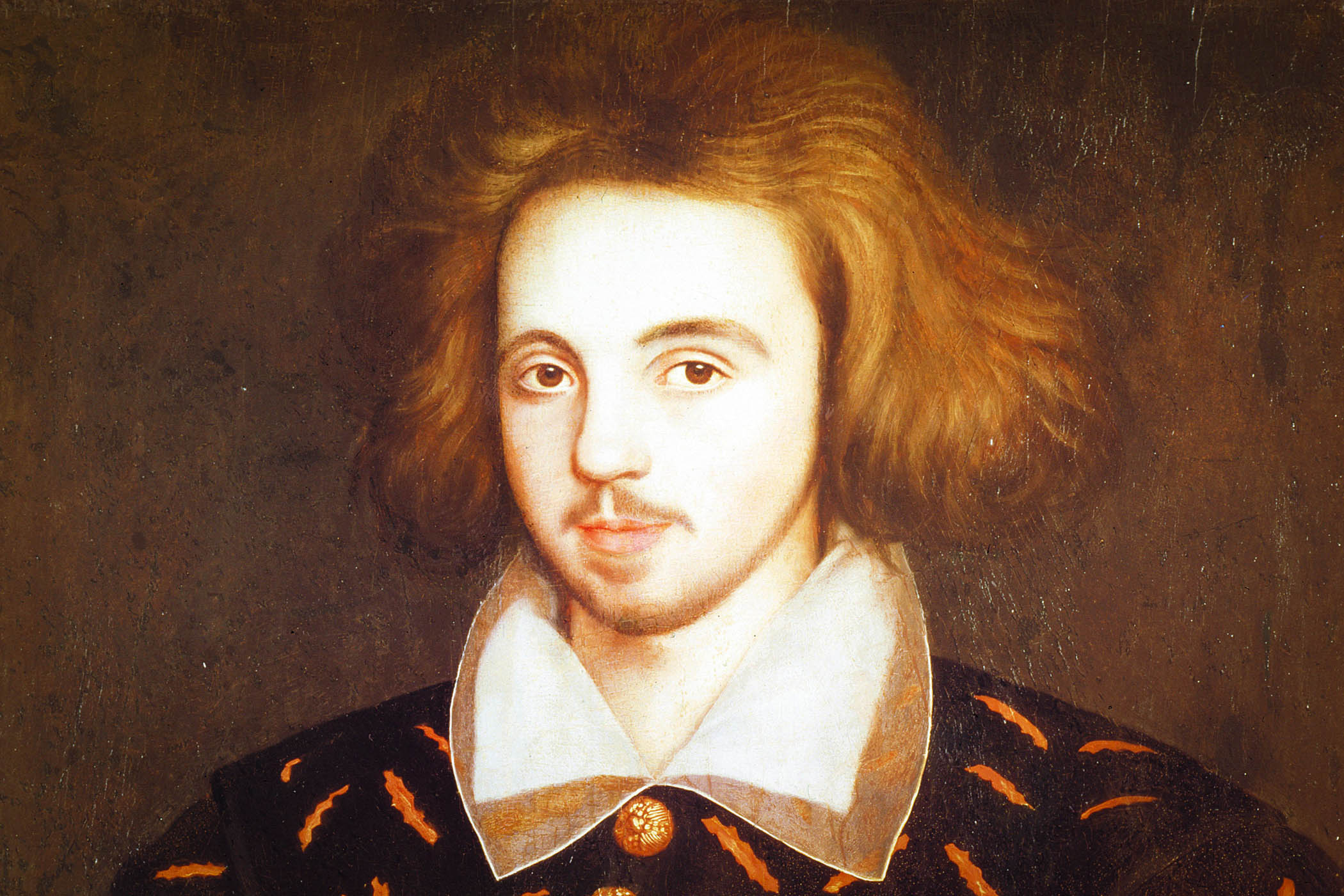
Portrait of Christopher Marlowe courtesy of Alamy