


The power structure of the US military-industrial complex has changed beyond recognition since President Eisenhower famously warned of the dangers it posed to civil society more than 60 years ago. Back then, the government called the shots. It was deeply involved in critical research and development programmes for the military. And it could pick and choose between dozens of manufacturers when buying its weapons systems.
Since then, responsibility for product development has been handed over in large measure to the private sector. A series of mergers in the defence industry has concentrated power into the hands of half a dozen giant contractors, such as Lockheed Martin or General Dynamics, and this trend is likely to continue. Many of the weapons of the future, above all those including artificial intelligence, are likely to come from a small set of very large tech companies that will drive many established weapons manufacturers out of business.
The process is already under way. Palantir, a company that builds software capable of managing and analysing enormous volumes of data, is now valued by the stock market at nearly four times the figure for Lockheed Martin. And its leadership is about as far removed from the buttoned-up executives of the old defence industry as it is possible to imagine.
The company was founded in 2003 by Peter Thiel, the libertarian tech billionaire, in direct response to 9/11, and its prime mission from day one has been the development of digital technology to defend the US and the west from their enemies. The driving force almost from the beginning has been its chief executive, Alex Karp, the subject of this well written and researched book by the journalist Michael Steinberger.
Karp’s background is unlike that of any of his peers. He had no business or technology experience when he took leadership of the company at the age of 36 – positively geriatric by tech industry standards. He befriended Thiel at a time when they were both bored out of their skulls at Stanford Law School, and then went on to complete a doctorate in social theory at Goethe University Frankfurt – an ambitious undertaking since at the time he didn’t speak German. Not long after Karp’s return, Thiel invited him in to take a look at his new company and soon appointed him chief executive.
This turned out to be a smart move for a company whose activities were bound to arouse suspicion. Part-funded in the early stages by the CIA, Palantir is a secretive organisation involved in the mass surveillance business, and Thiel – who remains as chair – is regarded with loathing by the left. Karp was a self-described progressive who could argue brilliantly about the importance of privacy protection, and had the ability to justify Palantir’s activities in terms of civil liberties. If it hadn’t been for the company’s technology, he would say, terrorist outrages in the west would inevitably have led to the rise of the far right. “The ability of free and democratic societies to prevail requires something more than moral appeal,” he argued. “It requires hard power, and hard power in this century will be built on software.”
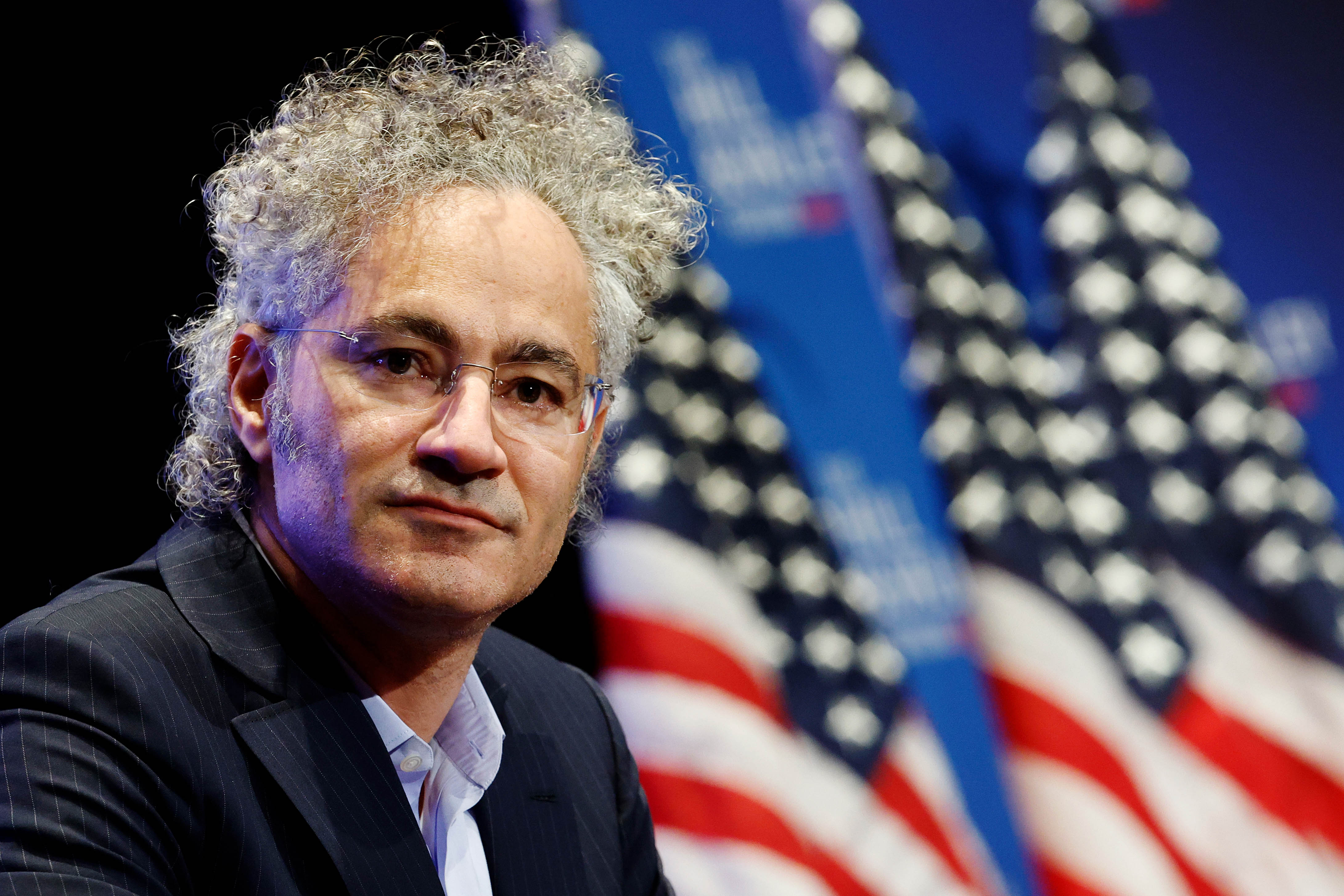
Karp had no business or technology experience when he took leadership of Palantir
Karp had no business or technology experience when he took leadership of Palantir
Karp cultivates an air of intrigue – he only smiles ambiguously when asked if his software helped to track down Osama bin Laden. Severely dyslexic and mixed race, with a black mother and Jewish father, he has always seen himself as an outsider. He lashes out at those he considers enemies: Wall Street analysts; Facebook (a company he thinks has lured America’s best talent into selling rubbish advertisements); and former employees who have quit on ethical grounds. When not travelling, he lives in large houses along with his bodyguards and Norwegian ski instructors (he’s a cross-country fanatic).
Palantir has a large commercial business, including a £330m contract to help build a new data platform for the NHS. But its other activities are what has made it widely feared and loathed. The company has been working with US Immigration and Customs Enforcement – ICE – for years and this year signed a $30m contract for a new software platform to expedite deportations. Five years ago, Amnesty International said there was “a high risk that Palantir is contributing to serious human rights violations” of migrants by the US government.
Palantir’s work with police departments has been equally controversial. In Los Angeles, for example, its technology has become a general investigative tool for the police department, used among other things for predictive policing, a controversial practice that pinpoints areas prone to crime and individuals who are likely to commit or fall victim to crime. Critics of this approach say it reinforces biases in the US criminal justice system and inevitably leads to racial profiling.
Steinberger believes that the horrific attacks in Israel on 7 October 2023 have shaped and hardened Karp’s thinking. He was outraged that so few US business leaders sprang to Israel’s defence: shortly after the terrorist act, he and Thiel visited Israel and signed a contract formalising Palantir’s relationship with the country’s Ministry of Defence. A former donor to the Democrats, Karp is now full of praise for Donald Trump following the US attack on Iranian nuclear facilities in June, an operation in which Palantir software played a part. The company is among those to have contributed to the cost of the new White House ballroom.
Newsletters
Choose the newsletters you want to receive
View more
For information about how The Observer protects your data, read our Privacy Policy
Karp’s view of the world today is illustrated in a bestselling book he published earlier this year, The Technological Republic. Among the opening quotes is a chilling line from the American foreign policy academic Thomas Schelling: “The power to hurt is bargaining power. To exploit it is diplomacy – vicious diplomacy, but diplomacy.”
Karp devotes pages to what he describes as the essential failure of the contemporary left to talk about national identity. He says the necessary task of building a nation, of constructing a collective identity and shared mythology, is at risk because we’ve grown too fearful of alienating anyone in the process. But as Steinberger points out, Karp has nothing to say about the rise of the populist right and the threat it poses to democratic governance in the west, and he gives no indication that he regards democracy and its underpinnings as essential to the west’s success and continued prosperity.
The question then arises: to whom is Palantir accountable? It’s something that Karp himself acknowledges in his book, when he asks: “What will happen when the defence products of the future, including the artificial intelligence software that will enable the battles of this century, are made by an increasingly concentrated set of companies in Silicon Valley – a sliver of land in a single part of the country?”
And in that, perhaps surprisingly, he is echoing what President Eisenhower had to say in 1961. “In the councils of government,” Eisenhower warned, “we must guard against the acquisition of unwarranted influence, whether sought or unsought, by the military-industrial complex. The potential for the disastrous rise of misplaced power exists and will persist… Only an alert and knowledgable citizenry can compel the proper meshing of the huge industrial and military machinery of defence with our peaceful methods and goals, so that security and liberty may prosper together.”
That seems unlikely to happen any time soon. President Trump is in the White House, and Karp is promising explosive growth for Palantir in the next few years. The balance of power is continuing to swing in a troubling direction.
The Philosopher in the Valley: Alex Karp, Palantir and the Rise of the Surveillance State by Michael Steinberger is published by Simon & Schuster (£25). Order a copy from The Observer Shop for £22.50. Delivery charges may apply
Editor’s note: our recommendations are chosen independently by our journalists. The Observer may earn a small commission if a reader clicks a link and purchases a recommended product. This revenue helps support Observer journalism
Photography courtesy of Kevin Dietsch/Getty Images