Portrait by Suki Dhanda for The Observer
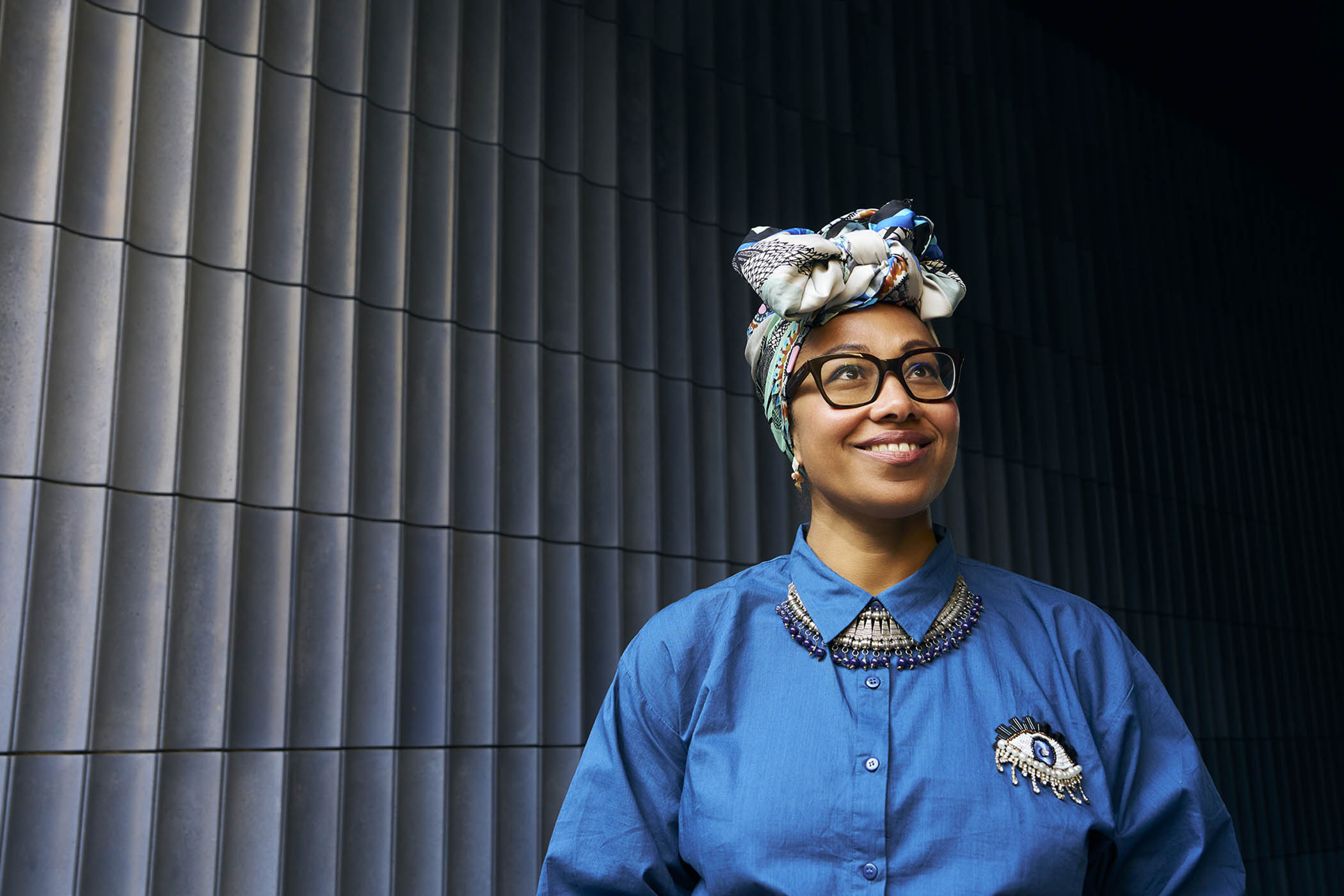
Yassmin Abdel-Magied, 35, is an essayist, children’s and YA author, and award-winning social advocate. She was born in Sudan and moved to Australia at 18 months old. After studying mechanical engineering she worked as a drilling engineer on oil rigs across the world. In 2017, she described herself as “Australia’s most publicly hated Muslim” after receiving a torrent of online abuse following comments she made about Islam and Palestine. The same year she moved to London, where she still lives. Her first adult novel, At Sea, follows Zainab, a driller who is called upon to lead an oil rig operation on the brink of disaster.
Where did the idea for At Sea come from?
There are two elements that fed in. One was my long-term obsession with technical disasters, specifically the Deepwater Horizon explosion [of 2010]. I do a lot of work on organisational strategy and I use that example to show how groupthink and confirmation bias have a huge effect on the decisions we make. At the same time, when I started to take my writing more seriously, I realised there was nothing I’d read that speaks to an experience I’m really familiar with – being an outsider on an oil rig, which is such a specific, rich environment.
Tell me about your experience working on offshore oil rigs.
I was 20 when I started. I was the first woman who was hired in my department in Australia. In my first role, I was a contractor and could be away for anything from two to nine weeks. Then I became a drilling engineer, which is a lot more structured: three weeks on, three weeks off. I’m nostalgic for elements of that life – the thrill of it, and the fact that with every job you have no idea what’s going to happen. But I think I would have found it harder and harder to swallow the contradictions that Zainab does.
Zainab is a Muslim woman in a very macho setting. Why did you want to explore that dynamic?
She categorises the men mentally: “this is the kind of man that requires this kind of handling”, or “this guy needs his ego massaged”. I wanted to explore how women will either become super professional in order to make themselves not be seen as a woman or a man but just a professional being, or they’ll lean into more archetypal masculine roles. It’s an extreme environment, but what we’re talking about are the dynamics of being an outsider, and the ways in which you don’t always try to change the system, but you find ways to navigate it.
The rig setting makes for a claustrophobic novel.
Newsletters
Choose the newsletters you want to receive
View more
For information about how The Observer protects your data, read our Privacy Policy
I love a chamber piece. I love a single location. I love a thing happening over a single dinner. There was an early version that had multiple timelines and was about the history of petroleum. It became unwieldy. I had to ask: “What is the actual story I’m interested in telling?” For me, the essence was: how do you hold on to what you know to be true in the face of crisis when everyone around you doesn’t believe you?
It must feel rather unfashionable to write about Big Oil now. How does the climate fit into this for you?
When I was first shopping this book around, I had agents reject it because they were like, “I can’t ethically work on a book about oil and gas because of the climate crisis.” I thought that was a shame because maybe they were missing the point. It’s not like everyone I knew who worked on the rigs was a true believer in the oil and gas industry. I was trying to write a book about a larger point to do with the environment, using the most unlikely allegories – because ultimately, the question of how you hold on to truth when no one believes you is something that a lot of folks in the climate movement feel too.
There’s an omniscient voice who speaks between chapters who gets at the environmental question too.
I don’t name it, it could be Mother Nature, but it is a force bigger than us that is adding to that sense of foreboding, saying: “The signs were there, did you not pay attention?” I wanted the grandest, most awe-inspiring voice, and as a Muslim person, I turned to the Qur’an for inspiration.
Which other books inspired At Sea?
I drew inspiration from science-fiction. The book that became a north star was Children of Time by Adrian Tchaikovsky. It’s completely out of the realm of anything you can ever have imagined, but it feels so emotional. The other novel I picked up, which is very different, is [Aleksandr Solzhenitsyn’s] One Day in the Life of Ivan Denisovich, about the gulag. What was inspiring from that was the minutiae of life in that world.
How is being a Muslim in London different to being a Muslim in Australia?
I don’t know if you could find two poles that are further apart. I live in a part of London where the majority of people walking down the street wear a headscarf. [In Australia] I was the first girl in my high school to wear a headscarf and the majority of the schools that I applied to wouldn’t allow a child to wear one. No city is perfect, but in London I have always felt like I’m part of a collective who has my back. I did not feel like that in Australia.
You’re a writer for Emmerdale. What has that taught you about British storytelling?
It is truly the most British of the soaps. It’s taught me a lot of Yorkshire slang. But it’s also taught me that no matter where you are in the world, humans are humans. You have the same familial dynamics, the same hatreds and betrayals and loves and highs and lows. You could take these storylines and, with a bit of tweaking, put them in a village in Sudan, and they would all translate. That’s why I love writing stories: when you get down to it, humans want and desire and fear – and that’s universal.
At Sea by YM Abdel-Magied is published by Canongate (£16.99). Order a copy from The Observer Shop for £15.29 (10% off RRP). Delivery charges may apply