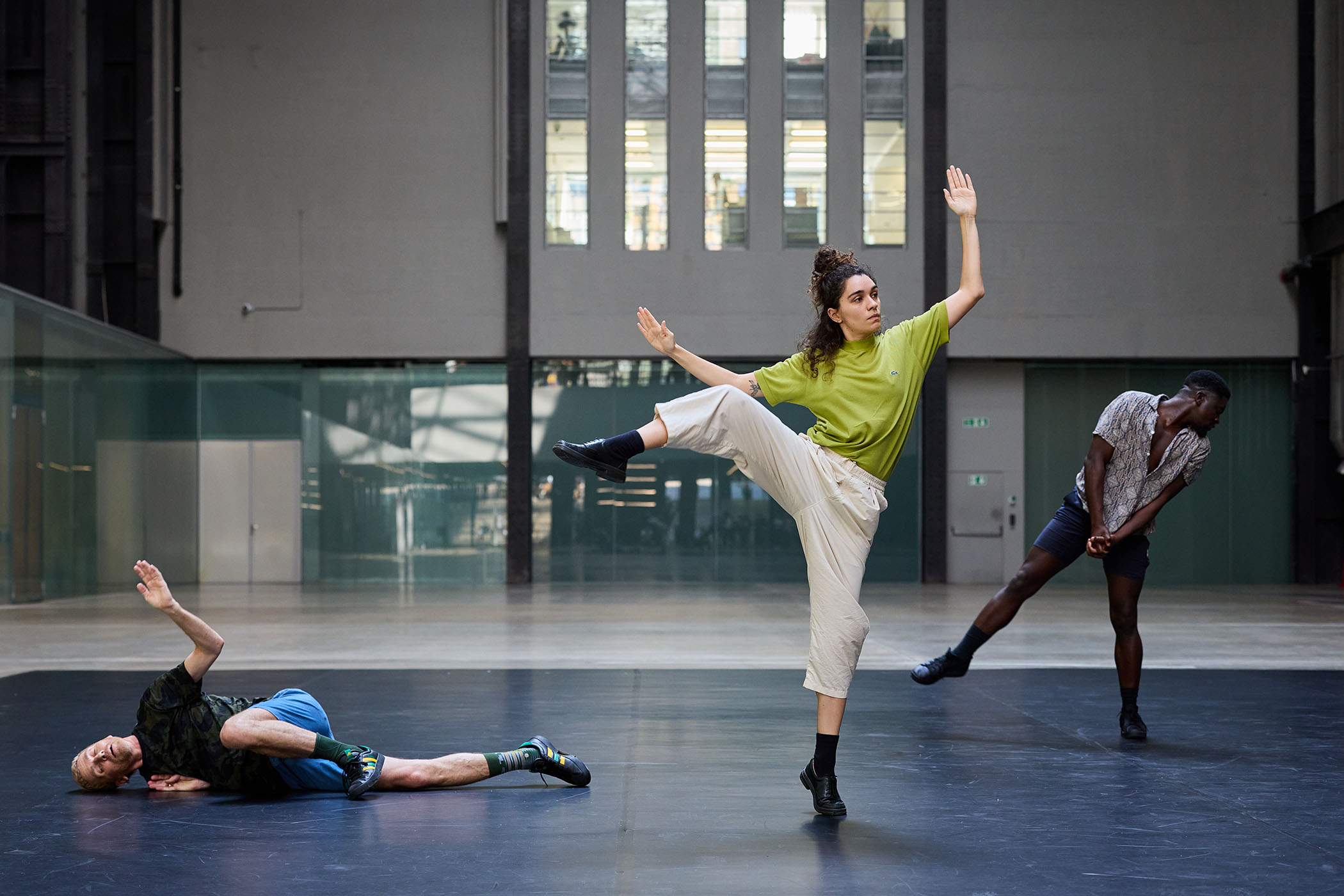
Tate Modern’s Turbine Hall is a wonderful setting for dance. Some of the greatest performances of the past two decades have unfolded under its sky-high ceiling and within its industrial walls: William Forsythe’s dancers flying over white tables in geometric shapes at the building’s inception; Michael Clark’s elegant company tipping and dipping like exotic birds; Merce Cunningham sitting on the balcony that bisects the space, looking down on his performers as if he were a benevolent god.
Yvonne Rainer’s Trio A is rather quieter but just as revolutionary, one of the key works in the contemporary dance history performed, more or less continuously, over two afternoons and evenings to mark the 60th anniversary of its premiere. Rainer, now 91, is one of the last of the Judson Church pioneers, the choreographers who transformed dance by bringing it so close to everyday movement that if you just happened across a performance you might think you could join in.
Some people tried to do exactly that on the night of its premiere in the Judson Memorial Church in downtown New York in 1966 but quickly discovered its deceptive difficulty. Rainer had worked on the piece for years, experimenting with found movements woven into an unbroken shape. She demanded that the piece – originally a solo – should be performed with “uninflected continuity”, a surprisingly difficult demand to make of a dancer.
Each of the movements is precisely choreographed, but it is up to the dancer how fast or slowly they perform them, so the duration alters as the performance unfolds. Crucially, however, they must not make dancerly phrases. Each gesture, every tiny step, jump or extension is given exactly the same importance as the next. Nor must the dancer at any time make eye contact with the audience: they move as if they are dancing only for themselves.
The work repays repeated, patient viewing, giving up its secrets slowly
The work repays repeated, patient viewing, giving up its secrets slowly
At Tate, the first iteration I watched involved six of the 16 dancers performing the work, here staged by Martin Hargreaves and Sara Wookey. They walk in slowly from the back of the Turbine Hall, as the afternoon light streams through the long windows.
All start the routine, which runs to about six minutes, with their arms swinging, as if – according to Rainer – they have rocks suspended from their wrists. All end with a little tap of the toe at the back of their standing leg. Though they all begin together, their different speeds mean that sometimes one dancer’s pattern races ahead of another; sometimes they catch up and so fall into unintentional unison.
Later, three dancers enter together but take to the sprung floor at different times so that the steps unfold in a canon. Later still, one man moves through the space alone. Within the routine, there are little hops and skips; some dancers make them folksy, others lend them weight. There is a handstand and a body roll. There are hands that shape and clutch around the head, and feet that twist into a hook.
The work repays repeated, patient viewing, giving up its secrets slowly. The dancers don’t emerge as personalities – that would be against Rainer’s carefully neutral aesthetic – but the way they shape movement in space becomes infinitely fascinating.
In a room to one side of the Tanks performance space, Tate was also showing a film of Rainer herself dancing the piece as a solo in 1978. On a zoom lecture she participated in as part of the weekend, she said she could see only the flaws. Yet it seems pretty flawless. Dressed all in black, with those Chinese work shoes so popular at the time, she has a casualness that today’s dancers struggle to catch, a sense of utter absorption in movement. It’s a flickering memory of a time when dance was remaking itself.
Photograph by Reece Straw/ Tate Photography, Yvonne Rainer
Newsletters
Choose the newsletters you want to receive
View more
For information about how The Observer protects your data, read our Privacy Policy