
The end of civilisation is a forked road. One path leads up, to the highest ideals of human society. One path leads down, with the embrace of base cruelty and hate. It is, put simply, a question of good versus evil.
Nia DaCosta’s stylish, savage instalment of the seminal zombie series is starker and more extreme than the last, 28 Years Later, directed by Danny Boyle. While that picture presented life alongside the infected as a murky middle ground, with the small minds, shrunken horizons and Brexity insularity of fortified micro-communities, DaCosta’s film is a macabre morality tale about the best and worst of human nature. It is utterly brutal, and one of the most compelling so far.
The film, which like 28 Years Later was written by Alex Garland, follows on from the events at the end of the previous picture, in which 12-year-old Spike (Alfie Williams) is rescued from an onslaught of the infected – those zombies ravaged by the “rage virus” – by a tracksuited gang of warriors who call themselves “the Jimmies”, modelled on Jimmy Savile. In Boyle’s film, it felt like a jarring tonal swerve into what seemed, initially, like absurdist humour. But from the first scene of The Bone Temple, it becomes clear that the Jimmies are no laughing matter.
Their cult leader calls himself Lord Sir Jimmy Crystal – he is a monstrous creation by Jack O’Connell who, following his performance in Sinners, seems to be cornering the market in sadistic, charismatic horror villains. At Jimmy Crystal’s instruction, Spike is forced to fight for his life. His options are defeat and slaughter at the hands of a gang member, or triumph and a fate arguably worse than death: he must join the Jimmies and participate in their ritualistic killing rampage.
In desperate times, the film suggests, it is human nature to seek the comfort of a manufactured belief system, but Jimmy Crystal’s doctrine is a twisted, grotesque thing
In desperate times, the film suggests, it is human nature to seek the comfort of a manufactured belief system, but Jimmy Crystal’s doctrine is a twisted, grotesque thing
The Bone Temple is classified as an 18, up from the 15 certificate of the previous film, and it is immediately clear why: we are faced not just with the graphic, artery-spurting carnage of the initial fight scene, but also the sniggering, casual cruelty of the cult leader and his craven acolytes, who perform grisly acts of “charity” at his behest. In desperate times, the film suggests, it is human nature to seek the comfort of a manufactured belief system. But Jimmy Crystal’s doctrine is a twisted, grotesque thing, warped by trauma and spawned from a childhood defined by his preacher father’s religious fervour and TV pop culture.
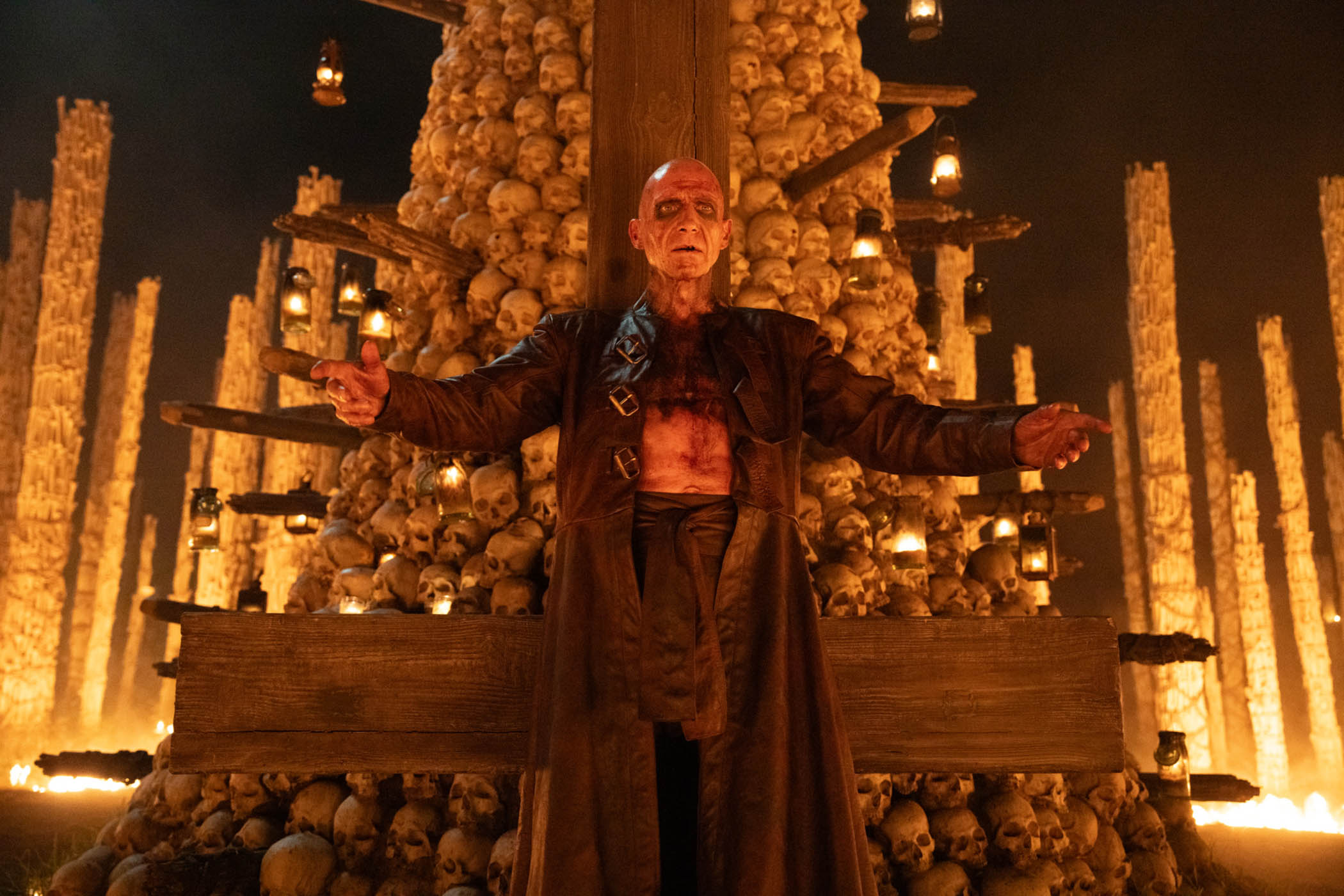
At the opposite end of the spectrum is Dr Kelson (a magnificent Ralph Fiennes, conveying dignity and decency under his filth-smeared exterior). He is the creator of the extravagant memento mori sculpture, the Bone Temple, and a character introduced in the previous picture. Here, we settle into the rhythms of his solitary, hermit-like existence. This is a man who still draws solace and meaning from humanity’s greatest achievements, be they scientific (he keeps detailed notes on the nature of the infected) or artistic (he’s a Duran Duran fan). Crucially, the doctor is open-minded and generous; he seeks human connections, even with the zombies whose souls were obliterated by the virus. The uneasy bond that grows between Kelson and the alpha zombie he names Samson (Chi Lewis-Parry) is a testament to the former’s belief that love is as much a certainty as death (“Memento mori, memento amoris”). And Kelson’s inherent goodness is its own potent message: true virtue doesn’t require an audience, but evil is a performance magnified by being witnessed.
The film is an impressively confident addition to the varied CV of DaCosta, whose previous work includes the horror hit Candyman, the Marvel misfire The Marvels and, most recently, her teasingly sexy Ibsen adaptation, Hedda. What links these disparate titles is DaCosta’s keen embrace of every film-making tool at her disposal: she’s not just a visual stylist (although The Bone Temple looks terrific), but a director as interested in immersive soundscape (created by sound designer Glenn Freemantle) and distinctive use of music. Gloriously unexpected needle-drops slice into the organic, percussive score by Hildur Guðnadóttir (Hedda, Tár) – music that sounds as though it was played on the Bone Temple itself, beaten out with tibia and fibula on a rib cage glockenspiel.
A final sequence dangles a tantalising taster for the third part of the Garland-scripted films. It leaves us with a message – that knowledge is a beacon in dark times – and also a warning: evil is itself an infection, and it can taint all it touches.
Photograph by Sony Pictures
Newsletters
Choose the newsletters you want to receive
View more
For information about how The Observer protects your data, read our Privacy Policy