
There’s no plot to speak of. No tension, no drama. Absolutely no sex or violence. And yet the latest picture from Jim Jarmusch, the understated triptych Father Mother Sister Brother, is utterly compelling. It’s a small treasure of a film that muses on awkward, angular family dynamics through loaded silences, strained politeness and copious tea-drinking.
Even by the standards of Jarmusch’s loose-limbed minimalism this is a low-key work. At first it seems as if someone unscrewed the bolts of his hipster, zen-like style of film-making. But while this may be simple in themes and structure, it is far more precise and detailed than Jarmusch’s last film, the cluttered 2019 zombie flick The Dead Don’t Die.
Father Mother Sister Brother won a Golden Lion at the Venice film festival last year – unexpectedly, since subtle films tend to be drowned out by louder, showier pictures. It marks a return to form for the director, and to the essence of his approach, combining the deadpan observational gaze of early works such as Stranger Than Paradise with the vignette structure of Night On Earth, Mystery Train, Coffee and Cigarettes.
It comprises three stories set in rural New Jersey, in Dublin and in Paris. Each is distinct – there are no links between the characters in each chapter – but they are threaded together by subject matter and playful leitmotifs. They are variations on a theme, in some ways more like three movements in a piece of music than three short films.
The first follows siblings Jeff (Adam Driver, his face an elongated question mark) and brisk, no-nonsense Emily (Mayim Bialik) on a visit to their father, played with a dishevelled canniness by Tom Waits. The kids have followed a rather more conservative path than that of their free-spirited hustler father; his choices, the very nature of his day-to-day survival, remain something of a mystery to them. He prefers it that way: before they arrive, we see him dressing his Bohemian home with the signifiers of squalor (piles of washing; tattered magazines; a mess of unwashed glasses and mismatched cups on every surface). It suits him to project an image of breadline subsistence and, as moments of fumbled intimacy unfold, both the audience and Emily begin to suspect why.
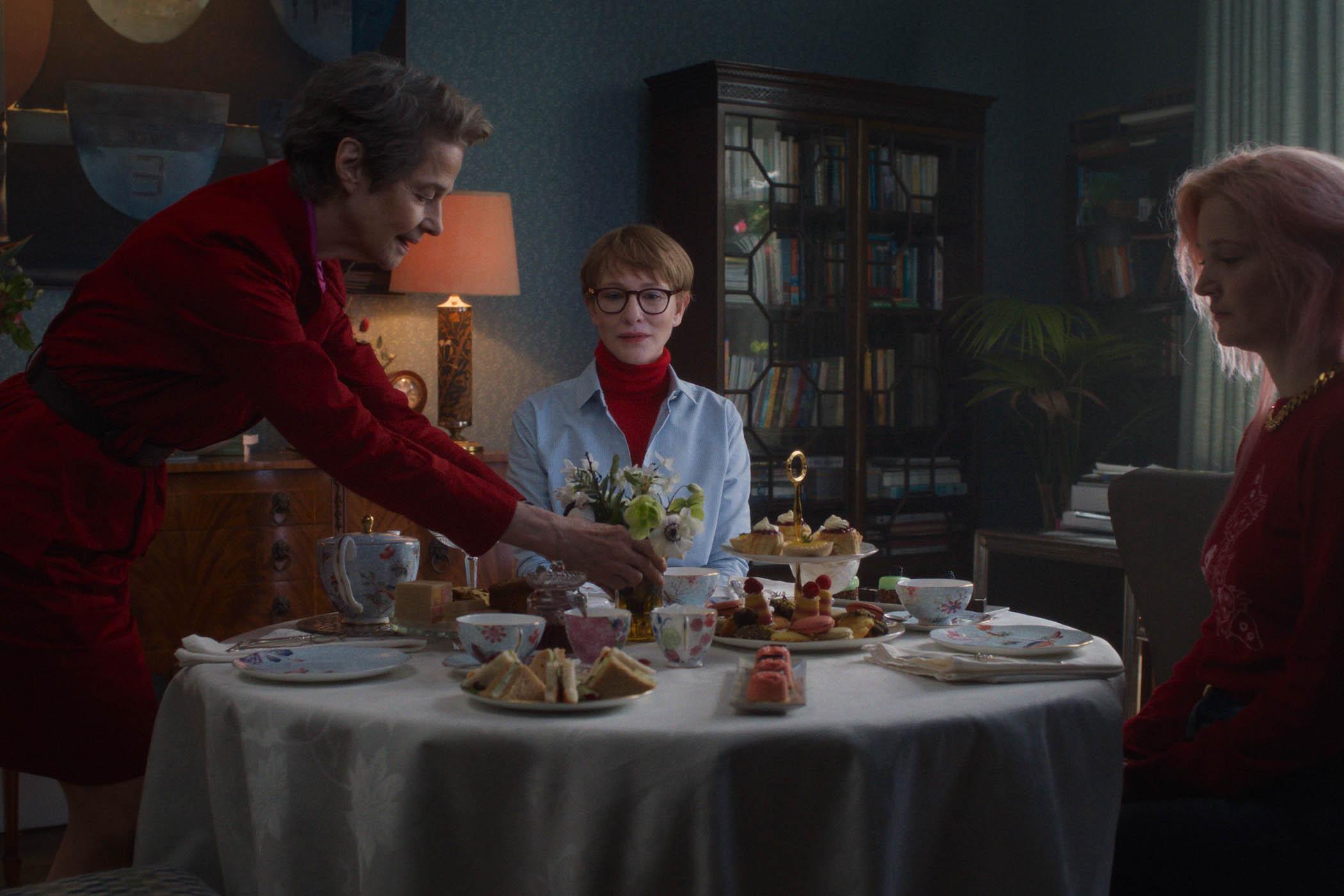
Over an intimidating display of cakes, the daughters regress, little girls once more, seeking their mother’s approval
Over an intimidating display of cakes, the daughters regress, little girls once more, seeking their mother’s approval
The droll tone of the first section continues into the second, in which two daughters, the mousy Timothea (Cate Blanchett) and pink-haired rebel Lilith (Vicky Krieps), make their annual visit to their formidable romantic novelist mother (a wonderfully frosty Charlotte Rampling). That the get-together only happens once a year is the mother’s attempt to set boundaries, on the advice of a therapist she finds markedly easier to talk to than her own daughters. Over an intimidating display of regimented cakes, brittle silences stretch to breaking point and the daughters regress, little girls once more, seeking their mother’s approval.
In the final chapter – the warmest, most conventionally satisfying of the three – the siblings are fraternal twins Skye (Indya Moore) and Billy (Luka Sabbat), returning to their family apartment in Paris one last time following the death of their parents in a plane crash. The pair have an easy shorthand of shared memories and the intuitive “twin factor” bond, but there are elements of their former life with their late parents that remain teasingly elusive.
The short films are linked not just by the enigma of family, but by recurring images: skateboarders slide in slow motion through the frame in each story; there are Rolex watches and the repeated phrase “Bob’s your uncle”. They hint at symbolism – but what is the significance? Possibly very little. Jarmusch has stressed in interviews that he was not trying to convey meaning or message.
You can find it, though, if you look for it. Families are complicated; empathy is precious. There are spaces between us, and we may never really understand one another. But still, we care. That is the sentiment of this quiet film, and it is worth shouting about.
Photograph by Yorick Le Saux /Mubi
Newsletters
Choose the newsletters you want to receive
View more
For information about how The Observer protects your data, read our Privacy Policy