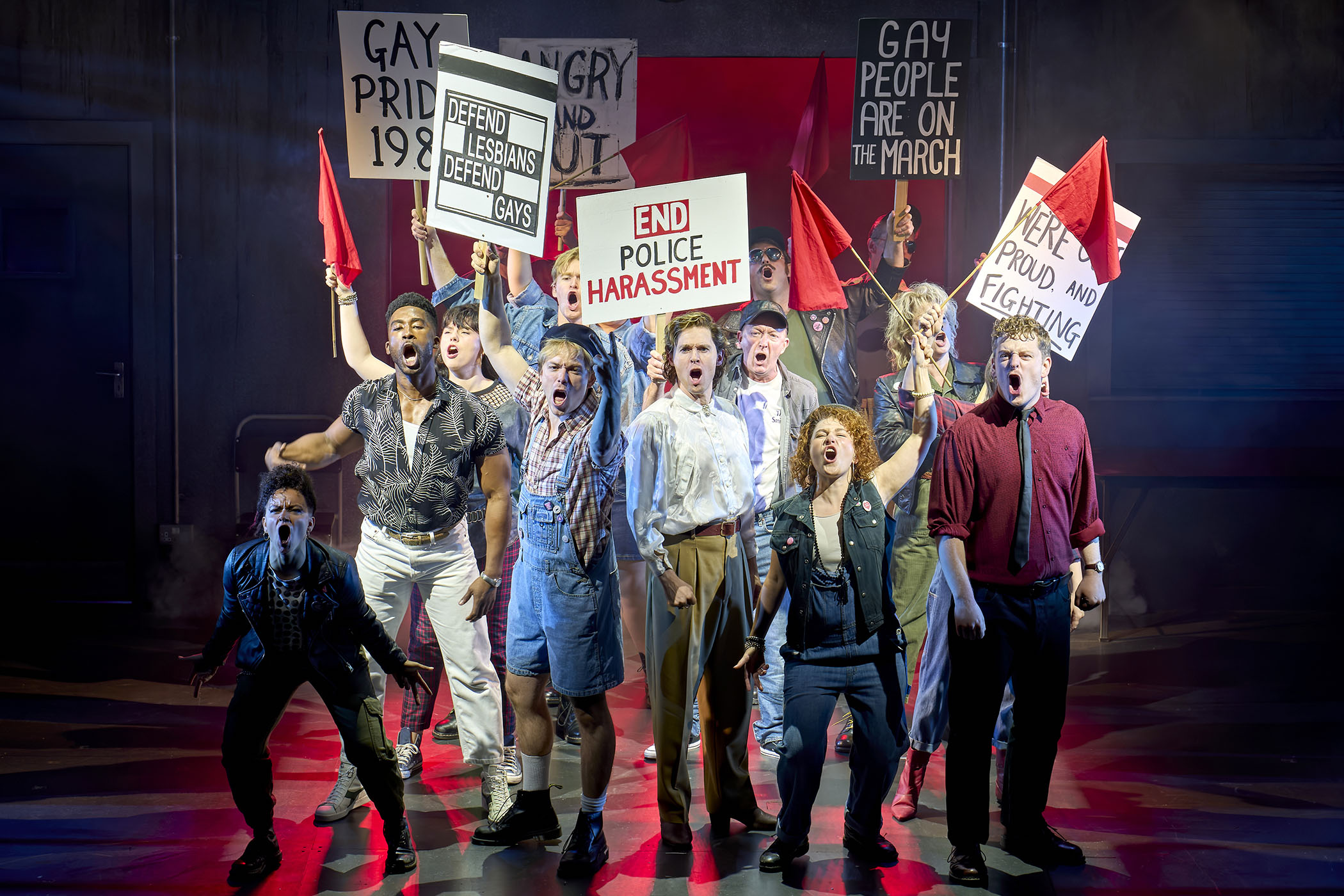

Fifty-six minutes into Matthew Warchus’s 2014 film Pride, a young woman stands up in a Welsh pit village hall. It is 1984, and among the striking miners and their community are the activists of the unlikely sounding fundraisers Lesbians and Gays Support the Miners. Having travelled from London to meet the miners, they’ve announced that they’re returning home to launch an event to make serious cash. At this pivotal moment, the woman begins to sing the suffragette and Labour movement song, Bread and Rose, and gradually everyone joins in.
It’s magnificently stirring – but the film-makers make a misstep. The singing is powerful not only because it’s traditional but because it’s grounded in reality. On the soundtrack, however, wholly unrealistic musical accompaniment steals in. A scene of truthful sentiment lurches into sentimentality, and trust between the film and the viewer is broken. The great thing about the new stage adaptation of Pride at the National Theatre, also directed by Warchus, is that the truth of that moment is no longer wrecked, because instead of being a drama with one song stylistically out of whack, the entire production is a musical.
Turning screen successes into stage musicals is scarcely a new idea; the West End has been awash with them for years. Look, for example, at those aimed at female audiences: after the surprisingly smart Legally Blonde came Mean Girls, 9 to 5, Pretty Woman, Waitress, Clueless and even Burlesque, though few had staying power.
Currently, alongside the massively hyped, dramatically shameless runway musical The Devil Wears Prada – at which audiences pay to hear favourite lines from the film being parroted amid forgettable sub-vintage Elton John songs – there’s also the runaway hit Paddington (based on the first of the three films) which is as inventive, funny and astonishingly charming as you could wish for. Between those extremities, there is Moulin Rouge! or the infinitely sharper The Producers. And from the Disney stable, Michael Grandage’s gorgeously designed stage version of Frozen filled the massive Theatre Royal Drury Lane for three years, to be replaced by the brash, vacuous Hercules, which is all gong and no dinner. Not that Disney is worried. The Lion King, playing for nearly 27 years in London, is their cash cow and the world’s most successful stage production. Having toured every continent except Antarctica, it has grossed in excess of $11bn (£8.3bn).
It’s easy to despair of cynical, commercial enterprises reselling movie titles, but some audiences are understandably reticent to pay vast sums for seats at the unknown quantity that is an original musical. History is not littered with the latter: even Oklahoma!, My Fair Lady and The Phantom of the Opera are based on existing properties. Three of Sondheim’s musicals were based on movies, the finest of which, the blithe A Little Night Music, is based on 1955’s Smiles of a Summer Night by Ingmar Bergman, and gave him his biggest hit, Send in the Clowns.
Successful stage transpositions only happen when creative teams understand that content is not necessarily king. The choice of film has to be one that translates into a completely different form in which far more long-winded singing can encapsulate and drive drama. To borrow an old song title, It Ain’t What You Do, It’s The Way That You Do It. Even the experienced can come a cropper. Trevor Nunn, whose monster hits include Cats and Les Misérables, in 2023 directed the lamentable musical of The Third Man without ever showing why any of the material needed to be sung. And its dogged faithfulness to the screenplay meant it fell foul of the three golden rules of great screen-to-stage adaptation: first, obey the spirit, not the letter, of the original. Second: remember you cannot rely on closeup. Finally, don’t mess with a masterpiece – if it didn’t need songs, don’t add them.
Which is where Pride comes in. The plot, key moments and even some lines are replicated; the telling is not. This rethink is genuinely theatrical. The fourth wall is constantly broken by witty narration that woos audiences who are acknowledged throughout.
Are the actual songs masterpieces? Nope. Does it matter? Not a jot. Like the rest of the agitprop-flavoured show, it’s overflowing with heart and Warchus’s winningly fluid, gorgeously performed production delivers surprises atop overwhelming sincerity. Like Billy Elliot, the only other musical about the miners’ strike, the stage version turns out to be better than the film.
Pride is at the National Theatre until 12 September
Photograph by Manuel Harlan
Newsletters
Choose the newsletters you want to receive
View more
For information about how The Observer protects your data, read our Privacy Policy