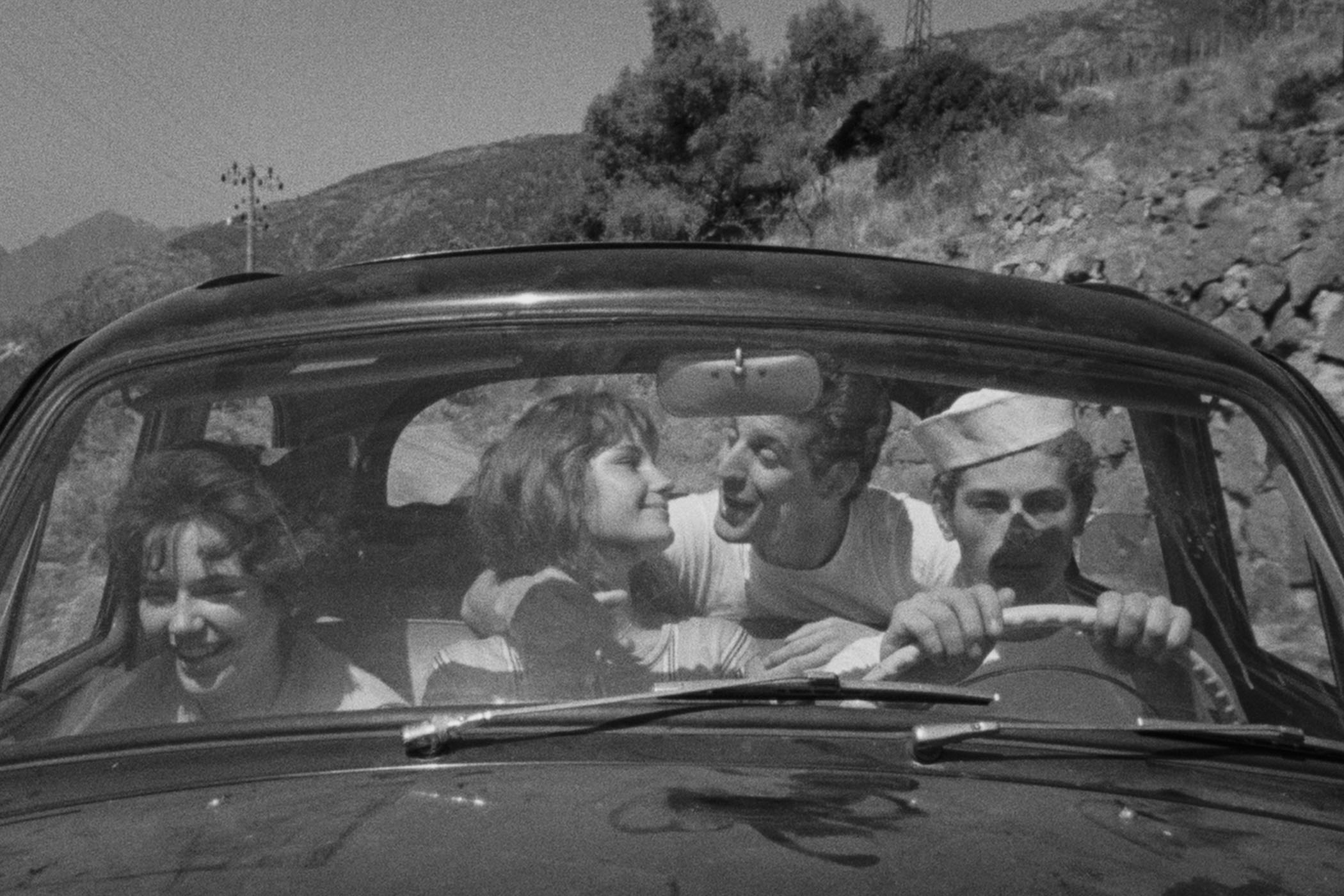


In December 1962, two young women in swimsuits, standing on the deck of a boat, waved cheerfully from the cover of the. French film journal Cahiers du Cinéma – a special issue dedicated to the then ascendent Nouvelle Vague. The image, chosen to exemplify the French New Wave’s image of youthfulness, adventure and freewheeling glamour, was from Adieu Philippine, the first feature by the writer-director Jacques Rozier.
Cahiers called Rozier’s film “the paragon of the Nouvelle Vague … where the virtues of young cinema shine with their purest brilliance”; Jean-Luc Godard hailed it as “quite simply the best French film of recent years”. But on release in 1963, it was a commercial failure, and Rozier would long be regarded as the Lost Man of the New Wave.
Nevertheless Adieu Philippine has endured as a much-admired classic. On a balmy July evening, a decent-sized, substantially young crowd has foregone the temptation of the England v DR Congo World Cup match to watch the film at London’s Institute of Contemporary Arts (ICA), kicking off a Rozier season. It’s the week after the heatwave, and Londoners once again feel inclined to fantasise about a Mediterranean getaway – and about a long-lost France in the ferment of cultural change.
Adieu Philippine follows Parisian teenagers Liliane and Juliette (Cahiers cover stars Yveline Céry and Stefania Sabatini), who spend the summer of 1960 with Michel, a cocky young technician in a TV studio. He’s played by Jean-Claude Aimini, who resembles a sullen, wispy-moustached James Dean. The girls enter the fringes of the media world, appearing in comically misfiring commercials for cleaning products and refrigerators; while Michel hangs out with his car-fixated chums.
The location shifts to Corsica, where the girls have followed Michel to a Club Med-style resort – a boisterous place where holidaymakers carouse to, of all things, Roll Out the Barrel (Adieu Philippine is a world away from the image of New Wave cinema as a furrowed-brow Left Bank affair). The trio then trek around a gorgeously photographed Corsican coast, as Liliane and Juliette compete for their grouchy beau’s affections.
Adieu Philippine is a world away from the image of New Wave cinema as a furrowed-brow Left Bank affair
Adieu Philippine is a world away from the image of New Wave cinema as a furrowed-brow Left Bank affair
French cinema has its own history of films inspired by the national obsession with the summer holidays – a phenomenon that still leaves much of Paris resembling a ghost town in August. The canon runs from the broadly comical, such as Les Bronzés, the hit 1978 farce – English title French Fried Vacation – about buffoonish sun-seekers, to the contemplative, notably Éric Rohmer’s The Green Ray (1986), whose heroine vacillates about where to spend her break, making up her mind just in time for a last-minute seaside epiphany.
Amid these, Adieu Philippine – written by Rozier and his then wife Michèle O’Glor – retains a special allure, partly because it’s tinged with an awareness of youth’s approaching end. When the film starts, Michel has two months to go before he must report for military service; the Algerian War is still raging, and he could be facing something far grimmer than routine manoeuvres. When his companions wave him goodbye at the end, their idyll is under a dark shadow, but the finale still feels tenderly euphoric.
Of the film’s three debut stars, only Sabatini would act again, in a handful of Italian pulp pics. And Rozier, who died in 2023 at 96, wouldn’t make another feature until 1971’s Du côté d’Orouët (Near Orouët) – another holiday story, about three young women visiting France’s windblown west coast. Rozier directed only five features over some 40 years, but also worked in TV and made several shorts. Among them is 1963’s Paparazzi, about the hordes of photographers who descended on Capri in pursuit of Brigitte Bardot, on location there for Godard’s Le Mépris; Rozier’s documentary is a jazzy snapshot, pun intended, of a particular moment in European media culture.
Today, Adieu Philippine remains as buoyantly inventive as better-known New Wave landmarks, such as Godard’s Breathless. It shares that director’s fascination with modernity, youth culture and commercialism. It pursues an improvisatory approach in both camerawork and acting to exuberant effect. Its soundtrack (rock’n’roll, trad jazz, cod-Latin exotica) pinpoints its era beautifully. Its young cast irresistibly catch the spirit of a generation on the brink of a decade’s radical change. Emerging from the ICA screening, my friend Simon, watching Adieu Philippine for the first time, comments: “It’s a film that celebrates insouciance.” As proved by the person in the ICA toilets, heard enthusiastically whistling the Greek folk tune from the closing sequence.
Photograph by Janus Films
Newsletters
Choose the newsletters you want to receive
View more
For information about how The Observer protects your data, read our Privacy Policy