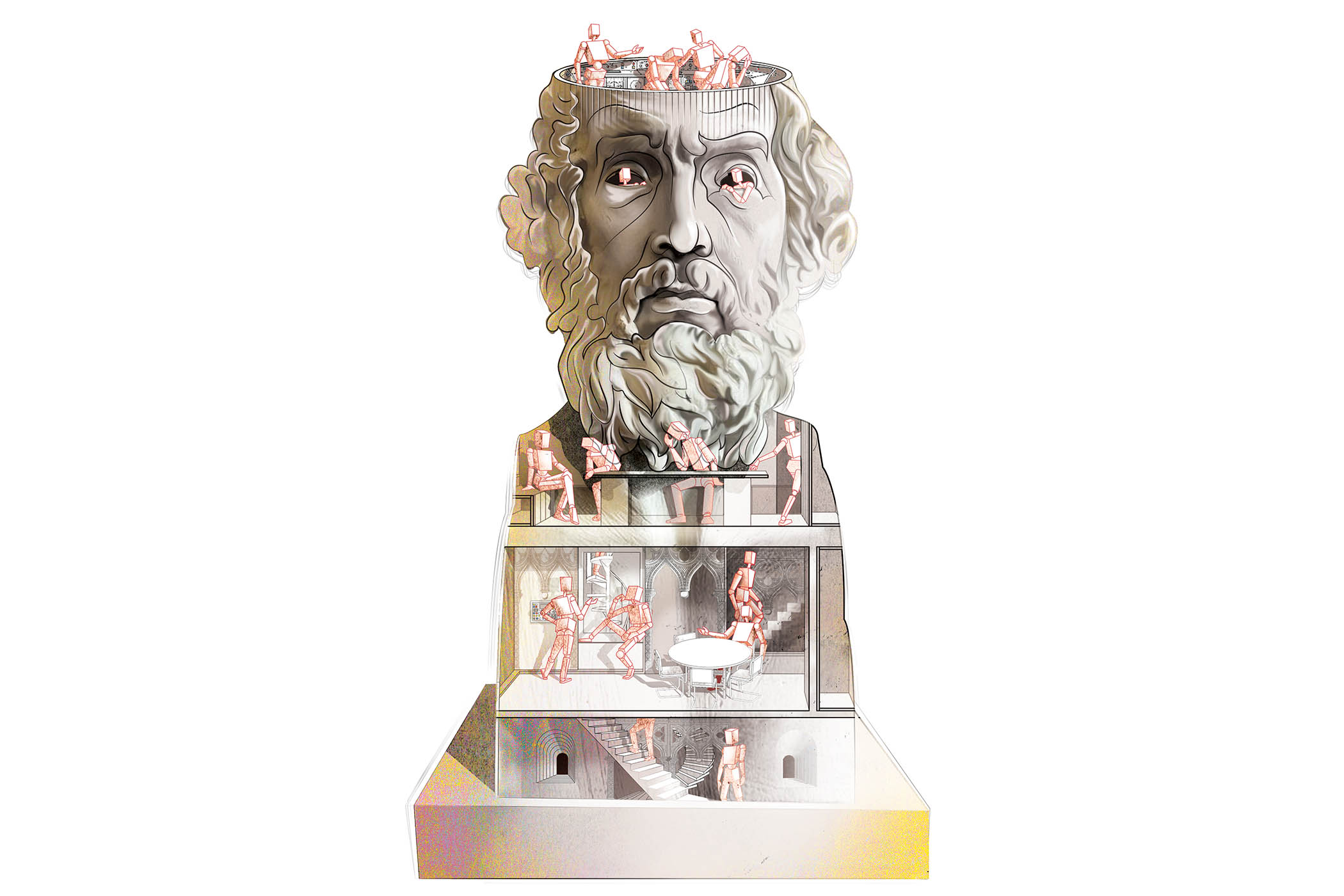


I have come to the Louvre in Paris to find Homer in 33C (91.4F) heat. I am shuffled up and down stairs, through climate-controlled rooms, past mini fans and selfie cams, until I get to him. Here he is, next to Napoleon, resplendent, marble glistening like sweat. He has a thick beard, holds a lyre and casts his gaze upwards in search of escape. But I am not standing in front of a classical relic: this statue is from 1812. Philippe-Laurent Roland knew no more about Homer than I do.
I want to find Homer because I believe he is owed some money. His epic poem the Odyssey is a foundational work of western civilisation, charting the monstrous journey of Odysseus back from the battlefields of Troy to his home in Ithaca. Now it is also the basis of a blockbuster by the British director Christopher Nolan. Released this Friday, the movie is forecast to make as much as $250m (£186m) in its opening weekend. That would go a long way in the pre-Christian era. Homer ought to get a cut of the royalties. But where and who is he?
It seems wise to go further back in time, and the Louvre should be able to help me with this too. It possesses a second-century marble bust of Homer unearthed from Palazzo Caetani in Rome. But the museum seems to fear that it will be pilfered by a Nolan stan and it is now in storage. I pull up a picture on my phone. The lips are more pursed than in Roland’s effort. The cheeks have deeper lines. But otherwise, the depiction is similar – and similarly useless. The bust was made 1,000 years after the estimated composition date of the Odyssey.
Tech evangelists predict that AI will soon surpass human intelligence, so I put Google Gemini to the test. “Please can you show me what Homer looks like?” Gemini responds that Homer is “instantly recognisable by his bright yellow skin”.
I persist: “I am actually looking for the Greek poet.” Gemini sends me an eBay listing. Someone is selling a desktop statue of Homer for £47. Tempting but unhelpful.
Plenty of classical figures are willing to give their two drachmas’ worth
Plenty of classical figures are willing to give their two drachmas’ worth
I am going to have to hit the books. This is made easier by having studied ancient Greek at university, but much harder by the available source texts. Plenty of classical figures are willing to give their two drachmas’ worth. Aristotle writes about Homer’s “wonderful superiority”, crediting him with inventing epic and teaching other poets “the art of skilful lying”. Herodotus writes that Homer and Hesiod, another ancient poet, created Greek theology. But even Herodotus, a historian from the fifth century BC, engages in guesswork. He says that Homer lived no more than 400 years before him, but admits that this is only his opinion. At least he is honest.
A Greek epigram sums up the fundamental problem. “Seven wealthy towns contend for Homer dead,” it reads, “through which the living Homer begged his bread.” Homer was highly respected in ancient times, and so people want to claim him for their own. Or at least claim that they know the real Homer. The Greek historian Plutarch writes that Homer’s epics, the Odyssey and the Iliad, were first assembled by a Spartan called Lycurgus. But what does that prove when the act of compilation has also been attributed to a politician called Peisistratus? Besides, it still wouldn’t tell us who ultimately created the Odyssey.
There was a degree of self-awareness to this mythmaking. Lucian of Samosata, the second-century satirist, imagines a conversation with Homer in which the poet tells him he was Babylonian and actually called Tigranes. As far back as the fifth century BC, Heraclitus of Ephesus recounts an urban legend that says Homer died in despair after failing to solve a riddle about head lice.
But some biographical claims persist through the ages. The hymn to Apollo, dating from the seventh century BC, asserts that Homer lived in Chios, an island off modern-day western Turkey, and was blind. This is not implausible. Chios was home to a guild of poets who said they were descended from Homer. The Odyssey and the Iliad are predominantly written in the Ionic dialect that was spoken in the region.
Did Homer invent the Taylor Swift Easter egg?
Did Homer invent the Taylor Swift Easter egg?
As for Homer’s impaired vision, the ancient Greek word Ὅμηρος (Hómēros) can be translated to mean “blind” (but also “hostage”). Scholars have claimed that the figure of Demodocus, a blind poet who sings about the fall of Troy in the Odyssey, is a cipher for Homer. Could it be true? Did Homer invent the Taylor Swift Easter egg?
Perhaps Demodocus is relevant for another reason – the fact that he sings. Various prominent figures try to answer the Homeric question. The British prime minister William Gladstone wrote in the 1850s that the Odyssey and the Iliad are the invention of a single genius. A few decades later, the novelist Samuel Butler posited that the Odyssey was written by a woman.
But it is a man of more humble reputation, a young Harvard professor called Milman Parry, who popularised the most convincing theory in the 1930s. After carrying out extensive fieldwork listening to bards in the former Yugoslavia, Parry made the case that the Odyssey wasn’t composed as a written text at all. He concluded that Homer’s epics are products of an oral tradition, pointing to the use of stock phrases designed to fit a metre, and therefore aid memory and performance. The argument goes that, if someone wrote the Odyssey, they would have written it very differently.
That leads to the conclusion that there is not a single Homer but many Homers who created what became the Odyssey and the Iliad, adding and changing scenes in semi-improvisation, until at some point, probably in about the eighth century BC, the poems were put into writing. If you read Homer’s epics in the original, it makes sense. Even though they mainly use the Ionic dialect, they include flavours of different regions and eras. There are other pieces of evidence. The Iliad contains a moment when Greek heroes compete for a lump of iron. And yet elsewhere in the poem the archer Pandarus fires arrows tipped with the metal. It would be quite wasteful unless the two scenes were composed at different times.
All this time, I have been afraid that Nolan’s adaptation of the Odyssey will not be faithful to the original poem. But maybe I am looking at it the wrong way. Are Matt Damon, Anne Hathaway and Tom Holland not more similar to the bards who riffed on an existing story than whoever canonised the text?
I would love to ask Homer, though he is in statue form, but he won’t look me in the eye. Until I hear a gruff bark. Could it be? Really? No. Someone has coughed on my neck.
Illustration by Andy Bunday
What are your thoughts on this? Send us a letter to letters@observer.co.uk
Newsletters
Choose the newsletters you want to receive
View more
For information about how The Observer protects your data, read our Privacy Policy