
Appraising Julian Assange, the founder of WikiLeaks, is a bit like looking at one of those viral internet sensations that half the public perceive in a dramatically different way to the other half. Instead of a striped dress that some see as black and blue, or some see as white and gold, we have a martyr to a noble cause or a sexual predator; the greatest publisher of the 21st century or a sleazy narcissist; a fearless pioneer who dared to expose the dark truths of the most powerful nation on Earth or a dissembling control freak who acts like an egomaniacal cult leader.
While his supporters tend to construe any questioning of his character as evidence of a multi-governmental dirty tricks campaign, his detractors often find it difficult to get past the allegations against him to appreciate the true significance of his work.
But can both perspectives be true, or contain truths that do not rule each other out? A new film about Assange by Eugene Jarecki claims to tell the “real story”, detailing his far-reaching impact and addressing the Swedish criminal investigation into rape and sexual molestation. It took five years to make and it’s called The Six Billion Dollar Man: Julian Assange and the Price of Truth.
Jarecki is a seasoned documentarian who makes complex, committed films such as The Trials of Henry Kissinger and a critique of the war on drugs called The House I Live In. The Six Billion Dollar Man is so named because, Jarecki tells me on a video call, that was the amount “the United States paid the country of Ecuador to torture Julian Assange”.
On 11 April 2019, Ecuador revoked Assange’s seven-year asylum and British police removed the bearded and haunted-looking figure from the Ecuadorian embassy in London’s Knightsbridge. The following year, Ecuador received a $6.5bn US-backed International Monetary Fund loan to support macroeconomic stabilisation. Jarecki contends that the latter was the pay-off for the former.
The film lasts more than two hours, has a rather serpentine structure in which cause and effect take a while to surface, and is packed with interviews with WikiLeaks members, journalists, lawyers and observers.
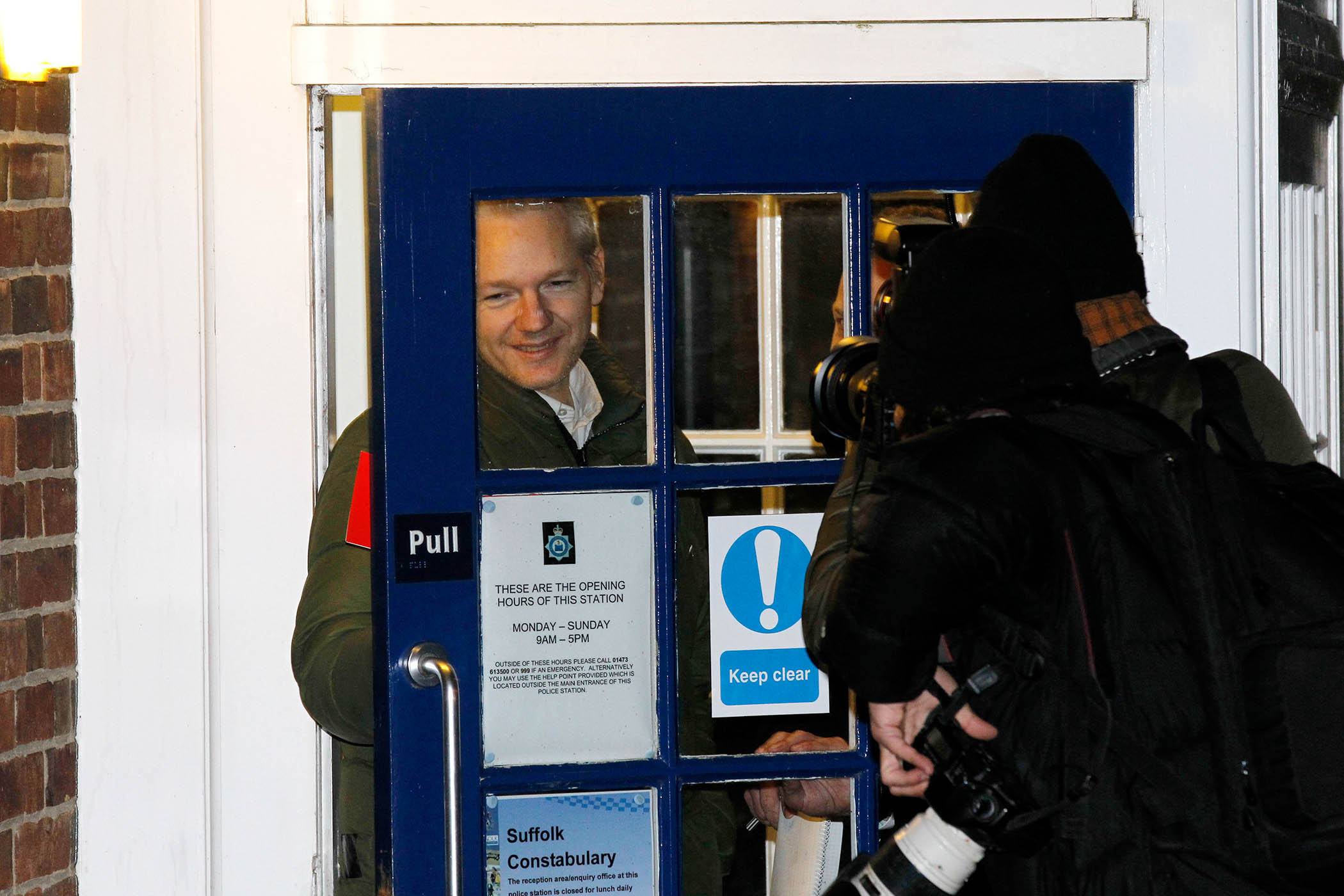
Julian Assange leaves a police station in Beccles in December 2010 after complying with bail conditions
One odd character who keeps cropping up is the former WikiLeaks volunteer Sigurdur “Siggi” Thordarson, an Icelander who has a criminal record for fraud and sex offences. He says he was coerced by the American secret services to give evidence against Assange, stating that he had been asked by the WikiLeaks leader to hack the phones of Icelandic officials. He has previously admitted that he lied and does so again here on camera.
“The story kept changing,” Jarecki says in explanation for how long it took to make the film. “We didn’t know if it would end up in the high courts of England or go to the European court of human rights. Or would he suddenly be shipped, in an almost extralegal way, to the United States? So we were making four or five parallel films until the story started to become more clear to us.”
Jarecki’s wearing a T-shirt, and the sun behind him appears to be blazing. Where is he? He says he’s somewhere in the southern states of the US but won’t say exactly where. He sounds a bit like his subject, who is renowned for his paranoia. “Yeah,” Jarecki laughs. “You touch this guy and all of a sudden you’re on the run!”
Although there is a mass of footage featuring Assange, Jarecki never interviewed him, mostly because Assange was in London’s Belmarsh maximum security prison. He was held for five years in harsh conditions while a protracted extradition procedure played out, before a plea bargain was eventually agreed with US authorities and Assange was returned to his homeland, Australia. Assange did not have any editorial input into the film, says Jarecki.
Newsletters
Choose the newsletters you want to receive
View more
For information about how The Observer protects your data, read our Privacy Policy
He says he ran into him for the first time at the Cannes film festival earlier this year, having been wary about his reputation. “I’ve been told he’s an unbelievably difficult person by people who are friends of mine who’ve made films about him. They all warned me: ‘Boy, this is going to be a nightmare for you.’ I have not found that. I have found that his comments were extremely reasonable. He loved the film in a way that I didn’t expect.”
That doesn’t surprise me. While it is in many respects a diligent documentary that covers a lot of territory, it presents an image of Assange that largely corresponds to the one that the man most likes to project and have reflected back at him: a heroic if idiosyncratic idealist beset by powerful enemies and shadowy forces.
At the outset of the film, Edward Snowden, the former National Security Agency contractor who revealed the US global surveillance programmes and is now a Russian citizen, suggests that while Assange is no angel, it’s more important that he exposed liars in powerful places. He did more than that. He enabled the dissemination of evidence of war crimes in Iraq and Afghanistan, as well as of documents detailing the diplomatic dark arts and international double-dealing.
Does the man’s moral character matter when set against his record of shining a light “on things the most powerful government in history did not want the world to know”, as Jarecki puts it?
“I think it is important that we look at the moral character of the people we want to idealise in the world,” Jarecki says, “but that’s different [from] the moral character of someone who might prove useful. So I think Assange is a very valuable figure, whatever his persona is – and then you can decide whether you want to have cocktails with him. But Assange is not a person who has done something terrible.”
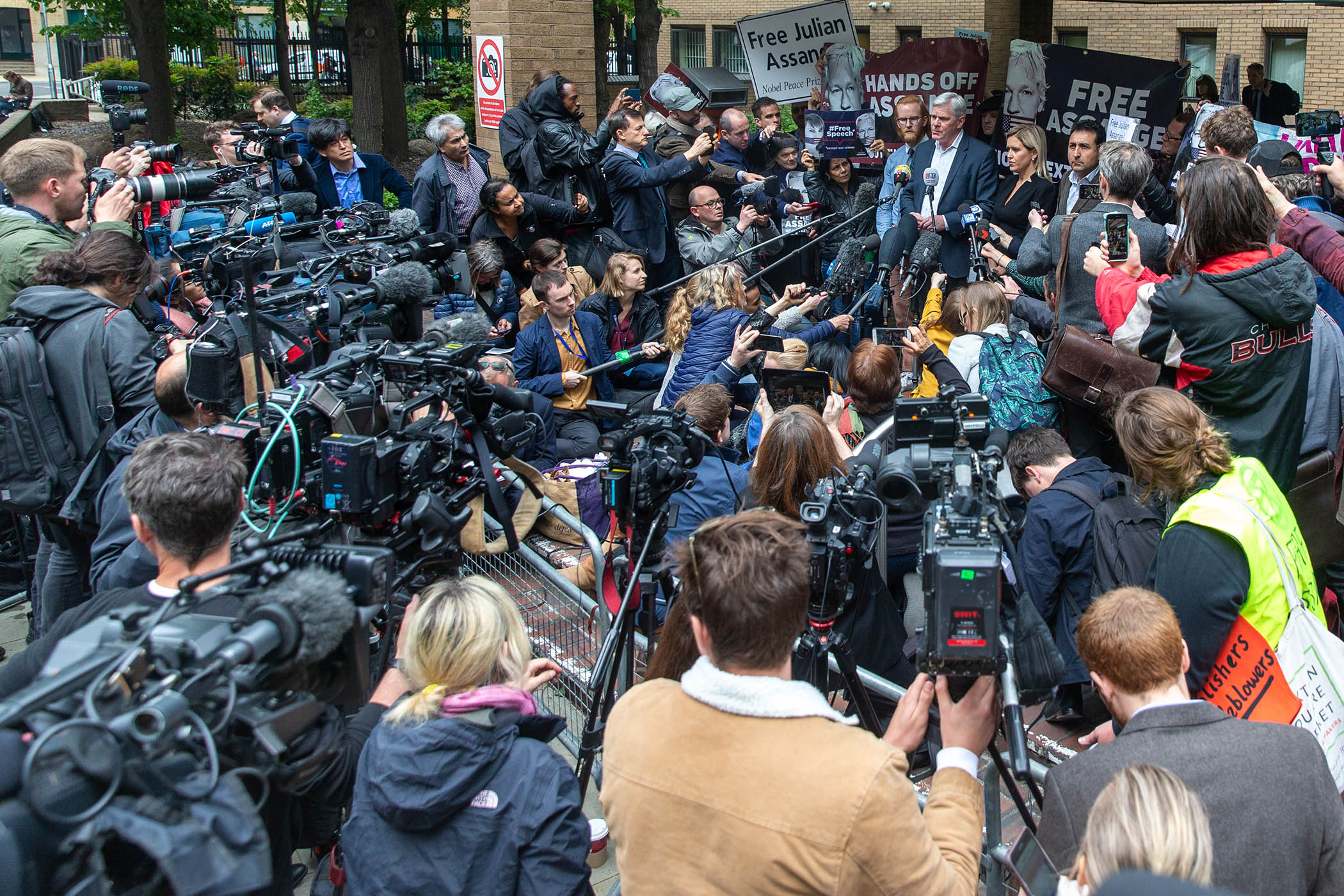
Lawyers from Assange’s defence team speak to the media outside Southwark Crown Court after Assange’s sentencing in May 2019
Much of the controversy about Assange can be traced to events in the summer of 2010 in Sweden, where police launched a rape investigation after complaints from two separate women the Australian slept with that he might have infected them with HIV. Jarecki believes that Assange took part in consensual sex and, while he may have been guilty of unchivalrous behaviour in refusing the women’s demands that he take a HIV test, he did nothing criminal or illegal. The women, both WikiLeaks supporters or volunteers, gave statements to the police saying either that Assange, against explicit instructions, didn’t wear a condom or that he sabotaged the condom he wore.
When I put these points to Jarecki, he says: “You’re quoting an unsigned police statement that she didn’t write – are you aware of that?”
I’m aware that there is a great deal of dispute about exactly what did and didn’t happen, and what was and wasn’t said to the police. The film suggests it’s fairly straightforward: the women weren’t interested in filing rape allegations; they simply asked the police if it was possible to compel Assange to take the test, so it would save them the three-month wait of finding out results from their own tests. It was the police, Jarecki says, who launched a criminal investigation against the women’s wishes.
The problem with that is one of the women wrote a book entitled No Heroes, No Monsters: What I Learned Being the Most Hated Woman on the Internet in which she stated that Assange “deliberately sabotaged” the condom and she cooperated with the criminal case over the course of the next nine years. If she disagreed with her statement, why did she not withdraw it?
Moreover, although the film shows Eva Finné, the original prosecutor who cancelled Assange’s arrest warrant, saying “there was no suspicion of rape”, it does not quote either of the two prosecutors who thereafter reopened the case.
In 2019, prosecutor Eva-Marie Persson called the female complainant “credible and reliable” but finally closed the case on the grounds that the “evidence has weakened considerably due to the long period of time that had elapsed since the events”.
In other words, by first declining to return to Sweden, then fighting extradition, and then seeking asylum in the Ecuadorian embassy, Assange had successfully run down the evidential clock.
He was happy to go to Sweden. He just wanted assurance of non-extradition, which is standard practice, and they wouldn’t do that
He was happy to go to Sweden. He just wanted assurance of non-extradition, which is standard practice, and they wouldn’t do that
Eugene Jarecki
According to the writer Andrew O’Hagan, who was commissioned to ghost Assange’s autobiography, Assange’s own take on the allegations was that the women were part of a “honeytrap” set by “dark foreign forces”. Jarecki dismisses that idea, but maintains that the women were “manhandled” and “hijacked by the authorities” for their own ends in service to a British and American agenda.
This leads to what is, in many respects, the key issue that is never touched on in the film. It’s always been Assange’s position that it was unsafe for him to return to Sweden because of the threat of being extradited to the US. That is also a given in the film. But why was Sweden more of a danger than the UK, which is notorious for its compliant extradition agreement with the US?
It takes several attempts for Jarecki to answer what seems to me a straightforward question. First of all, he says it would have been poor optics for the US if the Swedish women were refused their day in court, as if I was asking why the US didn’t put in an extradition request to the UK after Sweden’s request. Then, when I restate the question in even plainer language, he thinks I’m referring to a conspiracy theory that he doesn’t subscribe to – namely, that the women were part of a plot to ensnare Assange.
No, I say, reformulating it for a third time, why, if the Americans were so eager to extradite Assange, didn’t they seek his extradition from the UK before the events in Sweden? Why did they have to wait for these unforeseen allegations, which Jarecki agrees the US did not instigate, to “lure” Assange to Sweden, when the UK is a famously open door for American extradition requests?
“Well,” he says, “there was an unfolding narrative. Remember [Barack] Obama was in power and he proposed himself as a constitutionalist. The Obama team was not an obvious lock-him-up-and-throw-away-the-key group of people. They’re not Trump.”
It was under Donald Trump in 2019 that the extradition request was finally made to the UK government and under Joe Biden’s administration in 2024 that a deal was reached enabling Assange to go free.
So does that mean between 2010 and 2016 – the Obama years –Assange could have gone to Sweden, after all?
“Not at all,” he replies. “Anyway, he was happy to go to Sweden. He just wanted assurance of non-extradition, which is standard practice, and they wouldn’t do that.”
The Swedes have said that they couldn’t give assurances on an extradition request that didn’t exist. That was not standard practice. And given that the Americans had made no request to the UK before (or indeed for nine years after) the Swedish drama, what reason was there to believe they would suddenly do so in Sweden?
Jarecki doesn’t appear to have an answer to this – or at least not an answer that makes any credible sense.

Supporters of Assange outside a London court in December 2010
Personally, if you take into account cases such as that of the late Mike Lynch, the well-connected British tech billionaire who was shipped off to the US to face 20 years in prison, I’d rather take my chances with the Swedish criminal justice system.
It might seem an arcane point, but it isn’t. Almost the whole story hangs on it. If Assange had not been in any greater danger of extradition to the US in Sweden than he was in the UK, and arguably would have been in less, then his restrictive bail at Ellingham Hall – the Norfolk pile of ex-soldier turned award-winning video journalist Vaughan Smith – where he was surrounded by his supporters and well-wishers, was self-inflicted.
By the same token, the cramped sanctuary he endured in Knightsbridge under the round-the-clock surveillance at the Ecuadorian embassy, which Jarecki believes amounts to torture (he puts forward evidence in the film that the embassy’s private security contractors were secretly working for the US), was less a courageous stand than another avoidable own-goal. Unless, of course, the reason Assange didn’t go to Sweden was out of fear of being charged with some form of sexual abuse.
None of this should detract from the role Assange and WikiLeaks have played in revealing shameful state secrets and revolutionising the gathering of information. “The movie is most of all about the danger we are all now facing in authoritarian disinformation,” says Jarecki. “We are living in a world that is incarcerating journalists; 2024 was the most dangerous year in history for journalists, with so many being killed. The story of WikiLeaks was a canary in the coalmine. Now the thing he invented – an anonymising upload process that protects the identity of whistleblowers – is in every newsroom of the world.”
Yet even in that regard, Assange’s moral character is not an incidental issue. If you accept that some state secrets are legitimate, that some diplomacy must by its nature be conducted behind closed doors and that some state actors require anonymity, then the decision about what classified information to make public is hugely important. In an ideal world, you would want the person or people making those choices to be reliable and trustworthy.
Assange fell out with almost every journalist he worked with, and acted as if he personally owned the leaked or stolen information that came into his possession. Media relationships with WikiLeaks invariably ended in tears, and anyone who questioned his authority within WikiLeaks didn’t last long. That does not mean he should have been placed in Belmarsh – what Jarecki hyperbolically calls “the Guantánamo of England” – but nor does it mean he’s the best person to entrust with highly sensitive information.
What if he had maintained a lower profile, I ask – if he had been a facilitator rather than a figurehead? Could he have been a more effective operator and less of a conspicuous target?
“You can’t have Falstaff and have him thin,” Jarecki says.
You can’t have the political gains without the personal flaws, is his point, and he accepts that Assange can be “arrogant and boorish”. But, he says, “he has been in prison for his virtues, not his vices”.
If this is true, then it’s at least in part because he wasn’t prepared to have his vices judged. The portrait Jarecki paints in his film is not a whitewash, but it’s fair to say that the colours he focuses on are at the white and gold end of the spectrum rather than the black and blue.
The Six Billion Dollar Man: Julian Assange and the Price of Truth is in cinemas from 19 December
Photographs by Boesl/Picture Alliance/DPA/AP, Matt Dunham/AP, Luke Dray/Getty Images, Lefteris Pitarakis/AP