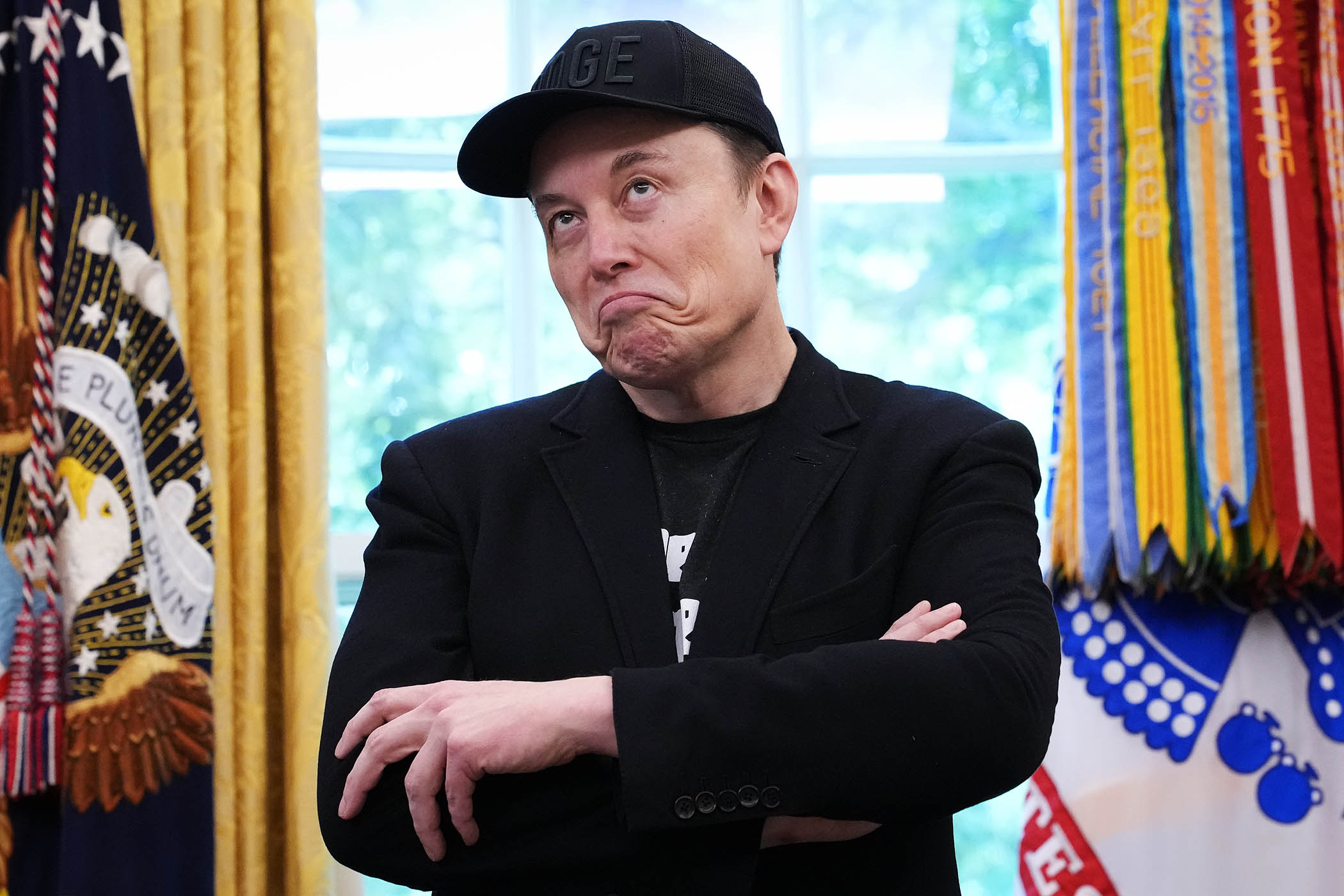

In the months that it was laying waste to American public services, the “department of government efficiency” (Doge) only really seemed to have one face: that of Elon Musk. But for a couple of days last week, as videos of depositions of an ongoing lawsuit were leaked to the internet, we briefly got to see a couple more (until those videos were ordered to be taken down by a judge).
The pair of Doge employees (how best to describe them? operatives? agents? shock troops?) answered questions about their efforts to shut down US government departments and projects. Specifically, in this case, the grants of the National Endowment for the Humanities – as part of the effort to fulfil Musk’s wild aim of slashing “$3tn” from the federal budget (the budget had risen by the time he left). There had been some anecdotal descriptions of the former Tesla interns who had been hastily recruited, staring at screens 24/7, sleeping on Ikea beds in sequestered offices, refusing to speak to long-term staffers – but here they were in person.
The pair made a compulsive and somewhat chilling spectacle, one which appeared to shed a light on many currents in our world, but perhaps chiefly the way that, like all would-be dictatorships, Donald Trump’s version began its second term as an attack on institutional intelligence, the kind of nuanced wisdom that is embedded in organisations over years and decades, that can be removed at a blunt stroke. “We love the poorly educated,” as Trump once declared at a campaign rally.
The Doge project was Musk’s performative version of Mao’s cultural revolution, essentially giving free rein to young men to denounce perceived academic and governmental elites; Mao’s infamous “four olds” – old ideas, culture, customs and habits – that were to be destroyed here became the billionaire’s catch-all “woke-mind virus”. This iteration did away with show trials and instead employed ChatGPT. It looked something like the difference between strategic boots on the ground and the video game bombardment of Operation Epic Fury.

Nate Cavanaugh (left) and Justin Fox (right) seen during their depositions
The Doge duo, Justin Fox and Nate Cavanaugh, appeared to be from central casting in their chosen role. They might have a future as Rosencrantz and Guildenstern. In response to the lawyers’ questioning they spoke entirely unemotionally, apart from the occasional smirk, about how they had gone about their work of rooting out and slashing the notion of DEI – diversity, equity and inclusion – from the humanities. That assault was used as an easy political front, for the attacks on other departments. Similar “Doge kids”, “Doge musketeers”, in the same spirit, shut down USAID, the multi-billion dollar foreign aid operation that was helping to protect millions of marginal lives; or eviscerated the Consumer Financial Protection Bureau that protected US citizens from corporate scammers and grifters (280,000 jobs were “liquidated” in the effective closure of those two departments). In a separate move, Musk’s affectless shock troops tried to hollow out the IRS on the basis that it was overstaffed (one independent review of this work estimated “very conservatively” that, if Doge cut half the IRS’s employees, as it had planned to, the net cost government would be four hundred billion dollars in lost tax revenue a year.) In this process, people who had deep knowledge of potential cost-cutting solutions were actively ignored, along with, for example, elected members of congress, who were reportedly dismissed in Musk’s terms as NPCs, non-playing characters.
Both Fox and Cavaunagh were happy to parade their lack of care as a virtue. In one clip, Fox, over many minutes, refused to offer his own understanding of what any of the words diversity, equity and inclusion might mean, instead cockily referring the prosecutor back to Donald Trump’s original executive order that defined them (the “I was only following executive orders” defence). Cavanaugh, separately, blithely agreed that he had no qualifications at all to carry out this work – which resulted in thousands of job losses – but that he could have gained some from reading relevant books. And what books had he read? he was asked. He was more than happy to admit he hadn’t read any.
In place of qualifications they had AI; ChatGPT was prompted to sift through the thousands of grants awarded by the national endowment for the humanities with the following request: “From the perspective of someone looking to identify DEI grants, does this involve DEI? Respond factually in less than 120 characters.· Begin with ‘Yes.’ or ‘No.’ followed by a brief explanation.· Do not use ‘this initiative’ or ‘this description’ in your response.” On this basis eventually 97% of all NEH grants were revoked.
In his deposition, Fox was asked to explain certain specific decisions, the defunding of language centres, for example, or long-term projects related to Black history and the documentation of the civil rights movement.
“Why is a documentary about Holocaust survivors DEI?” a lawyer asked him at one point, about a research project to understand the lives of Jewish women slave labourers in concentration camps.
Newsletters
Choose the newsletters you want to receive
View more
For information about how The Observer protects your data, read our Privacy Policy
“It’s a gender-based story that's inherently discriminatory to focus on this specific group,” Fox said. Any future grants, it was suggested by Doge, would be strictly “awarded to pro-America causes.”
Watching these videos – and in light of this Sunday’s story in this paper of Reform’s plans for an “ideological purge” of the UK civil service, beginning with removing all permanent secretaries – I was reminded of an interview I did with the journalist Michael Lewis, back in 2019. In typically pointed fashion, watching the drift of Trump’s actions and rhetoric, Lewis had written a book entitled the Fifth Risk, which identified the existential danger to our democracies of the attack – by oligarchs and tech bros and populist political movements – on good government, by bullying and firing independent experts, demonising “wasteful” research departments, scapegoating and destroying civil services, and dismantling regulators.
Lewis’s book took a handful of US civil servants from departments that seemed least promising for narrative excitement – energy and agriculture and commerce – and showed how their work touched on “hundreds of stories that were of potentially earth-shattering importance” for our daily lives. He tried, for the book, he told me, to speak to the Trump officials who were engaged in this slash and burn. The closest he got was Steve Bannon who had coined the populist election line: “We are going to tear down and destroy the administrative state.”
Lewis asked him what on earth he meant by that. What would it mean to destroy the Department of Agriculture, say? He recalled how Bannon “didn’t really even try to answer”. (I imagine except with a smirk.) Lewis took his book’s title from an Obama-era memo at the department of energy that set out the key threats to its function: nuclear accidents and cyberterrorism and so on; the existential “fifth risk” was a lack of effective “internal project management”; Lewis broadened this to mean good governance in general, a faith in institutional expertise rooted in people. He characterised the ignorant political calculus that seeks to undermine that as “destroying what you never learn that might have saved you.”
It’s a phrase that might describe any one of those Doge videos; and it’s one to always have in mind when, in the coming months, snake-oil politicians start shouting about wars on red tape and bureaucracy.
Photograph by Kevin Dietsch/Getty Images, Observer Composite/YouTube