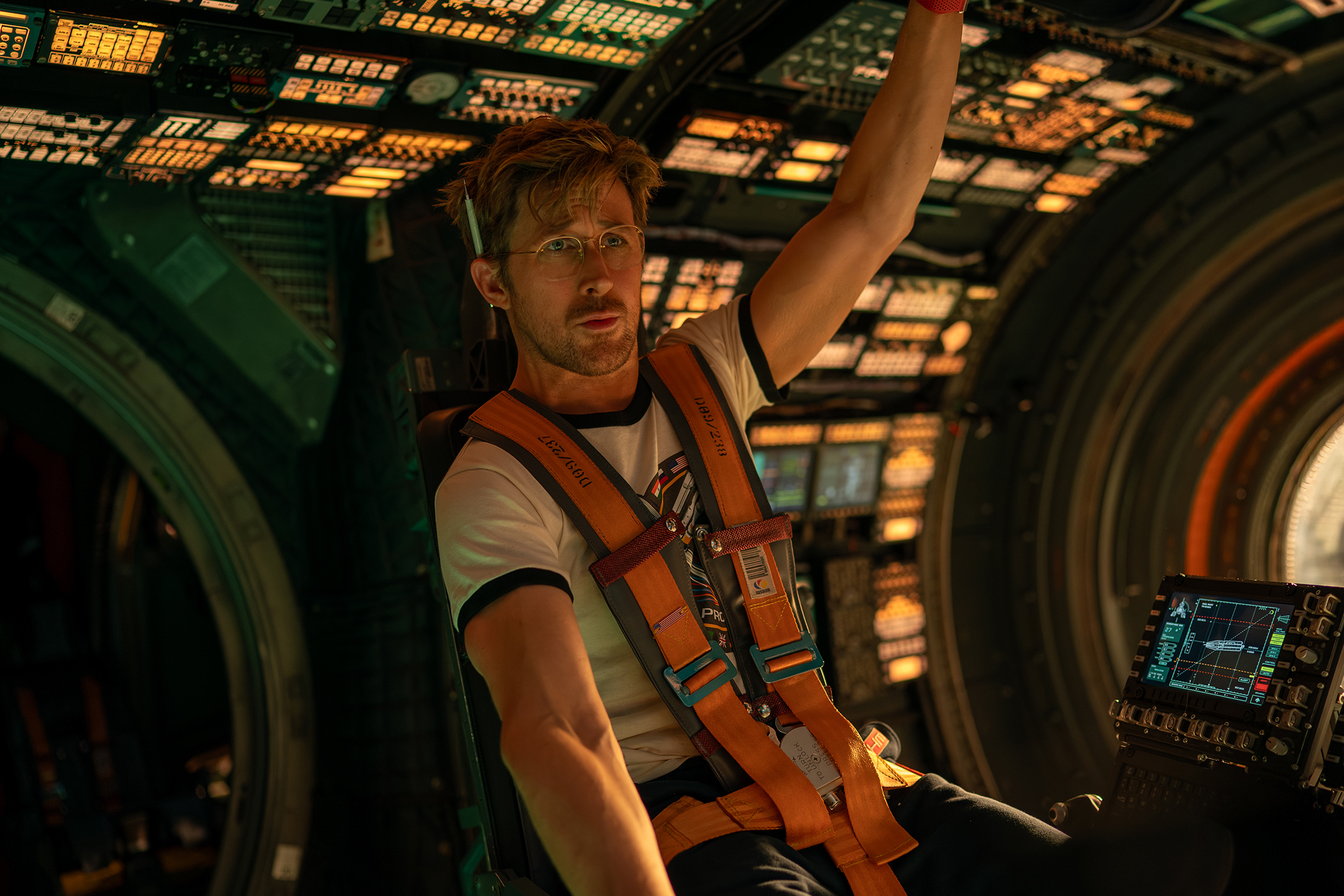



An interstellar buddy movie with a message of hope hardwired into its circuitry and an engaging, goofy central performance from Ryan Gosling. A film that shares DNA with family-friendly sci-fi classics such as ET: The Extra-Terrestrial. A movie that not only sets out to save the world but also to mount a persuasive case that it’s worth saving. What’s not to like?
Well, there’s the fact that Project Hail Mary so desperately wants to be loved. For all the heart-warming button-pushing, there’s something off-putting about a picture so aggressively feelgood. It may seem churlish – this amiable, sweet-natured space adventure is designed to put a smile on viewers’ faces and who doesn’t need that right now? – but I couldn’t shake the feeling that it is also a cynically calculated crowd-pleaser that reveals too openly its workings.
Project Hail Mary, directed by the former animation team Phil Lord and Chris Miller (Cloudy with a Chance of Meatballs, The Lego Movie), is adapted from a novel by Andy Weir, who also wrote the book on which Ridley Scott’s The Martian is based. In Drew Goddard, the two films even share the same screenwriter. There are marked similarities: both stories feature men marooned in space and forced to draw upon vast reserves of determination, resourcefulness and scientific genius to survive.
But unlike Matt Damon in Scott’s film, Gosling’s character, Ryland Grace, has another hurdle to overcome: temporary amnesia has wiped his memory of who he is and why he is in a spaceship many light years from home, with just the dead bodies of two other crew members for company. He must piece together his own backstory, packaged up in conveniently linear and digestible chunks of flashback, before he can get down to the serious business of fulfilling his mission.
I couldn’t shake the feeling that this is a cynically calculated crowd-pleaser that too openly reveals its workings
I couldn’t shake the feeling that this is a cynically calculated crowd-pleaser that too openly reveals its workings
Grace, we learn, was a school science teacher; his PhD research proved too radical for the academic world, and he was gently encouraged to leave it. But now the future of Earth, not to mention that of numerous other galaxies, is threatened. An alien microbe known as astrophage is feasting on the radiation of stars, including our sun. Eventually, there won’t be enough heat left to sustain life on Earth. The scientific community, led by Sandra Hüller’s astringent administrator Eva Stratt, is clutching at straws. A discredited wacko relegated to wrangling high-school pupils is the longest of long shots when it comes to saving the world.
Grace, still wrestling with the question of how he ended up in outer space, discovers he is not alone: an alien ship is lurking. He makes contact with the life form on board the vessel, and finds a crab-like entity made of what appears to be stone. Displaying a worrying lack of imagination for a man who is apparently humanity’s last hope, Grace names it “Rocky”. Then he whips up a complex piece of computer programming through which to translate Rocky’s lexicon of clicks and whistles into adorably geeky English (James Ortiz, who is the main operator of the alien puppet, provides his voice).
The friendship that develops between human and rock-crustacean is utterly disarming. Rocky is a sweetheart, given to childlike enthusiasms and humorous grammatical mangling (“Fist my bump!”). The design team have created a genuinely original version of an alien life form, one that stubbornly refuses to slot into a recognisably anthropomorphic mould and yet manages to be somehow familiar. This is partly Gosling’s achievement: he creates a convincing bond with something that looks like a sentient hilltop cairn.
But while the friendship is persuasive and warm, it’s also a bait-and-switch distraction, obscuring the fact that the plot itself is thunderously dumb. Repeatedly, the script reaches a plot cul-de-sac and tries to escape it with a combination of blind luck and preposterous coincidences. The film may be likeable, but it’s also lazy. And, at more than two and a half hours long, it feels as though it takes light-years for the point of Project Hail Mary to land.
Photograph by Jonathan Olley
Newsletters
Choose the newsletters you want to receive
View more
For information about how The Observer protects your data, read our Privacy Policy