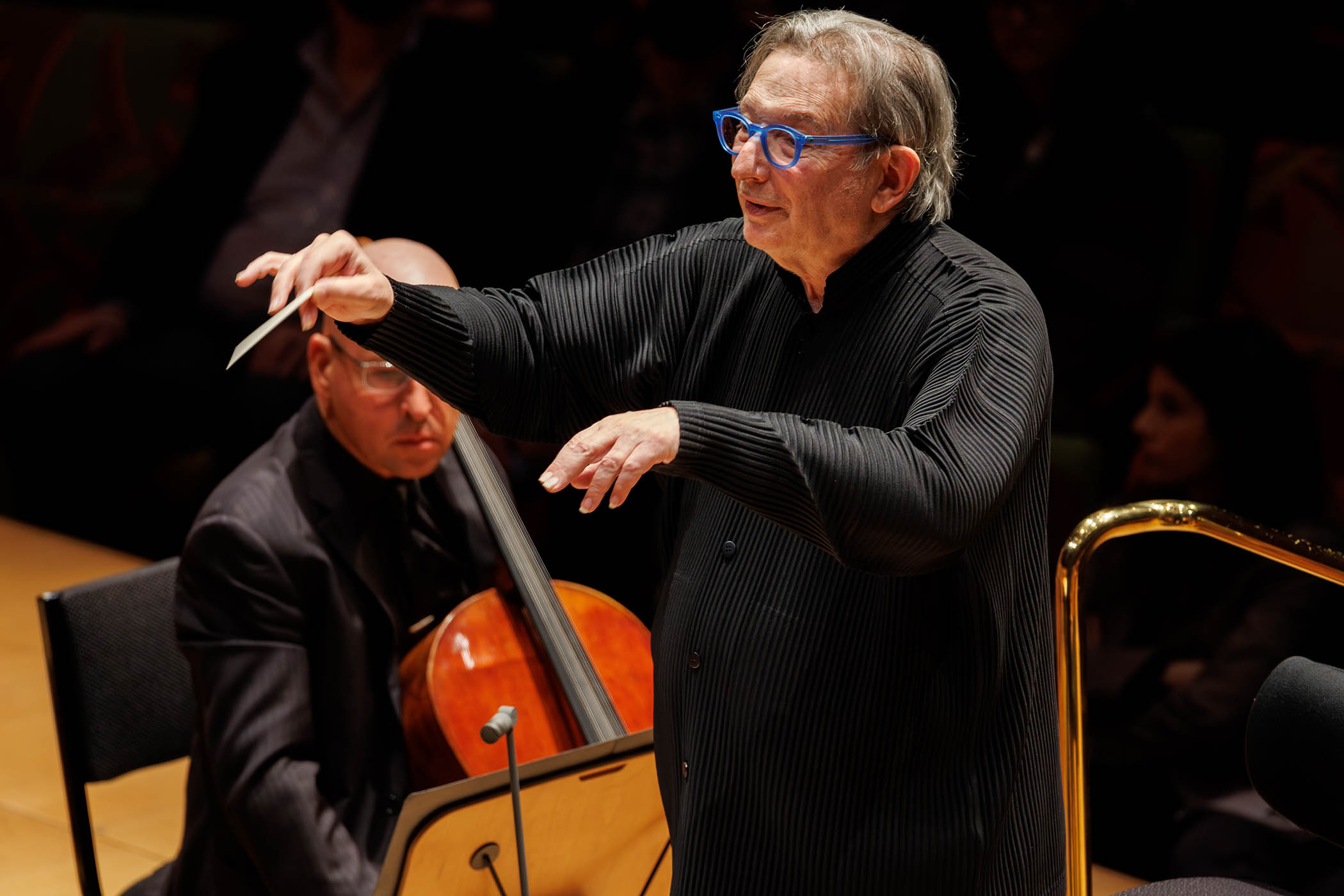

Michael Tilson Thomas’s parents wanted him to be a scientist. He went to the University of Southern California to study mineralogy and crystallography but his heart belonged to Mahler and Copeland. “I have to make music,” he told them before transferring to study under the baton of Ingolf Dahl. He promised that if he had not accomplished anything by the time he was 20, he’d return to the lab.
His parents’ caution was understandable. They worked in Hollywood and his grandparents had been actors. They warned of the insecurity of the entertainment industry but Thomas, a talented pianist, felt its pull. “Why did I go over to music?” he said in 1971, a 26-year-old working with the Boston Symphony Orchestra. “You could say it was because of genetic influences, or that something within me told me that’s what I should do.”
The scientific instinct remained. That same year, his mentor Leonard Bernstein, whose flamboyance Thomas shared, told the New York Times he was a genius. “He reminds me of me at that age, except that he knows more than I did,” he said. “Not only music but things like the functions of the brain, cerebrology, physics, biochemistry.”
Thomas first met Bernstein at the Tanglewood music festival, where he won the prize for outstanding student conductor. They bonded over a love of Mahler’s Das Lied von der Erde and fast-cracking Jewish repartee, but perhaps most out of an understanding that music is theatrical and a conductor should be more like a director than a dictator.
He had already worked with some of the greats. At 14, he played a Shostakovich prelude for the composer; at 16, he rehearsed with Stravinsky and spent a summer working with Pierre Monteux, who had conducted the premiere of the Rite of Spring in 1913 in Paris. That had caused a riot, something Thomas experienced in 1973 when conducting Steve Reich’s challenging work for four electronic organs and maracas at Carnegie Hall. He recalled one woman walking down the aisle to bang her head on the front of the stage and wail: “Stop! Stop! I confess!” Reich was mortified but Thomas told him: “By tomorrow morning, everyone will have heard of you.”
His grandmother told him that if you want to produce an impassioned performance you need ‘a little raw material’
His grandmother told him that if you want to produce an impassioned performance you need ‘a little raw material’
His cultivation of a celebrity image as a young conductor did not always win fans. As director of the Buffalo Philharmonic in his mid-20s, musicians took to calling him Michael Tinsel Tushy. He preferred it to “maestro”, which made him feel old, though he later said that MTT, by which he was widely known, could stand for Musical Time Traveller. He was as comfortable conducting the complete works of Mahler as he was recording with the heavy metal group Metallica. He twice conducted the YouTube Symphony Orchestra, around 100 musicians from more than 30 countries who had met in cyberspace.
He was principal conductor of the London Symphony Orchestra from 1988-95, having first worked with it in 1970, and principal guest conductor until 2016. He was musical director of the San Francisco Symphony from 1995-2020. However, his longest relationship in music was with Joshua Robison. They met in a junior high school orchestra, where Thomas played oboe and Robison the cello, and married in 2014 after 38 years as a couple. Robison, who became his manager, died in February.
Thomas was an only child. His father, Ted, produced Roy Rogers westerns and wrote scripts for Lassie films; his mother, Roberta, ran Columbia Pictures’ research department. His grandparents, Boris and Bessie Thomashefsky, were Ukrainian immigrants who pioneered Yiddish theatre in Manhattan and were friends of George Gershwin. Both were philanderers – his grandmother told him that if you want to produce an impassioned performance you need “a little raw material” – and people would sometimes approach him and suggest they might be related.
After Tanglewood, he became assistant conductor of the Boston Symphony under William Steinberg, to be told, before their first rehearsal: “We will see how it goes on the field. And let us hope it will be the playing field not the battlefield.” Three months later, he was given a field promotion when Steinberg fell ill during a concert and Thomas had to take the baton. He would conduct 37 concerts that season.
He was 26 when first invited to work with the LSO, which had a reputation for destroying uncertain conductors. In the last rehearsal before his debut, he tried to get more energy, leading the principal oboist to ask: “Young man, would you like the performance now, or perhaps some time later this evening?”
Newsletters
Choose the newsletters you want to receive
View more
For information about how The Observer protects your data, read our Privacy Policy
Like Bernstein, Thomas also composed. A piece inspired by The Diary of Anne Frank, commissioned by Unicef, had its premiere in 1990 with the New World Symphony, an orchestra for young musicians that he had founded. He also wrote music inspired by the poets Rainer Rilke, Emily Dickinson and Walt Whitman. “I can labour mightily in other composers’ cause,” he said. “But it’s difficult to do that with my own music. If it doesn’t immediately sound wonderful, I want to take the whole thing and throw it.”
In 2021 he was treated for glioblastoma, an aggressive brain cancer, which returned. His final public appearance was with the San Francisco Symphony last April. Though frail, he remained elegant and effervescent to the last, reflecting a line by Whitman he liked to quote: “Muscle and pluck forever! What invigorates life invigorates death.”
Michael Tilson Thomas, conductor and composer, was born on 21 December 1944, and died on 22 April 2026, aged 81
Photograph by Gina Ferazzi/Los Angeles Times via Getty Images