

On an October night in 1816, John Keats visited his friend Charles Cowden Clarke. The poet’s mentor had recently been loaned an edition of Homer’s Odyssey translated by the Elizabethan playwright George Chapman. The two men stayed up late, drinking and reading one another favourite passages. Keats left at dawn. Later that morning, Clarke received a letter from his friend containing a sonnet. On First Looking into Chapman’s Homer describes the effect of that night. Keats was familiar with Alexander Pope’s hugely popular version, but encountering this older, rawer and more immediate variant, brought Homer’s epic to life in a previously unimaginable way. It made him feel “like some watcher of the skies / When a new planet swims into his ken”.
Keats’s poem came to mind a few days ago, at the world premiere of Christopher Nolan’s $250m film adaptation of the Odyssey. As the lights were extinguished in the vast auditorium of the Odeon Leicester Square, I wondered: was I about to have my relationship to Homer’s poem reconfigured in the same way?
The Odyssey, the story of the Greek hero Odysseus’s decade-long journey back to the kingdom of Ithaca, after the decade-long siege of Troy recounted in its sister poem, the Iliad, is one of the cornerstones of world literature. If you haven’t read the poem itself, you have almost certainly read one of the many works based on it, from James Joyce’s Ulysses, which adopted the Roman name for Homer’s cunning hero, compressing his journey across the Aegean into a single Dublin day, to Derek Walcott’s epic poem Omeros, Margaret Atwood’s The Penelopiad, which shifts the focus from the returning hero to his waiting wife, Penelope, and Circe, Madeline Miller’s feminist retelling.
There have been filmed versions for as long as there have been films. To mention just a few: Georges Méliès’s three-and-a-half minute The Mysterious Island (1905) combines two episodes from the Odyssey; in the 1950s, Mario Camerini’s much longer (and creakier) Ulysses gave it the sword-and-sandals treatment; and Stanley Kubrick’s 2001: A Space Odyssey (1968) is an oblique retelling, Homer’s “wine-dark sea” replaced with the vast reaches of space.
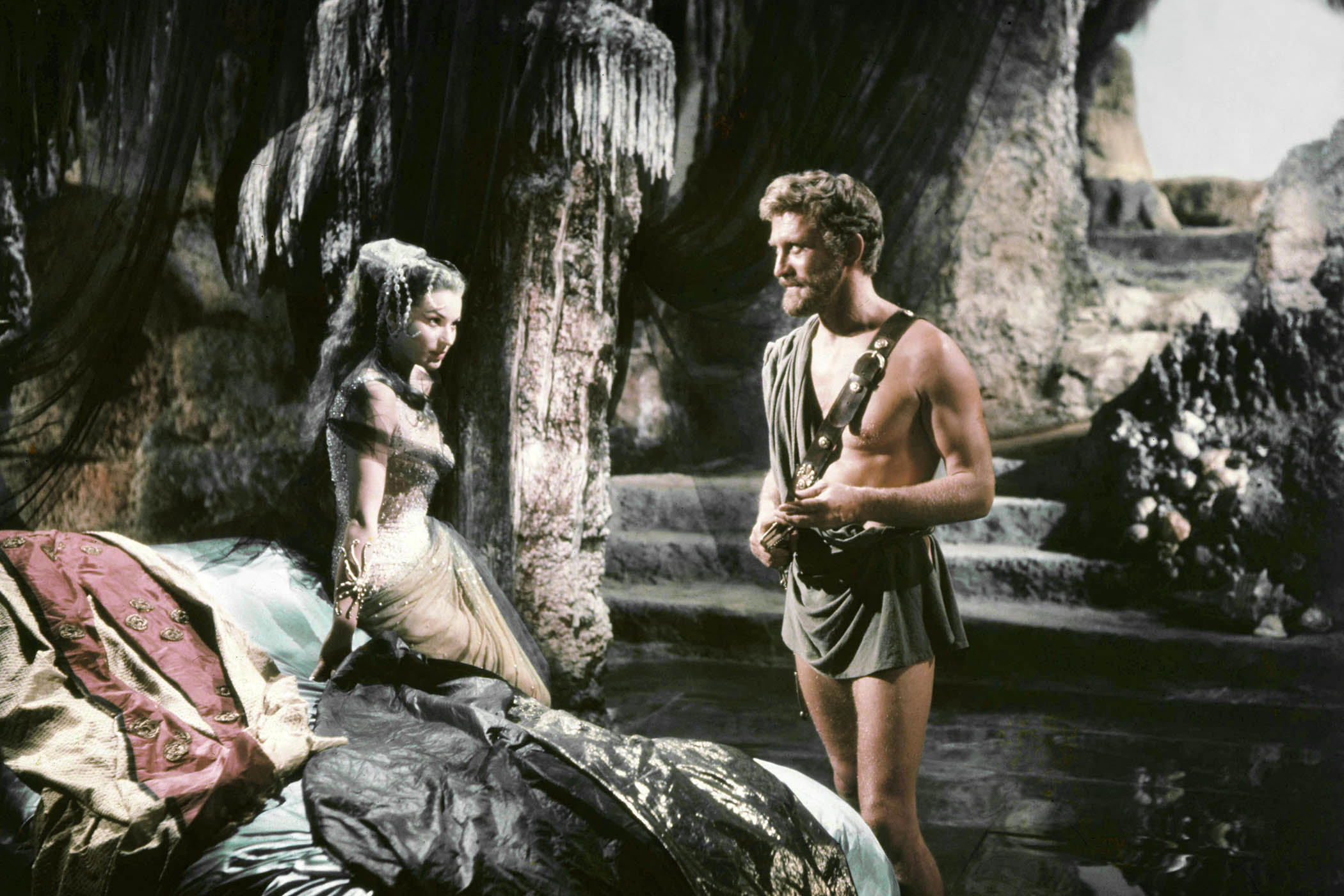
Silvana Mangano and Kirk Douglas in Ulysses (1954)
Meanwhile, Franco Piavoli’s extraordinarily beautiful Nostos: The Return (1989) keeps the poem’s Mediterranean setting but strips out the action, more a hypnotic mood piece than a narrative retelling; Joel and Ethan Coen’s O Brother, Where Art Thou? (2000) transplants the story to the deep south and foregrounds the comedy; and Uberto Pasolini’s recent The Return (2024) concentrates on the poem’s latter half, with Odysseus back on Ithaca to take revenge on the suitors who have been feasting in his halls and competing for Penelope’s hand.
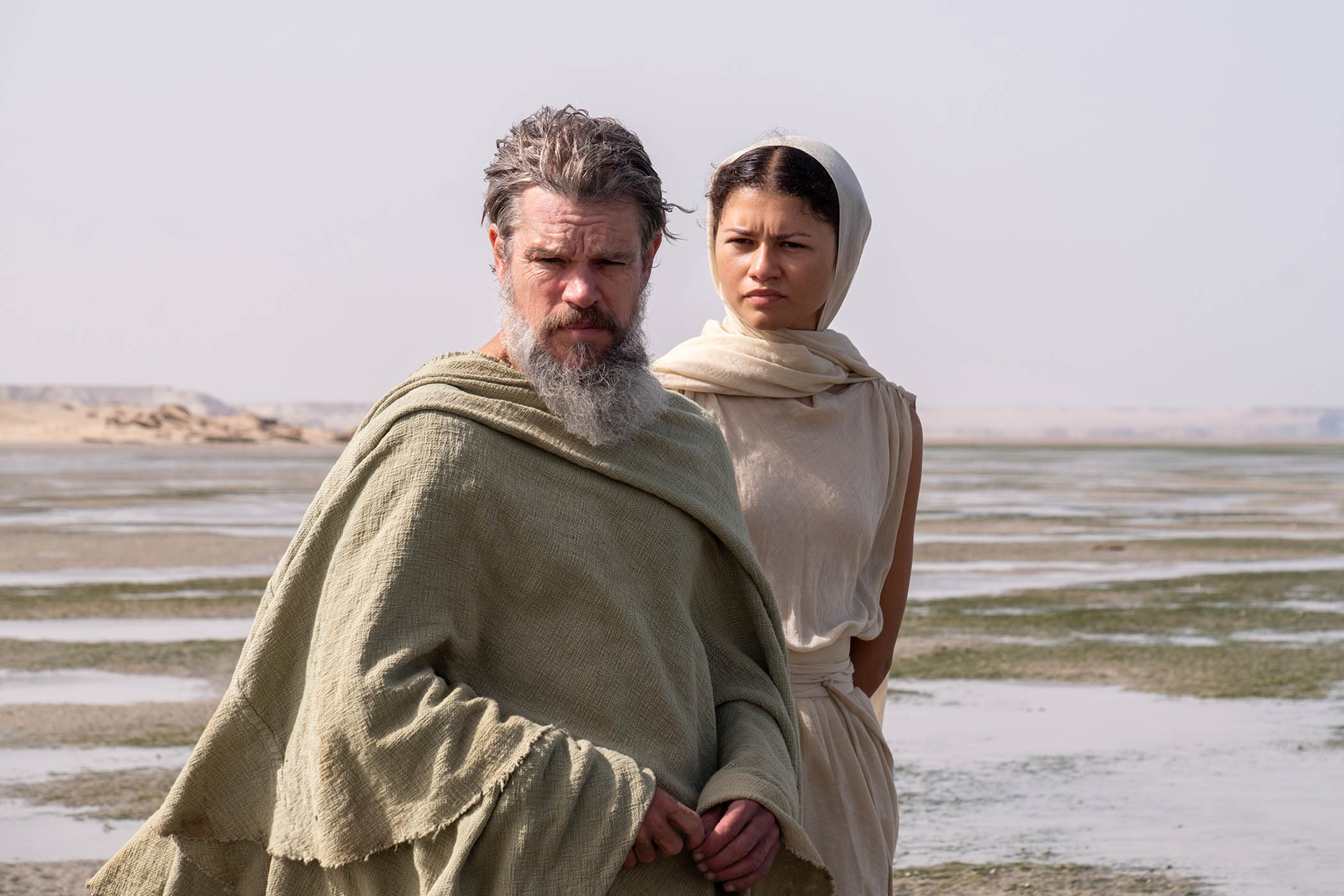
Matt Damon, the star of Nolan’s film, adds his interpretation to a gallery including Kirk Douglas, Harvey Keitel, Armand Assante, George Clooney, Sean Bean and Ralph Fiennes. Odysseus is one of literature’s most complicated, multifaceted characters. When describing the welter of roles he performs in the poem, Emily Wilson, whose 2017 translation was one of the texts Nolan namechecked when making the film (a copy of which I saw being waved by someone in the crowd at the premiere, hoping for a signature from Zendaya, who plays Athena), makes him sound like an actor himself: “a migrant, a pirate, a carpenter, a king, an athlete, a beggar, a husband, a lover, a father, a son, a fighter, a liar, a leader, and a thief”. Damon’s Odysseus is brave, troubled, compassionate up to a pragmatic point, but lacks the wiliness integral to the character.
When I first heard Nolan was following up his Oscar-winning Oppenheimer (2023) with an adaptation of the Odyssey, I thought the one obvious point of connection between his films and Homer’s poem is the treatment of time. The Odyssey begins in the thick of things, then makes a series of backward loops: at first, the poem concentrates on Odysseus’s son, Telemachus, who leaves Ithaca in search of news about his father. He sails to the court of Nestor, then that of Menelaus, husband of Helen, whose elopement with Paris caused the Trojan War.
Both men plunge into memories of Odysseus and their own journeys home from Troy. Fifty or more pages go by, depending on the translation, before we encounter Odysseus weeping on a beach, held captive by the nymph Calypso. But his time on her island is ending. He builds a raft and heads for Ithaca, landing first at Phaeacia, where he relates to King Alcinous and his queen, Arete, the story of his thwarted voyage home. This section – the central four books of a 24-book poem – contains the episodes most people associate with the Odyssey: the cyclops, the enchantress Circe turning Odysseus’s crew into pigs, the journey into Hades, Odysseus lashed to the mast hearing the sirens’ song, the monsters Scylla and Charybdis, and the slaughter of the sun god’s cattle. Only past the halfway mark does the poem settle into a more straightforward chronology.
Nolan is no stranger to intricate timelines. Memento is told backwards; time dilation occurs in both Interstellar (the crew lands on a planet where one hour is equivalent to about seven Earth years) and Inception (depending on how deep into the dream state the characters travel, hours of sleep equate to weeks, months or even years within the dream); and Tenet features a set-piece battle in which some combatants are moving backwards through time, others forwards. But the most elegant example is Dunkirk, in which the three narrative strands – land, sea and air – span an hour (a Spitfire mission), a day (a small boat sailing to Dunkirk) and a week (the soldiers waiting there to be rescued). At the film’s climax, these wheels – all turning at different rates – mesh.
Rather than recreate Homer’s time scheme, Nolan replaces it with one of his own. We cut back and forth between Telemachus and Odysseus, who recounts his adventures not at the Phaeacian court, which has been jettisoned, but on the island of Calypso (Charlize Theron). She has wiped his memory by feeding him lotus flowers (which, in the poem belong on another island, and which Odysseus never eats). After seven years, she has decided to reverse the process, weaning him off the flowers to let his memories slowly return: we see each episode as he remembers it.
Newsletters
Choose the newsletters you want to receive
View more
For information about how The Observer protects your data, read our Privacy Policy
Since the first pre-production still was released all the way back in February 2025, showing Damon in plumed helmet and cloak, there has been outcry of various sorts online. At first, it was about the accuracy of period details, but as trailers began to be released and the cast revealed, culture warriors, among them Elon Musk and the rightwing American pundit Matt Walsh, made racist complaints about the Black actor Lupita Nyong’o being cast as both Helen and her sister, Clytemnestra, wife of Agamemnon (leader of the expedition to Troy).
Just last Tuesday, Musk took to X to call Tom Holland a “cuck”. For a while, no one was sure which Tom Holland he meant: the actor, who plays Telemachus, or – as it turned out – the historian, who earlier that day had posted a reaction to the film: “by some way the best cinematic adaptation of a Greek myth I have ever seen”.
Personally, the only problem I have with the presence of Nyong’o in the cast is that she doesn’t have more to do. When Telemachus travels to Sparta to consult Menelaus, Homer gives Helen a teasing, ambiguous speech that Nolan replaces with plot mechanics. It’s just one of many deviations he makes from the source text. Some are completely understandable; after the climactic slaughter, I wasn’t expecting to see Odysseus order his son to hack the Ithacan slave girls to pieces when they finish clearing his hall of the suitors’ corpses, or Telemachus disobeying that order to slowly strangle them instead.
Some make sense but don’t quite work; for example, compressing the year Odysseus and his crew spend on Circe’s island into a day and cutting his decision to become her lover. Others, such as giving the lead suitor, Antinous (Robert Pattinson), a cowardly backstory – and, for good villain-making measure, having him abuse Odysseus’s elderly dog – or having the hero’s visit to Hades end with a chase sequence, seem jarringly conventional beside the poem’s intelligence, strangeness and beauty.
If these changes sit uneasily with me, it isn’t because the text is sacred. Nearly 3,000 years on, I trust its staying power. And, anyway, every new translation differs to some degree from the original: you only need read Daniel Mendelsohn and Wilson’s opinions of each other’s versions – the two most recent – to know that every take on the poem is an interpretative act. That’s why Keats had his brain set alight by Chapman’s while Pope’s left him cold. And there are changes Nolan makes that are undoubtedly interesting. One occurs after Odysseus has heard the sirens’ song, when he tells his lieutenant Eurylochus (Himesh Patel) that the song contained all the promises he didn’t want to keep, and: “It told me I don’t really want to go home.”
The very existence of the Odyssey – originally an oral work, collated and codified over decades, if not centuries, by a collective of artists and performers known collectively as Homer – is a challenge to any ideas of compositional purity, and the idea that its original intentions might be too remote for us to understand is a thought that’s as thrilling as it is frustrating. Jorge Luis Borges, who returned to Homer throughout his life in both stories and essays, once wrote that “the Iliad and the Odyssey amply survive, even though Achilles and Odysseus, what Homer meant by naming them, and what he actually thought of them have all disappeared. The present state of his works is like a complex equation that represents the precise relations of unknown quantities.”
What values, then, does Nolan choose to insert into this equation’s gaps? The biggest differences between his Odyssey and the one we encounter on the page, in whichever translation, is firstly how much of the Iliad it contains, as well as other accounts of the Trojan War including the Aeneid by the Roman poet Virgil. From this he takes a relatively prominent character, the Greek warrior Sinon (Elliot Page), the story of the Trojan horse (mentioned only in passing in the Odyssey), and the film’s striking final image. If the fallout from the war is a constant undertone in the Odyssey, here it’s brought to the fore.
Second, its attitude to the gods is strikingly different from the poem. Zeus, Poseidon, Hermes, and, particularly, Athena feature prominently in Homer. Odysseus falls foul of them – especially Poseidon, father of the cyclops, which the hero blinds – but often receives their favour. Nearly everything he achieves is with the help of the gods. By contrast, the film’s attitude towards the deities is either sceptical or antagonistic. “Defy the gods,” reads its tagline. While the poem begins with a debate between the gods, the first thing Nolan presents us with is a title card: “A time of apparent magic.”
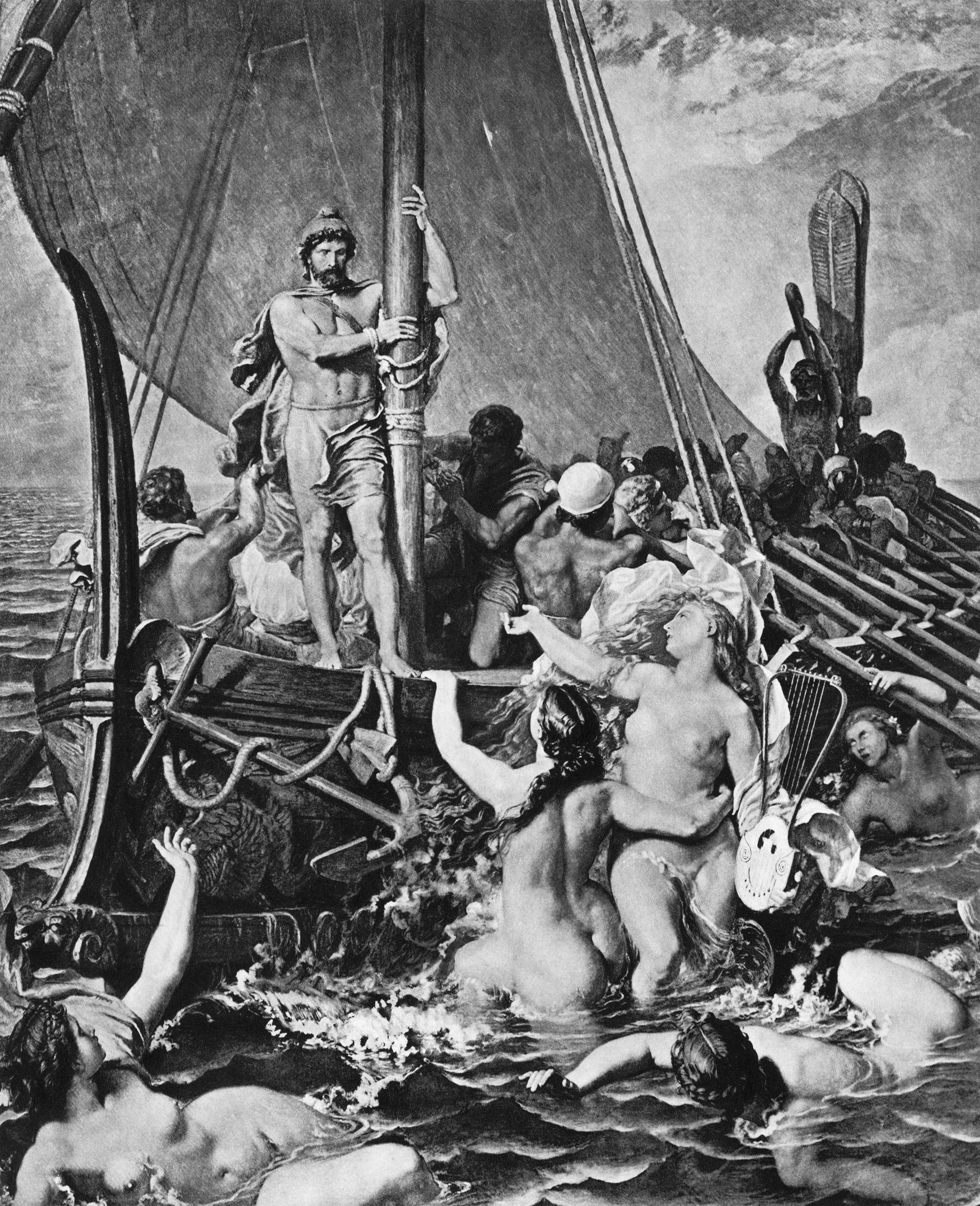
Ulysses and the Sirens, from the undated painting by Léon-Auguste-Adolphe Belly
The film repeatedly turns its back on the divine. When Telemachus stops the suitors from bullying a stranger, reminding them of Zeus’s law of hospitality, a peal of thunder suggests the god is listening. Walking away, the stranger mutters to Telemachus that the thunder was a happy accident. When Odysseus’s men plead with him to ask the gods for forgiveness he corrects them: “Your gods.” Calypso might be a nymph, or just a woman with a good working knowledge of mind-wiping flora.
I won’t spoil it, but an earthly explanation is found even for the regular appearances of Athena. While in Hades – despite the film’s rationalist agenda, there is still a land of the dead – the prophet Tiresias tells Odysseus his crew will die but he will make it home. “I can still save them from the gods,” Odysseus protests, establishing a conflict that is nowhere to be found in Homer, while marking Nolan’s adaptation as a deliberate severing from the belief system expressed in the original. His Odysseus is a proto-rationalist; in psychological terms, virtually a modern man. His long voyage home is also a journey towards recognising the war crimes he is responsible for in Troy, and the post-traumatic stress disorder he is suffering as a result.
There is a word in the first line of the Odyssey that has always divided translators. Wilson’s version reads: “Tell me about a complicated man.” Others opt for “the man of twists and turns”, the “man of many turns” or “many devices”, a “resourceful” man, a “cunning hero”, “a man … who had so many roundabout ways”. It is as if, from the very first line, Odysseus is too slippery to categorise. Nolan’s protagonist is complicated too, but tellingly, near the end of the film, we hear the bard of Ithaca’s court (Travis Scott) speak the poem’s opening line with that unstable adjective removed: “Sing, muse, of a man.”
In communicating his message – the gods aren’t coming to help, it’s up to us, and only by heeding the violent lessons of the past can we salvage the future – it seems Nolan has decided our complicated times demand a simpler response.
Photographs by Melinda Sue Gordon/Universal Pictures, Alamy, Bettman Archive