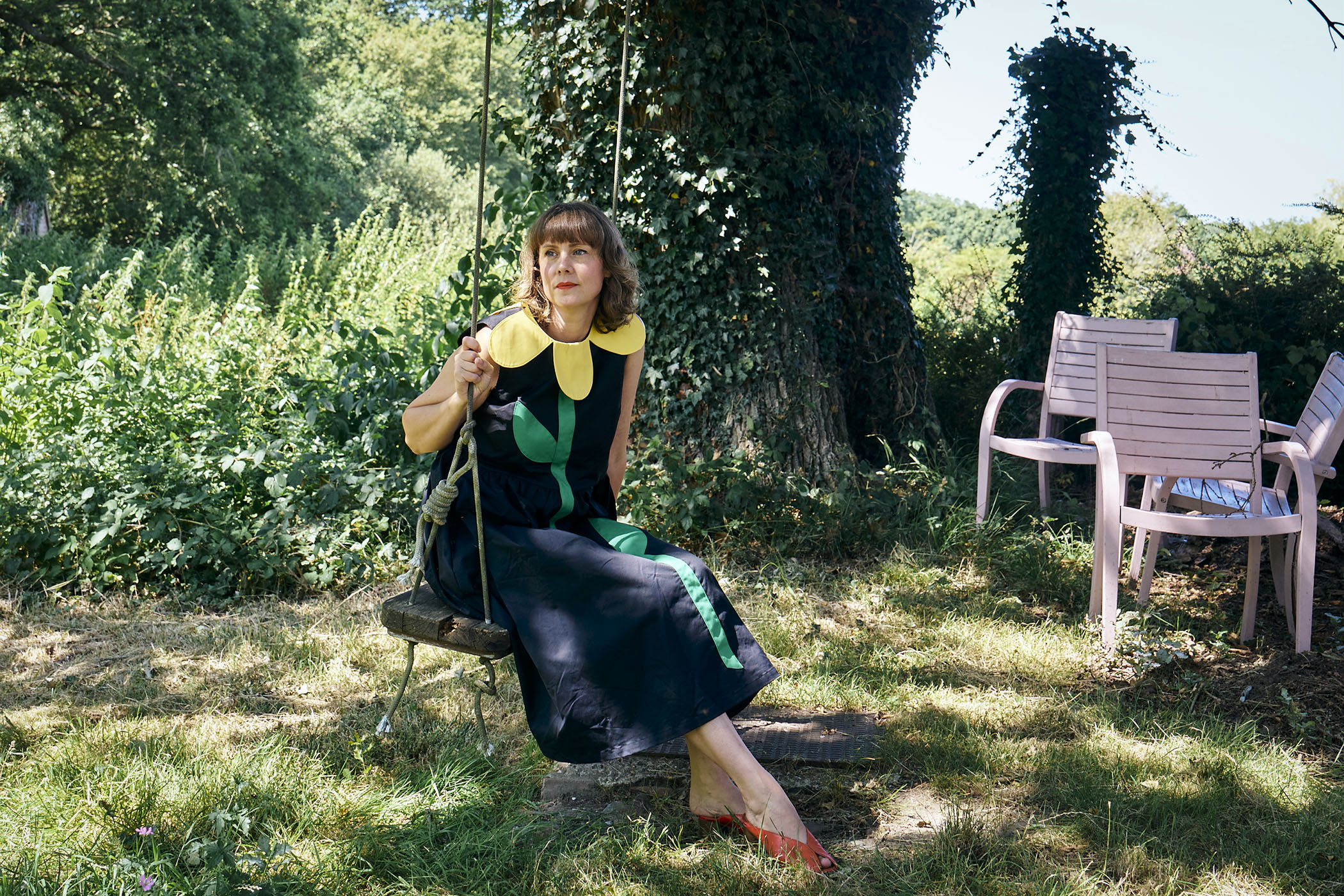
Photograph by Suki Dhanda for The Observer
The career of the performance artist, screenwriter, theatre-maker and one-time bodybuilder Bryony Kimmings is not easy to sum up. Her confrontational shows have tackled motherhood and mental and physical illness. In the past decade she has won plaudits for her solo stage piece I’m a Phoenix, Bitch, and then for Bog Witch, a show she is about to take to the Edinburgh fringe. Kimmings, 45, lives in an isolated corner of East Sussex with her partner, the stage and light projection designer Will Duke, and their children. She co-wrote the 2019 festive romcom Last Christmas and her co-authored adaptation of the bestselling Liz Jensen thriller The Rapture comes to the BBC later this month.
Will you keep mixing up your work, writing for stage, TV and film, or are you still looking for the perfect creative arena?
I seem to be a bit of a chameleon – luckily, because a lot of people don’t get that luxury. No one wants to make the same show over and over again, but I also don’t like the idea of preaching to the converted or just talking to a particular echelon. I’ve got a chip on my shoulder about class. So at the moment I really like adapting things like The Rapture. But I make sure I’ve always got the climate crisis in there somewhere, whether it’s front and centre, or just a part of it.
Some of your solo stage performances – such as Sex Idiot, which notoriously involved pubic hair – have had an edginess to them. Do you like creating a sense of jeopardy?
I call myself a performance artist for a reason. When I was a young upstart from Peterborough, with all my gold jewellery and my sovereign rings, I connected to extreme performance artists who were cutting themselves and bleeding in galleries, or pulling scrolls from their vaginas. I thought: “This is my world.” It speaks such volumes about being a human and being a woman. I still follow it all. I’m such a fan. But I don’t like how limited its audience is. I want people to think that performance art is as cool as I think it is.
What did you learn from writing the screenplay for Last Christmas with Emma Thompson?
That was such a fluke. I was working in a shared office trying to write a treatment for my first feature and Emma rang up the guy sitting next to me and asked if he, by any chance, knew a weird sort of feminist loudmouth. And he was like: “She’s right here!” It was that serendipitous. She’s an Oscar-winning screenwriter and also the most generous human. So I watched my shoddy draft being taken away and deconstructed. I saw what was good and bad about it. When I watch that movie now, I can hear which bits are me and deduce what I’m good at: honesty, women and talking about emotions.
When you write and perform, are you aiming to entertain or to shake things up?
I write for my mum, although I’m probably less patient with my mum than with my audience. I’m often trying to decipher the science or history I have read and I just want to explain it to my mum, or my mates down the pub. It’s that kind of vibe. If you’re telling an anecdote down the pub, it’s not going to be all doom and gloom. You want to make people laugh. My mum, who has an ironing business, is definitely my sounding board for the telly stuff I write because she watches so much while she’s ironing. She’s quite discerning.
Newsletters
Choose the newsletters you want to receive
View more
For information about how The Observer protects your data, read our Privacy Policy
Your stage work is often personal and covers serious events in the lives of people close to you. Do you feel a responsibility to them?
It is always tricky, but my family and friends know me and they’ve got to know my work. So far, no one’s ever really been upset with me. That’s mainly because I ask them to read it, and then give them the right to reply, but also because I can articulate to them why I need to do the piece after something that I went through. It’s always like there’s this thing; it feels very unjust and it needs sorting out and I want to be part of the sorting out. And there’s always room for negotiation.
The struggles you had both as a young mother and with your son’s health condition, known as West syndrome – an extreme form of epilepsy – have been part of your stage work. How is your family’s health now?
Everyone’s good. I’m a bit perimenopausal, I’m not gonna lie. My brain just isn’t as focused as it used to be. But in some ways, I love it. I am sort of mellowing out. The children are great. My stepdaughter is just finishing primary education today and so is just on the cusp of something very different. And I enjoy being able to converse with my son Frank now. I didn’t think he’d ever walk or talk. So every day, as cheesy as it sounds, is a gift. We talk about everything. It just feels very grown up in a nice, relaxed way.
What appealed to you about turning The Rapture into a TV thriller?
I chose it partly because one of the lead characters, played by Ruth Madeley, is a wheelchair user and because both female leads are reluctant heroes. I thought: “I have to write this.” It was interesting to me because normally women in dramas are either a saviour or evil. I also really liked the way it is an overt sort of allegory. There’s a teenager inside a high-security psychiatric hospital who can see what’s going to happen in the future – and at the moment many young people are a bit like that, pointing out to us that we need to stop [what we are doing] to prevent a climate disaster. So I just knew. I got sent a lot of books, but it was this one that I felt we needed to see.
Bog Witch is at the Traverse theatre, Edinburgh, from 2-30 August, as part of a tour that runs until 1 October. BryonyKimmings.com
The Rapture is on BBC iPlayer and BBC One from 26 July