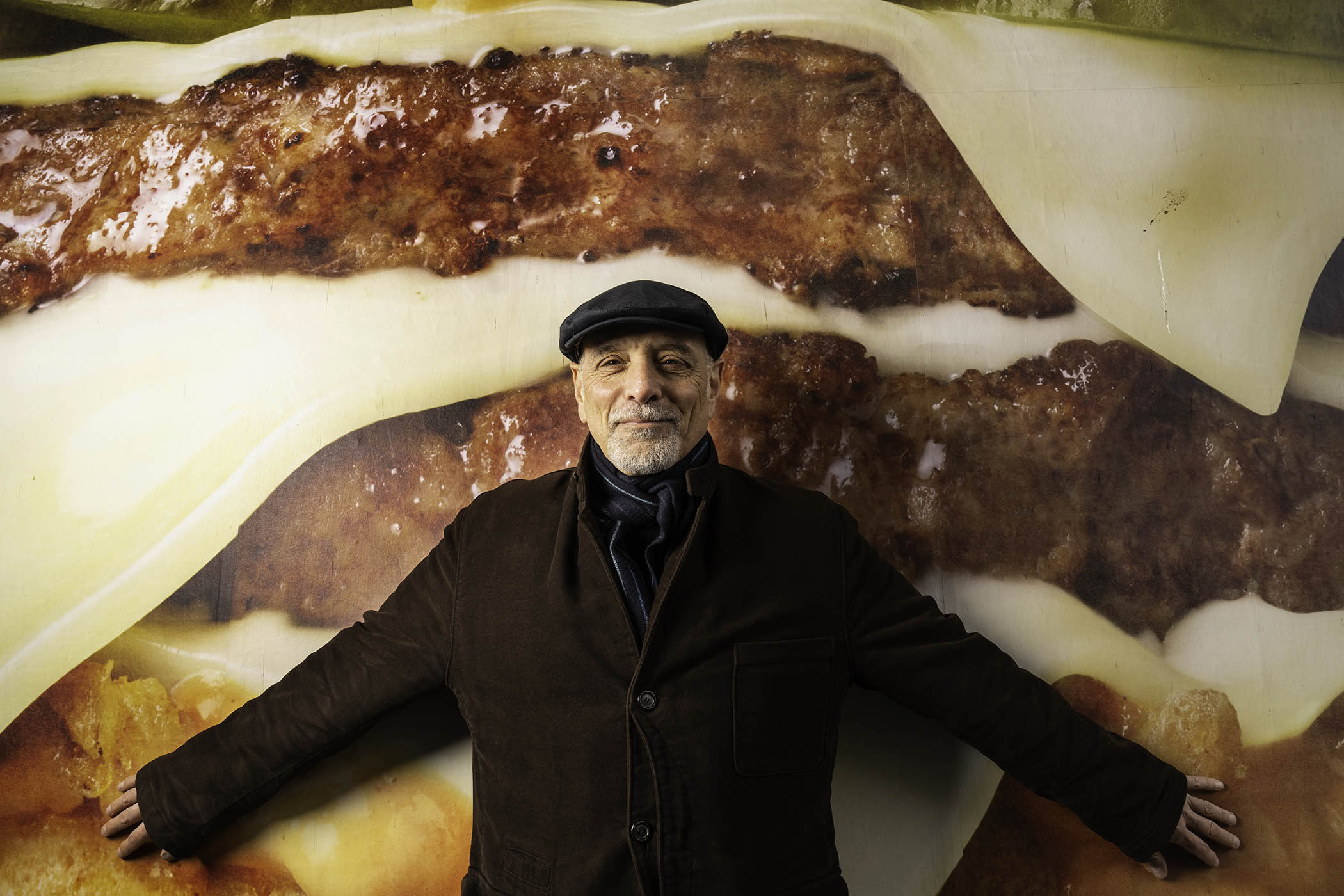

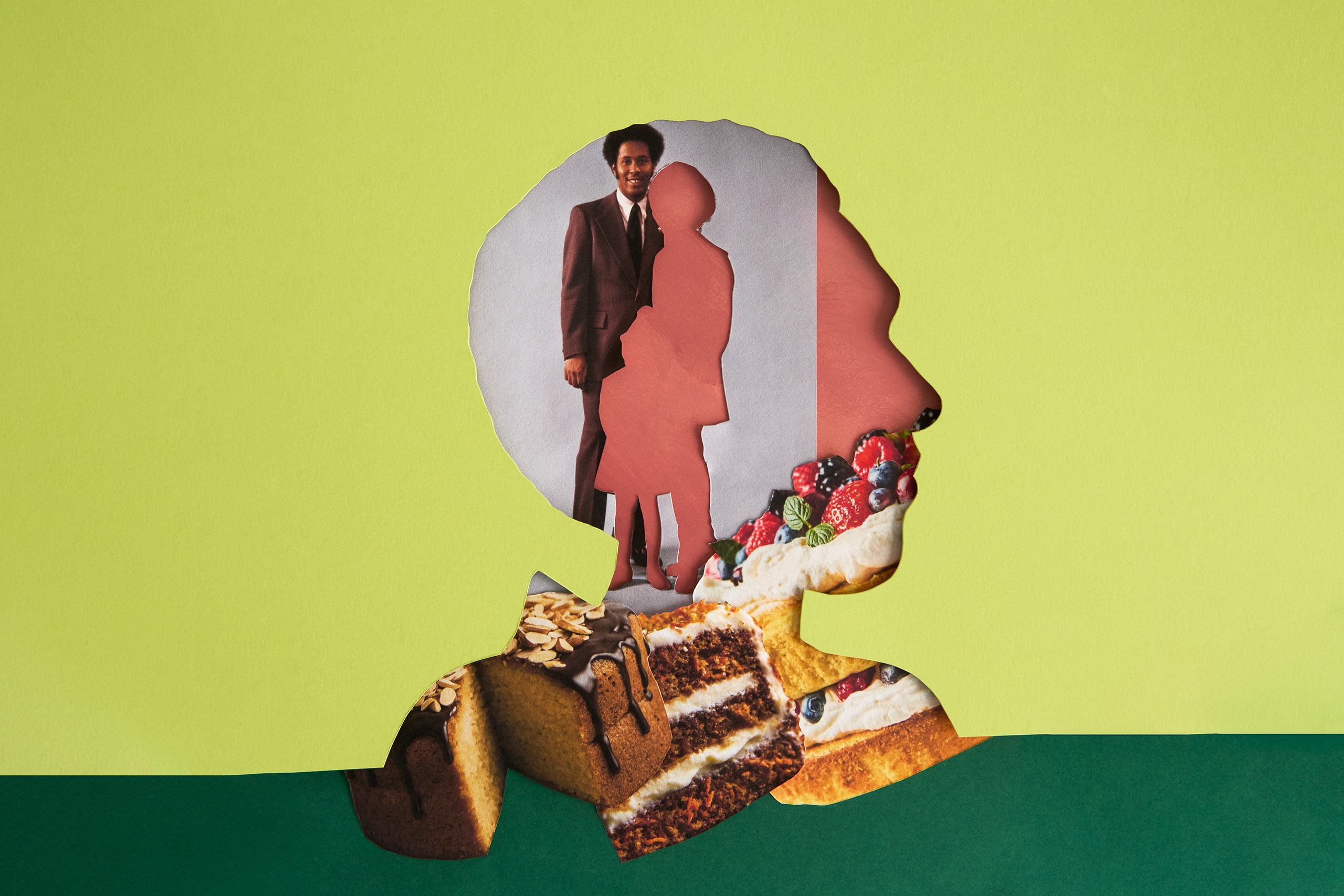

Portraits by Antonio Olmos
It was never Eric Schlosser’s intention to become McDonald’s public enemy number one. Back in 1997 the American investigative journalist hadn’t given much thought to hamburgers, other than when he was hungry out on the road. So when an editor from Rolling Stone asked him whether he’d write an expose of the fast food industry, he wasn’t exactly filled with enthusiasm.
“I didn’t want to write something that was condescending towards fast food, because I liked those foods. I ate those foods. I took my kids to McDonald’s,” Schlosser recalls, standing in a McDonald’s on Kilburn High Road in north-west London.
He said he would think about it and went off to the New York public library to read up on the industry and its origins. “I became fascinated by it,” he says, his eyes sparkling at the memory. “It became a story that wasn’t just about the changes in food production but the rise of unchecked corporate power in America post-Ronald Reagan.”
A year later, having traversed the country looking at all aspects of the history, economics, gastronomy and culture of fast food, he filed a two-part piece that became the foundation for a book that, 25 years ago, transformed the US’s understanding of its eating habits. A rich, meticulously researched portrait of a system of comprehensively industrialised food production, Fast Food Nation was a bestseller that was acclaimed by critics, devoured by readers and denounced by the monopoly businesses described within its pages.
The book has been reissued with a new afterword by Schlosser to mark its quarter-century – and it more than stands the test of time. If the image the industry promoted was, at one end, of cattle roaming on limitless ranges and, at the other, of happy smiling people eating in bright shiny restaurants, the reality Schlosser encountered was eye-opening: massive land despoliation; vast but cramped feedlots in which cattle, pumped full of antibiotics, consumed food that contained unnatural ingredients including, in some cases, chicken faeces; nightmarish slaughterhouses; minimum-wage workers all along the production line; a franchise system of food outlets run on high rents, low pay and a strict limit on employees rights; and soaring rates of obesity and cardiovascular illness.
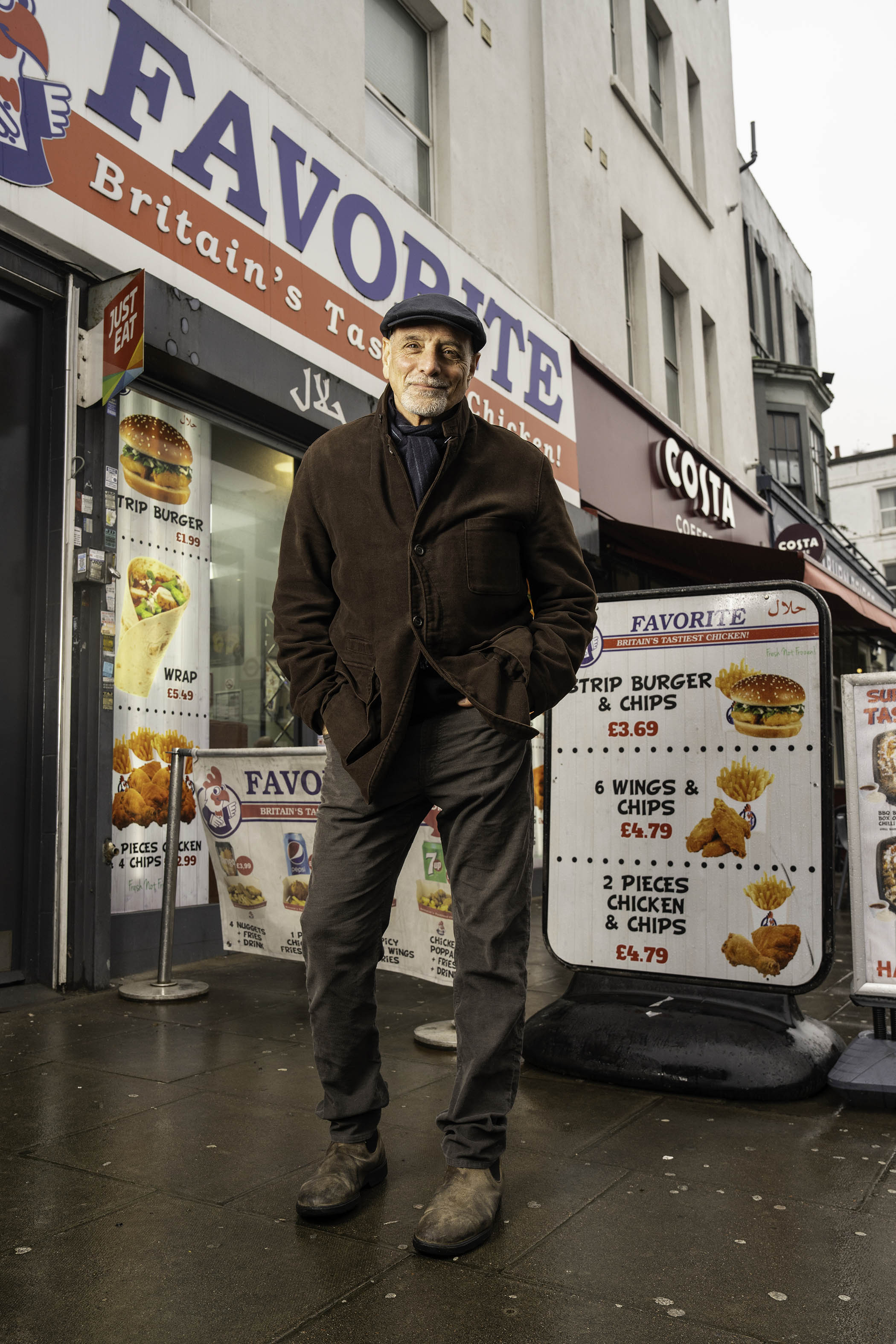
Schlosser outside a fast-food shop on London’s Kilburn High Road
Maximisation of profit seemed, at that time, to be the guiding principle that overruled all environmental, health or personnel concerns. As a result, Schlosser’s probing journalism went down very badly with those the book focused critical attention upon.
“I was called a socialist and a communist and there was a lot of personal vituperation,” he says, adding that he got off lightly compared with workers in the industry who tried to stand up for their rights.
Tall and lean, Schlosser looks like a man who is not easily intimidated. His book events drew hostile groups that seemed to be pre-organised. There were also a number of accompanying threats and, on one occasion, during a speaking engagement at Indiana University, he found himself with a police escort.
“Leaving a talk in Tuscon,” he says, shaking his head, “someone came up from behind and got me in a headlock and was yelling at me: ‘Why do you hate America?’ It was just crazy.”
Despite these incidents and the corporate defensiveness, the book launched a debate about food, led to a 2006 film directed by Richard Linklater and co-written by Schlosser, and opened the way for Morgan Spurlock’s Oscar-nominated 2004 documentary Super Size Me.
But, 25 years on, how much has really changed?
In Schlosser’s sobering afterword to the reissued book, he suggests that there is little cause for celebration. He gives particular prominence to the US meatpacking industry that still seems rife with disturbing practices, including the use of child labour in slaughterhouses – not something Schlosser saw any sign of in his original investigation.
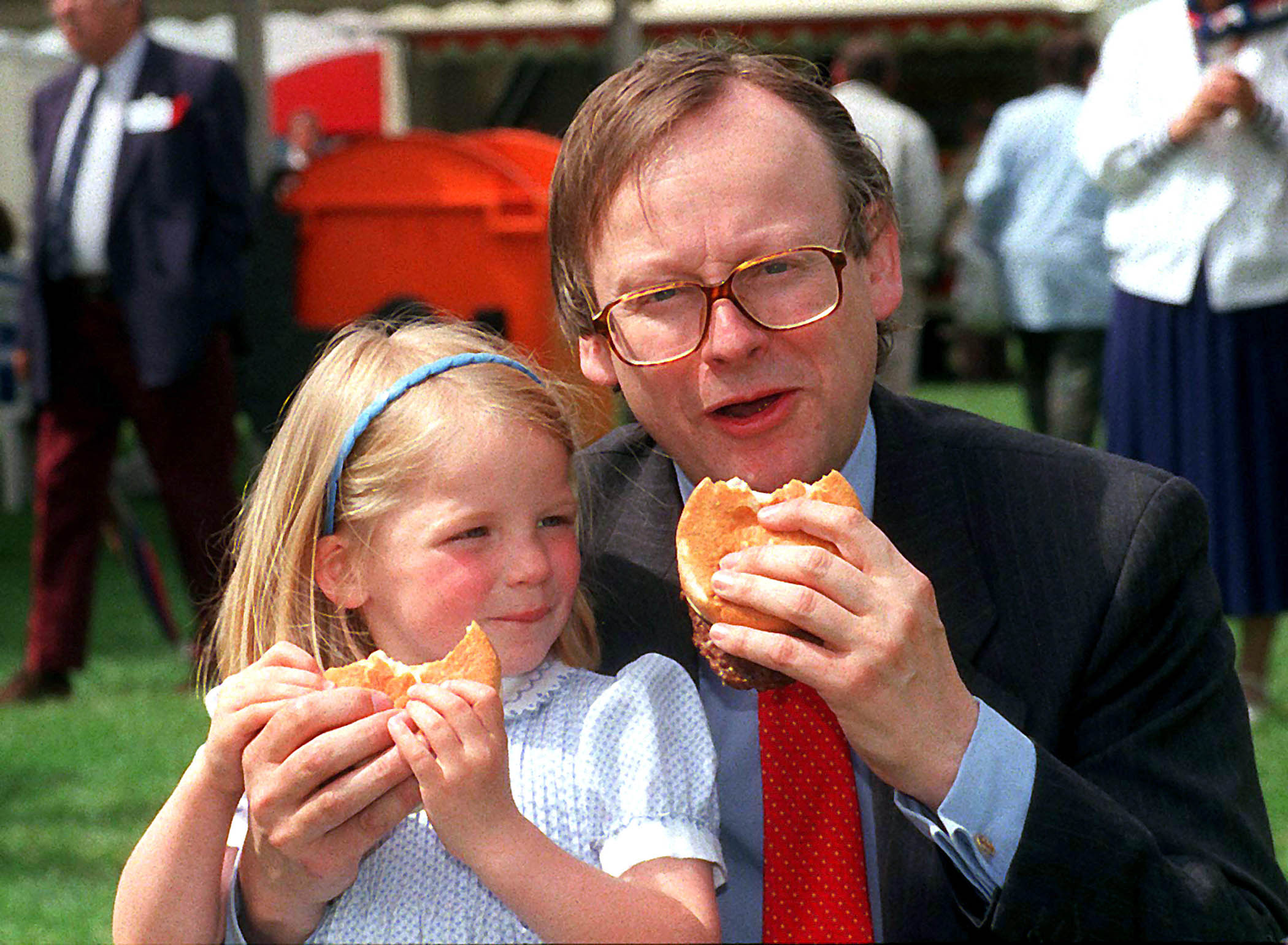
John Gummer, the minister of agriculture during the BSE epidemic, tried to convince the public of beef’s safety by offering his daughter a burger at an event in Suffolk
“I’m unbelievably grateful that my book was published, that it’s still in print and that Penguin have reissued it, but you have to be quite humble about the power of the pen,” he says. “I’m not so megalomaniacal as to have thought that I alone could change this gigantic industry.”
We’re in Kilburn because, in many respects, it’s a typical British high street that features six burger places and, the real mainstay of British fast food, nine chicken shops, most of them independently owned rather than franchises in large chains.
Because in both culture and politics we tend to absorb many American trends, the distinct historical and geographical differences between the US and UK can often be overlooked. One of Fast Food Nation’s many strengths is that it sought to place the rapid postwar growth of fast food in the US within the context of the social domination of the motor car and the suburbanisation of American cities and towns.
In a sense, the rise of the fast food industry was like a marriage between the ideas of two American business titans: Henry Ford and Walt Disney. The assembly line that Ford pioneered in car manufacturing was adopted by the early fast food outlets that saw lucrative efficiencies in mass production with the division of unskilled labour. And building on Disney’s example, cartoon characters and merchandise were used to attract children and, therefore, families.
The man who most embodied this Ford-Disney combination was Ray Kroc, a milkshake machine salesman who first partnered with, and then bought out, the McDonald brothers, Richard and Maurice, who in 1940 had opened the first McDonald’s in San Bernardino, California (also the birthplace, as Schlosser wryly notes, of the Hells Angels). Kroc, who had served in the same first world war ambulance corps as Disney, emerged as a classic American entrepreneur in Schlosser’s telling: a self-made man with an almost religious devotion to the profit motive. He successfully lobbied the Nixon administration to lower the minimum wage for teenagers, who made up a large part of the McDonald’s workforce. Just as he grasped that child customers were the gateway to families and the starting point of brand loyalty, Kroc also knew that teen workers were the least able to organise and assert their employment rights.
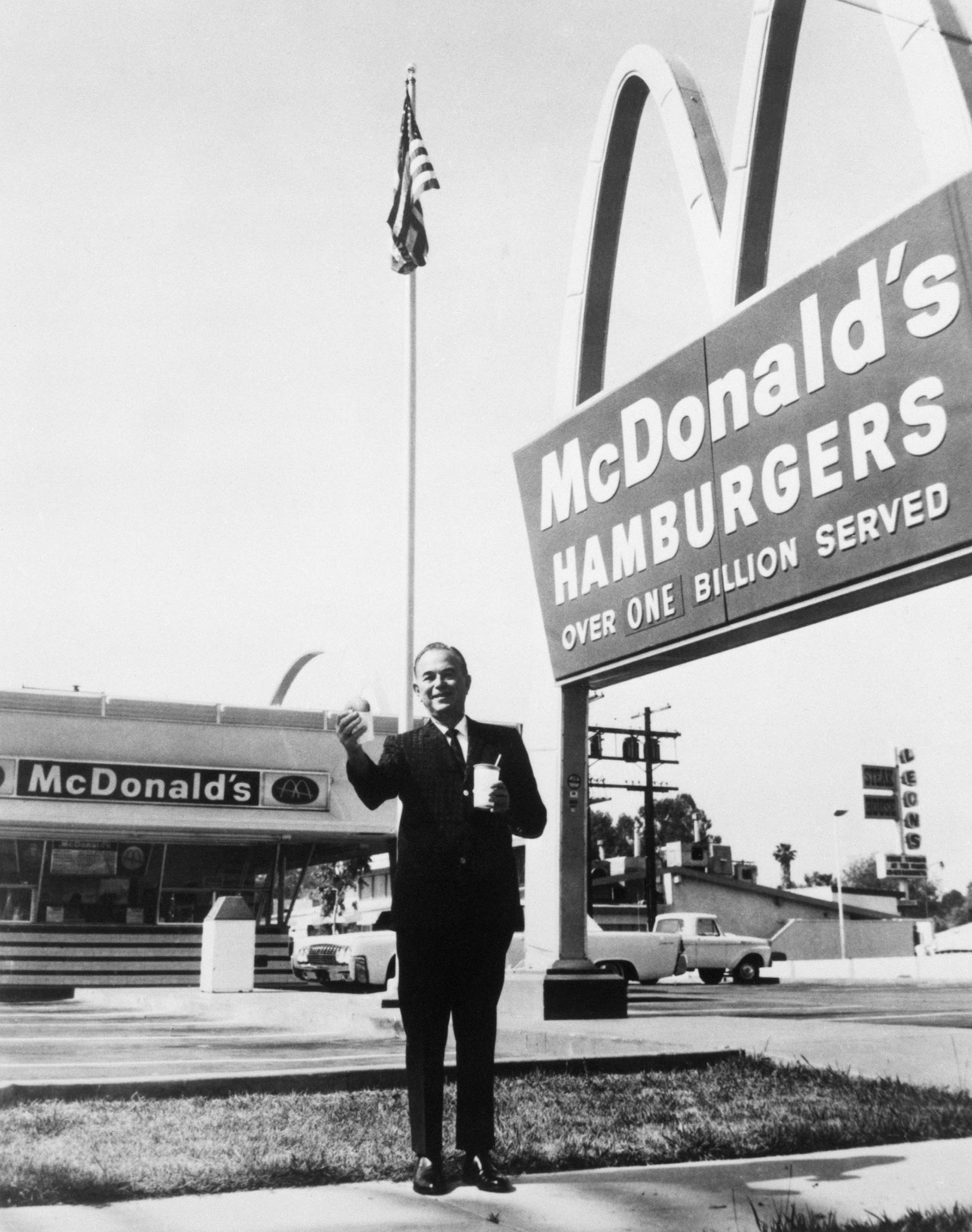
McDonald’s founder Ray Kroc
But as Schlosser acknowledges, it wasn’t the plight of teenagers and low-paid workers that captured most attention and headlines when his book was published, or the monopolisation of the market and suppliers by a handful of mega corporations, but instead the dubious practices that were commonplace in the industrialisation of food production.
McDonald’s states that it is now committed to greater nutrition transparency, and improved animal welfare and is “working toward the responsible use of antibiotics in our supply chain”. In the UK there is also a greater emphasis on sustainability and environmental goals. So did it actively respond to the criticisms?
“I think the changes that have been made have been in reaction to pressure from consumers – things like the use of organic milk and the different sustainability measures they’ve announced. But at its core,” he argues, “it’s exactly the same corporation with its founder’s ideology. There’s a Kroc quote in the book in which he says: ‘If I saw that one of my competitors was drowning, I’d walk over and put a hose in his mouth.’”
By and large, fast food consumption is less unhealthy in the UK than in the US. We eat it less often and less of it when we do; the regulations on rearing cattle and on food production are stricter (in part due to the legacy of EU legislation); and there is much greater diversity in farm ownership and slaughterhouses. Even our McDonald’s tend to feature more choice. “It’s a much bigger menu,” says Schlosser surveying what’s on offer in Kilburn, “with wraps and salads, vegetarian and vegan.
“But that’s where they make their money,” he adds, pointing to the £1.98 Coca-Cola. “They’re the biggest seller of Coca-Cola in the world, and that is carbonated water with colour and sugar and flavour additive. That is pure profit.”
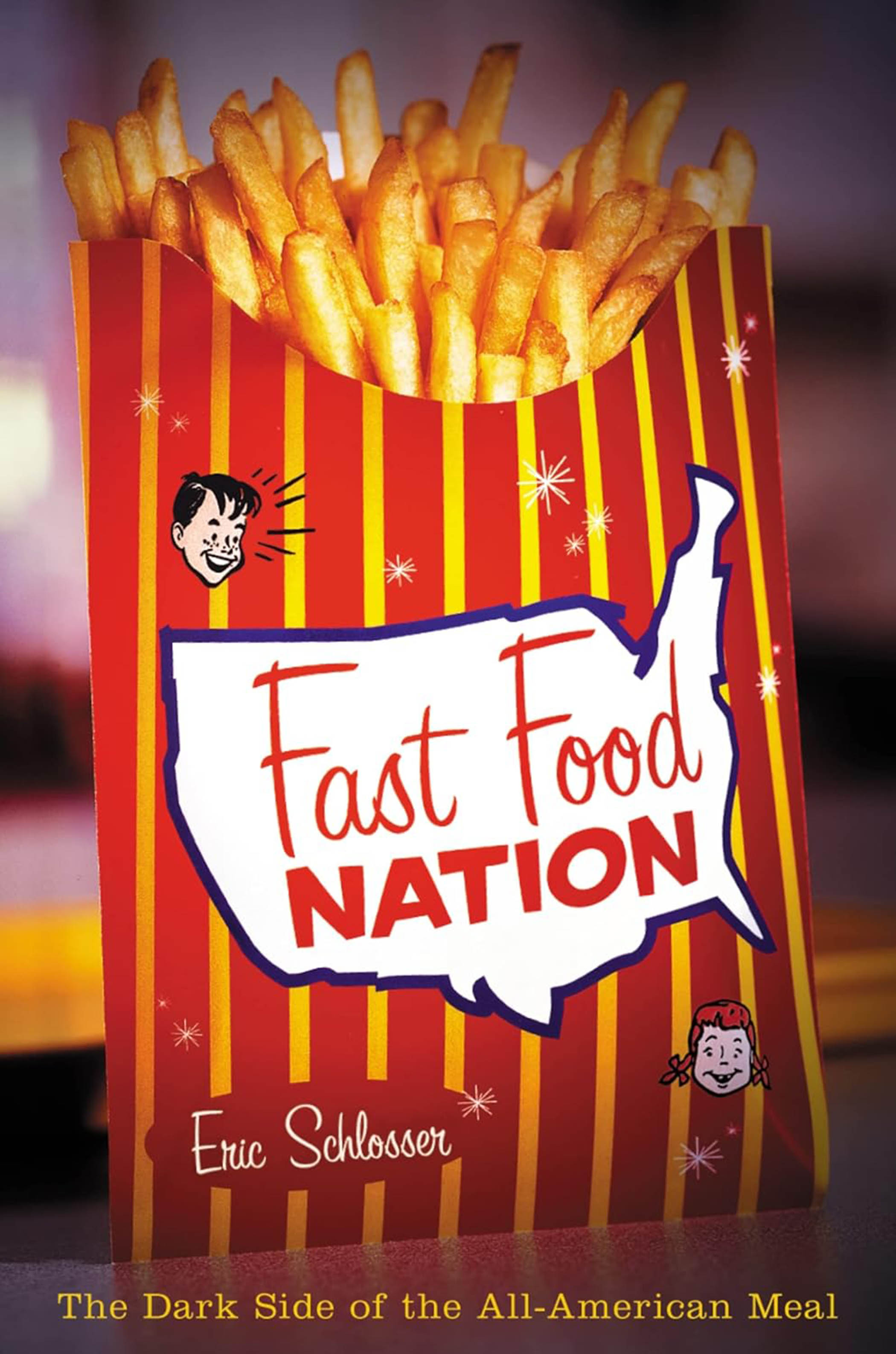
The first edition of Schlosser’s book was published in 2001
Along with high street chicken, the sandwich is another staple of British fast food. It’s a much less varied business than it appears, with chains such as Pret a Manger owned by an arm of the German billionaire Reimann family, who control a number of other coffee and sandwich chains. And, as Schlosser notes in his book, an Ireland-based company called Greencore “sells about 600 million sandwiches a year in cardboard packages bearing the logos of other brands”.
Moreover, if our obesity levels are not quite as high as those in the US, and our fast food is less dominant and uniform, perhaps the two most shocking events that Schlosser documented in the book took place in the UK. The first was the outbreak of BSE – bovine spongiform encephalopathy or mad cow disease – in the 1980s and 1990s, after young calves of dairy cows were fed meat and bone meal. It led to the slaughter in Britain of about 4.4 million cows and the banning of any kind of mammal or poultry-based products from cattle feed.
The other incident was the “McLibel case” in the 1990s in which two environmental activists were taken to court by McDonald’s over a damning leaflet that was partly written by an undercover police officer.
“McDonald’s used the British libel laws, which uniquely favour big corporations,” says Schlosser, who points out that McDonald’s private investigators and the Metropolitan police infiltrated London Greenpeace, and wonders why “the undercover Scotland Yard officer who was seen handing out these pamphlets was never sued?”
The infiltration of London Greenpeace was part of the notorious undercover police operations in which officers assumed false identities, and in a number of cases fathered children with unwitting partners, that remain a grotesque stain on the reputation of Met.
The British courts initially found in McDonald’s favour in the libel suit but ultimately, and some years after the publication of Fast Food Nation, the activists – Helen Steel and David Morris – were vindicated by the European court of human rights.
Tens of thousands of people may die because of Robert Kennedy Jr’s absurd beliefs
Tens of thousands of people may die because of Robert Kennedy Jr’s absurd beliefs
One big development that’s taken place since the book was first published is a greater medical awareness of the deleterious health effects of ultra-processed food (UPF). A curious cheerleader for the anti-UPF cause is the US heath secretary, Robert F Kennedy Jr. Given his history of controversial scientific and anti-vaccination statements, how seriously can his Donald Trump-backed “Make America healthy again” crusade be taken?
Schlosser believes that Kennedy has been politically astute in appealing to public opinion, which has not been reflected in party policies because both Republicans and Democrats have been “beholden to campaign donations from the big food companies”. So although there is a real public appetite for regulatory reform, particularly in relation to children’s food, he does not believe RFK Jr will deliver it.
“No,” Schlosser says firmly, “tens of thousands of people may die because of his absurd beliefs. His greatest achievement so far in making America healthy has been to persuade certain companies to remove artificial food colourings from their ice-cream.”
We leave McDonald’s and walk along Kilburn High Road in the endless winter drizzle. The illuminated signage of the fast food shops– all based on the template McDonald’s originally laid down – make for a gaud il y colourful contrast to the greyness of the buildings and the day. This cheery allure conceals the world of stress and suffering that is the basis of the industry, the cooped up broilers and grim slaughterhouses – what Schlosser calls a “petri dish for zoonosis”.
It’s been established that a number of modern infections – such as bird flu, swine flu and the spread of antibiotic-resistant bacteria – have stemmed from the intensive farming of animals.
“We have been raising livestock for 10,000 or 15,000 years,” says Schlosser, “but we’ve only been raising them this way, literally, for 40 years. It’s cruel to the animals, it is terrible for the environment and it creates all kinds of potential health harms. But I do believe that the overwhelming majority of Americans have no idea.”
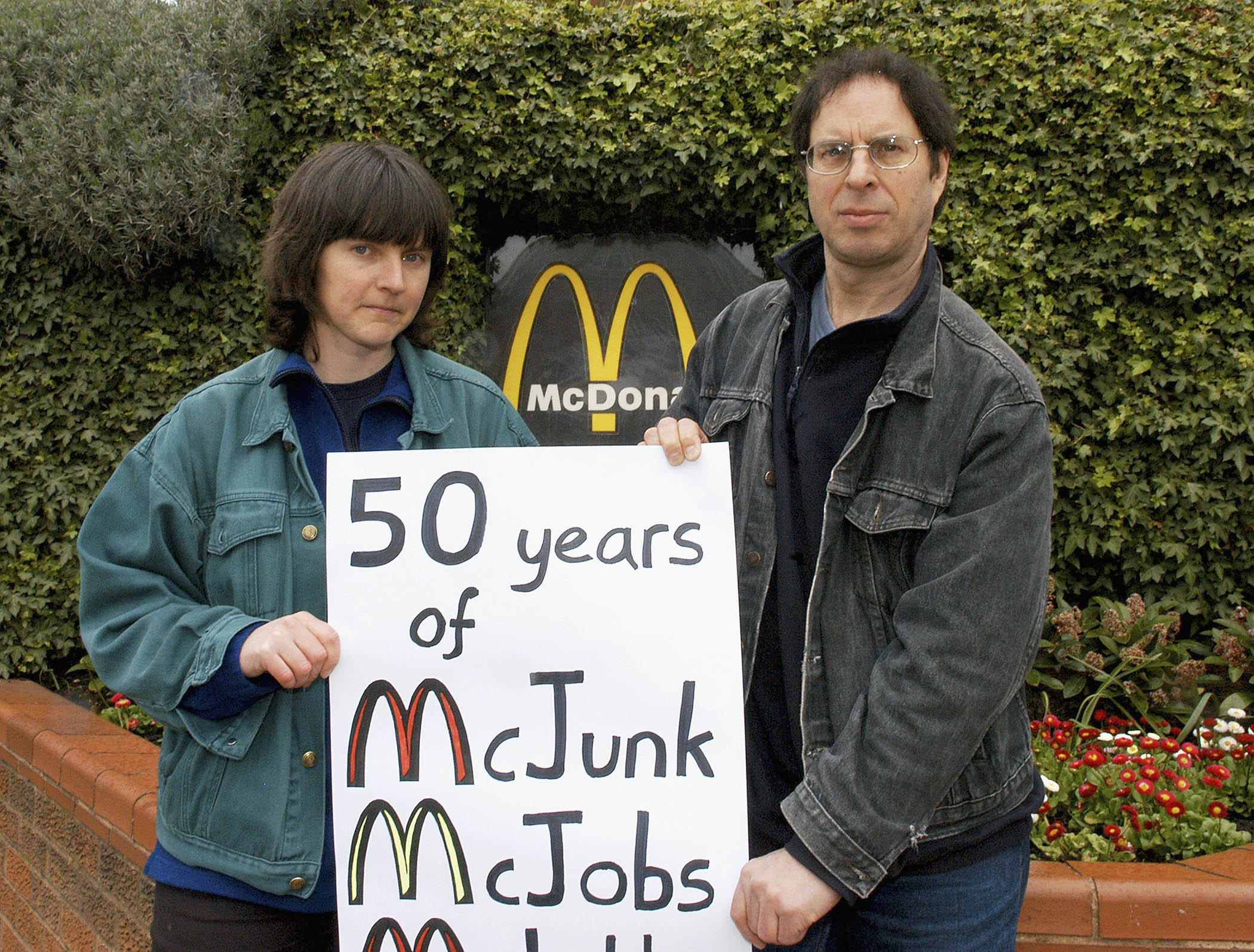
Helen Steel and David Morris outside the McDonald’s London offices in 2005
The same is almost certainly true for the majority of Britons, even if the conditions of our farm animals are not quite as extreme. What Schlosser emphasises is that the cheapness of fast food is misleading, because it does not take into account the whole costs – in the US, the fast food industry has often benefitted from government subsidies – or what’s known as the true costs, which take into account long-term effects.
“It’s cheap when you buy it, but it’s not cheap when you need the dialysis,” he says, referring to the rise of type 2 diabetes; over the past 30 years, incidence rates have doubled in the UK (to 8.8% of the adult population) and US (to 12.5%).
Schlosser, who lives south of San Francisco with his wife, Shauna, the daughter of late actor Robert Redford, has been a tireless investigator of American business. I first met him just over 10 years ago after he had written a couple of books on the precarious nature of the nuclear weapons industry. He has spent much of the intervening time researching a book on the American prison system.
“It tries,” he says, “to answer the question: how did the land of the free become a nation behind bars? Unfortunately, many of its central themes are relevant to countries that have emulated American correctional practices – like the UK.”
If the resulting book enjoys half the success of Fast Food Nation, it could mark a watershed moment in the debate around the prison-industrial complex. He “really hopes” to finish the writing this year. For all his despair at the direction of US politics – and he spends as much time discussing events in Minnesota and elsewhere as he does his book – there is something fundamentally optimistic about Schlosser that is enormously winning.
As he puts it in his afterword, he is “humbled, disappointed, amazed, outraged, angry beyond words, and yet hopeful”.
Fast Food Nation: The Dark Side of the All-American Meal is published by Penguin Classics (£12.99). Order a copy from The Observer Shop for £11.69. Delivery charges may apply