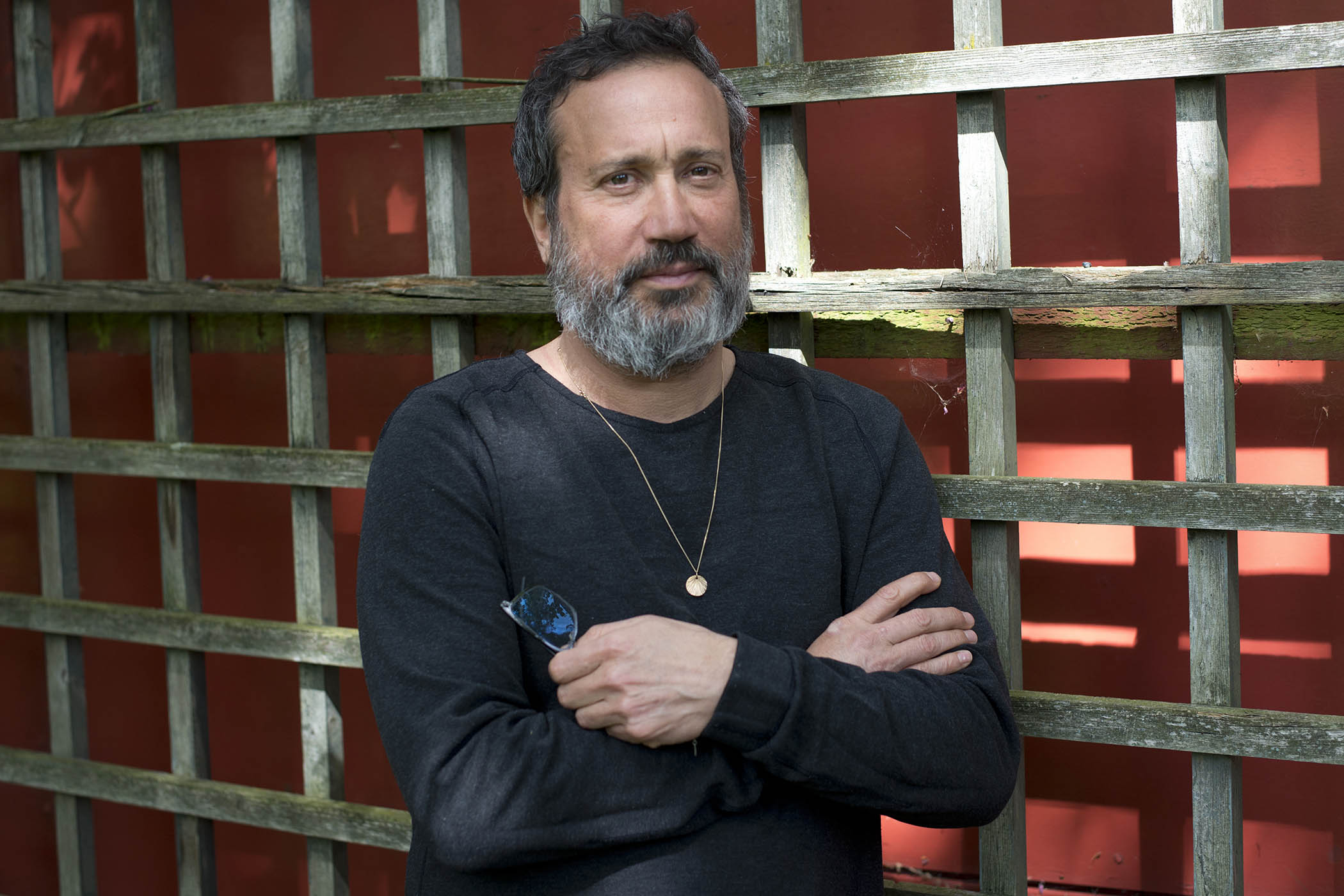
Portrait by Sophia Evans
There’s a description in Eyal Weizman’s new book, Ungrounding, of a few days last May in the London studio of Forensic Architecture (FA), the research agency he founded and leads. News started to arrive of the bombing of a house in Gaza. A video circulated online showing civil defence workers trying to help a family buried under the rubble, their shouts and banging audible, until the would-be rescuers were driven off by Israeli gunfire. The people in the studio contacted whoever they could inside and outside Gaza – physicians, politicians, UN representatives – to get them to persuade the army to allow access to medical help, but to no avail. The military kept Red Cross ambulances away from the house.
The bodies under the rubble, at least 14 of them, are still there (and there were others in surrounding houses). They were cousins of a Palestinian colleague at FA. She was in the studio, watching with the others. “We could do nothing more than hold on to her,” writes Weizman. “We felt the pain of each breath we took, as her relatives’ lives withered away.”
Writing Ungrounding, Weizman says, was his way of dealing with trauma. The purpose of FA is not to design buildings in the way that most architects do, but to analyse the physical fabric of crime scenes – usually but not always in war – in order to work out what did and did not happen. It examines atrocities in close detail. Ungrounding delves into history and geology to argue that Israel’s actions in Gaza are genocide. The book describes acts of vast brutality in factual, sometimes technical terms. “It’s easier that way,” says Weizman, who speaks in the same measured tones as he writes.
His emotions are heightened by the fact that he is an Israeli-born Jew, the son of “survivors” who “grew up as refugees in a displaced persons camp in Germany”. At the same time, he passionately opposes the actions of the Israeli government. “I was crushed by the 7 October attack [by Hamas]. People that were connected to my family were killed.” More losses would follow during the Israeli response. “There was a group in Gaza called Ain Media, who were media investigators. They were very close to us. We were talking to them all the time. And they started being killed, one after the other.
“When you experience a shocking event, you get so much information, you’re in a flight and fight mode, no? The intake of information is amplified. Different memories that would otherwise calmly lie within the order of time are scattered in your brain in different places because the information just needs somewhere to go.” At FA, they find themselves supporting, with the help of psychologists, both their own staff and first-hand witnesses to horrors. It helps the latter to build a timeline, to put their shattered chronologies back in order. “This,” says Weizman, “is what I was trying to do to myself.”
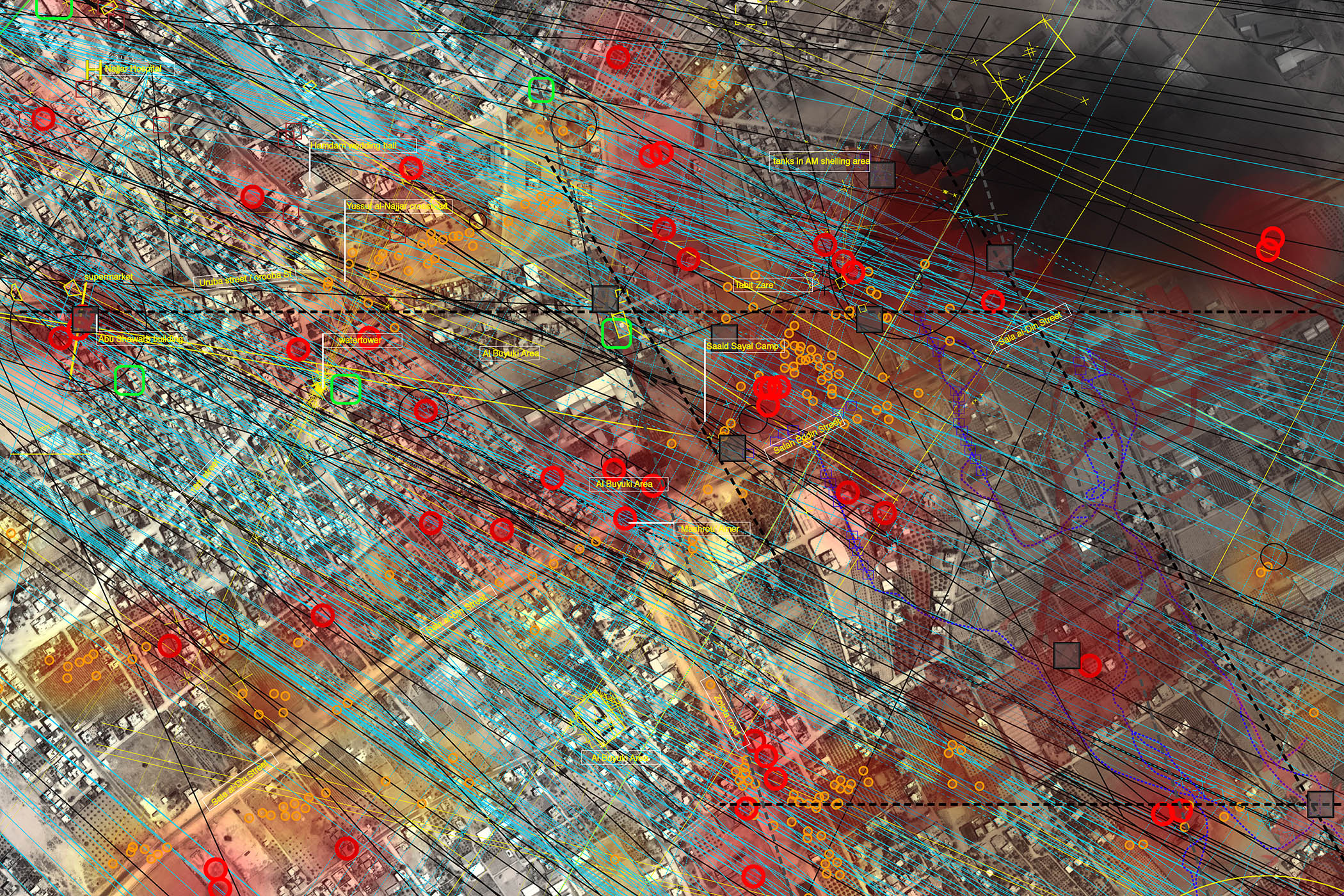
Bomb craters, tank paths and possible tunnel locations mapped onto a satellite image of eastern Rafah
His book goes back to the 1940s, and the expulsion of Palestinians from farms and towns on what would become the border between the Gaza Strip and the state of Israel. It focuses in particular on the village of al-Ma‘in, on whose razed site the Nirim kibbutz was formed. Nirim was the scene of the gang rape and murder of a bedouin child by Israel Defense Forces (IDF) soldiers in 1949. Five civilians would be killed there and five taken hostage by Hamas on 7 October 2023.
Ungrounding proceeds in three parts to the present, recounting what Weizman calls the “designed destruction of Palestinian life in Gaza”. His argument is that genocide is taking place, not only through killing people, but also through the removal of the conditions of existence – buildings, agriculture, infrastructure – and that this process has been going on for decades: “I needed to arrange that longer history and to see how slow and fast violence convert to each other. It was, for me, just the way to live through this time.”
Ungrounding tells the story through the medium of soil; carved out to mark the border, excavated into tunnels to transport supplies and weapons into and around Gaza, bombed and bulldozed beyond recognition. Weizman describes the local geology, where sand carried down the Nile and across the sea meets earthy sediment washed down from the Hebron mountains. These processes divide the strip lengthways into two bands. The inland, eastern side, was lush and fertile – compared by Napoleon to southern France – while the western coastal areas are more arid. There’s also a line between north and south formed by the Wadi Gaza, a watercourse that was historically seen as the border between Palestine and the desert regions to the south.
“I wanted to show how unique, precious, and fragile is the natural environment around the south-western coast of Palestine,” Weizman writes, “and how determining it was of the process of settler colonisation and of the genocide. The premise is, you cannot understand what has happened … without understanding soil.”
Newsletters
Choose the newsletters you want to receive
View more
For information about how The Observer protects your data, read our Privacy Policy
Weizman, 55, trained at the Architectural Association in London. In 1995, he volunteered with the Palestinian ministry of planning, which, in the wake of the Oslo accords, had several Norwegians on its staff. They found that, as an Israeli national, Weizman could access plans and aerial photographs of what he calls “pockets of land under siege” that they could not. “That told me the political significance of cartography,” he says.
In 2005 he founded the Centre for Research Architecture at Goldsmiths, University of London, “a kind of counter-architecture school”, dedicated to studying the relationship of buildings and planning to conflicts, politics and human rights. It reflected a new seriousness in the world of architecture; a desire to engage with contemporary events, rather than get excited about “the design of a shoe shop in New York”. In 2007 he published Hollow Land, a book subtitled Israel’s Architecture of Occupation.
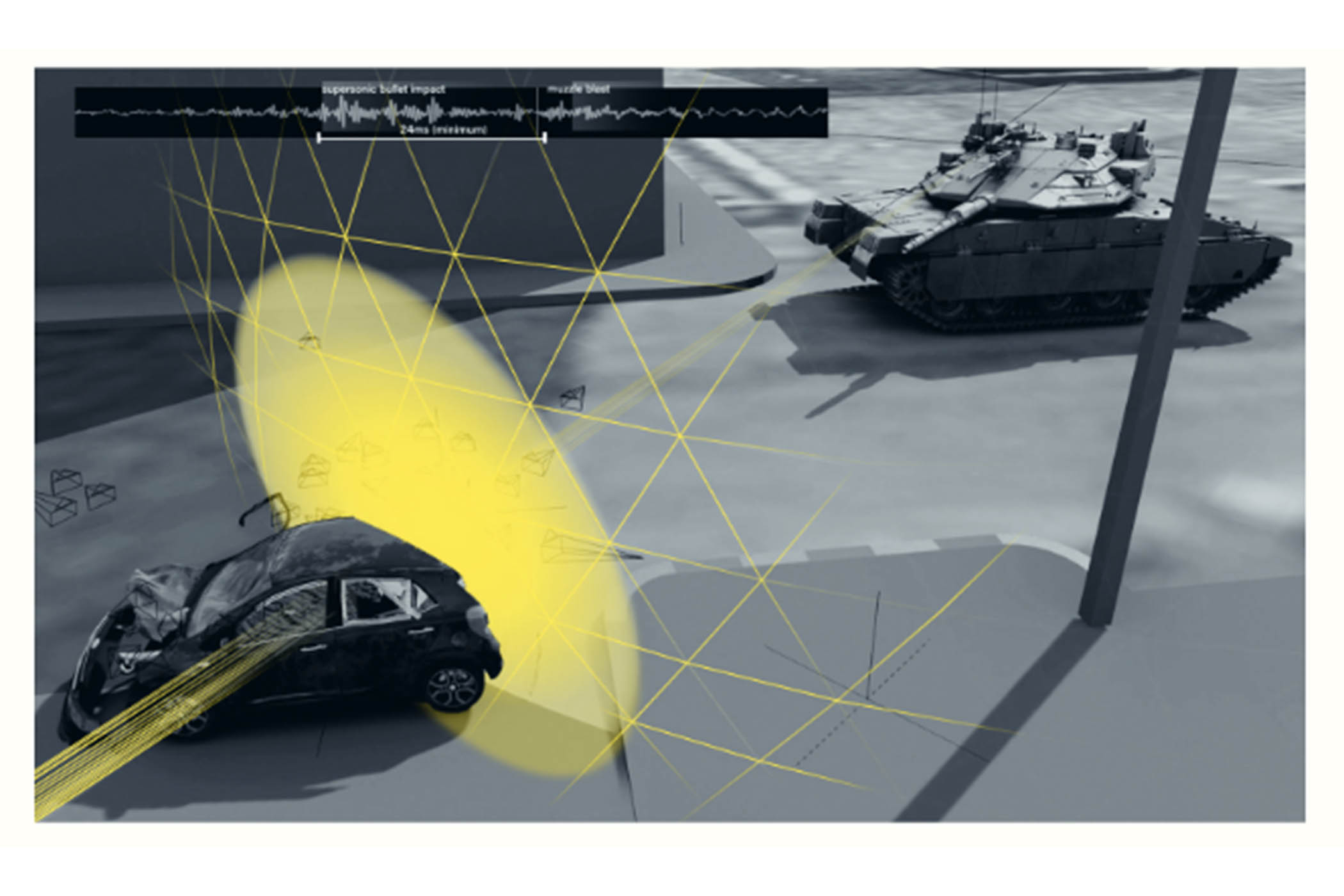
The killing of Hind Rajab
He founded FA – also at Goldsmiths – in 2010. It now employs between 25 and 30 people, and has investigated the Russian bombing of hospitals in Syria and of the Mariupol theatre in Ukraine, American drone strikes in Pakistan, the Grenfell Tower fire, the disappearance in 2014 of 43 students from the Ayotzinapa Rural Teachers’ College during Mexico’s drug war. It has brought new evidence to historic events, such as the German colonial extermination of the Herero and Nama people in Namibia in the early 20th century. In 2024 it assisted in the prosecution of Gen Manuel Benedícto Lucas García, commander of the Guatemalan armed forces from 1978 to 1982, for the genocide of the Indigenous Ixil people.
FA’s primary technique is to assemble all available evidence – films and still photographs taken on phones, satellite imagery, eyewitness testimonies, sound recordings, maps, archival images – and use them to reconstruct events in time and space, using three-dimensional digital models. “We kind of fell upon the open-source revolution,” says Weizman; namely, the discovery – also exploited by investigative agencies such as Bellingcat – of the wealth of material posted online with the help of social media.
“It’s about building relations between images,” he explains; images that may number in the tens of thousands for a single incident. Taken together with information about time and location, these can reveal such things as the angle at which a missile entered a building, its type and origin, the relative positions of victims and killers, and therefore their awareness of one another, or patterns of action that may indicate an underlying intent. It may take months to analyse a momentary event – Weizman speaks of “the long duration of a split second”.
FA only works on a case when it is asked to do so. “It’s a really important principle for us, because we don’t want to enter a site of somebody else’s trauma uninvited,” says Weizman. It doesn’t charge victims for its services, but raises funding from other sources. These are partly academic and partly from human rights grants, both general and specific to particular places in the world. It doesn’t work for governments.
It also gets some funding from public cultural institutions such as museums and art galleries. FA has exhibited, for example, at the Whitney Museum in New York and the Institute of Contemporary Arts in London, and was nominated for the 2018 Turner prize. Weizman says that these settings allow it to communicate its work in ways that are different from and complementary to legal and journalistic processes.
You cannot understand what has happened in Palestine without understanding soil
You cannot understand what has happened in Palestine without understanding soil
FA describes its approach as one of “engaged objectivity”, which “makes us take sides, never with the state and always with those exposed to state violence”. This opens it up to accusations of bias. NGO Monitor, for instance, the Jerusalem-based organisation that reports on international non-governmental organisations from a stance supportive of the Israeli government, has a lengthy entry on Forensic Architecture on its website. “Through slick graphic presentations,” it says, “the NGO creates a facade of credibility (‘CSI Effect’) to mask analyses that are consistently misleading, blatantly biased and based on unverifiable ‘evidence.’” FA’s appearances in cultural venues lead to accusations that it blurs art and science and is therefore less credible.
In Ungrounding, Weizman responds by writing that “our research is prepared and presented in as meticulous a way as possible … in a way that we can demonstrate, step by step, how we know what we know and why we say what we say. Having an axe to grind sharpens the quality of our research.”
Despite conducting 120 investigations in more than 30 countries, it has not yet had to retract anything in its reports. The NGO Monitor critique is light on specific instances of inaccuracy, dwelling more on language – such as “apartheid”, “genocide” and “war crimes” – that it finds “highly biased and politicised”.
FA’s work is used as evidence in national and international courts. In Greece, it helped to secure the banning of the murderous neo-Nazi party Golden Dawn through a legal case that found its leaders guilty of running a criminal organisation. New agencies are now emerging worldwide, supported by FA, that practise and apply its methods. “There were 12 when I stopped counting a year ago,” says Weizman. “There are probably more now.” It has started working with Redes de Maré, an organisation led by women in a complex of favelas in Rio de Janeiro that he says is “like an occupied zone, with the police entering with armoured vehicles or from helicopters, just shooting people in there”.
FA also has imitators, including, claims Weizman, the Israel Defense Forces: “They are starting to use similar aesthetics, kind of borrowing from the rigour by which open-source and spatial investigators are doing the work.”
But for all their wide global reach, Weizman and FA have a particular preoccupation with the actions of the Israeli government. “I was a Jewish person in Palestine,” he says – by which he means the land that includes the post-1948 state of Israel – and “it is my emotional and my professional duty to work for the liberation of this place.” He was raised in Haifa, “one of the cities where you grow up together with Palestinians, within this kind of colonial context – it’s not equal in any way”. His two sisters, like him, are anti-Zionist. How did their parents feel about that? “It had to be negotiated,” he says after a pause.
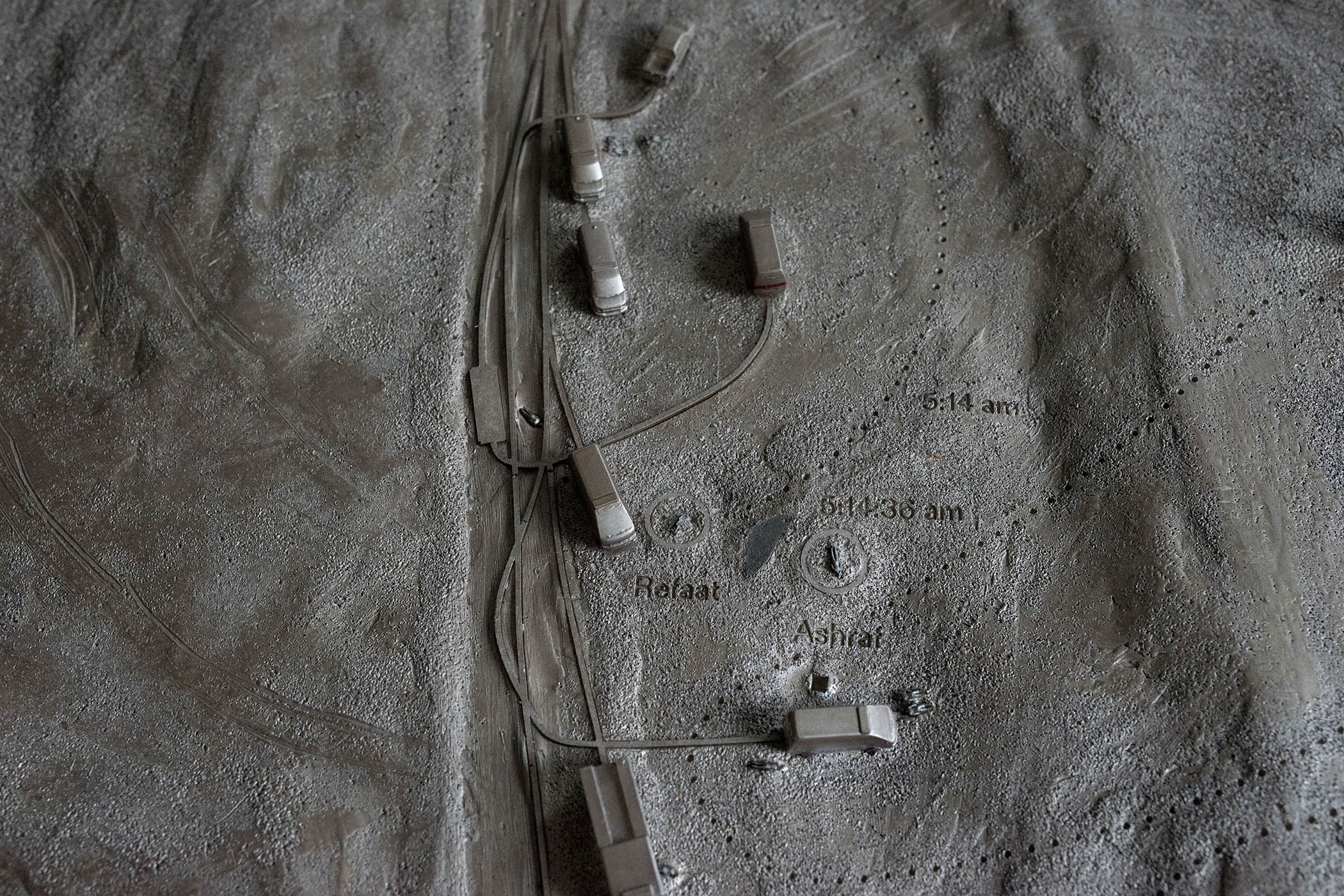
Model at the Forensic Architecture offices at Goldsmiths, London
FA has worked on Palestine from the organisation’s beginning. Now it is supporting the genocide case brought by South Africa against the Israeli government in the international court of justice. Its positions draw reactions: Weizman says FA has been deplatformed, had its websites hacked, been subjected to “bogus accusations of antisemitism” and seen funders walk away. A lecture at the Free University of Berlin, to be given with the UN special rapporteur, Francesca Albanese, was cancelled under pressure from the Israeli embassy. It took place in another venue, surrounded by police officers and detention vans. “When I enter Germany,” says Weizman, “I am stopped every time and interrogated. It’s more than hostility.”
In the last two years, FA has investigated the fate of the five-year-old Hind Rajab, who, along with her older cousin Layan Hamada, survived an attack that killed other family members in their car, only to die in the hours that followed. It studied the size and angles of 335 bullet holes in the car and worked with Earshot, an organisation that specialises in sonic evidence. They established, from the length of time between the sound of bullets being fired and their impact that they came from a tank that was close enough for its crew to know it was shooting at children.
Weizman’s team also examined the attack in the Tel al-Sultan district of Rafah, southern Gaza, in March 2025, in which 15 aid workers were killed, even though they were in clearly marked ambulances and a fire engine, their emergency lights flashing, and in two UN vehicles, also marked. Their bodies and vehicles were then buried in an attempt to conceal the crime. Again working with Earshot, and with the help of interviews with the only two survivors, FA established that Israeli soldiers repeatedly fired on the aid workers – in at least one instance, from a distance of between one and four metres of their victim – over a period of more than two hours. FA helped to prove that, contrary to IDF claims, the killers could see that they were shooting at emergency vehicles and their crews.
FA has also worked at a larger scale, mapping the pattern of expulsions driven by Israeli forces. On 13 October 2023, thousands of leaflets fell on Gaza City, telling residents to move out of what was now a “battlefield”. People were given 24 hours to evacuate. For some pro-Israeli commentators, this was a sign of humanity; that the IDF gave people the chance to avoid obliteration. Weizman calls the leaflets “some of the most lethal things to have fallen on Gaza”. They were the beginning of a pattern whereby people would be forced into hazardous journeys west and south towards the most barren parts of the strip, to dunes where they would struggle to survive. Some would be attacked en route.
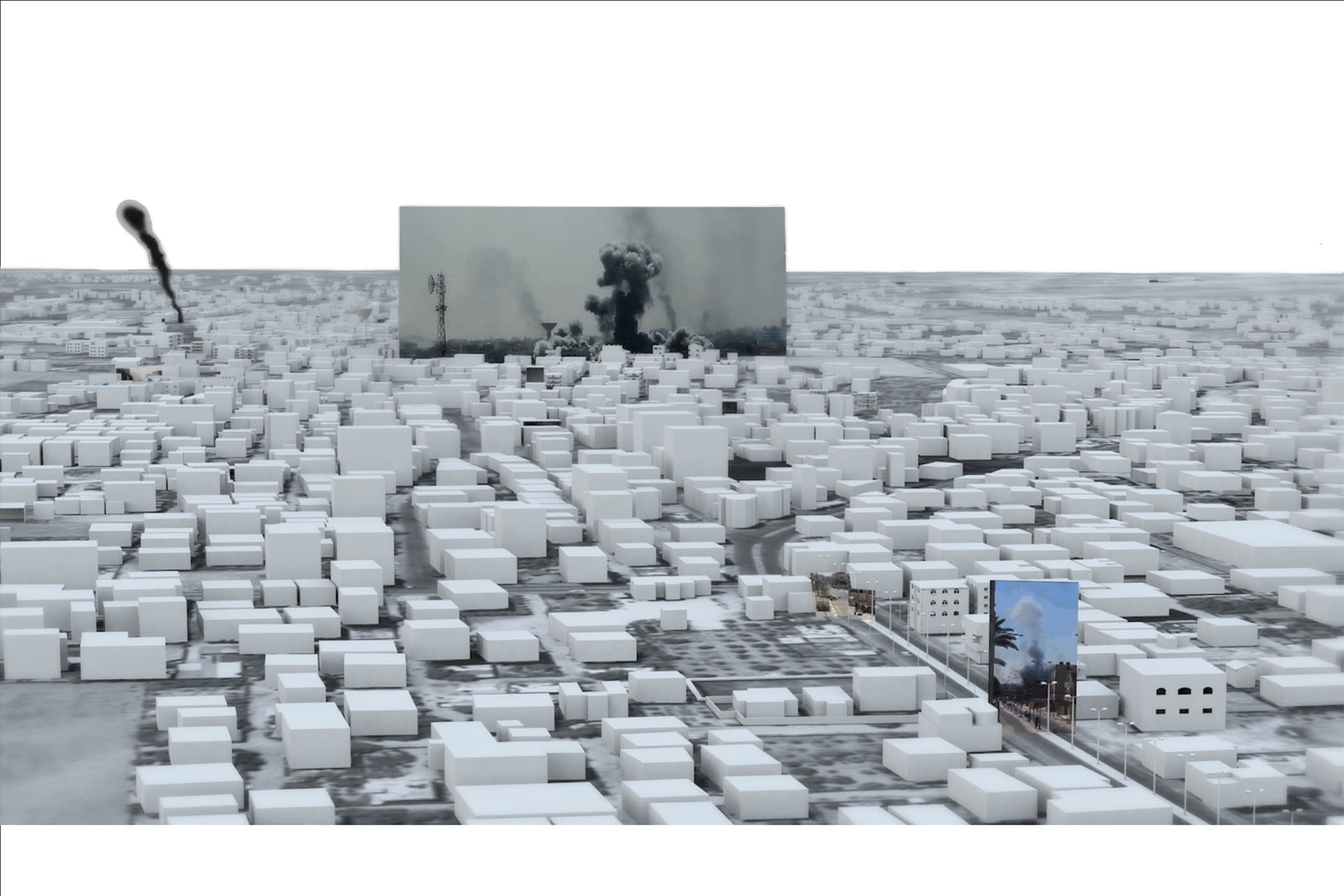
Forensic Architecture also uses three-dimensional digital models
Ungrounding tells how Israeli forces also attacked hospitals, schools, universities, mosques and churches. They destroyed orchards, farms, fishing boats, greenhouses, water desalination plants and wells. They polluted the land and the sea. They killed almost all the cattle, sheep, goats and poultry, blocked aid and attacked people who tried to receive it. According to Weizman, they “engineered famine”. They erased cemeteries and millennia of archaeological heritage. They converted towns and farms into rubble and dust, which they bulldozed over the landscape to change it beyond recognition. By FA’s estimation, 70% of Gaza is, as a result of actions both before and after 2023, now mounds of earth and rubble.
The Palestinians “will be returning to nowhere” claimed Avraham Zarbiv, a rabbinical court judge turned enthusiastic bulldozer operator, quoted in Ungrounding “… if they return, they will not know where their home is. All they will find is sand.” A tabula rasa has been created, on which Donald Trump and his son-in-law, US special envoy Jared Kushner, may build a new Dubai.
The justifications for Israel’s actions are well known: that it has a right to defend itself, that Hamas is a terrorist group that has to be defeated, and which hides in tunnels beneath the hospitals and schools that must therefore be bombed. Weizman argues that the scale and forms of destruction and expulsion show an intent that can only be called genocidal. If the aim was only to target Hamas, there would be a random pattern of attacks, responding to wherever terrorists might be found. Instead, he says, there is a concerted, planned and structured attempt to push out the population towards the desert.
He points out that the UN genocide convention of 1948 prohibits “deliberately inflicting on the group conditions of life calculated to bring about its physical destruction”. In the case of the Ixil people in Guatemala, he says that “the slogan of the military – by the way, armed and trained by Israel and the US – was: ‘You need to drain the river to kill the fish.’ Basically, destroy everything. There, the court has accepted that this is a genocidal act. It’s very similar to what Israel has done.”
Weizman paints a devastating picture, with a mass of evidence and level of detail that makes it hard to reach other conclusions. In the book, he finds himself questioning “my conviction that there could be a common life possible in this place”. His hope is for a single country where Jews, Muslims and Christians and whoever else could live together. “At the moment, it feels impossible. It is far too early to talk about what is necessary is to protect Palestinians, like you protect people exposed to domestic violence. They deserve repair, which includes return and compensation – only after which we can start discussing ways of common life.”
Ungrounding: The Architecture of Genocide is published by Fern Press (£25) on 7 May. Order a copy at The Observer Shop for £22.50. Delivery charges may apply
Additional images by Forensic Architecture, Earshot