Portrait by Lauren Forster
Even now, it’s difficult to say what came first: the desire to get to war or the drive to write about it. As a young man, Jon Lee Anderson had drafted a checklist of lofty goals to meet during his 20s. They included scaling the world’s highest peaks and traversing its hottest deserts on foot. This adventure lust had begun to crystallise during his teens, much of which Anderson had spent idolising Victorian men of action, including Sir Richard Burton and Henry Morton Stanley. “When [I’d] just turned 14, I went to Harar [in Ethiopia], the place [Burton] had snuck into 100 years before. That [had been] a closed city. I wanted to experience that for myself.”
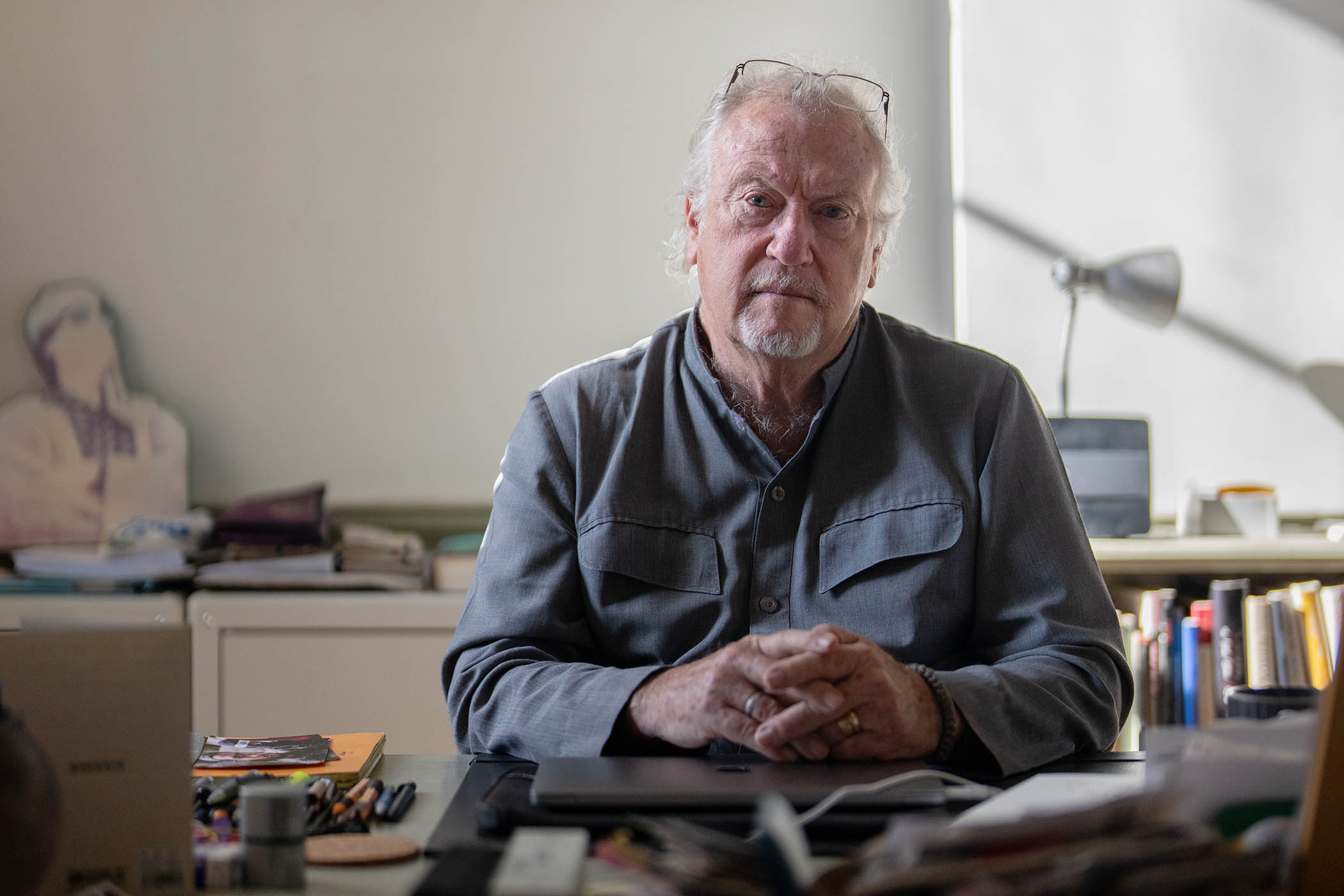
Anderson is a white-haired, lightly bearded, solidly built figure in his late 60s. We are talking at his home in Dorset. “My personal education, as I call it,” he says, “always came before everything else … And along the way, it included this urge to go to the primary, original world, to see the wildest places.”
He might not have climbed Everest or walked across the Sahara but he did make good on his pledge to experience conflict. For the past 40 years, he has built a reputation as one of the world’s pre-eminent war correspondents. In the 1980s, he worked as a stringer and reporter across Central America, covering that decade’s succession of terrible conflicts; 1997 saw the publication of his best-known book, Che Guevara: A Revolutionary Life.
Anderson began contributing to the New Yorker in 1998 and was later made a staff writer. Over the intervening quarter-century, he has reported from Syria and Iraq, Venezuela and the Democratic Republic of the Congo. This is by no means an exhaustive list of the dangerous and beleaguered places he has documented, often at their lowest ebbs. “War was always on [my] list because I felt that it was something that was common to human history and I had been appalled by it since I was a little boy,” he says. “I felt that it was necessary for me to experience it, [to] confront fear and danger.”
It was Afghanistan that had brought us together. Anderson has returned there repeatedly for the New Yorker, charting the aftershocks of the US invasion, the fall of Taliban and their gradual reappearance, as well as the disastrous US withdrawal in August 2021. His new book, To Lose a War: The Fall and Rise of the Taliban, collects these pieces in one place. Taken together, they stand as a record of breathtaking imperial hubris and ignorance. It is, in many ways, a horror story. One that has lost none of its power, despite its giveaway ending.
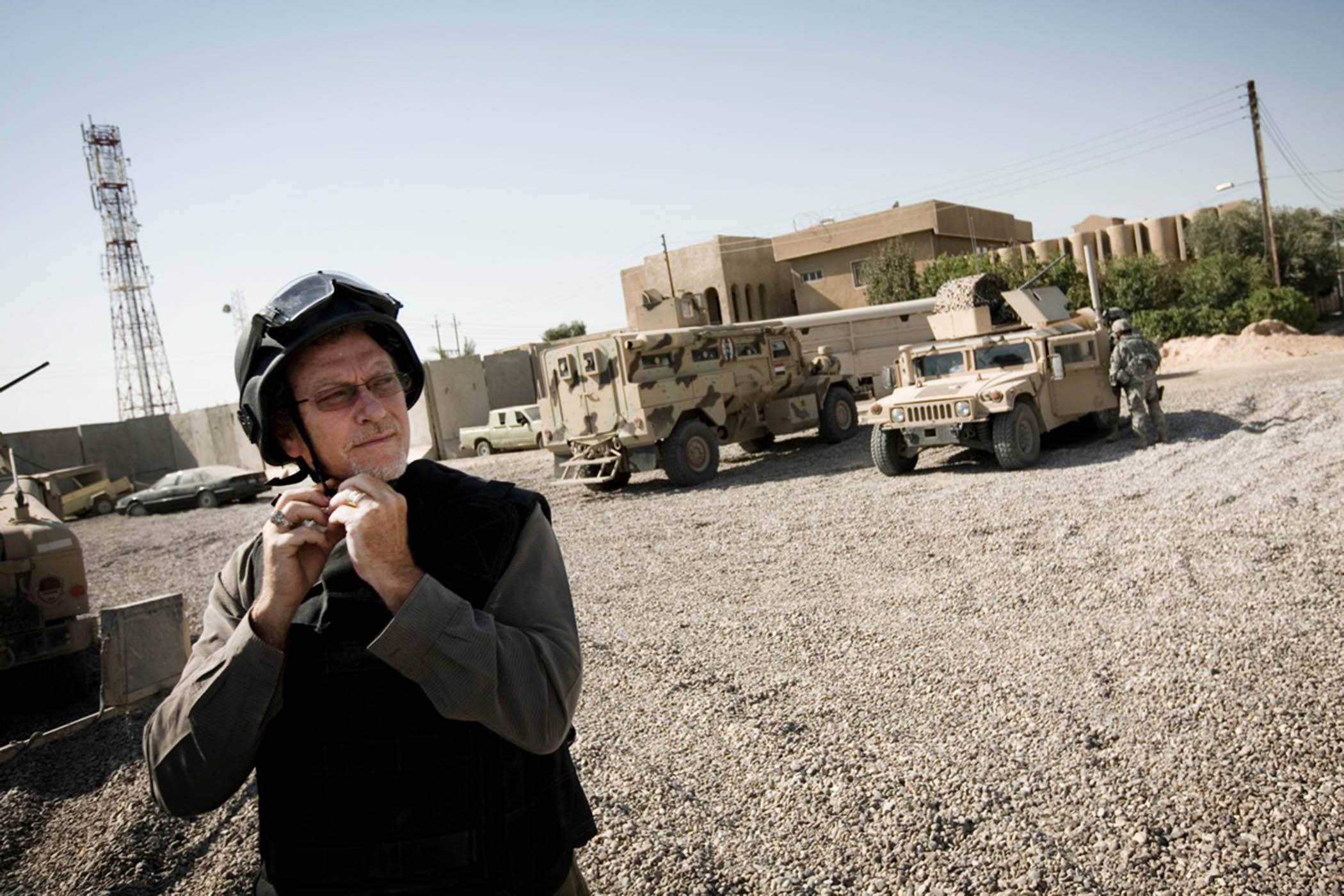
Jon Lee Anderson in Baghdad in 2007
He spent years interviewing warlords and puppet rulers, including the hapless Hamid Karzai, Afghanistan’s US-installed president between 2004 and 2014. Amid the gunfights and edgy audiences with inscrutable strongmen, there is a growing dread reading the book as the absence of any discernible long-term US plan is gradually revealed.
One of the most chilling scenes takes place in a previously unpublished piece he wrote in 2010 after a stint among 300 American soldiers and their Afghan counterparts at Combat Outpost Terminator, 40 miles (64km) west of Kandahar. The young Americans are musclebound and wired, stalking the base with “wide-elbowed alpha male struts”. Their Afghan counterparts are more discreet. Outside are mud-walled compounds and opium fields. Improvised explosive devices (IEDs) are a constant threat. Hatred and incomprehension is mutual and barely concealed.
On a dreary morning in late February, I drove from my home in London to Bridport, the small and steadfastly un-twee market town about a mile and a half or so from the Dorset coast. Anderson and his family have lived in a spacious Georgian house here for several decades. Although his adult children mostly live elsewhere, one of his daughters was in town from the US, along with her husband and young child. This vision of cosy domesticity is at odds with the cliche of the war reporter, living out of a battered suitcase between perilous assignments. Over the course of our afternoon together, he is charming, garrulous company; something that may surprise those he felt antagonised by during his combative heyday on Twitter, now X.
Anderson, it turns out, is no outlier. The south-west of England holds an unlikely sway for an entire generation of anglophone war correspondents. Distinguished ex-BBC lifer Kate Adie is in Cerne Abbas in Dorset; Damien Lewis, the former reporter and cameraman turned popular historian lives in a former Wesleyan chapel near Dorchester. Anthony Loyd, the enduringly intense Times stalwart, resides in Devon.
An armchair psychologist may draw a causal link between swapping the world’s most chaotic, often desperate places for rural England. For Anderson, at least, the reality is more intriguing. “ It’s funny, this was the last place my family lived together as a whole when I was growing up … So, in a way, I feel sort of rooted here as much as one can – as an expat, I guess.”
Anderson’s upbringing was not straightforward. Although born in California at the beginning of 1957, he did not remain in the US for long. His mother, Joy, was a renowned children’s author. His father, John, was a career diplomat with USAID and the Peace Corps. “In my 20s, when I told people that my father had worked for [USAID], the inevitable knowing response was: ‘You mean the CIA?,’” Anderson wrote in a piece last year.
This story was so alien to the western psyche that I felt it was imperative to share
This story was so alien to the western psyche that I felt it was imperative to share
If the Andersons were impeccable liberals of their era – the Kennedy brothers and Martin Luther King were enduring household heroes – they were not the settling types. By the time Anderson had reached adolescence, he and his siblings had lived in Taiwan, Colombia, South Korea and Washington, amid other stops. Having run away from home several times, he was sent to live with an uncle and aunt in Liberia for a couple of blissfully happy years.
He says Lyme Regis was his mother’s choice. “In the States, it was guns, Vietnam and assassinations. British society had structure. It was more disciplined.” The same did not quite apply for the young Anderson. He was, by his own admission, a boy who acknowledged few rules and was chucked out of several schools. Adventure and rebellion had also passed down to his younger brother, Scott, also a distinguished war correspondent, now based in New Jersey.
Anderson had visited Afghanistan for the first time in 1988 while reporting a book on guerrilla movements. “The Soviets were already beginning their pullout but they were still fighting. I went to see that in action. [Afghanistan] was an ancient battleground – one of the most ancient battlegrounds of all.” The mujahideen were growing in power, if riven with their own complex internal struggles. No one had yet heard of the Taliban, though the best informed had begun to notice a charismatic young Saudi named Osama bin Laden, who had launched an obscure new militant network called al-Qaida that year. Anderson documented the bitter 1989 battle for the strategic border city of Jalalabad and the influx of Arab fighters inspired to take up arms against the Soviet-backed Republic of Afghanistan.
“When I began writing for the New Yorker ,” Anderson says, “I [was] putting Afghanistan on my list of stories and trying to convince editors to let me go because the Taliban were in power … I couldn’t quite convince them. Until 9/11, [when] the world changed.”
In a 2010 report from southern Afghanistan, Anderson writes caustically that the “situation that the US military finds itself in in Afghanistan is an odd one. Formally speaking, it has been deployed in Afghanistan since the autumn of 2001, and yet, in areas like Maiwand, it is essentially a newcomer.” This persisted for two decades, against the backdrop of increasingly futile bloodshed. To call American imperial folly “topical” risks understatement: “perennial” is perhaps more accurate. Anderson is scathing about Donald Trump’s war in Iran and the catastrophes it has – and will – unleash. “[It] shows outright mendacity and a hubris based on little more than a political regime built around Trump’s preening vanity and self-regarding cult of power. We’re in emperor’s new clothes territory, and the negative consequences for US international prestige and reliability will be deep and long-lasting.”
Newsletters
Choose the newsletters you want to receive
View more
For information about how The Observer protects your data, read our Privacy Policy
Many of Anderson’s early warnings about America’s direction of travel went unheard. In a 2001 New Yorker piece called The Warlord, he profiled Mamur Hassan, a prominent north Afghan strongman. Hassan’s entire family had been wiped out by a rival local clan, though he had chosen to forgive their killers – at least for the time being. “This story [was] so alien to the western psyche that I felt it was imperative to share. This is a very different culture but they also have their own means to resolve their problems … Listen to them, pay attention to that. They have a very complex history of their own that you need to learn about.”
Such warnings were not heeded. I’d first read To Lose a War in a couple of sittings at the tail end of last year. I thought its pleasures would be reasonably predictable: a nice hit of American magazine journalism at its most distinguished and well funded. The cumulative effect was unexpected. It felt, in places, like watching an especially violent car crash in slow motion that, though glaringly obvious in its inevitability, no one, apparently, had the power to stop. It is clear early on that the Taliban’s retreat after the American invasion was never quite the decisive victory it had been marketed as. That much seemed clear to Anderson in 2005, when he arrived to profile Karzai. “ Once you left Kabul, it was still the same old Afghanistan,” Anderson added. “The [Taliban] were beginning to come back already.”
What, in the end, was it all for? The last piece in the book charts Anderson’s 2021 visit to Kabul, following the Biden administration’s abrupt withdrawal after 20 years of war. The Taliban were back in power, as if the entire occupation and its staggering losses had been little more than a fever dream. Anderson does not mince his words. “[Joe Biden’s] statements at the time were really cavalier and frankly morally bankrupt … if you’re going to make good on your pledge to the Afghan people or your superpower status and prestige, then you don’t just give [the country] back to the enemy you’ve been fighting for 20 years.”
He reserves his harshest words for Trump, though, who signed the initial US-Taliban deal in February 2020. “He opened the door [and] he’s a fool … if he re-engages with the Taliban, mark my words, it will be because of rare earth [minerals], not because of any perceived sense of moral responsibility.”
Though approaching his 70th birthday, Anderson shows few signs of slowing down. Before our afternoon together, he had not long returned from Latin America, where he had spent weeks tracking the aftermath of Nicolás Maduro’s extraordinary rendition from Venezuela to New York, as well as the latest chapter in Cuba’s slow disintegration. The world is as tumultuous as it has ever been. Anderson would be out of a job if it wasn’t.
To Lose a War: The Fall and Rise of the Taliban is published by Fitzcarraldo Editions (£14.99). Order a copy at observershop.co.uk for £13.49. Delivery charges may apply.