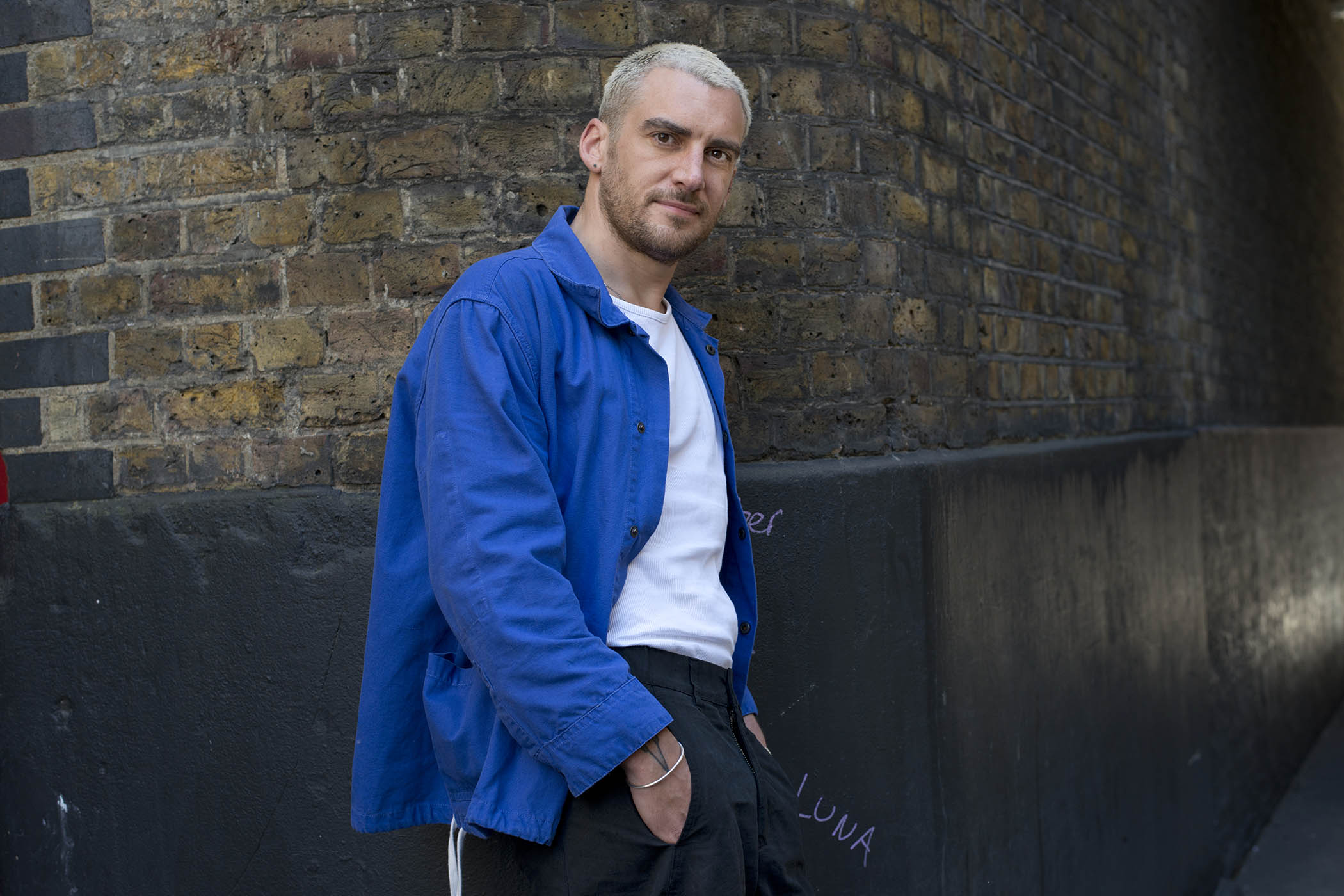
Photograph by Sophia Evans for The Observer
Josh Silver trained as an actor at Rada and went on to appear in the West End and on Broadway. He has since retrained as a mental health nurse for young people, and is also the author of two YA novels. His first novel for adults, Fruit Fly, is a dark satire that follows Mallory, a bestselling author struck with writer’s block, who seizes the opportunity to get to know Leo, a vulnerable young drug addict, as inspiration for her next book. Silver lives in Manchester.
How did your own experiences influence Fruit Fly?
Leo’s story is the most similar to mine of any character I’ve written. Growing up gay, I became a master of presenting myself in a certain way. Very early on [in my career], I felt the cultural expectation that you couldn’t be a gay actor – not openly, anyway. I felt a pressure to be a certain way that was completely at odds with who I was. I became addicted, not only to drugs and alcohol, but to external validation, which is why I fell into acting, really – because you literally get applause. I was using drinking as a way of escaping myself, as many addicts do, but I’ve been sober for nine years now. Like Leo, chem sex was a place I could get lost – it was like a fantasy.
How would you define chem sex?
There’s taking drugs and having sex. But there’s also a world in which there is prolonged sexual activity and drugs that keep you up for days. That’s chem sex. These parties are planned events; the drugs are there to keep things going – people come in and out. In the gay scene, chem sex isn’t spoken about that often. It feels like a taboo subject.
How did your experiences in that world affect you?
There’s this belief where, as a gay person, you think: “I can push against societal norms, so I will go out and I will take drugs, and I will hook up and I will live freely.” I fell for that fabricated view of freedom, which actually was not free. I got lost in a world of restraint and I couldn’t get out. It numbed so much within me and I put myself in many dangerous situations, and frightened a lot of people, including myself.
Fruit Fly plays with questions about performing our own suffering.
Do we live in a world where we feel like we have to show our pain to be taken seriously? Leo is being stalked by this writer who’s trying to write some tortured soul, but he is also elaborating and blowing things up for her because he’s desperate to be seen. I certainly relate to that, back when I was really struggling – that desire to want people to see how hard it was for me.
What did you want to explore about publishing’s exploitation of suffering for entertainment – or ‘trauma porn’?
The book is about the appropriation of pain. Who gets to tell the story? It’s very murky territory. I mean, I’m a gay, sober addict, writing a book from the point of view of a woman who is writing a book from the point of view of a gay addict. It all becomes very meta, and sometimes I get lost in the layers of it all. But publishing is a business. So, ultimately, who profits from the story? I’m interested in pain as a commodity: why there’s an appetite for it and who fuels the push for it. We’re all involved in some way: writers, readers, publishers, viewers, film directors, actors. But what is the need in us to view each other’s pain? Is it to understand each other, to be shocked, to feel an adrenaline rush? Or is it something darker?
What made you become a mental health nurse?
When I’d sobered up, I understood I needed to change a lot of things, and one of them was the profession I was in. I’ve been helped a lot by nurses. And, to be frank, it was one of the only degrees I could do that the government would give me a student loan for – that or teaching.
The need for mental health support has never been higher. Why is that?
It’s a really tough world out there. There’s a cost of living crisis. There’s the rise of social media. There are many different reasons why people might start to struggle. But I think it is massively to do with the way people are communicating with each other and feeling isolated and alone. I think a lot of people feel like they’re living in survival mode constantly. And when you’re in that high-adrenaline or high-cortisol state, you can do bizarre things and it makes sense at the time, because you’re just trying to get through. Often people then either crash or come out of this pattern of survival and realise that it’s not sustainable.
We hear a lot about the ‘crisis’ in mental healthcare. What do you understand by that?
I always say, if someone needs help, to reach out and get support. Because it does exist. But it can definitely be frustrating to feel like: why is there not more money going into this? And why can’t this be opened up so there are more nurses here, here and here?
What do you think policymakers misunderstand about mental health?
Policymakers or politicians are perhaps not able to understand the nuances of symptoms. We work in blanket diagnosis sometimes, and I think it can be quite unhelpful because we’re not looking at people as individuals and instead see them as a set of symptoms. But I also think that maybe it’s not where they want to put the money.
What would you say if you met the health secretary, Wes Streeting?
Do you know what it’s like in the system, for the people working in it and for the [patients] who are in it? Do you know how tough it is? And do you think each person should have the same access to mental healthcare, and have the same ability to reach it and be taken seriously?
Fruit Fly is published by Magpie (£16.99). Order a copy at The Observer Shop for £15.29 (10% off RRP). Delivery charges may apply
Newsletters
Choose the newsletters you want to receive
View more
For information about how The Observer protects your data, read our Privacy Policy