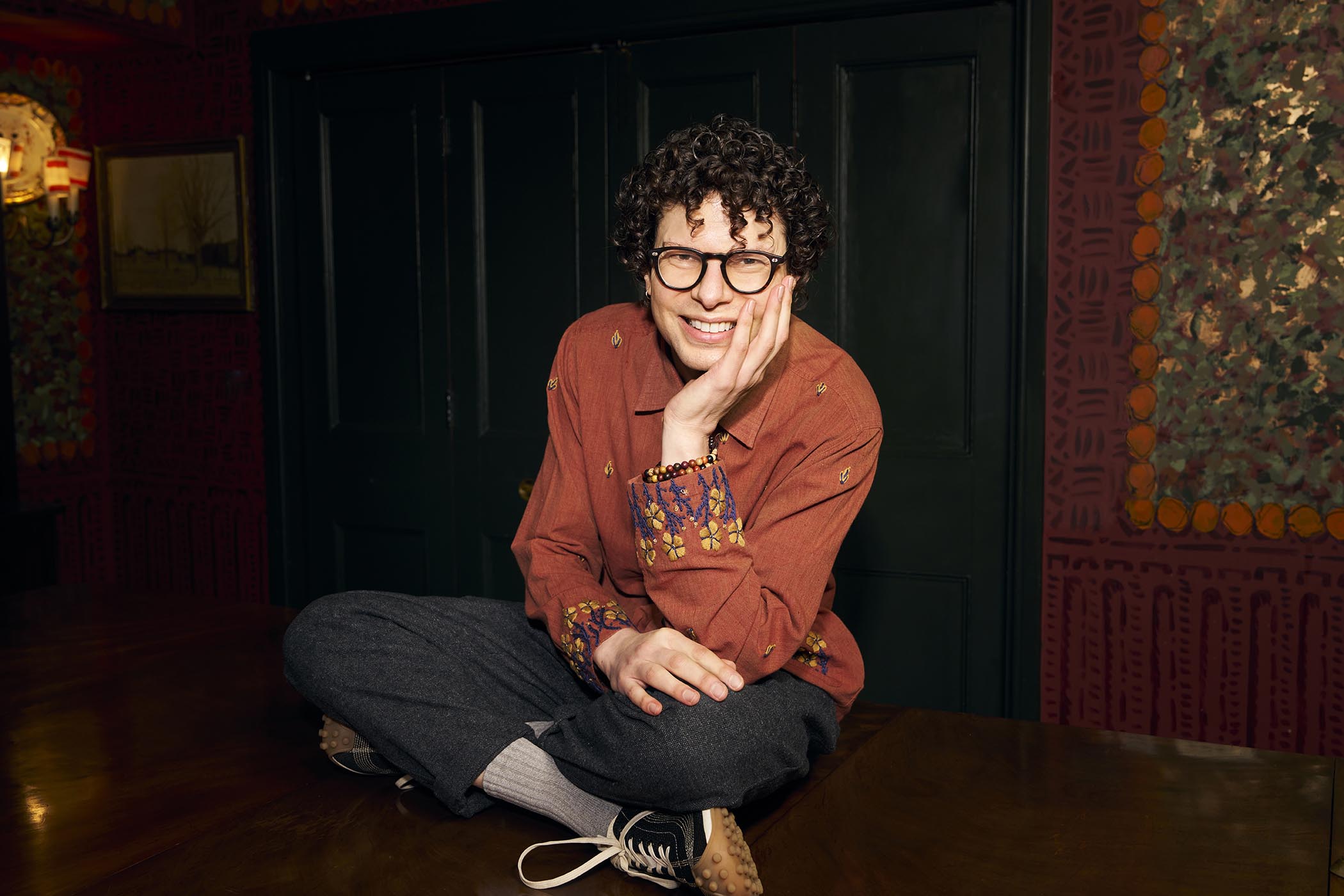

Portrait by Suki Dhanda
Simon Amstell, 46, grew up in London and began performing standup comedy aged 13 before presenting 2000s youth music show Popworld. As the host of Never Mind the Buzzcocks from 2006 to 2009, he won a British Comedy award and was nominated for a Bafta. His work also spans writing and directing, including the 2017 mockumentary Carnage and 2018 feature film Benjamin. Over the past decade, Amstell’s standup has frequently centred around his experiences with psychedelics, as part of the spiritual journey that also informs his new show, I Love It Here.
I Love It Here talks about a party hosted by Leonardo DiCaprio that you attended in Los Angeles. Why did that feel like ripe material to draw from?
I was feeling more at peace with myself and the world than I’ve ever been. I was in a house by a beach; my boyfriend and I were swimming and making our own açai bowls; and I wasn’t expected to “be” Simon Amstell anywhere. And then my friend said: “Do you want to come to this party?” and suddenly I had to start thinking: “Who am I? What do I mean?” And as well as DiCaprio – my 17-year-old self’s sexual awakening – I also had an inkling that a singer that I felt desire for was going to be at the party. So suddenly I was thrown into human ego insanity. But I had a great time and it gave me the material for a brand new show.
Do you get starstruck?
When I saw DiCaprio coming along our table for the first time, I couldn’t stop giggling because I used to have to rent out DiCaprio videos and masturbate in secret, and now, as an adult, I may have the opportunity to tell him. But I didn’t tell him because I couldn’t stop giggling.
What makes you want to be so vulnerable on stage?
It’s not interesting to me unless I feel scared to say it out loud. I feel like I’m called to free myself, and the people who are watching, of shame. I don’t want to come off stage thinking I wasn’t brave enough to say something because then I’m not free. I’m free now! You can’t get me because I’ve said everything! That’s the point of the whole thing.
You’ve been a vocal advocate for the benefits of the hallucinogen ayahuasca. What has it done for you that conventional therapies haven’t been able to?
I had two years of talking therapy prior to my first ayahuasca ceremony, but the plant medicines take you somewhere that you just can’t access through talking. You experience the truth that all of nature loves you and only wants the best for you. The suffering is in your head. That was a huge lesson as a comedian, when you think all the jokes are going to come from suffering and sadness and depression.
What happens in a ceremony?
I did an ayahuasca ceremony once where I got called to take off all my clothes. My body really wanted to go and stand naked in the rain, so I went into the rainforest and I had a vision of a balcony of gods checking me out. They got their cameras out, and this balcony of gods were photographing my hot, naked body. I never thought I had a hot, naked body before, but in that ceremony, I felt like Michelangelo’s David. Or more than that, I felt like me.
You started off presenting Popworld, from 2000 to 2006. How do you look back on that time?
Because of all the meditation and Buddhism and the magic mushrooms, I don’t really look back. But there’ll be an occasional moment where I see something that reminds me of something I did when I was 21 and I’ll think: “Wow, you were so young and you were really brave and funny.” I did my first standup show at 13 and, for a while, I felt a lot of shame and embarrassment for this precocious child who was wearing a colourful waistcoat and a bow tie. But I’ve grown to love that child and I feel very grateful to him, because if he hadn’t done all that, I don’t know who I’d be. He came up with this whole thing.
What gave you that level of ambition at such a young age?
I used to say that my parents were going through a divorce and I was starting to realise that I might like boys, so it acted as a great distraction. Which is true, but I also loved standing on stage and hearing people laugh, and nothing in my life felt better than that noise hitting me. When you’re communicating with people it’s lovely, because the ego says: “You’re all on your own. All your thoughts are insane and disgusting, and nobody else is thinking what you’re thinking.” And then you have the courage to say: “Well, let’s see!” It’s like the courage it takes to come out as a queer person; it’s the same with every joke that is rooted in something that you feel ashamed of. And there’s a blissful feeling when you say: “This is who I am,” and the audience laughs and you feel deeply connected to humanity.
Has what you get out of doing comedy changed over the years?
I think it used to be that I needed people to love me, and then I did a clown course in Paris and I learned that it’s actually about how you can love them. What can you do that expresses your love for the audience? You can be really funny, because you love them for coming to see you. It’s the same with sex, right? What can you do to make this person feel unimaginable pleasure? That’s a fun task, and what an honour that someone has bestowed that task upon me!
What else have you got in the pipeline?
There’s a film that I hope to be shooting next year, but I can’t say too much about it. I love writing and directing. The only thing good on screen is spontaneity, and it’s an incredibly beautiful thing to be able to capture it. I’m by the monitors with my headphones on and I would scream with delight if it wouldn’t ruin the take.
I Love It Here is at Arches London Bridge from 11 February to 14 March