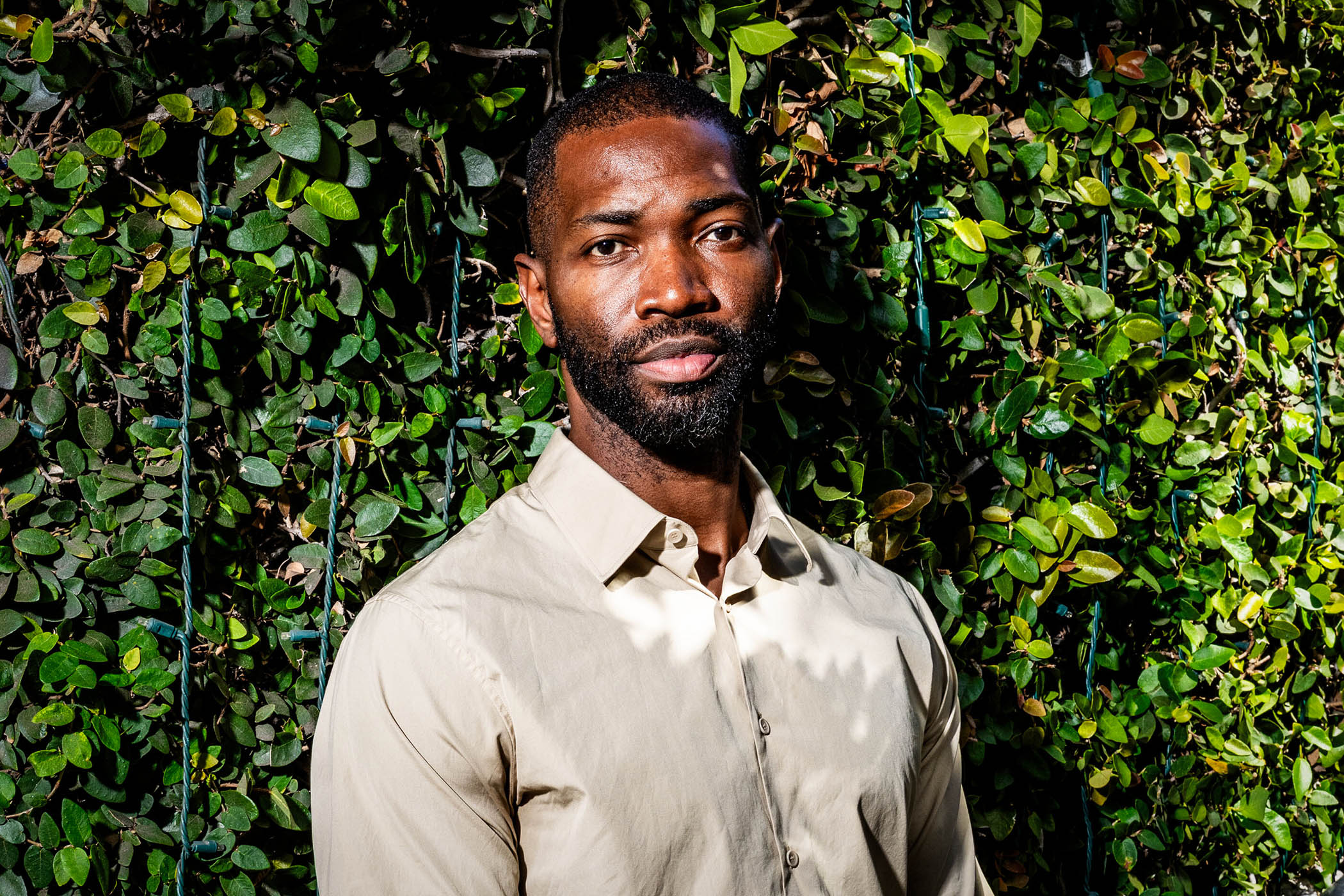
Tarell Alvin McCraney, 45, is an American playwright, screenwriter and actor born in 1980 in Florida. The 2016 film Moonlight, which was based on his life and original play, won the Academy Award for best picture, plus the Oscar for best adapted screenplay. He is the chair of playwriting at the Yale School of Drama, a recipient of a MacArthur “genius” grantand was the winner of the New York Times outstanding playwright award. His 2012 play Choir Boy, directed by Nancy Medina, returns to the UK this month. It’s a coming-of-age story about a Black, queer and gifted choir singer navigating spirituality, sexuality, race, identity and brotherhood while studying at an all-boys’ school.
What made you want to write a story about a choir?
American gospel choirs have become a bastion of years and years of political and spiritual resistance by Black people. Starting from the earliest recordings of gospel songs, people have corralled them together in order to find ways to use that music to uplift, to politically challenge and to praise God. The braiding of that is quite powerful. It wasn’t just political, it wasn’t just spiritually nourishing; it was also personally uplifting.
The protagonist, Pharus, is called racial and homophobic slurs while singing during a graduation ceremony, which causes him to freeze. Why open the play there?
When things like that happen, what trajectory do they put us on? How do we piece out something unfortunate that happens so publicly? That is why the play starts at a very vulnerable place. Pharus, who is trying to graduate and trying to find out who he is, is called something quite terrible and there is no recourse for it. As a person who has been embarrassed like that in front of many people, you think to yourself: do you get revenge? Do you turn the other cheek? Do you try harder to be better?
The play captures the bullies not as irredeemable characters, but as complex young men. Why show that nuance?
It’s important that we give them all space and breadth. They are all human beings coming to a collision point. Michael Boyd directed a production of Richard II that was the most compelling thing I’d ever seen because everybody in it was trying to do something good, even when they were doing something bad. When King Richard is dethroned, you understand why and yet you are still devastated by it.
You have said in the past that you want Choir Boy to be considered a historical document of its time. Is that still true?
My hope has always been for this play to become something people look back on and go: “This is how people related to each other at a certain period of time.” My fear is that we’re forgetting the lessons of stories like it, only for us to have to run into them all over again. The amount of anti-gay, anti-queer [rhetoric] has increased. We’ve gravitated back to harder structures.
It’s been 10 years since Moonlight was released. What new thoughts do you have about it?
The thing I’ve been wrestling with the most is the response of people who saw the piece and related. The response from men who were not queer – I would be lying if I didn’t say it was surprising. They didn’t want to go on record, but they wanted to say: “Hey, I’m not gay, but growing up, I was told to take any way I was feeling, any tenderness, any love, care, and to stuff it way down. I had to build myself back up differently, so that people couldn’t see that part of me.” That was wild to me, because I just didn’t know. This is happening everywhere. I’m talking about my trauma out loud – these men are not.
Do you have any thoughts on the manosphere; what it means to be man, look like a man, act like a man – all of these ideas that seem to be everywhere?
The generation of folks who are becoming adults have never known a world without the internet. Even in the most rural places, there’s still some access to a wealth of images and thoughts and ideas. We are still trying to figure out how fast our brains can cope with this amount of information. My world was never this connected. I had to watch Paris Is Burning on a VHS tape in the back of the library when I was 19 years old, in secret. There’s links to that groundbreaking filmnow that you can access for free. Their world is much bigger and maybe scarier and maybe [more] daunting. And how are we helping them prepare themselves for it? How are we safeguarding?
What is your advice for writers who draw from their own life experiences?
I’ve always told my students that what we do can be therapeutic, [but] it is not therapy. At least it isn’t for me. I have to go to a therapist. Writing is not a mental health practice. The creativity that I have in writing helps me sometimes to imagine things that I might not have been able to before, but it is not the part where I take accountability. Healing anything takes attention. There have been so many moments when my mind, body and spirit have said: stop. At 45, it’s much easier for me to [listen].
What does a typical writing day look like for you?
There’s no typical writing day, because there are meetings all the time, so I write within the margins.
What do you do for fun?
Watch films. I like to go to the movies by myself. I’ve seen all the films nominated for best picture [at this year’s Oscars]. They’re not playing about you having to watch all these films in order for you to vote for them [McCraney is an Academy voter]. Sinners is the top film in my mind, but Hamnet was pretty extraordinary.
What’s next?
I’m artistic director at Geffen Playhouse in Los Angeles. We are excited to announce our season very soon for next year. In my own writing, there’s a play called Windfall that we’re premiering in Chicago at Steppenwolf. We are also working on a production of Master Harold ...and the Boys at Geffen Playhouse that I’m co-directing. All the other projects that I’m writing haven’t been greenlit yet, but it’s a pretty packed schedule.
Choir Boy is at Stratford East, London E15, from 26 March to 25 April