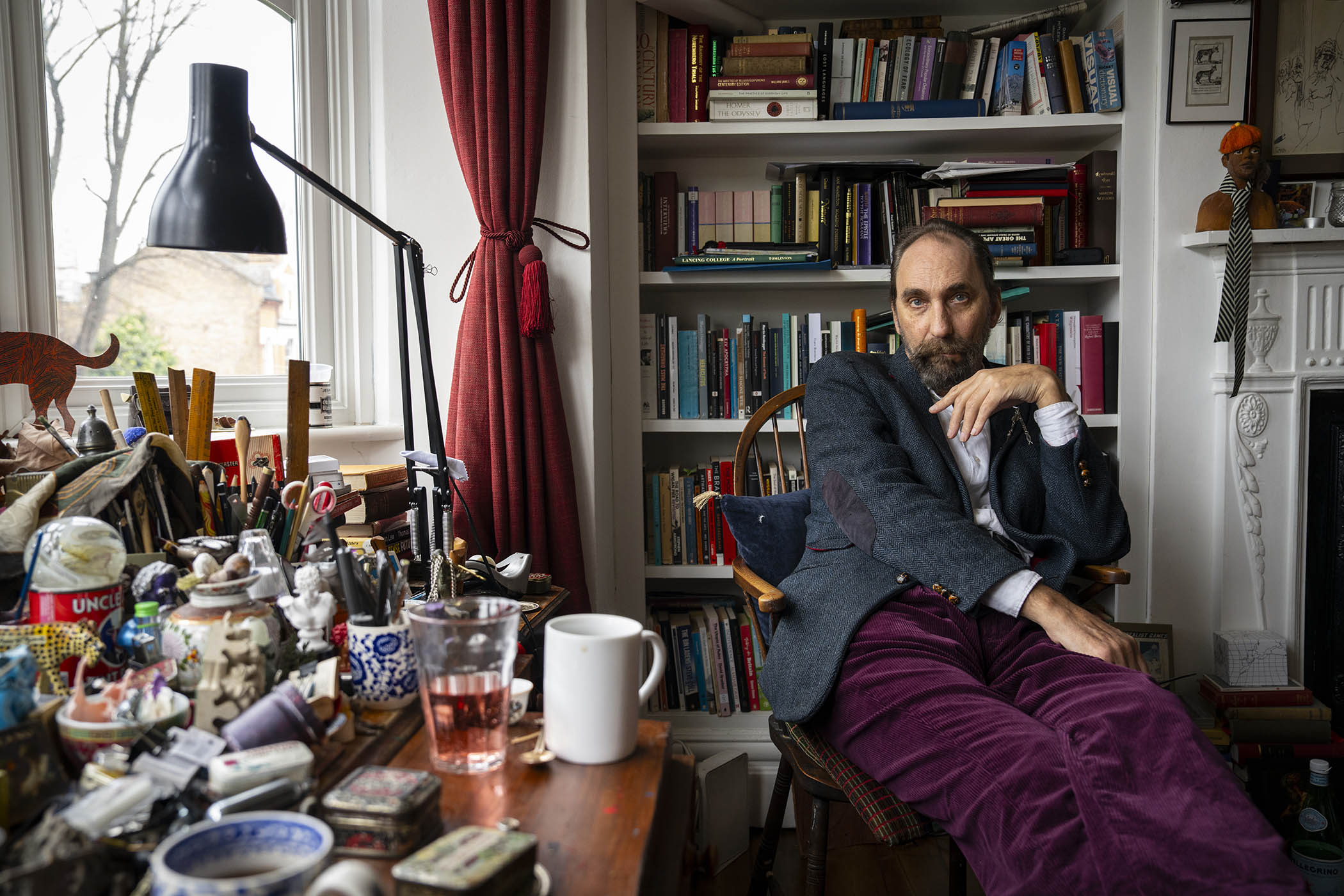
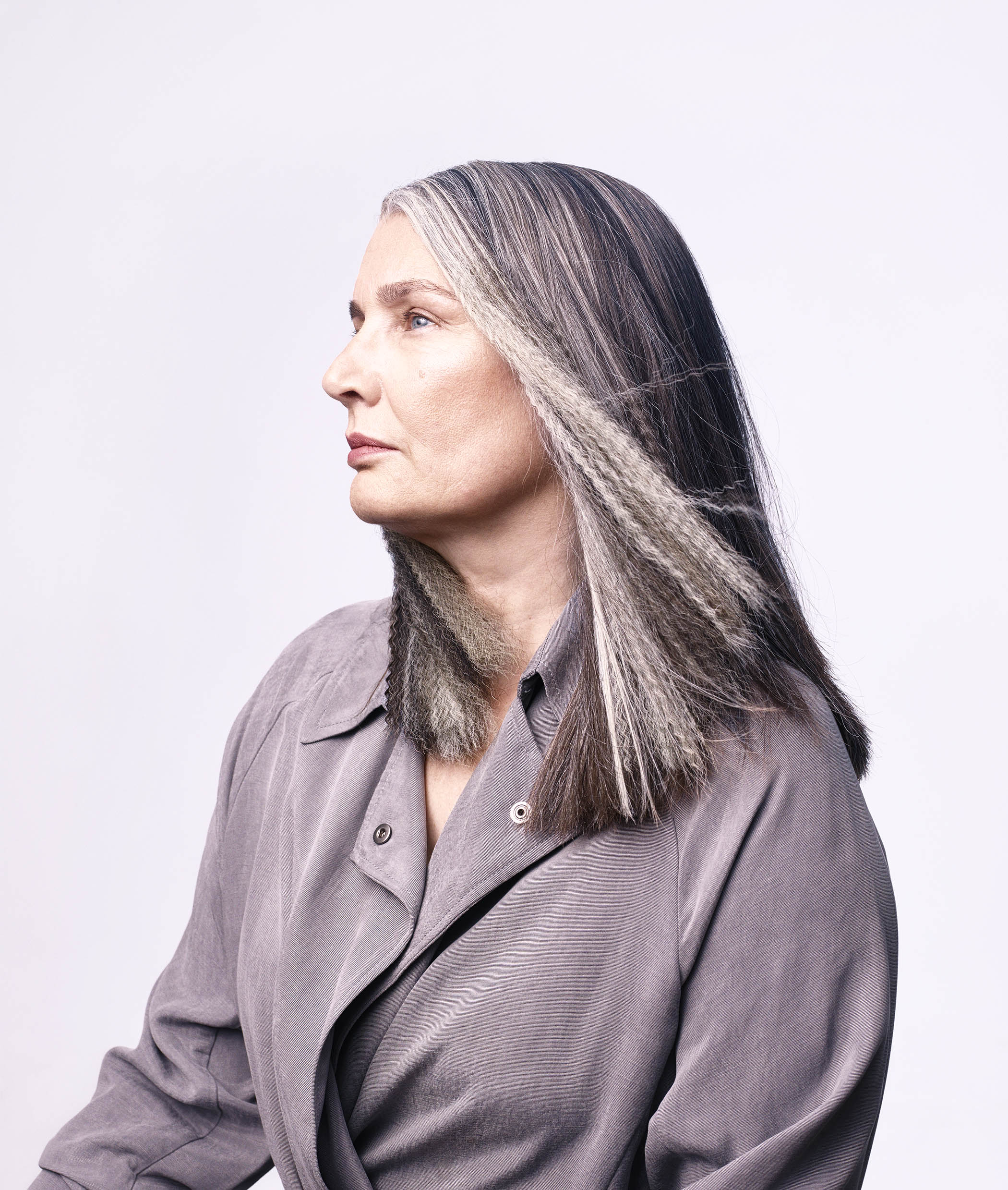
Portrait by Antonio Olmos
Will Self wrote his latest book, The Quantity Theory of Morality, in 10 weeks while on steroids. “I was on 40 or 50 milligrams of prednisolone, which is a very high dose,” he tells me. Soon after finishing the book, he had the mother of all comedowns and spent the entire Christmas season in bed, writhing in pain and weeping copiously.
“When they started decreasing the dose, it was like an induced mental breakdown,” he continues. “I’d wake up thinking: ‘You really ought to hang yourself; there’s a rope in the desk drawer.’”
As I am taking this in, he executes a characteristic conversational swerve from the visceral to the dizzyingly highbrow. “In the Science of Logic, Hegel writes that all existences are a compound of negativity and positivity. During the steroid comedown, my existence was all negativity. I felt I didn’t have anything to live for: I was 64, my health was appalling and the world was in a fucking terrible state. It seemed completely logical that I should end it all.”
Since 2011, when he was diagnosed with polycythaemia vera, a rare form of blood cancer, Self has come through a debilitating round of medical crises and complications. In October 2022, he learned that he had myelofibrosis – scarring in his bone marrow – and in 2024 underwent a stem cell transplant. “My consent form was 140 pages long,” he tells me, hooting with laughter. “It was so bulky, it was on an iPad.”
He pauses for a moment. “I mean, if you don’t come to your senses radically at that point, Seán, you never will.”
There was a time, of course, when the younger, more reckless Self was intent on doggedly pursuing what Arthur Rimbaud called “the systematic derangement of the senses” in pursuit of creative illumination. He gatecrashed the British literary scene in 1991, aged 29, trailing a bad boy image that made him seem, for a time, like the errant heir apparent to Martin Amis. Self's early fictions were wilfully absurdist, often featuring grotesque plots inspired by his admiration for the work of William Burroughs and JG Ballard, who was a close friend. In Cock and Bull, a woman grows a penis and rapes her alcoholic husband; in Great Apes, an artist wakes up after a night of excess to find London populated by intelligent chimpanzees.
For a long time, Self’s rhetorical audacity went hand in hand with an almost aristocratic hauteur and a rock star-like reputation for dissolution. In April 1997, he was famously sacked by The Observer for snorting heroin in the toilet of prime minister John Major’s plane. “That was actually a very stressful period,” he says, when I mention it, recalling how he and his then wife, Deborah Orr, who worked for the Guardian at the time, had to go on the run across the country to escape the paparazzi who were staking out their homes. He was fired when it became clear he had lied to his editor about the transgression.
“I did lie to my editor,” he says, sounding almost contrite. “Not about the incident itself, but about the truth of it. The reason I took smack on the plane is because I was a junkie. That’s all. And, by the way, the headline on The Observer the previous week had been: ‘Will Self back on drugs.’ Right above the masthead. They were using my drug habit to sell papers.” He fixes me with a defiant stare. “Make sure you put that in your newspaper.”
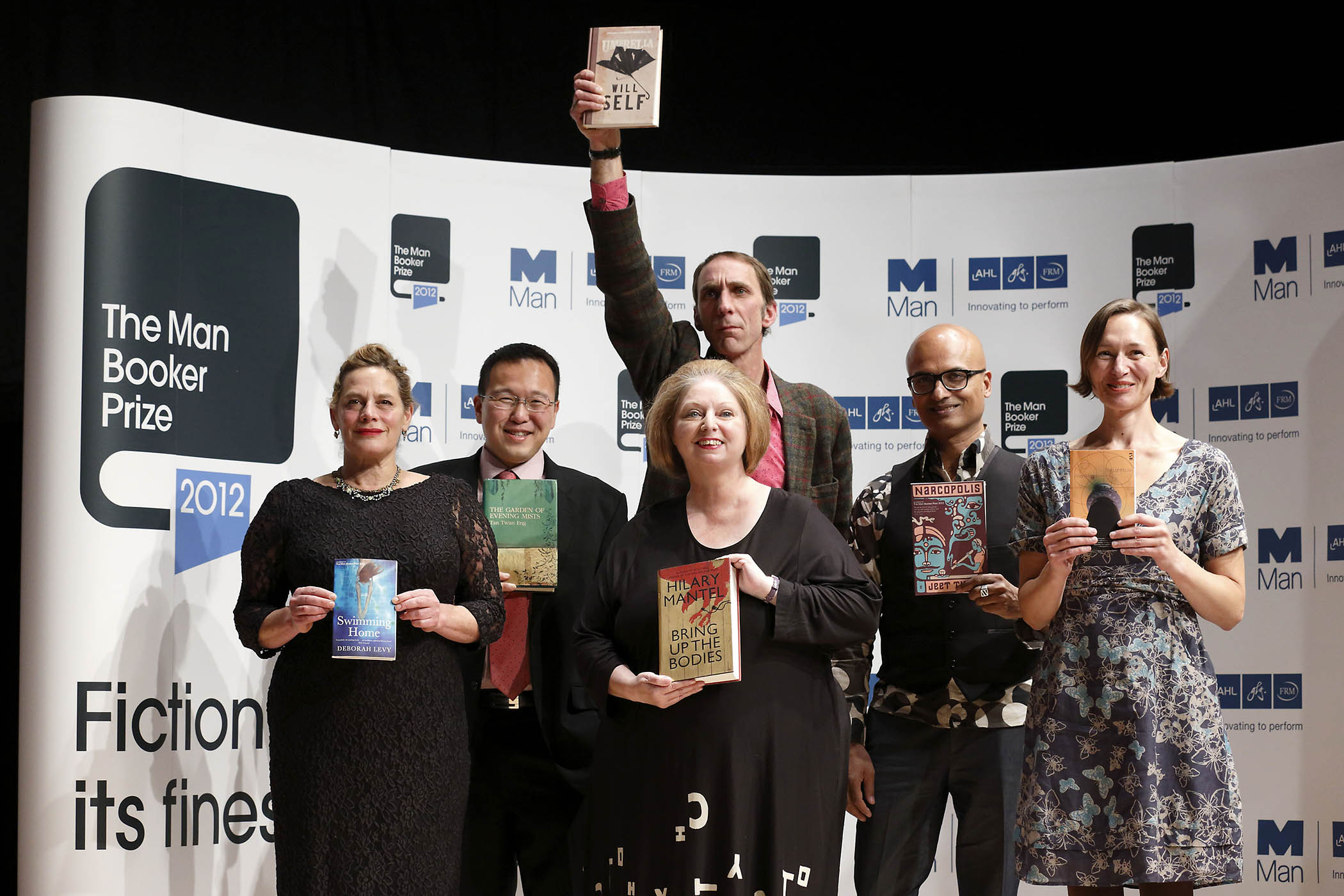
Self holds aloft Umbrella at a photocall for the authors shortlisted for the 2012 Booker prize
In the 1990s, he also became known to a more mainstream audience through his regular appearances on television, enlivening the political panel show Have I Got News for You, and, in the following decade, adding to the comedic surrealism of Vic Reeves and Bob Mortimer’s anti-gameshow Shooting Stars with this exaggeratedly lugubrious persona. That all seems like a long time ago.
After the initial onset of his illness in 2011, his fiction became more serious and formally challenging. He now considers his trilogy of modernist novels – Umbrella (2012), Shark (2014) and Phone (2017) – as his finest work. “If you want to understand me as a writer, I’m afraid, you have to sit down and read the trilogy, which explores the dialectical relationship between technology, mental illness and war,” he says, fixing me with a penetrating stare, before adding pointedly: “Almost no one who comes to interview me has read it, so I’m always giving interviews into a void, in a way.”
In the living room of his terrace Victorian house in Stockwell, south London, I sit socially distanced from Self by an open window while he reclines on the sofa. On the wall above him, there is a 19th-century panoramic print of London, the city he has lived in most of his life, and the backdrop to much of his writing. Around us, books are arranged on shelves and in piles on the floor, including a volume by Hegel in the original German.
From time to time, his wife, Nelly Kaprièlian, a French writer, looks in on us, proffering tea and snacks. At one point, after she exits, he says: “It’s very odd, but I haven’t had any hunger or thirst at all for years. I can’t really taste anything and my appetite is completely wrecked, but, on the plus side, I can justify my daily consumption of cannabis on that basis alone.”
Once again, he bursts into laughter so loud that it echoes down the street through the open window. He is on prescribed cannabis oil to relieve his physical discomfort. “A doctor assessed my pain level, which was about seven out of 10, and said: ‘Well, how about some morphine, then?’ I had to politely point out that, given my history of addiction, that was probably not a good idea.”
I have known Self, off and on, since the 1990s, when I first encountered him on a rare visit to the Groucho Club, where, surprisingly, he was hanging out with two members of the Bristol trip-hop group Massive Attack, having interviewed them for an article. Initially, I had him down as an intriguing, though tricky and temperamental character, but when my younger brother died in 2000, he was incredibly kind and solicitous, much more so than I had expected, given our fitful friendship. More recently, he lived on the same street as me in south London and we’d cross paths from time to time, usually as he was walking his small dog to and from Kennington Park.
Having not seen him since his illness turned even more serious, I am surprised to find him in good spirits. He looks paler, thinner and more hirsute than before, having grown a beard that gives him the appearance of an ascetic. His immune system is so compromised that he seldom leaves the house, save for hospital visits. For one of the great flaneurs of recent times, someone who has, literally, walked the length and breadth of the country as a psychogeographer, this seems doubly cruel.

A Self portrait at Edinburgh book festival in 2006
“I actually walked a lot before I went in for my transplant,” he tells me. “I walked 300 miles through the London suburbs with cancer and bad neuropathy in my feet. And then I walked to Canterbury. That was difficult, but I thought: ‘If I’m going to die, I’m not going to be one of those people who constantly hedges against that risk by not doing anything challenging.’ That would have been a sign of lost courage. I haven’t lost any courage.”
For now, though, the walking has ceased, as he has lost all feeling in his feet and his joints ache constantly. Throughout our four hours of meandering conversation – is there any other kind where Self is concerned? – he frequently rises unsteadily to go for a pee.
He is proud, he says, of The Quantity Theory of Morality, which is his 11th novel and is related tangentially to the first of his five short story collections, The Quantity Theory of Insanity. In the latter, a psychiatrist, Zack Busner, who recurs in several of Self’s novels as a kind of older and wiser Jewish alter ego, posits that there is a limited amount of sanity available in any social group.
This time around, it is morality – or, more precisely, the absence of it in our contemporary consumer-led, digitally driven culture – that underpins the spiralling narrative. Each chapter is a variation on the preceding one, as one character after another describes their version of the same set of events, until it becomes almost hallucinatory. “The whole structure and mentality of the book seems steroidal – brittle and glassy,” he says. “It’s like a glass onion; everything reflects itself.”
So far, so Selfian, but, as he insists more than once, there is an underlying seriousness to the book. In it, he gleefully depicts his characters’ monumentally indulgent and morally vacuous lifestyles: champagne-fuelled weekends at second homes in the country, extravagant dinner parties – “chicken livers wrapped in bacon, squid soused in vinegar, potato croquettes, mini-paellas and boquerones” – and, in one instance, an outing to see “Rihanna’s new production of Salome”.
For him, this collective moral emptiness is symptomatic of a society unmoored by the distractions of social media, falling literacy rates among the young, and a mixture of cultural superficiality and political apathy. There is a jolting narrative shift in the novel when it transpires that a far-right party, the Nationalist Trust, has come to power in Britain and immediately set about targeting the Jewish population with possible expulsion or worse.
“The point I’m making is that Jews are always the canary in the coalmine of European racism,” elaborates Self, whose mother, Elaine Rosenbloom Self, was Jewish American. “It’s historic and cultural. We have a society in which Jewish ambulances are burned in Golders Green and Jewish men are killed going to worship at synagogues. It’s happening. It doesn’t matter that another country of their coreligionists is waging a genocidal war – you don’t target them, you don’t kill them.”
I’m the Millwall of English literature. Nobody likes me and I don’t care
I’m the Millwall of English literature. Nobody likes me and I don’t care
He describes The Quantity Theory of Morality as “hyper-satire”, enumerating his targets in typical fashion as “not just the antisemites, but the rich who think they can just fly away from society’s problems, the racists, the anti-racists who are really racists, the narcissists, the Terfs [trans-exclusionary radical feminists] who are obsessed with trans people as well as the trans people who try to force their intimacy on the generality”.
The final chapter is an elegy for satire itself, which, he says, “has been dying throughout my life as a writer”. Titled The Principal Mourner, it describes the funeral of a character called Will. When I ask if it is a metaphorical elegy for himself, he answers cryptically: “I’m both present and not present in the novel.”
Today, he is fully present, overwhelmingly so: ideas, opinions, complex theories and lengthy philosophical quotations flowing freely from his overcrowded mind. Since the stem cell transplant, his recovery has been dogged by debilitating and often serious complications, including graft-versus-host disease, which produces a constant itching sensation underneath the skin. As it stands, he suggests he has a “four-out-of-five” chance of surviving for another few years.
Despite all this, he has been prodigiously productive and is now working on several books, including one entitled The Selfish Crab, which is about cancer, and another entitled Duty of Candour, which, he says, “is a memoir about all the things I can’t say on record that will be published after I die”.
His most ambitious work-in-progress is provisionally titled Mortal Morality: “I’m essentially building a new ethics: an ethics of finitude. That is pretty revolutionary, don’t you think? That’s chutzpah,” he says.
Chutzpah is one thing he has never been short of. In one way, the Self I spend several hours with seems dauntingly familiar: intellectually overpowering, opinionated, monumentally self-assured and erudite. In another way, though, he seems less formidable than before, humble even. He grows tearful recalling how, while he was in hospital recovering from the transplant operation, thousands of far-right supporters were marching though central London on a Unite the Kingdom rally.
“The people who were wiping my bottom in the hospital and putting in my drips were recruited mostly in the Philippines, where they’re educated by the NHS, take the exams and come over here. The guy who saw me through the transplant, Alex, who was from there, saved my fucking life 10 times over. When the Tommy Robinson march was happening, I had to tell the women who worked on the ward that they had to go to the tube together when they finished their shift. They had no idea what was happening outside. I said: ‘You don’t understand – the city’s full of racists.’” He breaks down. “I’m sorry, but I mean, that’s awful, its just fucking awful.”
Deborah Orr, Self’s second wife, accused the author of ‘mental cruelty’ before their divorce in 2018
I ask him if, despite his loathing for the state of contemporary culture and the rise of managerial politics, his illness has mellowed him somewhat. He looks bemused. “God, no, not at all. Why would I be mellowing? I do think we should be good, though. And I certainly disavow what I call lazy postmodernism, which I think I have been guilty of in the past. That’s over. Culture is coming to an end. The climate emergency is real. It’s happening. I’ve written this morally serious book, because all of this shit is real. Death is real. It doesn’t happen to other people; it happens to you.”
It would be hard to spend time with Self and not be aware of that particular inevitability. His response to his illness has been an almost monkish retreat from the world into a life of the mind. In October 2024, he presented an intriguing episode of the Radio 4 series Illumination. Titled Reclusion, it was a meditation on the creative and ethical importance of the solitary – and scholarly – life.
His reclusion, though, was mostly forced on him, and the manner of his banishment from his former social circle has left him deeply wounded. In 2018, Self’s messy divorce from Orr became even more acrimonious when she accused him on social media of “mental cruelty” and of wanting to keep her “in misery”. She posted that she had changed the locks on her house to keep him out and was suffering from post-traumatic stress disorder. Soon afterwards, he was summoned to Brixton police station, where he was interviewed about her accusations of coercive and controlling behaviour.
“Deborah called the police on me,” he says, shaking his head, as if still unable to make sense of it all. “I was interviewing the artist Jake Chapman when the police called me. He’s never spoken to me since, by the way. You know what people are like, Seán – everybody suspects you’re an abuser. Everybody, including the Guardian and The Observer, think it’s binary and she is the saint.”
Orr died from breast cancer in October 2019. By then, Self had been well and truly cancelled, he says, “by a combination of bidirectional digital media and cowardice – because that’s what it was”. Orr’s friends and supporters would no doubt disagree. He tells me he has confronted some of them in the past about what he describes as “their behaviour around Deborah’s death”. “I’ll take the fallout,” he says. “After all, I am the Millwall of English literature – nobody likes me and I don’t care.”
Is that really the case? “No, it’s not true. I had friends. People knew I was being very badly wronged, but because they were comfortable with the idea of my persona, which I joke about in the book, the bullying male persona, which is how they liked to interpret me. They were comfortable with the idea that I was getting my just deserts. It was as if the collectivity of who you are could be punished for one notional sin that they couldn’t even pin on me. But what was the sin I’d committed in relation to Deborah’s death? They had no idea.”
When I ask him if it can possibly be the case that none of his former friends have visited him during his illness, he replies: “I don’t have any friends, Seán. I lost them because of what happened with Deborah. Their hypocrisy became even more evident once I was seriously ill, but I’d already lost them. They all gaslit me. And I’m talking about friendships that in some cases went back to my childhood. Even my closest friends suspect I was an abuser. It’s just awful. It’s disgusting,”
I’ve written this morally serious book, because this shit is real. Death is real. It doesn’t happen to other people; it happens to you
I’ve written this morally serious book, because this shit is real. Death is real. It doesn’t happen to other people; it happens to you
Has he made new friends? “No, I’m too old for new friends. I’m in my mid-60s. It’s all gone. I’ve lost my whole affective life at this point – my companionable life. What I’m saying is that, because of the visibility of Deborah’s death, because of the way she attacked me while she was dying, people found it almost impossible to condole, or abide with me, in my suffering. And I did suffer.” He pauses again, as if gathering his thoughts. “But, listen, I don’t want you to write a piece saying that his life was ripped apart by resentment. I’m not angry – I’m heartbroken.”
Sensing his encroaching tiredness, I move on to other matters. The previous evening, I had rewatched a profile of him on ITV’s The South Bank Show, which was originally broadcast in 1998. In it, there is some revealing footage of his pre-fame younger self that was filmed in a county house rehab facility. It is a jolting interlude in which he talks openly about self-harming; a glimpse of the deeper discontents that underpinned his addiction.
When I mention it, he looks momentarily surprised. “I remember that, and that’s why I probably never watch it. I shouldn’t have let them use that clip.”
Has he given much thought to why he was so unhappy as a child, and indeed afterwards?
“That’s a good question,” he replies. “My mother was very ill and the form it took was often very histrionic. She was a frustrated writer. My father left when I was nine. I remember it was my birthday party, and when we got home, she told us the news, and she was crying and it was hysterical – beyond appropriate. I vividly remember sitting there thinking: ‘I’m a robot, I don’t have any feelings.’”
Can he understand now why he felt that way?
“I can see that I was overawed with the responsibility of looking after her. I now realise that my childhood was caretaking her, really. Even at nine years old, it was as if I was completely invaded and destroyed by her pain. And that went on. You know, I almost died in my 20s for her, in a way, but then she died and did the job for me.”
His mother died of breast cancer in 1988. His 2024 novel Elaine was based on her diaries. “My grandfather had died of cancer when I was 11 and my mother had been very affected by that. I remember her wandering around going: ‘I’m going to die, I’m going to die.’ And that became the self-fulfilling prophecy. But, you know, she was a very brilliant woman, very smart and eloquent and very funny. She commanded in that way, linguistically, and of course, that really went deep into me.”
Was his addiction rooted in that childhood?
“I think addiction is inherent to the human condition. It’s like a circuit that can be revved up too much by all sorts of external factors. In fact, it’s like my cancer. I have the gene for the cancer; its epigenetic and it gets potentiated by environmental changes in a dialectical process. It’s the same with addiction; it’s there in everybody – it’s a question of what potentiates it.”

Self reading his novel Dorian in 2008
So we circle back inevitably to his illness, his looming mortality. “I don’t consider the question mark over my approximate life to have been removed,” he says at one point. “I think of myself as released on licence.”
I ask him if the proximity of death has in any way pushed him towards a spiritual as well as an ethical reset?
He sighs. “There is no otherworldly beyond, Seán. You know that. I know that. But I did talk to priests a lot before the transplant. And you know what? Not one of them said: ‘Are you trying to find belief? Would you like to pray with me now?’ Instead, if they recognised me at all, they said: “Will you help us raise funds for our church?’ They wanted to use my notoriety to help mend the roof!”
Would he have prayed with them had they asked?
“Yes! Of course! I pray every day.”
I put it to him that most people pray because they believe in God and, by extension, an afterlife. “Really?” he replies, sounding surprised. “I pray because I don’t. For me, it’s really about piety and discipline.”
His in-progress book of ethics, Mortal Mortality, is, among other things, about how to live a morally responsible life in a digitally determined culture geared towards denial and distraction.
“Essentially, I am saying that you should do unto others so that the world endures, so it’s not destroyed. I’m also saying that we can’t allow a society in which we view technology as a desiderata – even though it kills cancer. Indeed, maybe we should live in a society without stem cell transplants, and accept that we get cancer and die in our 50s, 60s and 70s. Maybe the inversion of the demographic pyramid isn’t such a good thing.”
That seems an extraordinary thing to say, given his situation. He nods. “Well, maybe I’ve only been saved in order to tell you that I shouldn’t be saved.”
His laughter erupts once again, loudly and defiantly, then subsides as he becomes suddenly thoughtful. “Maybe we should develop some faith so we don’t mind dying, so that we are not afraid of death. I can say that because I’m not afraid to die. At all.”
That much seems self-evident. In the meantime, for Self, there is still so much to do. Same as it ever was.
The Quantity Theory of Morality is published by Atlantic Books (£18.99). Order a copy at The Observer Shop for £16.14. Delivery charges may apply
Photographs by Getty Images and Felicity McCabe