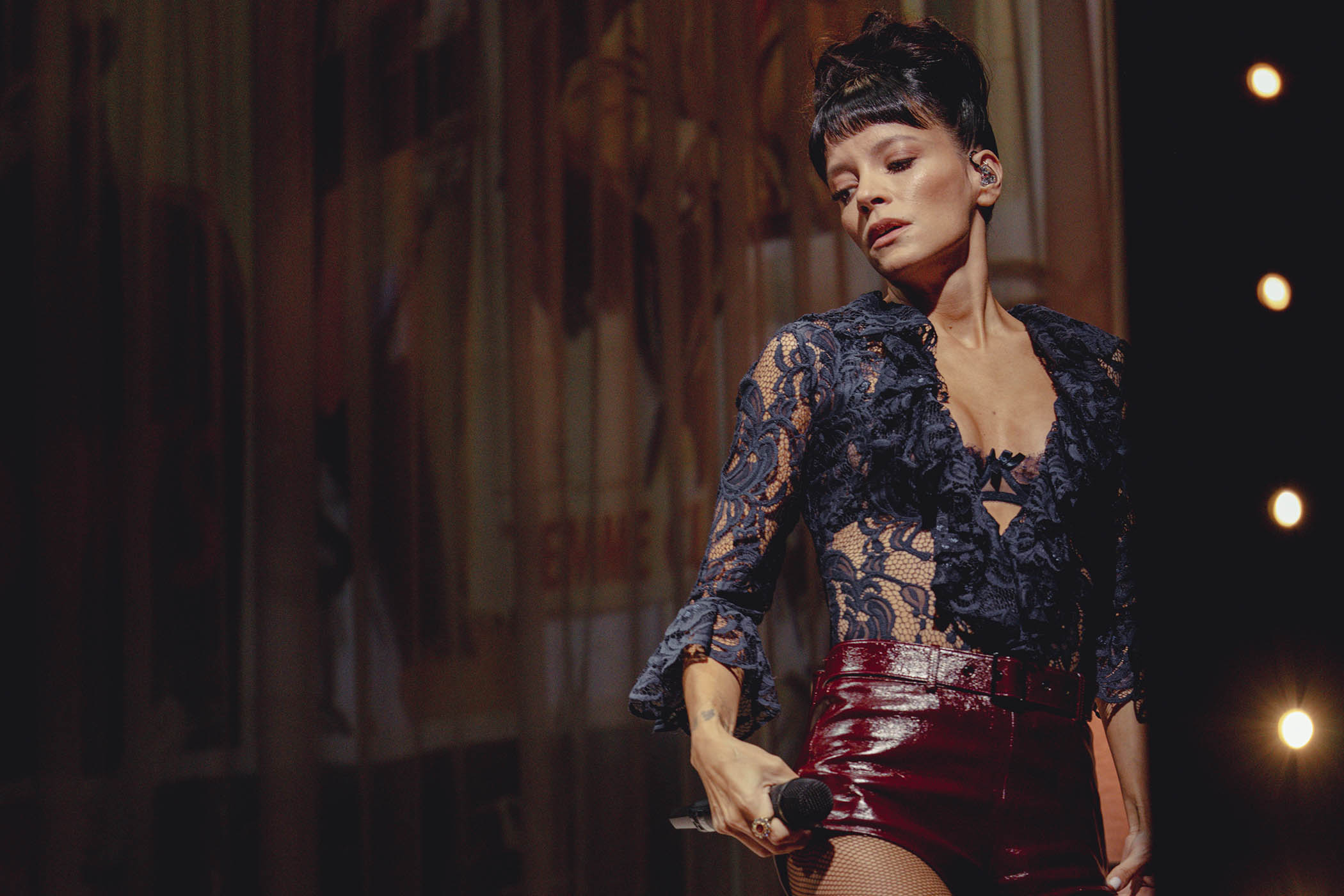


It begins with a karaoke overture. And it ends with a comeback artist being given her flowers – literally and figuratively. In between this show’s prelude and its standing ovation is one transformative hour in which Allen delivers a radically self-contained performance of her 2025 album, West End Girl.
No one in Glasgow’s Royal Concert Hall seems to mind the unexpected 30-minute, classical-themed karaoke at the start, in which Allen is absent: instead, three female cellists (the Dallas Minor Trio, named for Dallas Major, a song on West End Girl) play a selection from her back catalogue while their lyrics are projected on a screen. The setlist proves that Allen has long been a mordant truth-teller with melodic nous. Cheers ring out for nostalgic hits such as LDN and Smile, tracks that established the west London pop artist as a singular British voice just over 20 years ago. When Fuck You – Allen’s 2008 song taking an unpleasant man and his friends to task – begins, the whoops and choruses gain an edge, and not just because the song’s low opinion of racists and homophobes resonates acutely in 2026. With the benefit of wincing hindsight, it’s clear these songs foreshadowed West End Girl, which charted the downfall of her marriage.
This is an audience keen to sing along to one of the most cutting relationship post-mortems in modern pop, with all its telling lyrical detail: from the text messages from Madeline to the butt plugs in a Duane Reade bag. When Allen finally comes onstage, she chews her way through the five stages of lovelorn grief in 14 songs. One of the West End Girl standouts tonight is Ruminating, with its rave build and its increasingly deranged chorus. “‘If it has to happen, baby, do you want to know?’ What a fucking line,” Allen sings, describing the moment she agreed to an “open” marriage: a euphemism, it turns out, for a web of deceit.
The Royal Concert Hall is a sedate, seated venue, but some outliers eventually get up and dance. There are men here, but the crowd noticeably spans women of all ages – those who remember Allen as a hard-partying nepo baby before the term was born, and younger people eager to capture the set’s Instagram-friendly visuals and internet-melting tales of polyamory gone wrong.
Given the show’s extended runtime, some were perhaps expecting “an evening with Lily Allen”, with the star elaborating on her album and the eye-popping circumstances that led to its creation. That doesn’t happen. Instead, Allen, alone on stage, brings West End Girl to life track by track. There’s no talking, no playing these songs for laughs – even though, in the foyer, there’s a face-in-the-hole board of the album cover and Pussy Palace T-shirts for sale. Allen was nominated for three Brits at last weekend’s awards and came away with none: that feeling of still being outside the academy, despite making one of the most affecting and impactful albums of last year, isolates the lone, elegant figure even further.
Allen’s production, all contained in one lush, boxy set, recalls the cool distance of Lana Del Rey’s tour last summer, in which she moved through a country house and garden, mystique intact. With music delivered in playback, and only a fridge, two beds, some lamps and the contents of that infamous plastic bag on stage, Allen’s show is a compact and bijou offering. It is also a mark of this album’s impact that this theatre run sold out immediately. A series of arenas is her next destination, as well as a slew of summer festivals, which will undoubtedly see the show increase in scale.
Tonight, though, Allen remains a magnetic presence, maintaining a steely control throughout some of the most nakedly emotional material of her career. From the start – when a green curtain is gradually pulled back to reveal the room in which Allen ruminates, spirals and self-flagellates – this show is an act of careful unveiling. Allen herself disrobes gradually, removing a two-piece pink miniskirt and jacket to reveal something more boudoir-y: teetering around in high heels, sometimes coltishly, as though she is still feeling the fragility captured in these songs.
The songs, too, are revealed anew. Shouts of “who the fuck is Madeline?” are cathartic. There are heckles (“fuck him!”). But the anger of Allen’s album most often gives way to its hurt, self-abandonment and despair. And there is a poignant edge to this performance: for most of West End Girl, Allen is trying to make her relationship work against unreasonable behaviour and mounting odds. She executes everything with sweet sang-froid, neither mining her songs for melodrama nor lingering too long on comic sex toys. There is safety, and artistic integrity, in sticking tightly to the songs, in presenting the work with no editorialising.
It all amounts to vindication – both personally, for Allen, whose career had seemed to be evolving towards theatre and podcasting, that modern adjunct of confessional songwriting. Brit or no Brit, she is a pop star for the ages. But this album has resonated with anyone who has ever been wronged, gaslit or taken “for a fool”. It is perhaps not an exaggeration that, in the era of increased violence towards women, the success of Allen’s West End Girl feels like a sweet, icy blow – however symbolic – against the misogyny-industrial complex.
Newsletters
Choose the newsletters you want to receive
View more
For information about how The Observer protects your data, read our Privacy Policy
More from The Observer
Photograph by Henry Redcliffe