It is hard to go to the theatre without bumping into an Arthur Miller play. Ivo van Hove’s production of All My Sons came to the end of its triumphant run on Saturday. Next month, Henry Goodman opens in The Price at the Marylebone theatre. Meanwhile, Jordan Fein, who has rethought musical theatre with dynamic productions of Oklahoma!, Fiddler on the Roof and Into the Woods, fixes his directorial beam on a late Miller drama, first staged in 1994, 11 years before the playwright’s death.
Set in 1938, Broken Glass, which featured Goodman in its UK premiere, draws more evidently on Miller’s personal history than the plays that made him celebrated as a chronicler of the American dream and nightmare. Nevertheless, it too has glints of political prescience, seeming to be wired into present-day turmoil; 1938 was the year of Kristallnacht, the Nazis’ November pogrom, and the play turns, in part, on discussions about being Jewish: is it “a full-time job”?
Yet the title also glances at the idea of a looking-glass: this is a drama about the dangers of not seeing straight. In the closing moments, a character is told to look into the mirror to find out the source of his difficulties, and Fein’s production brings home to the audience, with uncomfortable physicality, the need for glaring at the truth. The play has episodes in the dark, but for most of the action, the houselights are full on: the audience, seated in the round, staring at other humans and being stared at, have no place to hide.
The title glances at the idea of a looking-glass: this is a drama about the dangers of not seeing straight
The title glances at the idea of a looking-glass: this is a drama about the dangers of not seeing straight
This is not, until its closing moments, a subtle play. Although concerned with buried psychological urges and political threats, the drama’s ingredients are evident and overdeliberately debated: separately interesting but not well integrated.
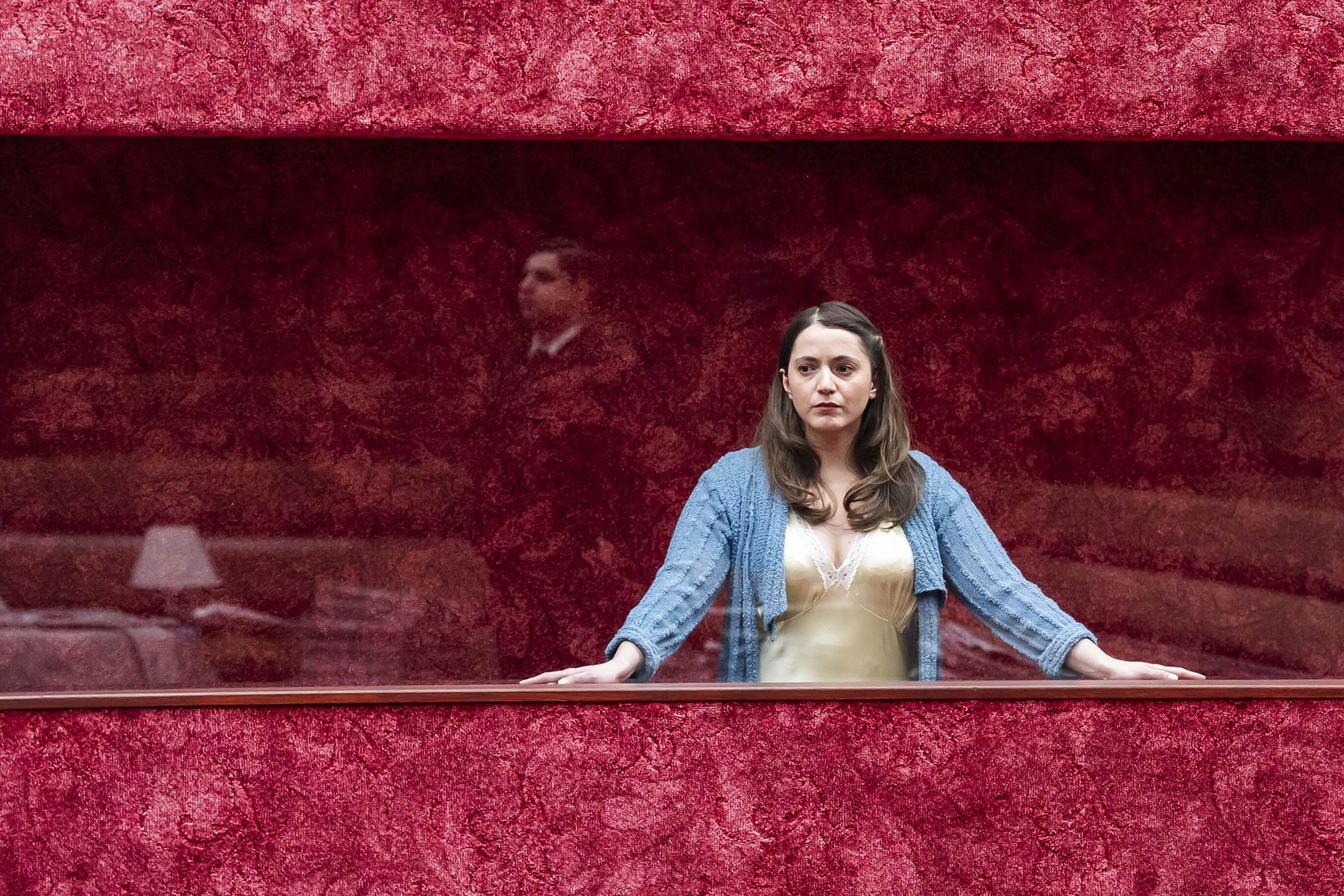
In New York, a Jewish woman is mysteriously unable to walk: without any apparent medical cause, her legs have suddenly “turned to butter”. She has become transfixed by the news from Germany, skewered by the violence as if the blows and humiliations were falling directly on her own body. She is sexually estranged from her husband who, resolutely escaping his own Jewishness, becomes her bully. She is treated by a doctor, who – this now feels terrible – asks her to imagine sleeping with him.
The constant presence of horrific news – the stage is strewn with newspapers – brings an electric echo of today, as does the flinching away from terror. Pearl Chanda is bold, unsentimental, striking as the woman who is brave despite her rag-doll limbs. Yet her character is essentially a series of notes for a case study.
As the husband, Eli Gelb moves heavily – with signalling hand flutters – from bullying to breakdown. Alex Waldmann is too wispy as the medic. A real-life inspiration behind Broken Glass was an elderly doctor who treated Marilyn Monroe, whose marriage to Miller lasted from 1956 to 1961. Miller said the physician “could tell from her fingernails how she was”. That sense of gifted insight is missing here: it is hard to see, until the closing moments, why anyone would trust this doc.
Other details – a concerned sister (intriguing Juliet Cowan) and a shrewd wife (bright Nancy Carroll) – are distractions rather than developments. It would be encouraging to think that the separate shards of the plot are purposefully scattered as a reflection of the title, but this looks more like oversight. After all, in a play that worries away about Freudian sex, what did Miller think he was up to when he called a character Dr Hyman?
Rosanna Vize’s design cannily brings disruption and watchfulness, wrapping walls and floor in the same red carpet, mixing the 1930s and the present in bundles of newspapers, putting a transparent screen at the back of the stage. In a tiny but original moment, a water cooler erupts into the silence, like the gurgle of a stomach.
Final speeches power up the strongest moments of the evening. What begins as a keen description of what it is to be Jewish turns without smudging into a wider, reverberating analysis of torment. Everyone is afraid, says the doctor; everyone thinks or claims they are persecuted. The persecuted become persecutors.
Newsletters
Choose the newsletters you want to receive
View more
For information about how The Observer protects your data, read our Privacy Policy
Worth hearing this; worth hearing the water cooler. Yet as a portrait of a shattered marriage, Broken Glass does not come close to the intricate, inventive wounding shown in Dance of Death by Miller’s admired Strindberg (Richard Eyre’s exemplary Orange Tree production is now streaming). Do we really need to see Miller plays so much more often than other essential American chroniclers? Step up, August Wilson and Lynn Nottage.
Broken Glass is at the Young Vic, London, until 18 April
Photograph by Tristram Kenton