


Chadwick Boseman died a superhero at 43. As T’Challa in Black Panther, the actor made screen history playing the first Black lead in the Marvel Cinematic Universe; he did not live to make the last of his five-film contract. He was revered and celebrated, with a posthumous Oscar nomination, and a star on the Hollywood walk of fame. The tweet announcing his death from colon cancer in 2020 is still the most-liked ever. Yet fans – in the many millions – will scarcely have known that, as a young man, Boseman had other ambitions: before he was T’Challa, he wrote plays.
Deep Azure, a hip-hop, Shakespeare-inspired drama about police brutality, has been plucked from the archives by the director Tristan Fynn-Aiduenu. It had just one run in Chicago 21 years ago; now, in a surprising, eccentric, even inspired piece of commissioning, it arrives in London at the Globe. “I’d produce anything Chadwick Boseman wrote, however ungainly, implausible, wrongheaded, or misbegotten,” was the qualified praise of one Chicago reviewer in 2005, spotting potential in the 28-year-old writer. Here, then, is another: this is a sophisticated play, for a beginner. It is flawed, brilliant, busy, overwritten, charged with restless creative energy and bracing imagination. It is odd, uneven. It cannot justify its length. Yet I entered the theatre wondering: why this play? – and left convinced it is a necessary mess.
Boseman wrote Deep Azure after the killing of his friend and fellow university student Prince Jones by police. Jones, unarmed, was shot six times. The officer, who bore the same surname, was also Black. It is a story of bias, of grief and ambiguity: if we are disappointed by contradictions, by muddled messaging, we should consider the reality. Boseman reimagines the event as an Elizabethan revenge tragedy: a ghost, a love triangle, pairs of eyes that cannot be trusted. So Shakespeare is in the plot as well as the language: it is written in lyrical verse, mostly lucid, ringing, with the occasional feeble throwaway. (“I’m not dope enough to cope,” one character speak-sings.)
Selina Jones is exceptional as Azure, a woman haunted by the death of her fiance Deep; Jayden Elijah is gentle, beatific as the evangelical, aspiring poet who hovers in her memory. She slips into madness as the law shrugs off his murder – “mistakes happen” – while her flatmate (Justice Ritchie) contemplates the course of justice: “It’s the same as Malcolm once said: there is no revolution without bloodshed.” Tone (Elijah Cook), a bounty hunter acting the concerned friend, constrains his feelings for Azure under a bulletproof vest; corruption penetrates.
Selina Jones emits her grief as if it were toxic gas; she is the play’s very atmosphere
Selina Jones emits her grief as if it were toxic gas; she is the play’s very atmosphere
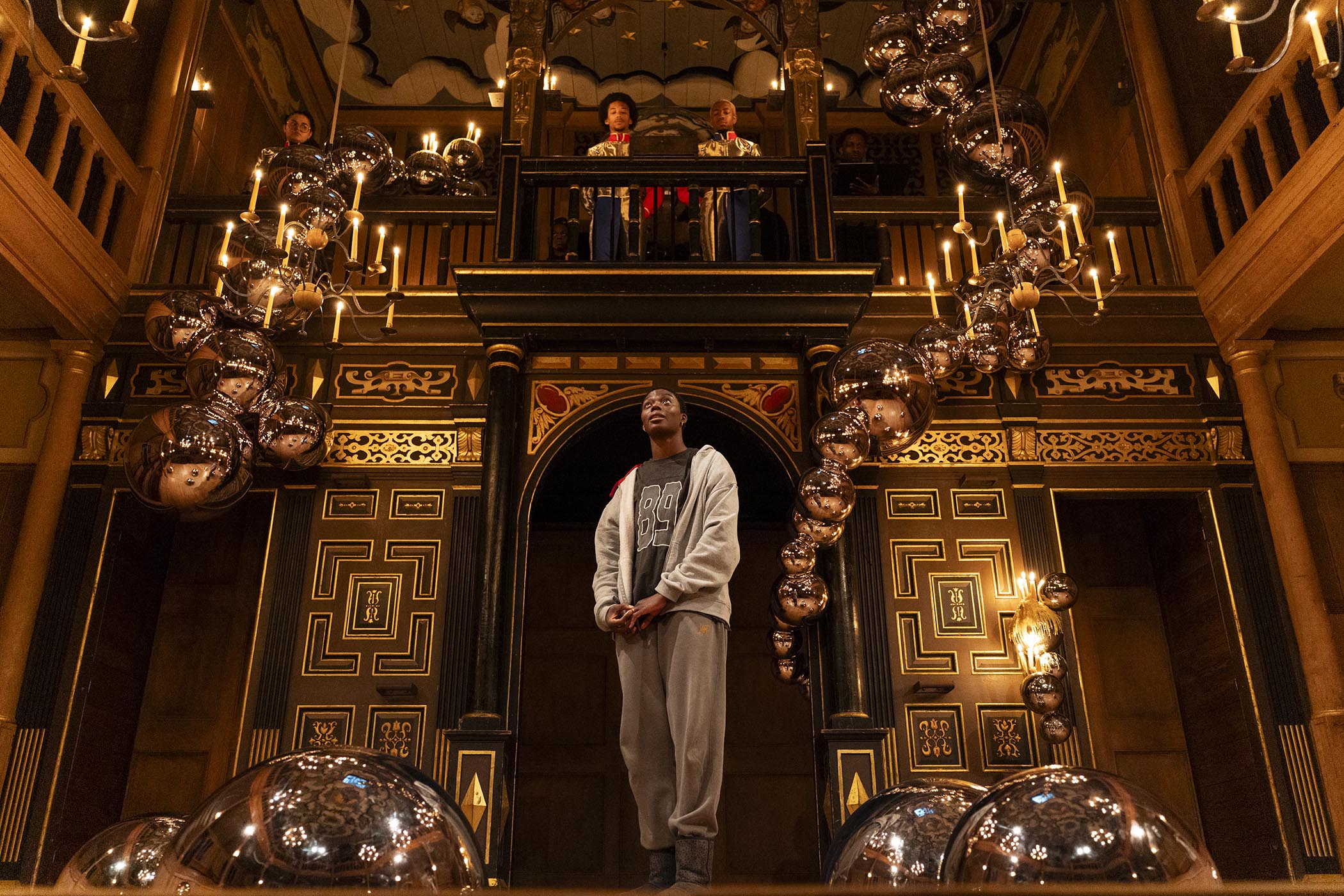
The Sam Wanamaker theatre hosts a candlelight vigil: 100 flames flickering in near-darkness, as Paul Wills’s mirrored orbs float like thoughts, gleaming, polished. A celestial ceiling mural, with the moon goddess Luna at its centre, shows new faces: a Black woman surrounded by angels. Jones, in anguish, lust or disbelief, looks searchingly up at it. She writhes and hunches, or drifts into ecstatic reverie. She finds no comfort, in the heavens or elsewhere. The actor emits her grief as if it were toxic gas; she is the play’s very atmosphere.
But the mood is disturbed by a procession of distraction: an all-singing, all-beatboxing Greek chorus dressed inexplicably in futuristic Power Rangers-style costumes, popping and locking in red white and blue.
Things get weirder: in one scene, Azure, wearing butterfly attire, literally spreads her mesh wings. There’s an extended montage about daytime TV. Ruminations on faith, anorexia and sin, are later followed by a rap about ... Rasputin? Mine ears deceive me.
Under the direction of Fynn-Aiduenu, Olivier-nominated for his work on the remarkable For Black Boys Who Have Considered Suicide When the Hue Gets Too Heavy, lines are fluent and intelligible, delivered with expressive musicality and flashes of wit. He makes muscular, engaging use of the space and draws out of his cast a rare, enchanting chemistry. A moment between Deep and Azure, retracing the steps of their first date, is so simple and affecting, it makes you long, as they do, for all the rest of it to melt away. Less is more; what was lacking here was tough-minded editing. But it is hard to be unsentimental when preserving a legacy: how do you cut the lines of a man who had so much more to say?
Deep Azure was written eight years before the start of Black Lives Matter, 15 before the murder of George Floyd. That it should resurface at this moment – with ICE on streets, making a show of violence – is not so much testament to shrewd commissioning as to the awful truth that this play may long be this timely. The villain here wears the badge and vest, emblazoned “fugitive enforcement agent”. It is the costume that needs least explanation.
Deep Azure is at the Sam Wanamaker Playhouse, London, until 11 April
Newsletters
Choose the newsletters you want to receive
View more
For information about how The Observer protects your data, read our Privacy Policy
Photograph by Sam Taylor