


In the Haringey warehouse district in north London, the building names allude to the area’s industrial past. There are old button and ribbon factories, cotton mills, a space once used by FedEx. Today, the spirit of making remains. Garden terraces sprout at improbable angles. Ingenious cat-flap set-ups create intricate feline obstacle courses to the outside world. A besuited mannequin with a watering can for a head stands sentinel near the gates, hand raised, blue ribbons cascading from its spout.
Up several flights of stairs, Max Allen’s ritzy, glitzy home doubles as headquarters for the practice he runs with his business partner, Elliott Adcock. Allen & Adcock operate as a costume studio, producing garments, props and scenographic details for photo shoots, events, stage and screen, and for drag and performance artists. In doing so, they move nimbly between art, fashion, theatre and film. Their work ranges from Shakespeare’s Globe and the Garrick Theatre to commissions for Selfridges and Vogue, as well as the BBC Proms and Glastonbury.
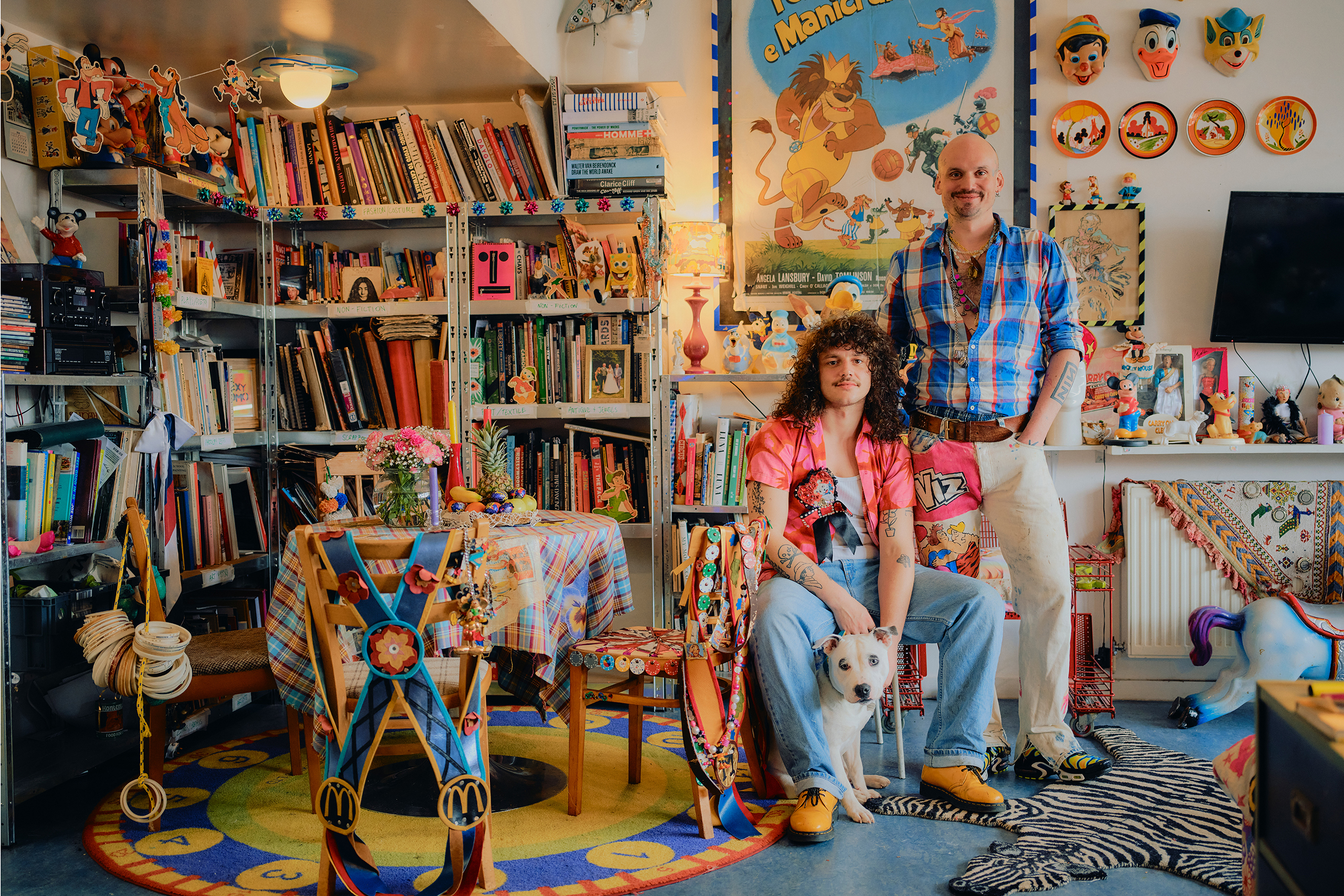
Allen lives here with his partner of four years, Kurtis Lincoln, an artist, musician and performer with whom he also collaborates; and Kermit, their eight-month-old Staffordshire bull terrier, a gorgeous white bundle of muscle and boundless energy, currently deep in his “adolescent” phase.
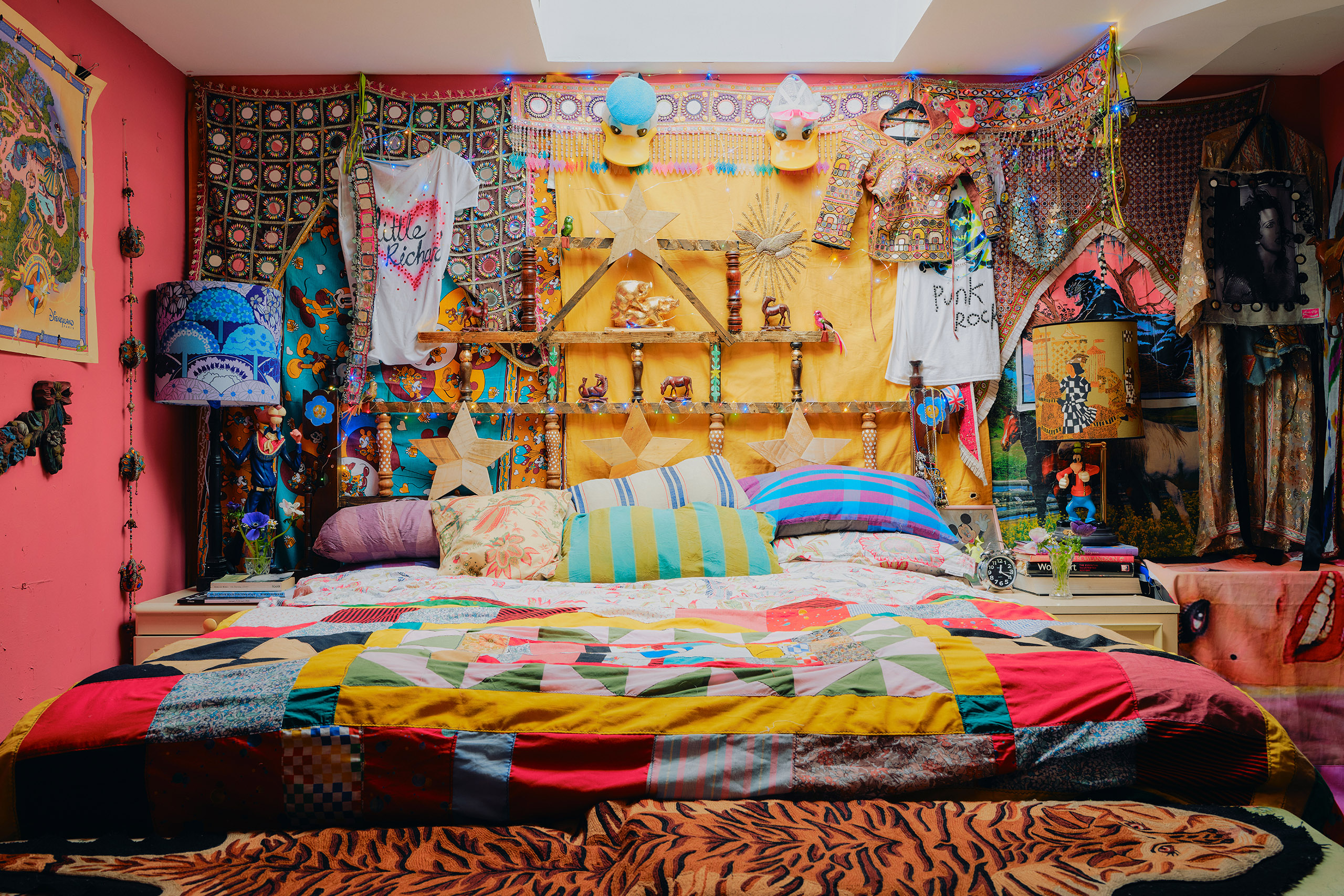
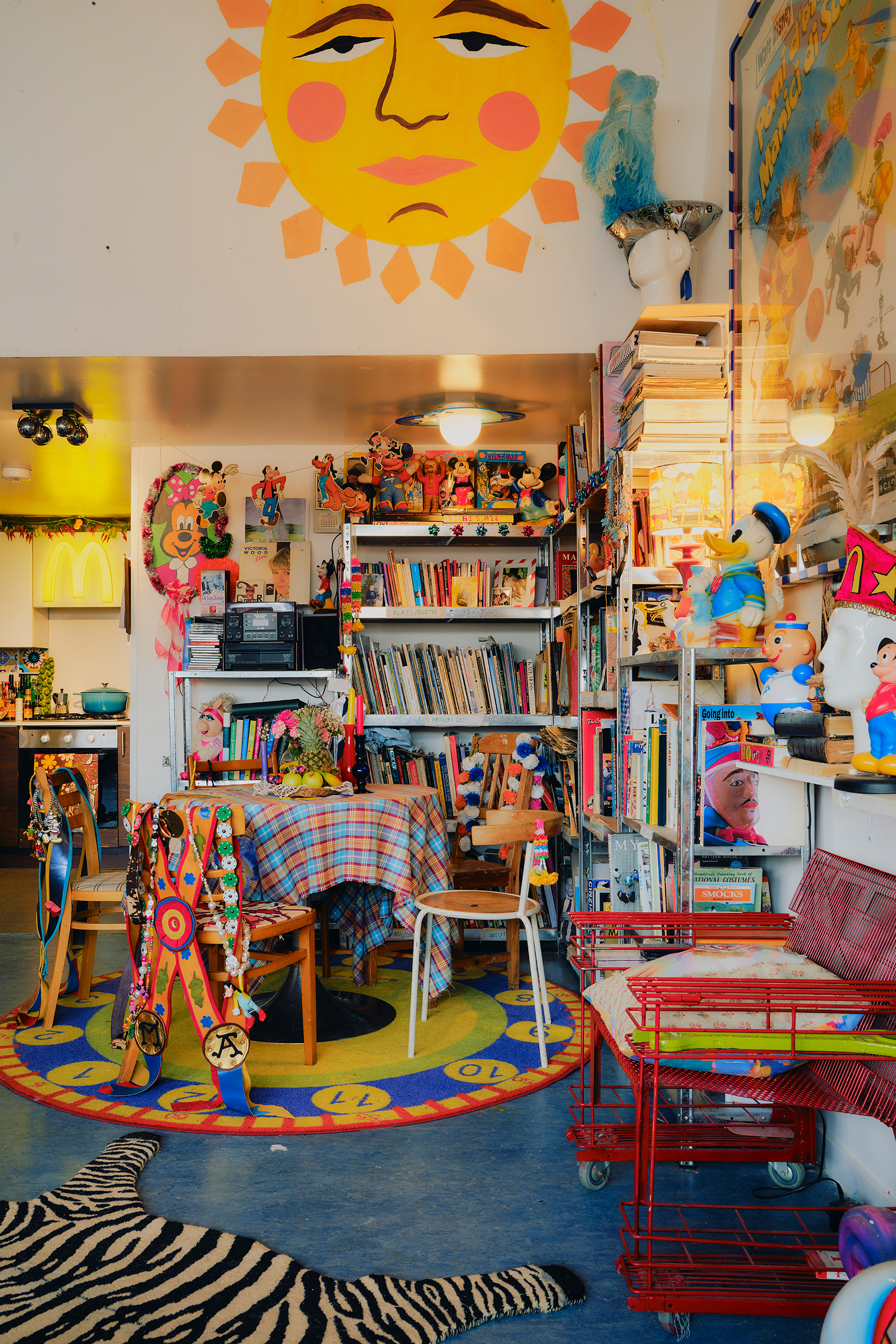
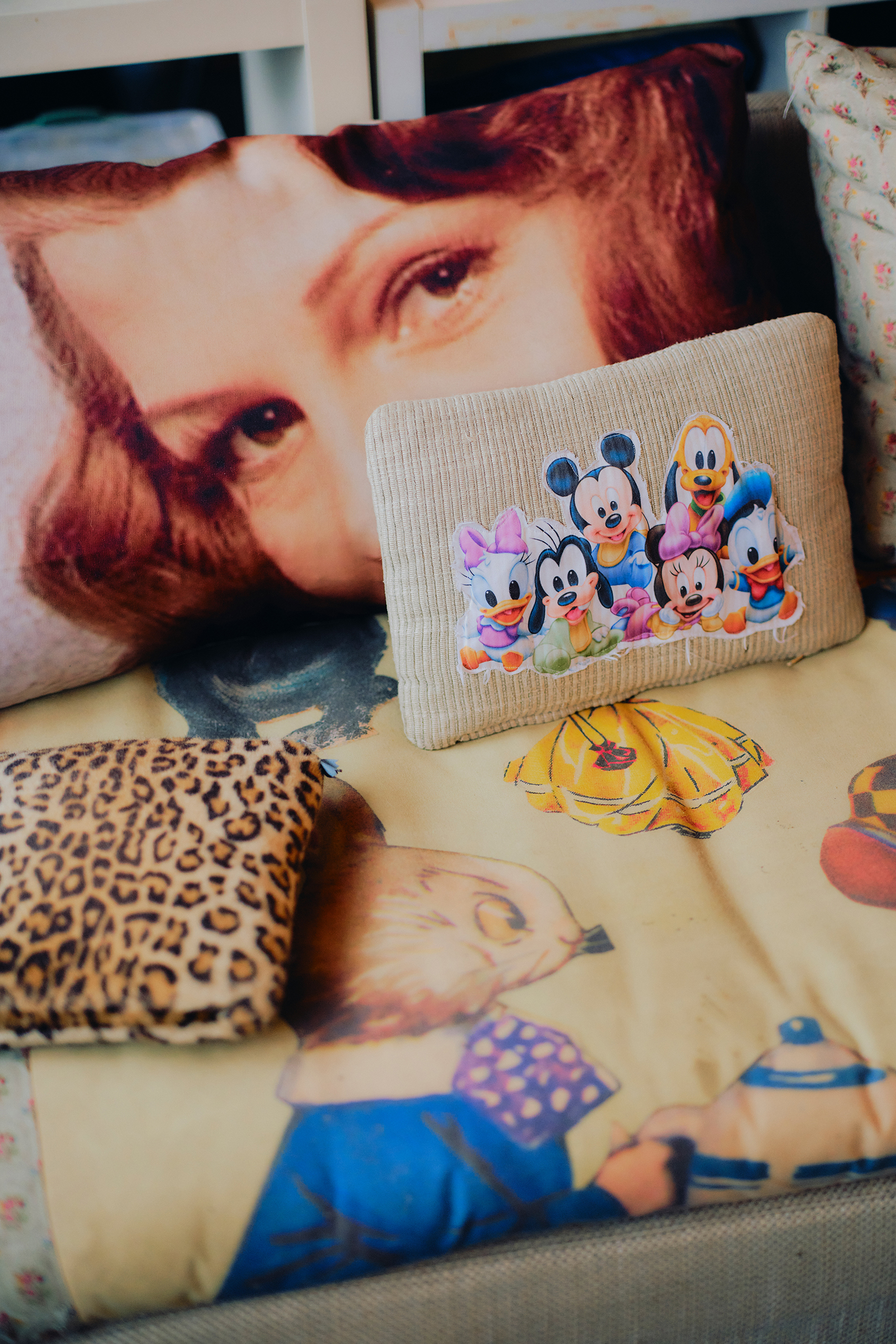
The flat is as exuberant as one might expect. Masks populate the walls; blown-glass witches’ balls hang in the windows like gargantuan Christmas baubles; cardboard German Easter eggs cluster in bowls; ranks of Disney figures hold their poses. Yet nothing is sealed off from use. The side table doubles as a print bench. Books are constantly being pulled down and rifled through, the apartment operating as a working library.
Walking through the flat, I’m reminded of Sir John Soane’s Museum in Holborn, another domestic space where collecting, working and living collapsed into one another. Soane arranged his home as a demonstration for potential clients and students: a walk-through architectural portfolio where every object testified not just to knowledge and range but to idiosyncratic taste. Allen’s operates similarly, but with glitter instead of marble busts. It is a scrapbook scaled to hold a life, a place that shows you what its inhabitants can do. “It’s not tat for the sake of tat,” Allen says. “It’s research.”
The proof is next door, where the mood tightens from domestic fantasia to working studio. Above the window, the name Allen & Adcock is painted across a pink ribbon drifting through a cartoon-blue sky: part fairground sign, part Renaissance fresco. Beneath it sit rails of garments, pinned photocopies, boxes of trims, rolls of materials and half-finished constructions.
One garment carries the face of Italian opera star Moira Orfei; another assembles a chorus of blondes, Marilyn Monroe and Gwen Stefani smouldering from the fabric. Here, ideas are sketched, cut, collaged and debated. A poster glimpsed in the kitchen or a piece of tinsel overhead might prompt a sleeve, a hat, or even a fully fledged character by mid-afternoon.
Above our heads, an unused costume for Kylie Minogue hangs within touching distance of outfits made for the film Sweetheart, directed by Luke Wintour. “That’s a recreation of an 18th-century dress made in scraps of fabric and ship cloth,” Allen says, “because it was imagined how poor queers would create a wedding dress at the time.”
Allen has been magpie gathering since adolescence. “I have worked since I was 12,” he says. “I’d always put my money into the charity shop, or on the sale rail in H&M, really outlandishly.” Today, the net stretches from Walthamstow Market to Shepherd’s Bush, with online searches filling the gaps. A curtain might become a gown; a jar of buttons can wait years before suddenly providing an answer.
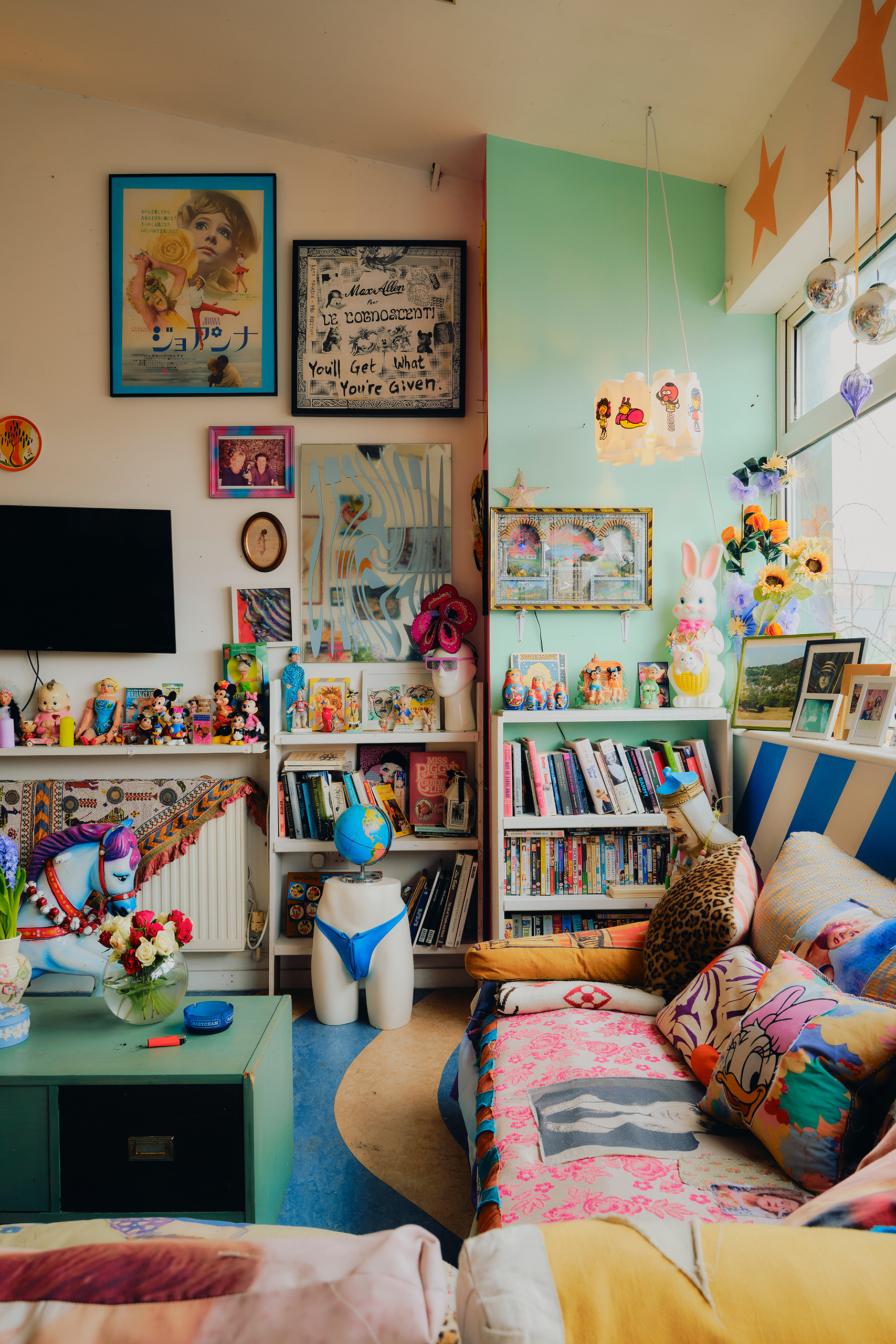
Allen prefers to paint, heat-print, or appliqué on to pre-existing materials so that the process remains legible. “You can bring an old sheet from a charity shop and some sequins through this studio, and it will turn into something interesting at the end of it.” This principle also applies to the interiors. “Lots of things were found in the street and painted,” Allen explains. The mirrors are pink, the doors decoupaged with faces both famous and forgotten.
What fascinates him most is what happens when images lose their biographies. Lately, he has been buying scrapbooks filled with stars he cannot identify, preserved by strangers. “They were enough for someone to cut them out and keep them for 60 years,” he says. “It meant something to that person.” Around him, fragments from wildly different arenas coexist without hierarchy: devotional objects, club relics, theatre history, souvenir glamour. “I like pop culture when it’s a bit detritusy.”
In the living room, I spy a Magic Eye book among the catalogues and chunky art tomes. Allen grins. He has never been able to see the pictures hidden within, though he used to pretend he could as a child. Yet his apartment demands precisely that kind of patience and perceptual adjustment. What appears at first to be random accumulation begins, gradually, to resolve into something coherent, taste made visible through recurrence and unexpected connections.
At the centre of those echoes sit a range of influences, including Andrew Logan, Leigh Bowery, Judy Blame and Michael Clark. It is, Allen says, a lineage he comfortably sits within. “It was a very natural London way of creating,” he says, forged through exchange between clubs, studios and friendship networks, where authorship was porous and influence travelled laterally. Jewellery might become costume, costume might become performance, performance was inextricable from nightlife. What mattered was not category but imaginative momentum. Today, he notes, the pressure is often to specialise, to declare a single lane and defend it.
Allen grew up in Derbyshire, in a village where five children made up his school year and well dressings marked the summer months. “I ran away from it,” he says, “and then realised that that is very similar to what I do.” His mother, who was in charge of the local play school and worked as a nanny, encouraged invention over instruction: she would rather hand him blank paper than a colouring book.
‘It’s not tat for the sake of tat,’ Allen says. ‘It’s research’
‘It’s not tat for the sake of tat,’ Allen says. ‘It’s research’
These days, he sees clear parallels between his upbringing and current preoccupations. “This is the thing that I’m really interested in – mixing folk with pop art, with drag. It’s all the same thing. It’s decoration for people to enjoy, storytelling,” he says. The same impulse that dresses London’s Pearly Kings and Queens in their button armour, or sent hobby horses clattering across village greens, finds a through-line in a pair of button-studded pink gloves nearby, Marilyn Monroe refracted through municipal pageantry.
Humour, Allen insists, is essential. He describes it as winking, British, a way of prising open seriousness without abandoning craft. A belt, hat, or other off-note accessory can tilt an image into something memorable. It is also, Adcock adds, a means of puncturing hierarchy: something that appears rudimentary can in fact be highly sophisticated.
While Allen frames the philosophy, Adcock explains the practice. “If we’re stuck,” he says, “you can sit and have lunch, look up – and there’s the answer.”
For Allen, that fluency now depends on structure. Earlier in his life he worked nights in bars and clubs, convinced he was naturally nocturnal and that creativity required disorder. It took time to understand otherwise. “I just need a good routine,” he says. Work begins at 10am, ends in the early evening. Why be a tyrannical boss to yourself, he asks, when you would not accept those demands from someone else?
The shift is visible in the interior. “I think this is my first grown-up place,” he says. Until 2025, he lived in another warehouse in the same district, occupied by 10 people. He’d been there for a decade, turning it into a dense jewel-box of a space. By the end, he tells me, the walls had reached saturation point: layers of images, objects and experiments built up through time until they were almost sedimented. Here, less than a year in, the process has begun again, though this time a little more judiciously.
It is impossible not to wonder what this flat might look like in another 10 years. Which objects will drift away? What fresh accumulations will press in at the edges or change the overall picture? Nothing here is finished, but already the house is learning what it wants to keep.
Newsletters
Choose the newsletters you want to receive
View more
For information about how The Observer protects your data, read our Privacy Policy