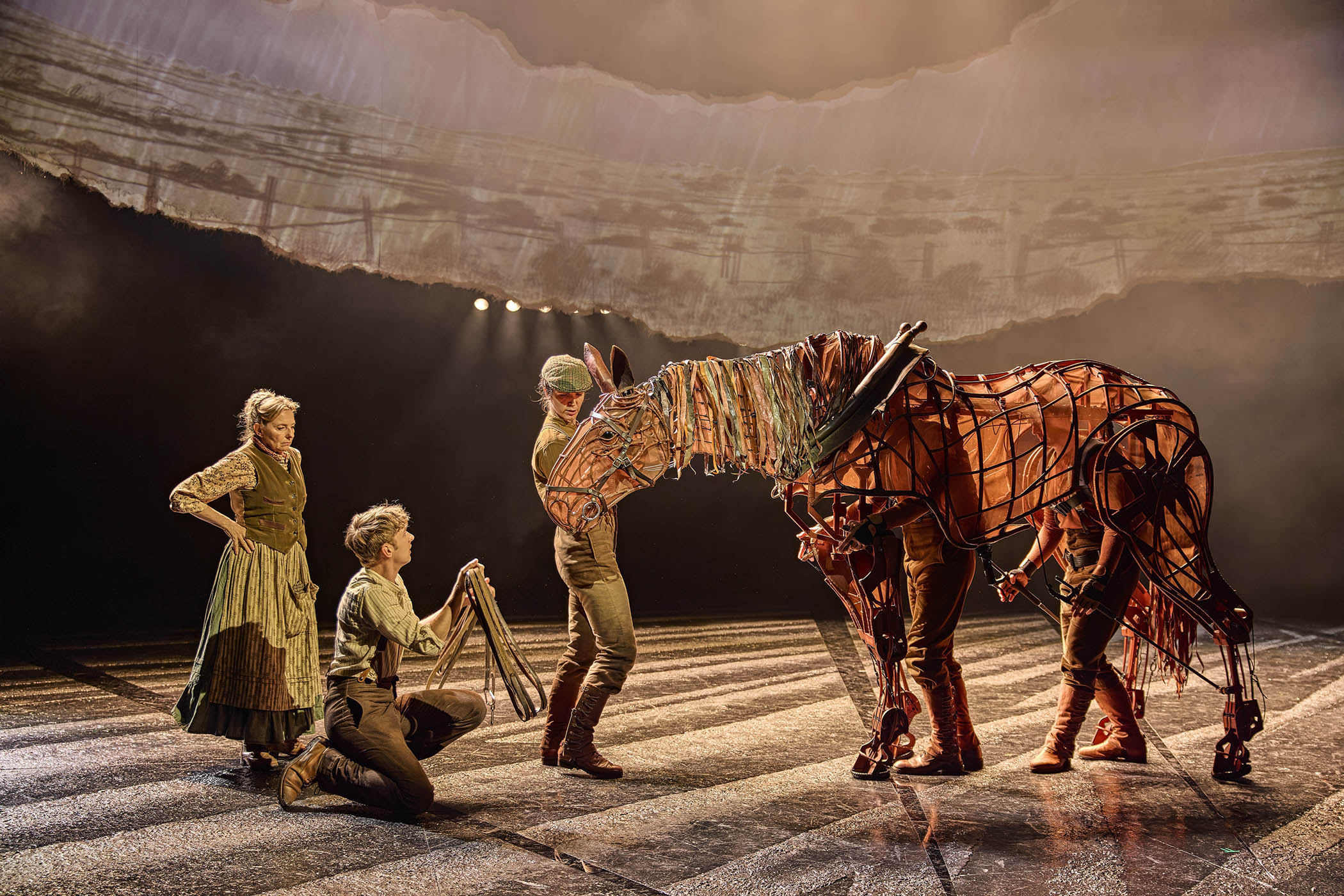

During the interval on the National Theatre (NT) terrace, my friend tells me she remembers almost nothing about her childhood, but she remembers this. This being the moment in War Horse – the play seen by more than 8.8 million people across the world, including us, when we were 12 – in which the foal puppet flies open to make way for the majestic full-grown animal. The last time we saw the horse in the Olivier was for his debut nearly 20 years ago, and so when it happens again, everybody in the audience cheers: hello, old friend. Later, we become teary – even me, the animal sceptic, immune since childhood to non-human charm. I was raised by a mother who finds animals alien: we never touched them, so they don’t touch us. Watching tonight, I wonder quite sincerely whether this horse – made from plywood, cane and mesh – was the first animal I fell in love with.
Why do children remember War Horse? Why did it amaze us, mark us and break our hearts? It is the most commercially successful play in the NT’s history, yet it is a bitter story, for anyone of any age, tracing the devastations of the first world war by blowing apart the bond between a farm boy, Albert (played here by Tom Sturgess), and Joey, his half-thoroughbred. Witnessing it as an adult, I am struck by how unchildish it is; how quickly delight and disbelief – why is this mass of sticks, held up by three puppeteers, stumbling on to the black stage so like the real thing? – turns to grim comprehension as the scene is littered with the carcasses of fallen beasts. Joey was Michael Morpurgo’s character – self-possessed, resolute and brave – but he became, in 2007, the NT’s creation: something inhuman in a world of human pain.
“They were all in it together,” Morpurgo tells me the next day. “I always have had this sense that horses, men and women, soldiers, civilians, were in that war together.” The 82-year-old former children’s laureate is speaking to me over video call from his home in Devon, where he had just received a letter from a woman who was there on opening night. The lady, “a granny now”, was raised on a farm in Kent. It grows strawberries today, but when she was little, she recalls wounded horses being brought there from the front and nursed to health.
“She remembers how good it was to see them all again, and then she remembers something else: that, when they were well enough, they were sent straight back again.” I think of the scene in War Horse that breaks us in the audience: Albert’s hard-fought reunion with Joey, in which he senses the horse’s presence, though his teargassed eyes are bandaged. Hobbled steed and blinded boy, in it together until the end.
Joey is a horse, but really he is an underdog, effortfully learning to pull a plough across fields in Devon, then pull a machine gun at the Somme. When Albert is barely old enough, he follows his lost horse to the front in the hope of finding him and bringing him home. The final image has them riding into the village: the pair who have suffered, who have made and lost friends. Roald Dahl once told Morpurgo that children don’t like history, but there is a way to make the past feel present: “You show them that the people who made history were real human beings.”
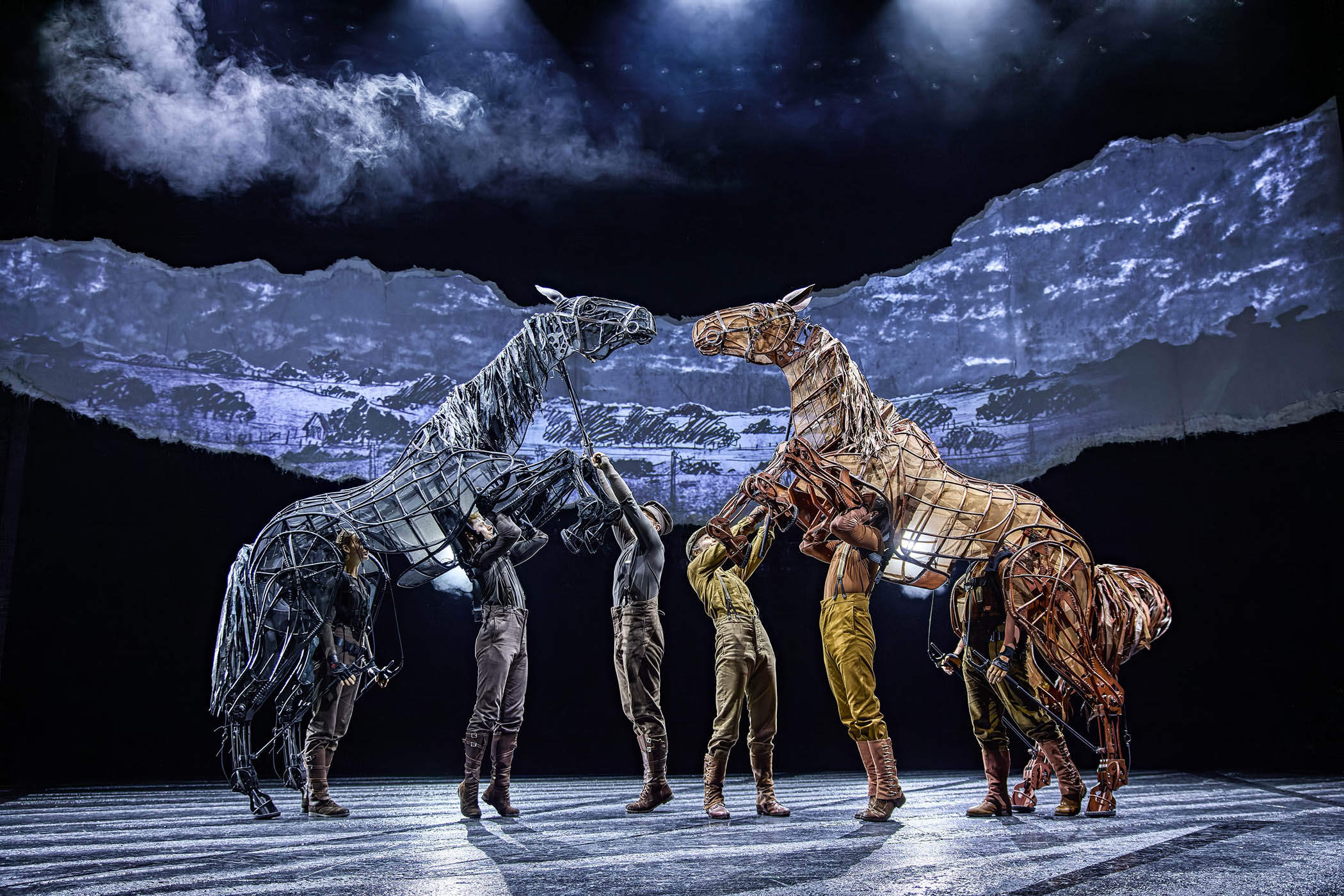
Joey and Topthorn spring to life in the National Theatre revival of War Horse
The horse doesn’t speak but seems designed (by Adrian Kohler and Basil Jones, co-founders of South Africa’s pioneering Handspring Puppet Company) to bare its soul: anatomical, red like our insides, gauze stretched thin over bent cane, so that all the working parts – and the puppeteers – are on show. In Morpurgo’s novel, as in Nick Stafford’s intuitive stage adaptation, Joey’s connection with Albert is formed of theatrical instincts: gesture, eye contact and touch. “A single twitch of his ear was worth lines of dialogue,” writes former NT artistic director Nicholas Hytner, who greenlit War Horse, in his memoir. Tom Morris, co-director of the original and this revival, distils Kohler’s artistry to me: “It’s like he’s a poet and a cloth maker at the same time.”
‘There is a crisis, because we as a society are moving away from the thing that has defined us as a species, which is expertise in making things with our hands’
‘There is a crisis, because we as a society are moving away from the thing that has defined us as a species, which is expertise in making things with our hands’
The famous play about a horse began life with a giraffe. Morris became familiar with Handspring when he was artistic director of London’s Battersea Arts Centre; soon after joining the NT in 2004, he travelled to Cape Town to watch Handspring’s production Tall Horse, starring a 4-metre-high (13ft) puppet. “My first instinct was that the play didn’t work, but the giraffe was amazing,” Morris says. “I wanted to fix that show. I thought they could create a puppet which could hold a big space.” The story – now the stuff of theatre legend – is that Morris’s mother suggested that puppet could be Joey after hearing Morpurgo on Desert Island Discs.
Morpurgo was apprehensive: he thought he was getting a pantomime horse. “When you’re handing over one of your stories, it’s like putting your life in the hands of a doctor. You have to trust the skill of the people concerned.” He did what any sensible person would do, and sought the wisdom of Philip Pullman, whose His Dark Materials trilogy had recently been staged by the NT. “He said: ‘Trust them, Michael.’” Morpurgo was convinced the first time he saw the puppet demonstrated. “It was a giraffe walking across the stage on a video. Somehow, the spirit of the animal touched me. I still don’t fully understand why, but that connection is at the heart of the whole thing: the connection we have with our fellow creatures and with one another, and the horror that results when we lose that connection.”
Morris says the puppets affect us emotionally because they force us to be creatively involved in the story. “When you put a bunch of sticks on stage and move them about in a convincing way, the audience has to give it life, give it character. Basil Jones from Handspring always says puppets are kind of begging for the gift of life from the audience. What that helps create is a phenomenon that’s true of any piece of theatre: its meaning depends on the people seeing it and the circumstances they’re seeing it in.”
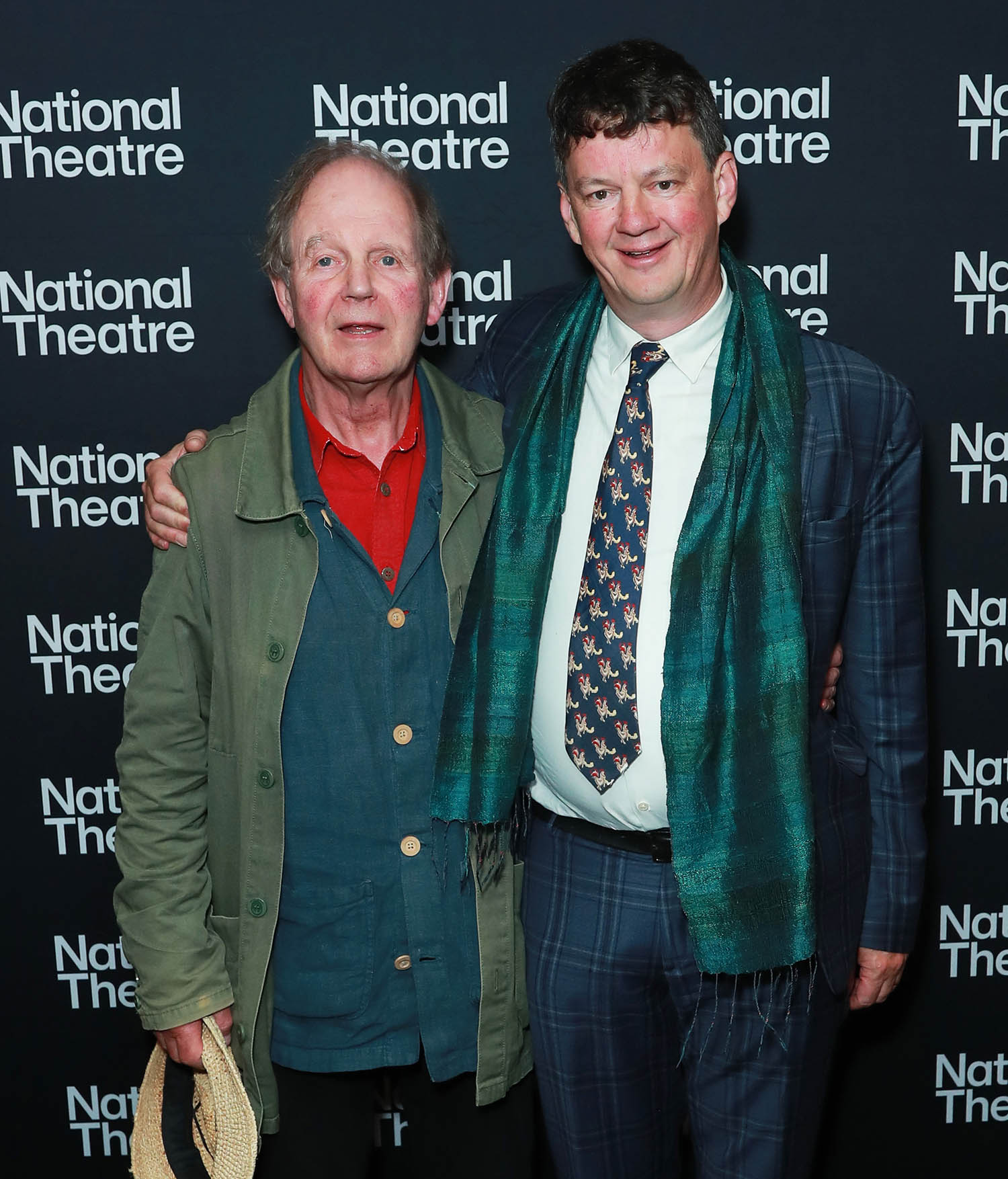
Michael Morpurgo, whose 1982 novel inspired the play, and right, co-director Tom Morris on opening night
The circumstances have transformed War Horse: the play charges at the audience perhaps more forcefully in 2026 than before. “I found it more powerful the other night than I’ve ever felt it,” says Morpurgo. “I noticed silence in that auditorium, among everyone; yes, it was about the play, but really it was about the world as it is now, as it’s become in the last four, five years. War is always out there. Now it’s coming closer, and the manner of the fighting and destruction is reminiscent of the first and second world wars.” His book sold poorly when it was published in 1982; he believes this is partly down to it being regarded as a piece of nostalgia: “It was Oh! What a Lovely War! with a horse.”
Newsletters
Choose the newsletters you want to receive
View more
For information about how The Observer protects your data, read our Privacy Policy
“After Cuba in the 1960s, we almost thought: ‘Well, that’s that’ – it was never going to happen again. Now we have realised war is something we go on doing. It’s not a nostalgia.” When a piece of shrapnel is removed from Joey’s front leg, you can hear the sound of metal hit the ground. “The NT removed any shred of nostalgia,” Morpurgo says.
Morris was aware of Ukrainians in the audience of one preview: what would they make of the discussions, in the first half, of how the war would be over soon? The tragedy hinges on the way it gathers pace: how quickly a light-filled meadow becomes a dark, desolate no man’s land. The revival’s co-director, Katie Henry, set out to tighten this iteration, “to get that sense of the speed at which there is just no space to grieve, to process, to interrogate, for the characters who are going through all these traumatic events”.
Morpurgo took his 11-year-old granddaughter – “a sensitive girl, a reader” – to the opening. “I was wondering how she would take it. She was sitting next to her mother, and I could tell that she was getting very upset. I reached across, and grabbed her hand, which she hung on to tight, tight, tight – all the way through until it was evident the horse was going to be saved.”
That’s what we want to do with children, he says: wrap our arms around them. We give them “wonderful shows and books like Paddington and The Tiger Who Came to Tea” which offer comfort – stories in which “people behave respectfully and the world seems very uncomplicated”. He says: “It’s how you want to send a child off to her or his dreams.”
At the same time, he adds, we mustn’t patronise them: “There comes a moment in a child’s life when they realise the world is also a place of great difficulty,” when they cannot shut themselves off from conflict, environmental collapse, disease. Because of smartphones, that moment is arriving earlier now than it ever was, Morpurgo thinks. “They’re all getting these messages well before they read a book about it.” He identifies a paradox of sorts: that British children today learn about war and its cruelties much earlier than he – a war baby – ever did. He describes playing in the rubble of bombsites, without really knowing what these makeshift playgrounds were. “I grew up with the loss and grief of it, but it was a slow discovery.” By contrast, “children these days are, in a sense, protected, until they see something on their phone; that must come as a sudden rush of fear and horror. Then, very often what they do, and what I’ve done, is I just switch it off.”
The 2007 play marked a turning point in family theatre: War Horse’s legacy, says Henry, is felt in a whole new breed of puppet plays, from Life of Pi to My Neighbour Totoro, as in the wider sophistication and ambition of children’s dramas. But it would be hard – even impossible – to make something so surprising today. War Horse was an unestablished title, made on a “wild hunch”, says Morris, who now works mostly in commercial theatre. It was built in a “realm of uncertainty” and improvisation; an environment in which arts funding structures meant repertory actors had the space and resources to gallop round in circles with cardboard boxes on their heads, pretending to be horses. “If I want to do Shakespeare in the West End, I can’t book a theatre unless I know which star is going to be in it. But Nick Hytner, at that point, didn’t have to say yes or no – he could say: ‘Take some cardboard boxes to the NT Studio for a week, and tell me if you think there’s something in it.’”
By the time War Horse closed its West End transfer in March 2016, its global success, including more than 3,000 London performances, had earned more than £30m for the NT. But Morris believes making the commercial argument is precisely the problem: “As soon as you’re trading in certainty – in known outcomes – that bit of your mind is no longer trading in experiment.”
One of Morpurgo’s happiest memories is of watching his great-grandson on the beach with his father, a picture book open on their laps. They were reading together; at one point, they had a small argument, because the child wanted to look at a page again, trying to flick back. “That image stayed with me. The closeness, the shared attention, the conversation, that is how a love of stories begins.”
I think about the little fingers tracing and turning: the connection between eyes, hand and mind.
“I was with the puppeteers recently, and they said something that struck us,” Morpurgo says. “Fundamentally, everything in the show is made by hand. The puppets are made and manipulated with hands. The writing was done by hand. The music was written by hand.” Rae Smith’s unpretentious animated backdrop is a giant rip of paper: Morpurgo recalls watching her tear out pages and pin them up.
Discussing the future of War Horse, Morris says, Handspring’s Jones wondered about the ideology that might come to underpin it. “He said there is a crisis, because we as a society, without thinking, are moving away from the thing that has defined us as a species, which is our expertise in making things with our hands.” Morris had what he calls a “dur moment”: “Of course! Their company is Handspring – it’s about everything that’s springing from the hand!”
It is a satisfyingly simple philosophy that Morpurgo finds instructive: “In a time of increasing inhumanity, there’s something deeply humanising about that.”
In the spring, a foal arrived in the field near where I live – blackish, scruffy and straight-legged. The stables had to stick a CCTV sign on the fence, for reasons I’d rather not imagine. I walk past him on my way to work, the land of screens, or at the weekend when there are always children gathered, smiling and squealing. They call for Joey, who is nervous but interested, and reach out their hands to touch him. I don’t remember the last time I felt that instinct, but look: my hands are free. Now could be the moment.
You can book tickets to War Horse with The Observer Theatre here. Subscribe to The Observer to join our Culture Club for an additional 10% off all listed prices.
Photographs by Brinkhoff Moegenburg; Grant Buchanan/Getty Images